Maja Popovska

Life goals worksheet: Turn what matters into SMART goals
Download your free life goals worksheet template A three-page PDF that moves fro...

9
Last Updated: Nov 4, 2026
Free PDF 2 pages, print-ready Clinician-reviewed
An end of year reflection worksheet is a printable form that guides you through a review of the past twelve months. This two-page version asks 12 open prompts. They cover your goals and progress, obstacles, achievements, setbacks and support, satisfaction and lessons learned, and how you will apply those lessons next year. A Notes box closes the form. It is a self-reflection exercise for personal and professional growth, and it does not diagnose or assess anything. This guide explains each question group, how to complete the form, and how to adapt it for teams.
A two-page printable form with name, gender and date fields, 12 open reflection prompts with writing space, and a Notes box. The prompts cover goals, obstacles, achievements, setbacks, satisfaction and lessons learned.
Start from scratch, or upload this PDF or any form you already use, and Pabau's AI Form rebuilds it with tick boxes, text fields and a signature. Attach it to the treatment once, and every patient gets it on time.
AI Form rebuilds the consent, history and aftercare forms you already use. You review each one, then publish.
Patients complete forms on their phone before they arrive, so the front desk stops retyping paper.
Every signed form is versioned and attached to the treatment record, ready when you need it.
Set how long a consent stays valid. Returning patients skip forms they have already signed.
Supports HIPAA and GDPR compliance AES-256 encryption 4.8 on G2 4.7 on Capterra Trusted by 4,000+ practices worldwide

The worksheet is a two-page self-reflection form with 12 open prompts and a notes box, not a diagnostic or appraisal tool.
Its prompts run in order: goals and progress, obstacles, achievements, setbacks and support, satisfaction and lessons, then closing thoughts.
Answer the obstacles and setbacks prompts honestly, since that is where most of the learning sits.
Gratitude lists and new goals are not on the form, so add them on a separate page if you want them.
Reuse the same worksheet quarterly or on your birthday to track progress more often.
An end of year reflection worksheet is a printable form that guides an annual review through a fixed set of questions. Writing the answers down also sharpens what you learn from them. In a Harvard Business School study, trainees who spent 15 minutes a day writing up their lessons outscored a control group by 22.8%.
Unlike an open journal, the worksheet asks its questions in a set order, so you are less likely to skip the uncomfortable parts.
Our version is laid out as a clinical form template, with name, gender and date fields at the top. That layout lets a therapist or coach file the finished form in a patient record. The questions themselves are reflective. The form supports personal and professional growth, and it does not diagnose, score or treat anything.
The format matters. A blank page invites vague answers like “it was a busy year”. A prompt such as “How did you overcome those obstacles?” pulls out concrete detail you can act on.
Reflection turns a year of experience into lessons you can carry forward. Without a deliberate review, the same mistakes tend to repeat because nobody stopped to name them.
Set aside 45 to 60 minutes in a quiet space, with no phone notifications. Completing the worksheet in one sitting keeps your answers consistent from the first prompt to the last.
The worksheet opens with name, gender and date fields and a short note asking you to answer honestly and thoughtfully. It then runs through 12 open prompts across two pages, each followed by writing space, and closes with a Notes box.
The form has no named sections. The groups below follow its own order, so you can see what each part asks before you print it.
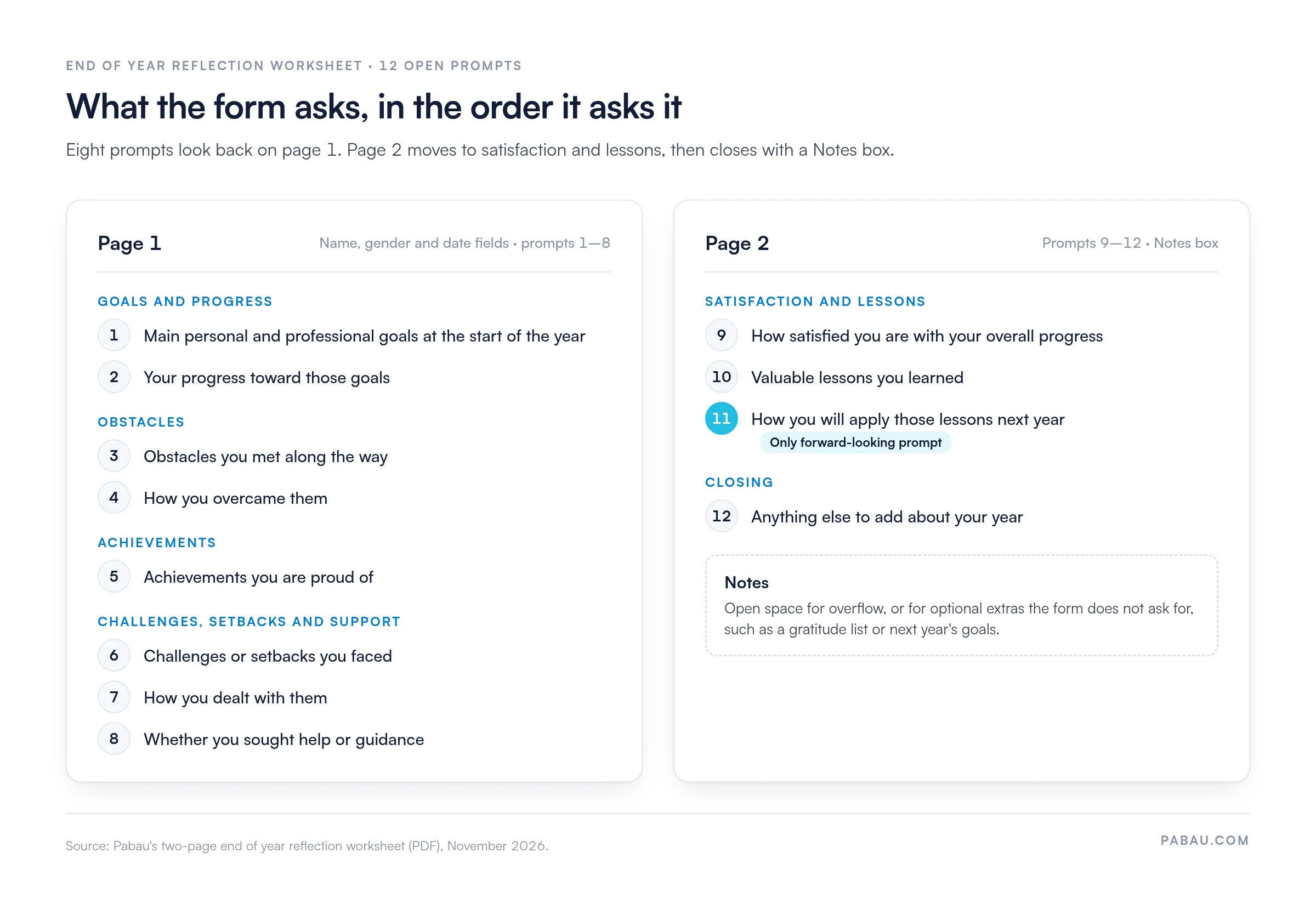
The form starts with the main personal and professional goals you set at the beginning of the year. The next prompt asks you to reflect on your progress toward them.
Two prompts ask which obstacles you met along the way and how you got past them. Name each obstacle before you describe the fix, so the pattern is easy to spot next year.
A single prompt asks which achievements you are proud of. Small wins count, and linking a win to the obstacle behind it shows what made it possible.
Three prompts ask whether you faced challenges or setbacks, how you dealt with them, and whether you sought help or guidance when needed. Keep the tone factual. Record what happened and what you would change, without assigning blame.
These prompts ask how satisfied you are with your overall progress and whether you learned any valuable lessons. The last one asks how you plan to apply those lessons next year, the form’s only forward-looking question.
The final prompt asks whether there is anything else you would like to add about your year. A Notes box follows for overflow, or for anything the form does not ask, such as a gratitude list or next year’s goals.
Employers and team leads can use the same questions for voluntary self-reflection. Keep it separate from formal performance reviews, since people reflect more honestly when the exercise carries no appraisal consequences.
You do not have to wait for December. You can run the same worksheet at the end of each quarter, or on your birthday, which gives a fresh starting point for the year. Read “the beginning of the year” as the start of whatever period you are reviewing.
For a shorter quarterly pass, answer the goals and progress prompts and the lessons prompts. Save the full worksheet for the annual review. For a check-in that is not tied to a date, a self-reflection worksheet also covers your strengths.
Therapists and coaches who use this worksheet often print it, hand it over in a session and scan the finished copy back in. Comparing it with next year’s copy then means digging through paper files or a shared drive.
Pabau, the therapy practice management software we build, lets you send the same prompts to a patient before the session. They complete the form in the patient portal on their phone or laptop.
Each completed digital form saves to the patient’s record automatically. Next December, last year’s answers sit in the same file, so you can open both during the review and talk through what changed.

Patients complete their year-end reflection in the patient portal, and every answer saves to their Pabau record. Each review then starts with last year’s form already on file.

The worksheet only pays off if the setbacks and lessons prompts get honest answers. Wins are easy to list, but the setbacks you name are what change next year’s plan.
If you set new goals on a separate sheet, keep them few and specific. A life goals worksheet can give that sheet some structure. Three measurable intentions you revisit each quarter will outlast ten ambitious resolutions you never read again.
File the finished copy where you will find it next December. Comparing two years side by side shows patterns a single review misses.
Running this review with patients? Book a demo to see how Pabau keeps each year’s reflections in one record, ready for the next review.

Want more prompts than the form’s 12? Reflection questions gives you 14 example questions and a free template for digging deeper into what worked and what did not.
Ready to review more than the past year? Life audit walks you through reviewing every area of your life before you set new goals.
Need help turning reflections into goals? Intention setting worksheet helps you turn the lessons from your review into clear intentions you can act on next year.
Want to add gratitude to your review? 5 minute gratitude journal offers a short daily format for keeping gratitude going all year.
Struggling to follow through on yearly intentions? Weekly goals template breaks big intentions into weekly targets you can track and adjust.
An end of year reflection worksheet is a printable form that guides a year-end review through a fixed set of questions. Pabau’s version asks about your goals and progress, obstacles, achievements, setbacks, satisfaction and lessons learned. It is a self-reflection exercise and does not diagnose or assess anything.
You can use it quarterly or on your birthday as well as in December. For a shorter pass, focus on the goals and progress prompts and the lessons prompts.
Yes, as voluntary self-reflection. Keep it separate from formal performance appraisals so people answer honestly.