Anja Dodevska

Stinking thinking worksheet
Download your free stinking thinking worksheet A three-page worksheet in four pa...

1
Last Updated: Nov 16, 2026
Free PDF 1 page, print-ready Clinician-reviewed
A today I feel worksheet is a one-page printable check-in that asks a person to name up to five emotions they feel today. For each one, they write why they feel it and what they need to handle it, then add one emoji for the whole day.
Children and adults both use it, in therapy sessions, classrooms and at home. Filled in daily, it gives a therapist, teacher or parent a short record of what the person felt and the support they asked for. It opens a conversation about feelings and does not assess or diagnose any condition.
A one-page printable feelings check-in with five blank emotion fields, a reflection prompt and an emoji box, for children and adults.
Start from scratch, or upload this PDF or any form you already use, and Pabau's AI Form rebuilds it with tick boxes, text fields and a signature. Attach it to the treatment once, and every patient gets it on time.
AI Form rebuilds the consent, history and aftercare forms you already use. You review each one, then publish.
Patients complete forms on their phone before they arrive, so the front desk stops retyping paper.
Every signed form is versioned and attached to the treatment record, ready when you need it.
Set how long a consent stays valid. Returning patients skip forms they have already signed.
Supports HIPAA and GDPR compliance AES-256 encryption 4.8 on G2 4.7 on Capterra Trusted by 4,000+ practices worldwide

A today I feel worksheet asks a person to name up to five emotions, say why they feel each one, and say what they need.
The What I need column is the part to read first, because it turns a feeling into a request someone can act on.
Children who can’t write much yet can still take part, with an adult writing for them and the child choosing the emoji.
A short check-in at the same time each day builds a more useful record than an occasional long session.
Pabau’s practice software can turn the worksheet into a digital form and keep each completed check-in in the patient record.
The today I feel worksheet asks a person to name the emotions they feel today, explain each one, and say what would help. Naming a feeling does measurable work on its own. In a 2007 UCLA brain-imaging study, putting feelings into words reduced the amygdala’s response to negative images.
The sheet is one page. Name, sex, age and date fields sit at the top, followed by short instructions. Below them are five blank rows, Emotion #1 to Emotion #5, and each row asks for three things.
An emoji box closes the sheet, where the person adds one emoji for their overall feeling that day. The diagram shows how the three parts of a row build on each other.
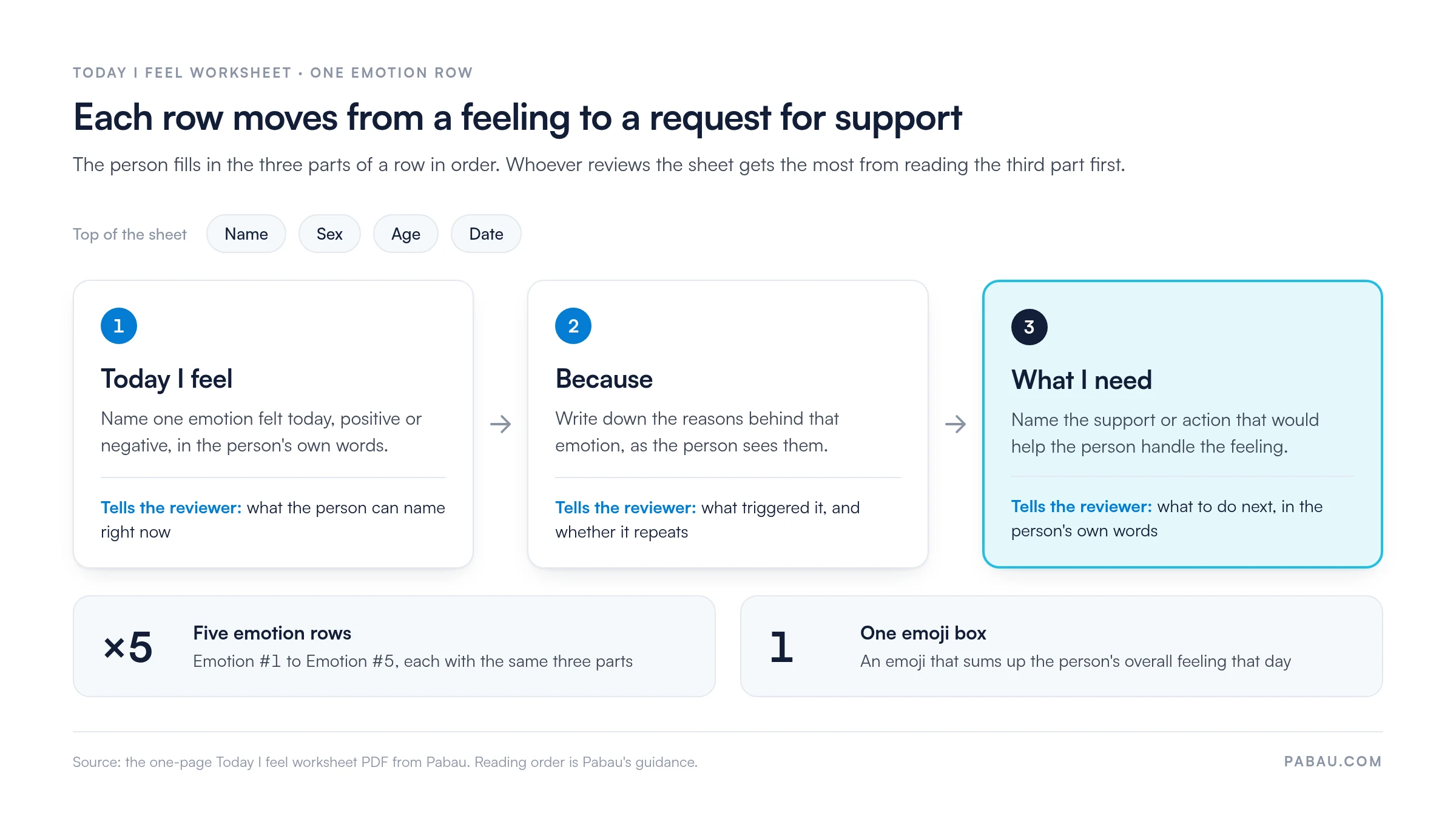
Read a completed sheet from the right-hand column back. The What I need entries are requests in the person’s own words, and they tell you what to do next. The Because column then shows whether the same trigger keeps coming back from one day to the next.
Younger children can use it with an adult reading the prompts aloud and writing their answers down. The emoji box gives a child who can’t write yet a way to answer alone. A child who needs more feeling words first can start with an identifying emotions worksheet, which adds an emotion wheel.
Teenagers and adults usually fill it in alone, often as homework between therapy or coaching sessions. Five rows encourage them to look past the first feeling that comes to mind. Where a clinician also wants a 0–10 mood rating, a mental health check-in worksheet covers that.
In a classroom, a teacher can run it as a short morning routine. Each student keeps their own sheet, so the answers stay private.
Print a fresh copy for each person, or share the PDF with a class or group. Keep one sheet per person so the entries stay private and easy to review.
Review the completed sheets once a month. Note the emotions and reasons that come up most often, then decide whether the next session or lesson should address them.
Teachers, parents and clinicians get the most value when they treat the worksheet as a conversation starter. The sheet is most useful when someone responds to what the person has written.
When the Because column keeps naming the same situation, the next step is often saying it out loud. An I feel statements worksheet turns those reasons into sentences the person can practice. If the What I need entries suggest the feelings are hard to manage, a regulating emotions worksheet teaches DBT coping skills.
Paper check-ins pile up fast. A therapist who sees a patient weekly soon has a folder of loose sheets, and spotting a pattern means reading them one by one.
Pabau, the time-saving therapy practice software we build, can turn this worksheet into a digital form. Patients complete it on their phone through the patient portal before a session, and each answer is saved to their patient record.
With every check-in in one place, you can scroll back through weeks of What I need entries before the session starts. Pabau’s digital forms handle intake and consent the same way, so the record holds the full history.

Pabau turns paper worksheets into digital forms that patients complete before a session, with each answer saved to their record. See how it fits your therapy practice.

The worksheet earns its place when someone acts on it. Five named feelings on a page are a start, and the What I need column is where a check-in becomes support.
Run it at the same time each day for two weeks, read column three first, and respond to one request each time. If the same reasons keep appearing, raise that pattern in the next session.
Want those check-ins to build into a record you can review in seconds? Book a demo to see how Pabau stores completed forms against each patient.

Want to connect feelings to what the body is doing? The body map emotions worksheet helps a person locate the physical sensations that come with each emotion.
Need a measure of how strongly someone reacts? The emotion reactivity scale (ERS-21) is a 21-item self-report form with a scoring guide.
Looking for journaling prompts and an emotion wheel? The expressing emotions worksheet combines emotion identification, journaling prompts and regulation strategies.
Working with younger patients? Therapy worksheets for kids explains how structured activities help children take part in therapy.
A today I feel worksheet is used to help a person identify and name their current emotions. It is a support resource for reflection and discussion, not a diagnostic instrument.
Keep it short and run it at the same time each day. An adult can read the prompts aloud and write the answers, while the child picks an emoji for the day. Follow up with one simple question about what they need.
Yes. Adults can use the same structure with more nuanced vocabulary, which suits therapy, coaching and personal self-care.
This worksheet leaves the emotion rows blank, so the person uses their own words. Younger children can start from a short list such as happy, sad, angry and scared, then learn more complex words over time.
Daily naming of feelings builds emotional literacy, which helps people notice changes earlier. It supports conversation with clinicians and carers but does not replace professional assessment.