Physician credentialing checklist
A physician credentialing checklist lists every license, certificate, verificati...

Last Updated: Oct 23, 2026

A patient visit summary is a plain-language record of the appointment that the patient takes home, covering diagnosis, medications and next steps.
Useful summaries carry patient details, reason for visit, diagnosis, medications, tests ordered, referrals, follow-up instructions and how to reach the practice.
No federal rule sets a deadline for handing over the summary, so timing is a care decision.
The 3-business-day clinical summary measure belonged to Meaningful Use Stage 1, and Stage 3 eliminated it in 2017.
Pabau Scribe, our AI scribe, structures your consultation notes as you go, which cuts the time a summary takes.
A one-page fillable form with fields for patient name, age, sex and visit date. The rest of the page covers the visit summary, care plan, medications, follow-up and any additional notes you want the patient to have.
Download templateA patient visit summary is the one page from today’s appointment that goes home with the patient. It names the diagnosis, the medications, the tests to book and the date to come back. Patients forget much of what they hear in the room, sometimes before they reach the parking lot.
Below are the eight components, a five-step routine, three worked examples, and a free form to print.
A patient visit summary is a written record of the appointment, handed to the patient before they leave. Unlike your chart note, it uses plain language and it goes home with them. The chart note itself stays in your clinical notes software, written for clinicians rather than for the patient.
It answers two questions. What should the patient remember from today, and what should they do next?
The page does three jobs at once:
Handing one over is good practice rather than a legal duty. No current federal rule sets a deadline for it, and the timing section below explains where that confusion started.
Eight sections cover almost every outpatient visit. Each one either tells the patient something they need, or tells the next clinician something they need.
The downloadable form above condenses those eight into five writing areas. Patient details and the visit date sit at the top, then visit summary, care plan, medications and follow-up. Tests, referrals and your contact details go in the additional notes box at the bottom.
The rules that make a good medical form apply here too. Keep sentences short, skip abbreviations, and give one instruction per line. Your note format does not change the handout, so whether the team writes SOAP entries or focus charting, the summary pulls the same facts.
A visit summary follows an outpatient appointment, such as a primary care check-up, a specialist consultation or an aesthetic treatment. A discharge summary is issued when a patient leaves a hospital or another inpatient facility.
Discharge summaries run longer and read more clinical, with detail like length of stay and procedures performed on the ward. A visit summary is shorter and written for the patient.
If you run a mental health practice, an urgent care clinic or an aesthetic business, you are writing visit summaries.
No federal rule tells you how quickly to hand a patient their summary. The deadline people remember came from Meaningful Use, an EHR incentive program, and it left that program in 2017.
Here is where the measure went.
The current program has four objectives. They are Electronic Prescribing, Health Information Exchange, Provider to Patient Exchange, and Public Health and Clinical Data Exchange. None of them mentions an after-visit summary.
The only business-day clock left sits in the patient access measure, PI_PEA_1, and it governs the record rather than the handout. Patients must be able to view, download and transmit their health information, and reach it through an API, within 4 business days.
Printing a page at checkout does not satisfy that measure, and the measure sets no deadline for your page.
Three other things get quoted as rules for this document. None of them sets a deadline for it.
Give patients a summary because it is better care, then check your payer contracts and accreditation standards for anything stricter. If you report MIPS, your obligations live in the CMS Promoting Interoperability programs.
The framing matters as much as the dates. Meaningful Use was a condition of an incentive payment rather than a statute, so “required by law” was never the right phrase.
The Medicare incentive track for eligible professionals has closed, and Medicaid Promoting Interoperability ended in 2021. The Meaningful Use program history shows where the old measures went.
A clear summary takes a few minutes when you start from digital forms and a saved layout rather than a blank page. Five steps get you there.
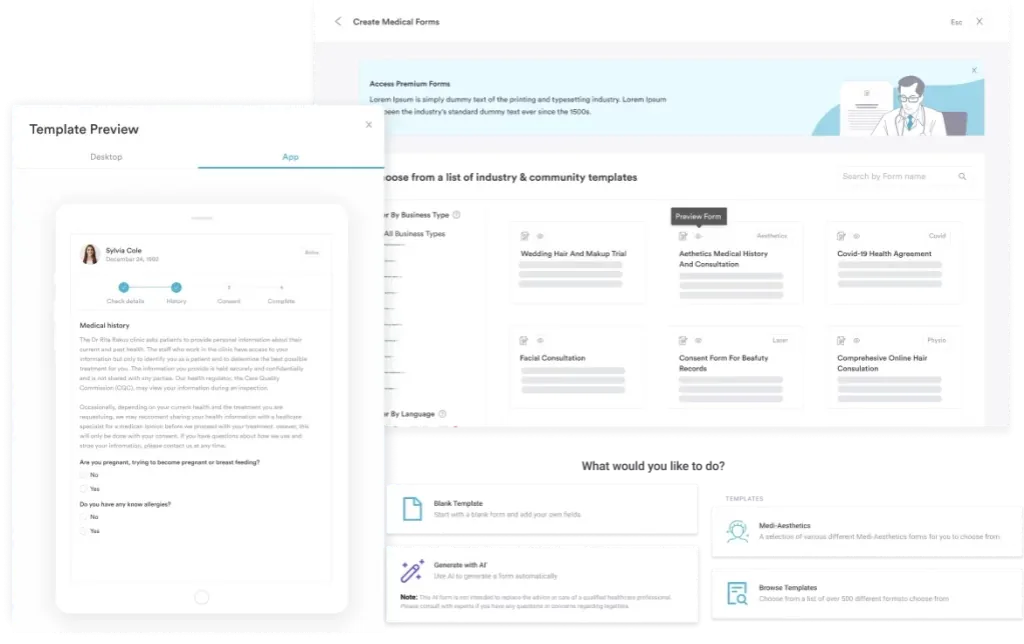
Most of the trouble comes from four things.
Good summaries bend to the clinical context. The structure holds while the language and emphasis shift.
Primary care. “You came in today with a cough you have had for three weeks. We found acute bronchitis, which is inflammation in your airway, and the chest X-ray ruled out pneumonia. A cough like this is almost always viral, so an antibiotic would not help you. Use cough syrup as needed, rest, drink plenty of fluids, and skip hard exercise for 5 days. Call us in 3 days if you are no better, or sooner if your fever goes above 101°F.”
Orthopedic specialist. “Your MRI shows a partial rotator cuff tear in your left shoulder. We recommend a cortisone injection, then 6 weeks of physical therapy before we consider surgery. You have naproxen 500 mg twice a day for pain and swelling. Physical therapy starts next Tuesday and I have sent your prescription to the therapist. Avoid reaching overhead for 2 weeks. I will see you again in 6 weeks.”
Aesthetic practice. “You had Botox injections in your forehead, crow’s feet and between your brows today. The effect starts in 3 to 7 days and peaks at 2 weeks. For the next 24 hours, do not touch the injection sites, lie face down, or exercise hard, as that can cause bruising. Mild redness and swelling today are normal. Call us if swelling lasts beyond tomorrow, or if you notice asymmetry after 2 weeks. Your next appointment is in 3 months.”
Notice what the three share. Every instruction carries a timeframe, and every warning names what to watch for.
Structure gets you a complete page. These four habits get it read.
A clear summary earns its keep after the patient leaves. It cuts medication mix-ups, keeps the follow-up on the patient’s radar, and gives any other clinician a readable account of what you decided.
For physical therapy practices, dermatology groups and mental health providers, the page becomes part of the care narrative. Patients arrive at the next visit knowing what happened at the last one, and your front desk fields fewer calls about instructions. Speech-language pathology fits the same pattern, where a speech therapy SOAP note records the objective figures behind the plan.
Pair it with a tracking tool where the condition calls for one. Sending a patient home with a pain journal alongside the summary gives you something to read at the next visit.
Most of the work in a visit summary is retyping. The diagnosis is in the note, the medication change is in the record, and the follow-up is in the calendar. Writing the page turns into copying between screens, and that is where the minutes go.
In practice management software like Pabau, those pieces already sit in one client record. Treatment notes, medications, tests ordered and the next appointment share a timeline, so you read one file instead of three. Pabau Scribe, our AI scribe, records and structures the consultation note as you talk. That leaves less to assemble afterwards.
Delivery is the other half of the job. You can share the finished summary through the patient portal, so the patient reads it again later instead of calling to ask what you said. Automated post-care workflows then send the follow-up message on schedule, without anyone remembering to do it.
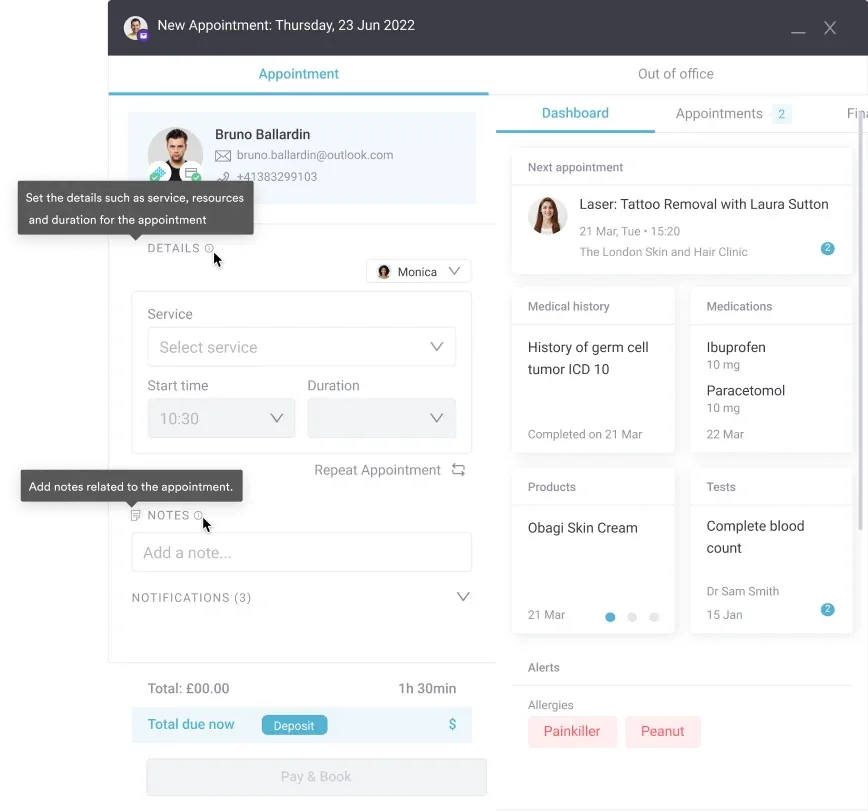

Pabau keeps treatment notes, medications, tests and the next appointment in one client record, and Pabau Scribe structures the note as you consult. That gives you a clean source to write the visit summary from, and a portal to share it through.

Treat the visit summary as a clinical tool rather than a compliance chore. The deadline that made it feel like paperwork left Meaningful Use in 2017, and nothing federal replaced it for this document. What remains is the reason to write one well.
So pick the same handful of components every time, and write them in words a worried patient can follow. Hand the page over before they leave. One trade-off is worth naming. A summary written from memory at the end of a long day will be thinner than one built from a structured note. The source data matters more than the layout. Practices weighing clinical documentation software should judge it on how well it structures that note.
If retyping is what makes summaries slow, that is a software problem worth fixing. Book a demo to see how Pabau pulls the note, the medications and the next appointment into one page for the patient.

Need a handoff format for the next clinician? The CVICU report sheet shows how to organize clinical detail for whoever takes over the patient.
Delivering the summary out loud instead? ICU presentation covers how to structure and deliver a patient story on rounds.
Clearing a patient to return to work? Doctor’s note for work template documents fitness for work, restrictions, and a return-to-work date.
Administering cytarabine to an oncology patient? Cytarabine administration note template covers route-specific prep, dosage checks, and post-infusion monitoring.
Building a quick-reference drug card? Drug card template covers dosing, contraindications, side effects, nursing considerations, and patient education.
No rule requires one, so this is a practice decision. Give one whenever the plan changes, a medication moves, or a test is pending. Many practices default to every visit, which keeps the habit consistent.
The clinician owns the clinical content, since the diagnosis and the medication changes are their call. Support staff can add the appointment date, contact details and referral information. Whoever prints the page, the clinician checks it before the patient takes it home.
Yes. A patient portal is the safer route. HIPAA also lets patients receive their information by unencrypted email, as long as they ask for it and you explain the risk.
Include the results you reviewed during the visit, with a plain-language reading of what they mean. List anything still pending, along with the date the patient should expect it.
No signature is required. Many practices note in the chart that the summary was provided, which gives you an audit trail if anyone asks later.
One page suits most visits. Use a second page when there are several diagnoses, multiple medication changes or detailed home-care instructions. Keep the clinical detail in the chart.