Scapular assistance test: Procedure, interpretation and free template
The scapular assistance test is a manual examination in which the clinician supp...

2
Last Updated: Oct 19, 2026

An ICU presentation follows an organ-systems framework, not the SOAP format used on general wards.
Every presentation opens with a one-liner: name, age, hospital day, primary diagnosis, and current status.
Lines, tubes, and drains get their own reporting slot, and first-time presenters skip it most often.
Close the plan by naming what still requires ICU-level care, or say the patient can transfer out.
Pabau’s AI-assisted documentation helps practice teams turn a structured patient encounter into a written note.
An ICU presentation is a short verbal summary of a critically ill patient, organized by organ system rather than by symptom. It runs in five parts. The one-liner, vital signs and hemodynamic trends, a head-to-toe systems review, lines and devices, then a problem-based plan.
Five minutes is the working target on most units. This guide walks through each part in the order attendings expect to hear it. It also shows how the words you say on rounds should line up with the note you write afterward.
Most interns walk into their first ICU rotation expecting to present patients the way they practiced on the general wards. They find out quickly that the format does not transfer. An ICU presentation is built around organ systems rather than the SOAP structure that dominates floor medicine.
SOAP stands for Subjective, Objective, Assessment, Plan. On a general ward, the subjective history drives the narrative. In the ICU, the patient is often intubated, sedated, or unable to give a history. Real-time physiological values take center stage instead.
According to the Society of Critical Care Medicine, structured communication frameworks in the ICU reduce errors during handoffs and rounds. Three things define the context you are presenting into:
Every strong ICU presentation follows the same backbone. Five components, delivered in sequence. Deviating from the order costs you credibility with the attending and slows rounds for the whole team.
Target: five minutes, delivered in this order every time.
Open with a single sentence that carries everything essential about this patient. The format is name or initials, age, hospital day, and primary diagnosis. Current status closes it in one clause.
Example: “Mr. J. is a 58-year-old male, hospital day four, admitted for septic shock secondary to community-acquired pneumonia, currently on low-dose vasopressors with improving hemodynamics.”
The one-liner is the standard opening across ICU training resources. It orients the whole room in ten seconds. Never skip it, and never let it run past two sentences.
Report overnight trends, not only current values. An attending who hears a blood pressure of 110/70 needs to know whether it is holding steady, climbing from 80/50, or falling from 130/80. The direction of travel is the information.
Cover vitals in this order: temperature, heart rate, blood pressure and MAP target, respiratory rate, SpO2, then vasopressor drug and dose. If the patient is on norepinephrine at 0.15 mcg/kg/min, say so. “Weaned from 0.25 to 0.15 overnight” tells a different story than “on norepinephrine.”
Write the numbers down before you speak. A printable CVICU report sheet keeps overnight values in one place, so you are not hunting through the chart mid-sentence.
This is the core of the presentation. Move through organ systems in the same order every time. Consistency prevents omissions, and an omission in the ICU can change a patient’s day.
Standard order used across critical care training programs:
Not every system needs a paragraph. For stable systems, one sentence is enough: “Renal: urine output adequate at 0.6 mL/kg/hr, creatinine stable at 1.1.” Spend your words where the clinical action is.
This component trips up first-time presenters because it does not sit inside any single organ system. It earns its own slot for a reason. Line complications such as infection, dislodgement, and malposition are among the most preventable ICU harms.
Report each device with type, insertion site, and date placed. For example: “Right subclavian central venous line, day six. Right radial arterial line, day two. Foley catheter, day four. No additional lines or drains.”
The Joint Commission’s Sentinel Event Alert on handoff communication warns that incomplete transfer-of-care information causes patient harm. Device status is one of the details handoff checklists commonly include.
The ICU assessment and plan is problem-based rather than system-based. List the active problems in priority order, then state the plan for each. Put the reason the patient is in the unit first and leave chronic stable problems until last.
Example A&P format:
Keep each problem statement tight. The attending does not need pathophysiology they already know. Say what is happening and what you are doing about it.
Then close on disposition. Name what still requires ICU-level care: pressor dependence, ventilator support, or hourly neuro checks. If none of that applies, say the patient looks ready for the floor. That one sentence tells the attending you understand why the bed is occupied.
Use this table as a bedside reference while you prepare. Print it, photograph it, or memorize it by system.
The five-step structure stays constant. What changes is where you spend your time. Three diagnoses account for most admissions in medical ICUs, and each one moves the center of gravity of your presentation.
Sepsis and septic shock. The infectious disease and cardiovascular systems dominate. Lead with culture results or pending cultures, the antibiotic regimen and day, and the vasopressor trajectory.
A line like “we de-escalated from meropenem to ceftriaxone after sensitivities returned” shows the team you are thinking about stewardship. The ARDS Network ventilation trial is worth knowing for patients who progress from sepsis to respiratory failure.
ARDS and respiratory failure. The respiratory system takes the lead. Report the P/F ratio, current PEEP, FiO2, and tidal volume in mL/kg of ideal body weight. Say whether the patient is meeting or failing liberation criteria.
Hemodynamic instability. Lead with the MAP trend and vasopressor requirement, then name the most likely etiology: distributive, cardiogenic, obstructive, or hypovolemic. An echocardiography report showing an ejection fraction of 15% changes the entire plan, so it should not surface four minutes in. Collected once and stored where clinicians read it, patient intake software removes the second round of questions.
The verbal presentation and the written progress note are the same content in two formats. Draft the note first and rounds become a reading of a document you have already organized. That order reduces omissions and keeps your reasoning consistent.
The written ICU progress note follows the same organ-systems structure as the spoken one. Habits around safer clinical notes built early in training tend to carry through the rest of a career.
Traditional SOAP note documentation is familiar from earlier rotations but does not map cleanly onto critical care. The organ-systems note replaces the subjective section with monitoring data and expands the objective section into per-system detail.
A clinical progress note template with the systems already listed removes the blank-page problem at 5 AM. The note carries billing weight too. Critical care time is billed under CPT 99291 for the first 30 to 74 minutes. The record has to show the time spent and the medical necessity behind it.
When the patient leaves the unit, the same structure feeds the discharge summary. A note already organized by system is far quicker to condense than one written as free text.
The errors that draw the most attending interruptions are almost always the same ones. Learning to avoid them is faster than learning everything else in this guide.
Before rounds, open the patient’s chart and say the one-liner out loud. Time yourself delivering the full presentation. If you cannot finish in five minutes, find the organ systems running long and tighten your language there. Speaking it out loud catches the pauses and filler words a mental rehearsal never does.
Your first week in the ICU is defined by information overload. The monitors never stop alarming. The terminology is dense. Attending questions arrive without warning. A few adjustments early on flatten the learning curve.
Pace yourself as well. Intensive rotations are a known driver of burnout in healthcare. The habits you set in month one decide whether you can keep them up through month six.
The ACGME Critical Care Milestones set out what attendings assess during your rotation: diagnostic reasoning, communication, and medical knowledge.
Knowing the framework tells you where to put your preparation. Medical dictation tools can also help you capture pre-rounds notes when time is short.
Most trainees leave critical care for outpatient work, and the documentation problem follows them. In a busy practice the notes stack up until the last patient has gone home. Detail fades with every hour of delay.
Practice management software like Pabau keeps the whole encounter in one place. The patient record, the appointment, the consent form, and the treatment note all live together, so nothing has to be copied between systems. Pabau Scribe, our AI scribe, drafts the note from the consultation itself.
The discipline you learn on ICU rounds transfers directly. Teams in primary care practices and physical therapy clinics work the same way. They rely on a consistent order, current data, and a plan the next clinician can act on.
AI-assisted clinical documentation turns a spoken summary into a written record while the detail is fresh. It comes with every Pabau subscription, because we do not gate features behind higher tiers.
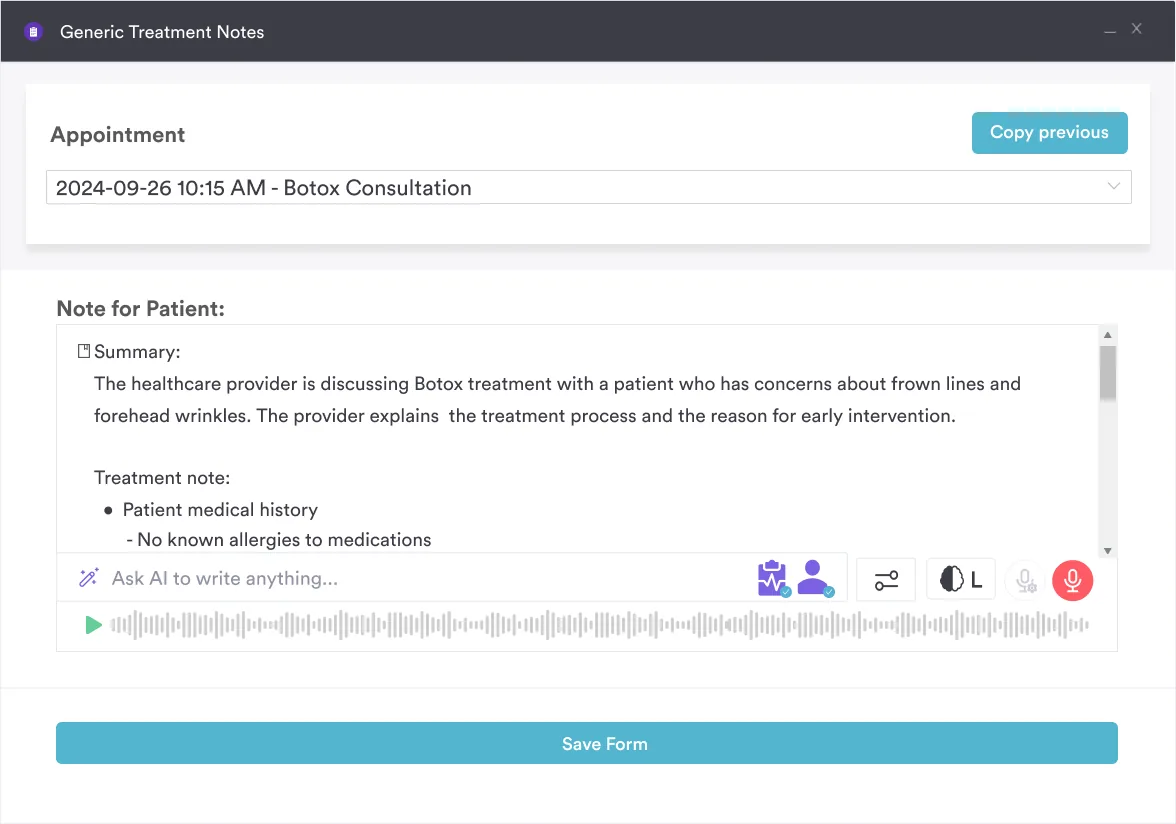

Pabau’s AI-assisted documentation helps practice teams turn a structured patient encounter into a written note. Less typing after hours, and records the next clinician can act on.

The ICU presentation is one of the highest-stakes communication skills in medicine. Get it wrong and rounds slow down, the attending loses confidence, and critical data goes unsaid. Get it right and you signal clinical competence faster than almost anything else a learner can show.
Pick one part to fix on your next shift. The one-liner and the disposition sentence are where the whole team is listening, so they repay practice first. The organ-systems detail in between tightens on its own once the frame is solid.
Whatever setting you end up in, the note is what outlives the conversation. Book a demo to see how Pabau helps practice teams document patient encounters without staying late.

An ICU presentation is a structured verbal summary of a critically ill patient delivered during rounds. It follows an organ-systems framework rather than the traditional SOAP format. It covers the one-liner, vital signs and hemodynamic trends, a head-to-toe systems review, lines and devices, and a problem-based plan. The format communicates a high volume of monitoring data to a multidisciplinary team in about five minutes.
A ward presentation follows the SOAP format, with the subjective history driving the narrative. An ICU presentation replaces the subjective section with real-time monitoring data. It organizes findings by organ system rather than by symptom, and it adds a category for lines, tubes, and drains. ICU patients are often intubated or sedated and cannot give a history, so objective data dominates.
The ICU one-liner includes the patient name or initials, age, hospital day number, and the primary diagnosis or reason for admission. A brief current status clause closes it. For example: “Mrs. K. is a 72-year-old woman, hospital day two, admitted for hypoxemic respiratory failure secondary to aspiration pneumonia, currently on assist-control ventilation with improving oxygenation.”
A well-structured ICU presentation runs five minutes or less, a benchmark widely cited in residency training resources. Critically ill or newly admitted patients with complex active problems may run slightly longer. The goal is completeness within a structured format, not speed for its own sake. Attendings usually interrupt and redirect when a presentation runs long on stable systems.
Yes. The standard sequence has five parts. First the one-liner, then vital signs and hemodynamic status with overnight trends. Third comes the organ-systems review from neuro to endocrine. Fourth, lines, tubes, and drains with insertion site and date. Fifth, the problem-based assessment, plan, and disposition. Write that structure on a pocket card and fill it in from the chart before rounds.
Five errors come up repeatedly. The first three are over-reporting stable systems, presenting static vital signs with no trend context, and reciting data without synthesis. The other two are skipping the lines and drains inventory and writing an assessment that restates findings without reasoning. All five are correctable with deliberate practice and a consistent structure.