Head to toe assessment cheat sheet: Printable nursing guide
A head to toe assessment cheat sheet gives you one fixed order at the bedside, s...

2
Last Updated: Oct 23, 2026

A SOAP note has four parts: Subjective (what the patient reports), Objective (measurable data), Assessment (your clinical judgment), and Plan (next steps).
The Objective section needs test scores, percent accuracy, and observable behaviors. A vague description will not support a medical necessity claim.
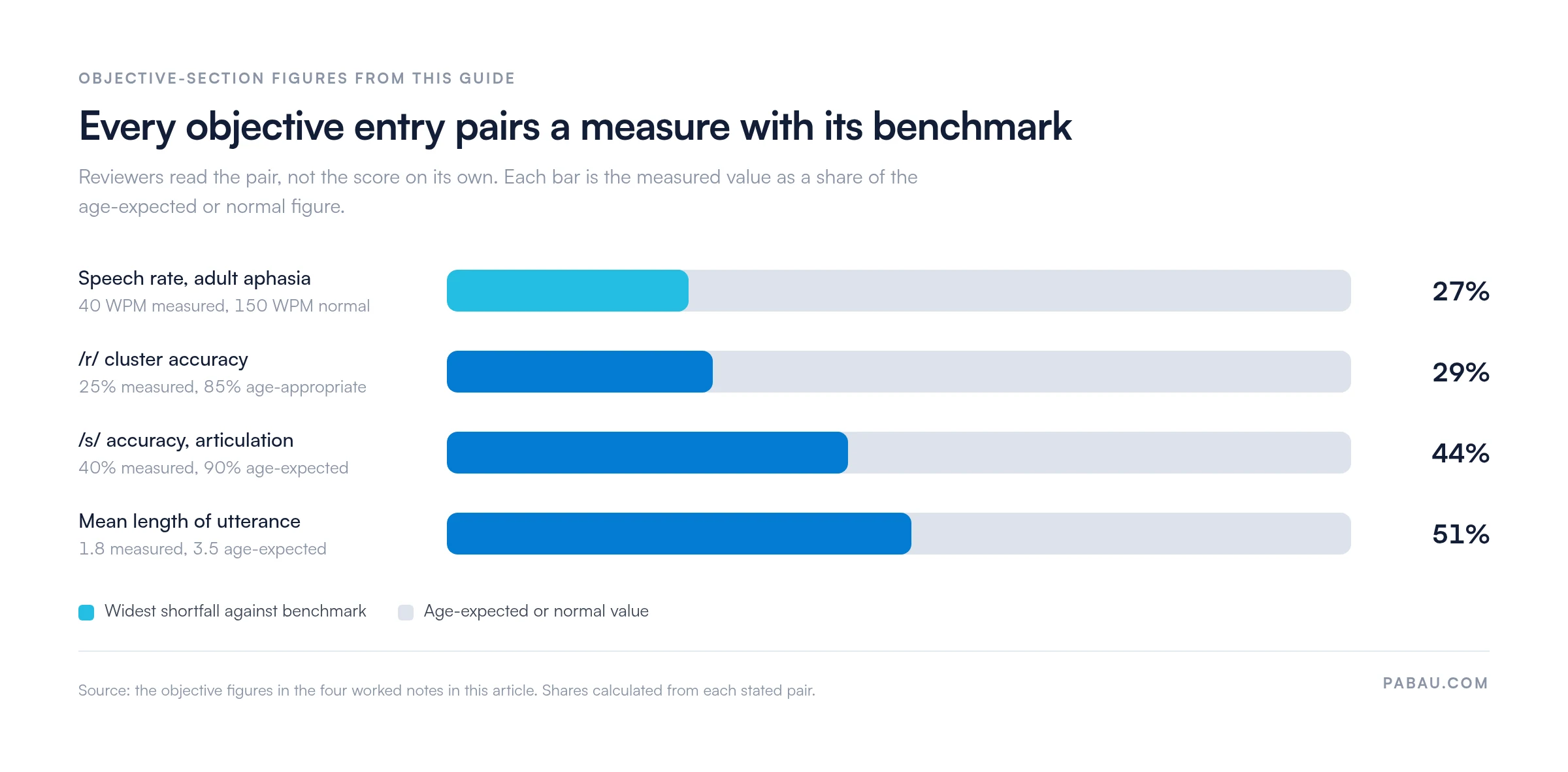
Pair every measure with its age-expected or normal benchmark, because a reviewer reads the pair rather than the score on its own.
SLP notes differ from general medical notes by tracking functional communication outcomes and documented progress toward each stated goal.
Practice management software like Pabau ships SOAP templates by disorder type, so notes stay compliant and ready for billing.
A blank, printable SOAP note form with four labeled sections: Subjective, Objective, Assessment, and Plan. It carries no specialty fields, so you can adapt it for speech-language pathology sessions.
Download templateA SOAP note example for speech-language pathology shows you how much detail one session note actually needs. The four sections are fixed. What belongs inside each one is where most notes fall short.
An insurance reviewer wants a measured figure sitting next to the benchmark it should be judged against. They also want one sentence saying why skilled care should continue. Miss either and the claim comes back.
This guide walks through four complete notes: articulation disorder, language delay, aphasia, and dysphagia. Each one shows what to record, how to justify medical necessity, and how to word the next goal. Software for speech therapists can pre-fill the structure, but the judgment in the Assessment section stays yours.
A SOAP note is a structured record of one clinical encounter, written in four fixed sections. For an SLP it captures what the patient or caregiver reports, then the measurable findings from the session. After that comes your clinical interpretation and the treatment direction. The format supports insurance billing, keeps care continuous between sessions, and satisfies ASHA documentation guidelines.
The strength of the format is its predictability. Payers, auditors, and other clinicians know where to look. When a reviewer decides whether speech therapy was medically necessary, they read your Assessment and Plan. A note with no test data and no functional goal reads like a denial waiting to happen.
Each section answers a different question for a different reader. Getting those boundaries right is what makes a note billable.
The Subjective section records what the patient says, or what a caregiver reports for a pediatric client. Include the chief complaint, relevant history, medications that could affect communication, and observations from between sessions.
The Objective section holds standardized scores and concrete behavioral counts. Record test results, percent accuracy on stimuli, the number of trials completed, and specific examples of performance. This is the data a payer uses to justify continued skilled care.
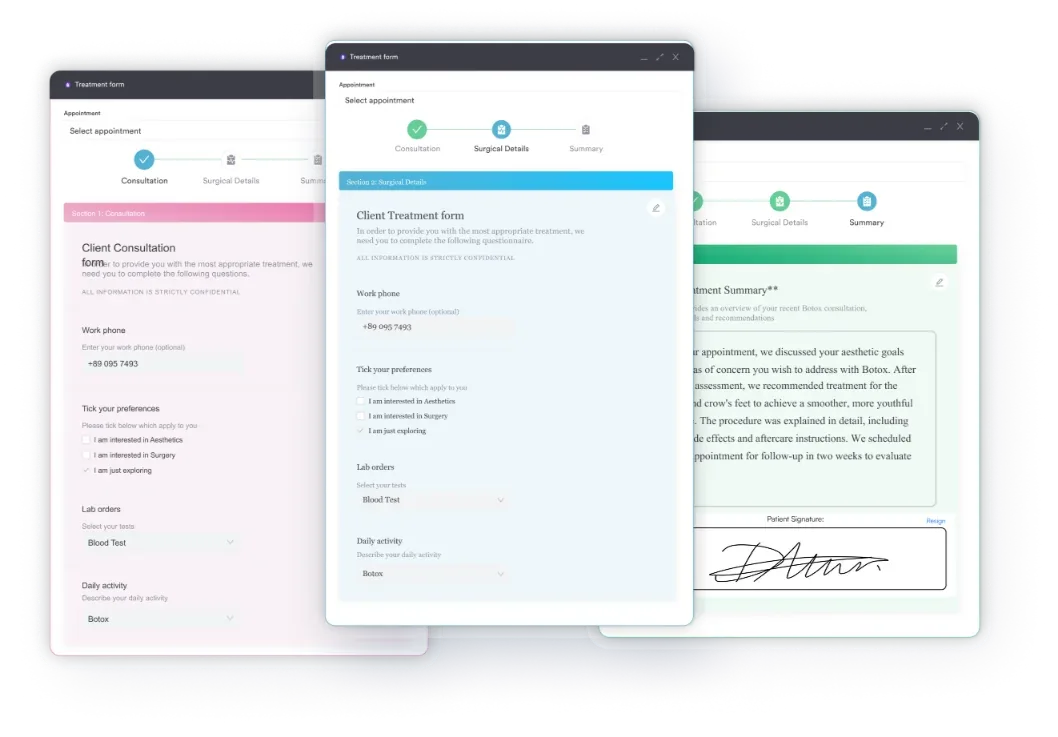
Other disciplines fill the same section with different data. A PT SOAP note records range of motion in degrees and manual muscle testing grades under Objective.
The Assessment section is where you interpret the Objective data. Compare current performance to baseline, name the impairment, and explain why skilled care is still needed. This section drives the insurance decision.
The Plan section sets the activities, the frequency, and the discharge timeline. State the next session’s focus, what the caregiver practices at home, and whether frequency or discharge is changing.
Each note below is complete and reads the way a payer will read it. Notice that every objective figure sits next to the benchmark it is being compared against.
Subjective: 5-year-old male, with parents reporting ongoing difficulty on /s/ and /z/ sounds. The kindergarten teacher notes he avoids speaking in group settings because of peer reactions. No significant medical history, and he passed a hearing screening this year.
Objective: Goldman-Fristoe Test of Articulation-3 gave /s/ accuracy of 40%, against an age-expected 90%, and /z/ accuracy of 35%. Stimulability testing showed 70% accuracy with a tactile cue for tongue-alveolar positioning. He produced 12/20 /s/ words correctly in conversation. Severity is mild to moderate, affecting intelligibility with unfamiliar listeners.
Assessment: Patient shows a phonetic-level articulation disorder affecting sibilant production. Positive stimulability suggests a good prognosis with skilled intervention. Current performance limits academic participation and social confidence. Continued SLP services are medically necessary to address the motor planning deficit.
Plan: Continue individual SLP sessions twice a week. Focus on /s/ production in CV and CVC words with a tactile cue, then progress to carrier phrases. Home program: the parent runs a 10-minute daily drill from the provided word list. Goal: 70% accuracy on /s/ in isolation within six weeks. Reassess at session 12.
Subjective: 3-year-old female. Her mother reports an expressive vocabulary of roughly 50 words and difficulty following two-step directions. She attends preschool three days a week, and teachers are concerned that her communication lags age-level peers. No reported developmental trauma. She attended early intervention at 18 months for speech delay and was discharged at age 2.
Objective: Receptive Expressive Emergent Language Test (REEL-3) gave a receptive score at 24 months and an expressive score at 22 months. Her chronological age is 3 years 2 months. A spontaneous language sample of 45 utterances was 38% one-word, 42% two-word, and 20% three-or-more-word combinations. Mean length of utterance was 1.8, against an age-expected 3.5. She followed one-step directions with 95% accuracy and two-step with 40%.
Assessment: Patient presents with a moderate expressive language delay, a 10-month lag, and a mild receptive delay of six months. The family is monolingual English-speaking, with no dialectal differences noted. Good motivation and eye contact suggest a favorable prognosis. Skilled intervention is medically necessary to address delays affecting preschool readiness and peer communication.
Plan: Direct SLP sessions twice a week, 45 minutes each, targeting expressive vocabulary, morphosyntax, and comprehension. Techniques: narrative play, recasting, and modeling. Home program: the mother uses embedded language teaching during daily routines such as mealtimes and bath time, working from the provided vocabulary targets. Goals: an expressive vocabulary above 200 words by session 24, and three-or-more-word utterances half the time. Recheck language measures at 12 weeks.
Subjective: 67-year-old male, four weeks after a left hemisphere ischemic stroke. His spouse reports he was a high-functioning executive and is now frustrated by word finding and by complex conversation. He lives with his spouse, who works part time, and the home setup supports therapy practice. He is motivated to return to work. No prior speech-language pathology history.
Objective: Boston Diagnostic Aphasia Examination-3 showed a Broca’s aphasia profile, with repetition relatively preserved and naming and fluency impaired. Naming accuracy was 45/60 objects. Repetition was 95% accurate for single words and 60% for multi-word sentences, limited by anomia. Comprehension was 90% for yes/no questions and 65% for complex sentences. Speech rate was 40 words per minute, against a normal 150. Self-monitoring is present, and he is aware of his errors.
Assessment: Patient presents with moderate Broca’s aphasia, marked by nonfluent speech, anomia, and agrammatism. The preserved repetition is a strength therapy can build on. Four weeks post-stroke sits inside the window for neuroplastic recovery. His motivation and home situation support intensive rehabilitation. Skilled SLP intervention is medically necessary to support language recovery and functional communication.
Plan: Individual SLP sessions three times a week, 60 minutes each, targeting naming retrieval, sentence formulation, and conversational discourse. Techniques: semantic feature analysis and script training for functional phrases such as ordering coffee or asking for help. Spouse education covers evidence-based communication partner strategies. Goals: object naming accuracy of 65% by week 8, and a speech rate of 70 words per minute in structured conversation. Consider group aphasia therapy at week 6, and a neuropsychology referral for cognitive screening if progress plateaus.
Script training needs written material the patient can rehearse between sessions. Our aphasia worksheet gives you naming and script drills you can send home with the spouse.
Subjective: 78-year-old female, admitted to a skilled nursing facility after hospitalization for aspiration pneumonia. History of Parkinson’s disease for eight years, with a recent decline in swallowing safety. Her husband reports she ate a regular diet at home and now needs a modified diet per the hospitalist’s recommendation. Weight is down six pounds over the past month. He is concerned about her nutrition and quality of life.
Objective: Bedside swallow screening was unsafe on thin liquids, with a cough and wet vocal quality after the swallow, and safe on nectar-thick. A Modified Barium Swallow Study showed premature oral spillage, delayed pharyngeal swallow initiation, penetration on thin liquids, and trace aspiration on thin and regular textures. Secretion management requires frequent suctioning, and she cannot clear oral secretions independently. She tolerates nectar-thick liquids and pureed foods, and is consuming 40% of offered meals.
Assessment: Patient presents with moderate dysphagia secondary to Parkinson’s disease, complicated by recent aspiration pneumonia. The swallow study confirms aspiration risk on thin liquids. Current medical fragility and limited mobility make intensive swallow rehabilitation impractical, so the focus is safety, comfort, and quality of life. SLP intervention is medically necessary to set a safe diet level, monitor swallow function, and train the care team on aspiration precautions.
Plan: Weekly SLP monitoring sessions, combining bedside assessment with staff education. Diet: continue nectar-thick liquids and a pureed diet under supervision. Positioning: upright for 30 minutes after meals. Techniques: effortful swallow cue, double swallow, and oral motor warm-up exercises. Nursing education covers aspiration precautions, secretion management, and diet protocol. The primary care physician should consider a gastroenterology referral if aspiration risk rises or intake stays below 50%. Reassess swallow safety at week 2, and repeat the swallow study at week 4 if she declines further.
A plan this detailed only helps if the nursing team can act on it at every meal. Our dysphagia care plan puts the diet level, positioning, and precautions on one page for the floor staff.
The structure is identical across age groups. What shifts is who reports, what the goals target, and how long the episode of care runs.
Medical necessity is what the insurance decision turns on. Your Assessment and Plan have to say why this patient needs a skilled SLP rather than practice with a family member at home.
Generic language fails. “Patient needs speech therapy” tells a reviewer nothing. “Moderate articulation disorder reduces classroom participation, and prognosis is good with skilled intervention” tells them what they came for.
The pattern that carries the most weight is a measured figure next to its benchmark. Every objective entry in the four notes above does that, and the shortfall is the argument.
Then add baseline against current performance, the functional impact on daily life, and how continued therapy moves the patient toward discharge. Those four elements, in that order, answer the reviewer’s question before they ask it.
SOAP notes get audited by insurers, Medicare contractors, and medical reviewers. Small errors turn into claim denials, and the same five show up again and again.
Most SLPs retype the same note skeleton for every patient on the caseload. The structure is identical from session to session, so the typing is pure repetition. The clinical thinking takes minutes and the paperwork takes the evening.
Practice management for therapists puts SOAP templates behind each disorder type. You pick the type and the sections appear pre-labeled. The note then links to the patient record, the billing line, and the appointment history, so each figure gets entered once.
Pabau Scribe, our AI scribe, drafts a first version of the note from your session recording or transcript. You review it, correct the clinical interpretation, and sign. The judgment stays yours, and the retyping goes away.
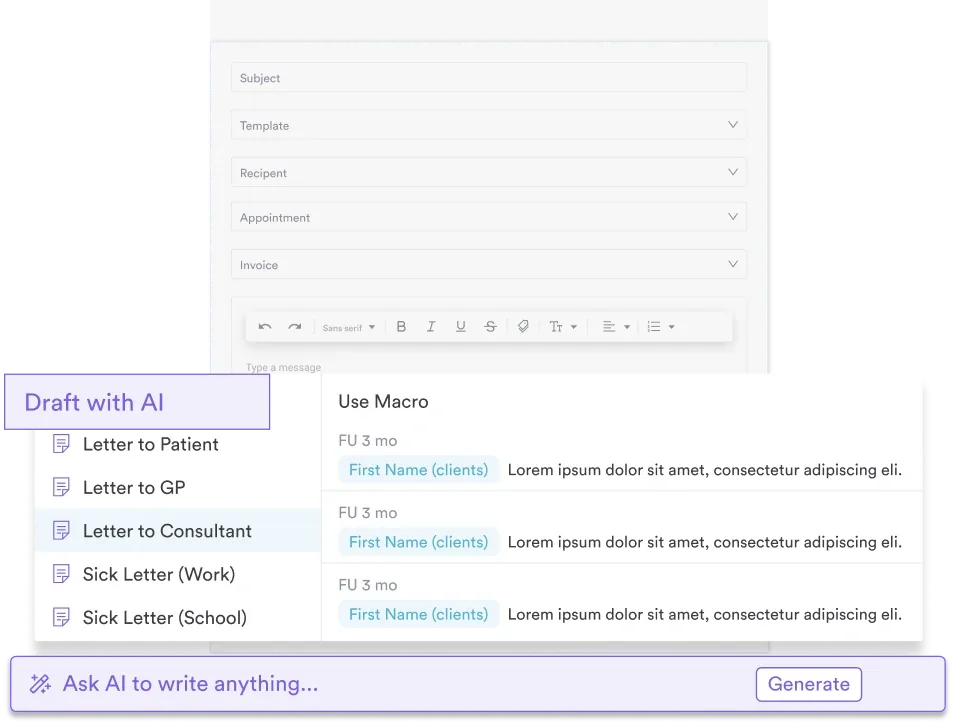
Letters take the same route. A school update, a physician referral, or a discharge summary gets drafted from the signed note. The family then hears the same figures the payer reads.

See SOAP templates by disorder type, an AI first draft from your session recording, and notes that link straight to billing.

The four letters are the easy part. The judgment call inside each section is what separates a note that gets paid from one that comes back with questions.
So pick one habit from this guide and make it automatic. Pair every objective figure with its benchmark. Do that consistently and the medical necessity argument is already on the page, because the comparison a reviewer wants is sitting right there.
The trade-off worth remembering is that a longer note is not a stronger note. A reviewer wants four specific figures, not four paragraphs of narrative. Write less, but write the numbers that matter.
Book a demo to see how SOAP templates and an AI first draft cut the hours your speech therapy caseload spends on documentation.

Comparing software for a speech therapy practice? Speech therapy practice management software weighs scheduling, notes, and billing against the size of your caseload.
Need measurable goals for the Plan section? Speech therapy goal bank lists goals by disorder type, worded so you can paste them straight into a note.
Scoring an articulation assessment? Articulation test explains what each score means and how to report it in the Objective section.
Subjective covers what the patient and caregiver report. Objective holds standardized scores and measurable behavioral data. Assessment is your clinical interpretation of progress and diagnosis. Plan sets the next session’s focus, the home program, the frequency, and the discharge timeline.
In the Assessment section, link the current impairment to a functional impact, such as reduced peer comprehension in the classroom. Compare baseline to current performance, for example an improvement of 15% since session 3. Then say why a skilled SLP is required rather than an untrained caregiver. Claims get denied when that connection is missing.
Yes. Include the primary diagnosis ICD-10 code, for example F80.1 for expressive language disorder, in the Assessment or on a separate billing line. This ties your clinical documentation to the billing record. Verify codes annually, because CMS updates the ICD-10 set each October.
SOAP and DAP (Data, Assessment, Plan) are both valid formats. SOAP keeps a separate section for what the patient and caregiver report. DAP merges that into a single Data section. Both are billable, so use whichever your practice prefers. SLPs in skilled nursing and home health often prefer DAP, because patient self-report is limited there.
Write a note for every billable session. Seeing a patient twice a week means two notes a week. Payers expect one note per service line billed, and a missing note triggers audits and denials. Templates keep the format consistent and cut the time each note takes.