Physician credentialing checklist
A physician credentialing checklist lists every license, certificate, verificati...

Last Updated: Oct 23, 2026
A nursing assistant skills checklist is a structured assessment form that records whether a nursing assistant can safely perform core clinical skills. It applies to certified nursing assistants (CNAs) and to candidates training to become one.
It covers 8–12 skill domains, from hand hygiene and vital signs to transfers, feeding and elimination care. Candidates use it to practice for the state exam, instructors use it to grade training, and employers use it to sign off new hires.
Most US states follow the National Nurse Aide Assessment Program (NNAAP) framework, which standardizes the skills evaluated across testing vendors like Prometric and Credentia. Some states add skills or adjust the evaluation criteria, so treat the checklist below as the NNAAP baseline and confirm your own state’s list.
A printable sign-off form with tick boxes for pre-procedure checks, the main care steps and close-out tasks. A separate section logs any item not completed, why, and the follow-up action. It ends with space for notes, a signature and a “checked by” line for the evaluator.
Download template
A nursing assistant skills checklist documents competency in 8–12 core clinical domains aligned with NNAAP standards and state exam requirements.
Hand hygiene and infection control is the most critical skill on every CNA state exam, and it is always assessed before other clinical skills.
The checklist serves three purposes: CNA state exam preparation, clinical instructor evaluation during training, and employer onboarding and competency verification.
Pabau’s practice management software stores staff documents such as qualifications and certificates, so a signed checklist can be filed with each new hire’s records.
The checklist is a performance assessment document that records whether a CNA or nursing assistant candidate has shown competency in hands-on clinical skills. It typically includes checkboxes, scoring criteria and space for evaluator notes. Three groups use it:
The National Council of State Boards of Nursing (NCSBN) governs the NNAAP framework, which sets the standards most states follow. Those standards trace back to the Omnibus Budget Reconciliation Act of 1987 (OBRA ’87), which mandates minimum CNA training and competency assessment.
The checklist covers eight core competency areas. Each domain includes several discrete skills evaluated during state exams and clinical practice.
Most states test five or six of these eight domains on the skills exam. Testing vendors may rotate which skills are evaluated or add state-specific changes. Candidates should confirm the exact skills list for their state through the Centers for Medicare and Medicaid Services (CMS) or their state board of nursing.
The communication domain is scored on how clearly the aide reports a change in the patient’s condition to the nurse. A structured format such as an SBAR nursing handoff keeps that report short and complete.
During exam preparation, the checklist works as a study and practice tool. Here is the step-by-step workflow:
The hand hygiene and infection control skill is always evaluated first on state exams. Failing it ends the exam on the spot, so practice it until you can run it without thinking.
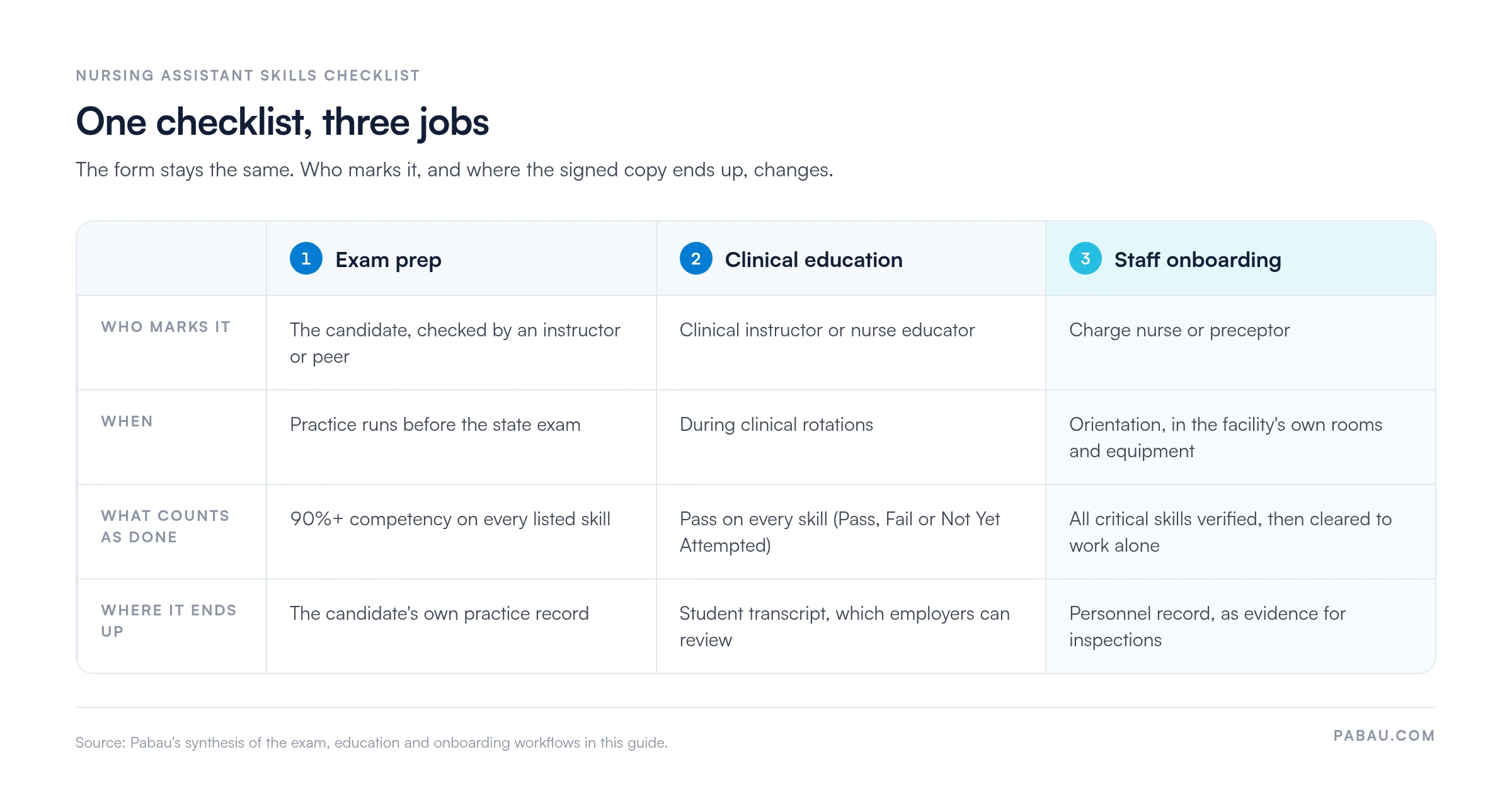
Clinical instructors and nurse educators use the nursing assistant skills checklist to document student progress during CNA training programs. It gives every student the same objective standard and creates a record for program accreditation.
During clinical rotations, instructors observe students performing each skill and mark the result, usually “Pass,” “Fail,” or “Not Yet Attempted.” Many programs require students to pass every skill before sitting for the state exam. The completed checklist becomes part of the student’s transcript, and employers can review it during hiring.
Graduates applying for their first role often point to those completed skills in a nursing assistant application letter. It shows the hiring manager what has already been signed off.
Hospitals, long-term care facilities and outpatient practices use the checklist during orientation. It confirms that each new nursing assistant can safely perform the required clinical tasks in that specific facility.
Orientation typically includes hands-on evaluation of each skill in the facility’s own patient rooms, with its own equipment and supplies. A charge nurse or preceptor uses the checklist to document competency. Once every critical skill is verified, the nursing assistant is cleared to work independently on the unit.
The completed checklist is filed in the employee’s personnel record. There it serves as evidence of due diligence during regulatory inspections or liability claims. Pabau, the practice management platform we build, includes team management software for staff scheduling and permissions.
It also stores staff documents such as qualifications and certificates. A scanned, signed checklist can sit in the same place as each nursing assistant’s CNA certificate.
Side by side, the three uses differ mainly in who marks the form and where the signed copy ends up.
Below are the standardized procedures for four of the most frequently tested nursing assistant skills. Each procedure is broken into discrete steps that align with NNAAP evaluation standards.
Hand hygiene is the foundational infection control skill. This procedure is always completed first on state exams.
Accurate vital signs measurement is a critical clinical skill, and blood pressure is commonly tested on state exams. A high reading goes to the nurse, who may start or update a hypertension nursing care plan.
Bed making is a high-frequency skill evaluated on most state exams. The occupied bed procedure keeps the patient in bed while changing linens.
Feeding assistance is evaluated for patient safety, including aspiration precautions and respect for patient preferences.
Aspiration, when food or liquid enters the airway, is a life-threatening complication. Always position patients upright and monitor closely during feeding. Patients with a known swallowing problem usually have an aspiration risk care plan that sets their positioning and diet texture.
Although most states follow the NNAAP framework, state boards of nursing may add, remove or modify skills based on local practice standards. For example, some states require a catheterization skill, while others do not. A few states test more than eight core skills. Before using this checklist, verify the exact skills your state’s testing vendor and board of nursing require. They may differ from the NNAAP baseline.
Many facilities still run competency sign-off on paper. The preceptor ticks the form at the bedside, and the original goes into a personnel folder. When an auditor asks for it, someone has to find it by hand.
With Pabau, the signed checklist is stored as a staff document alongside each nursing assistant’s qualifications and certificates. Managers set schedules and permissions in the same system, so a new hire’s paperwork and schedule live together.
The patient side moves off paper too. Pabau’s intake software for practices turns paper forms into digital form templates, and completed forms auto-populate the patient record. Nursing assistants start a shift with medical history already on file instead of chasing a paper copy.
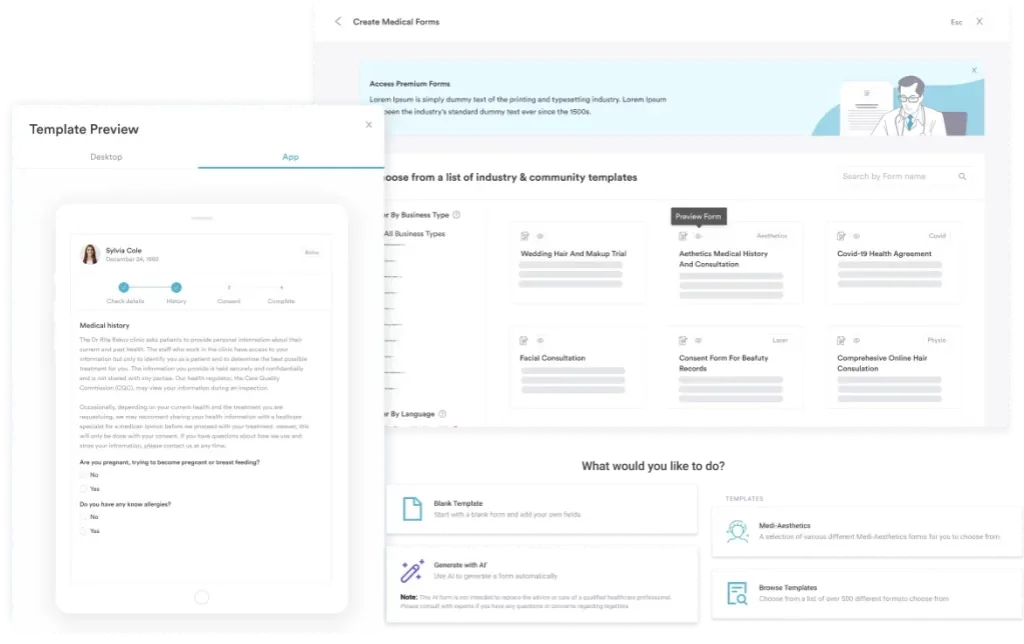

Pabau stores staff qualifications and certificates next to schedules and permissions, while digital intake forms auto-populate the patient record. New nursing assistants start with their paperwork filed and patient history on hand.

The checklist earns its keep when someone other than the candidate marks it. Self-assessment tells a student what they have practiced, while an instructor’s or preceptor’s marks show what they can do under observation. Book the exam, or clear a new hire for independent work, only once every critical step has been observed and signed.
For employers, the trade-off is preceptor time during orientation. In return, you get a dated, signed record that answers an inspector’s question in one page.
Book a demo to see how Pabau keeps every signed competency record with the right nursing assistant’s staff documents.

Learning the basics of charting? Nurse charting cheat sheet covers what to record and how to word it after each patient interaction.
Documenting care in a home or community setting? Caregiver note template gives a simple structure for recording each visit.
Want to tighten up your nursing records? Nursing documentation guide explains what complete, defensible nursing notes look like.
A certified nursing assistant (CNA) has completed a state-approved training program and passed the NNAAP state skills and written exam. A nursing assistant is an unlicensed healthcare worker who may not have completed formal training or passed state certification. CNAs are regulated, while uncertified nursing assistants are not. Most healthcare facilities hire only CNAs.
Most state exams test 5-6 of the 8 core competency domains listed above. The exact number and which skills are tested may vary by state and testing vendor. Check with your state board of nursing or Prometric/Credentia for the current skill list in your state.
Failure on any single skill means failure of the entire skills exam. You must retake the exam, which typically costs $50-150 depending on your state. However, if you fail only the hand hygiene skill, the exam terminates immediately without testing other skills. Most states allow 2-3 retake attempts within one year.
List your CNA credential and license number prominently (e.g., “Certified Nursing Assistant, License #12345, State of California, Expires 12/2028”). Under a “Core Competencies” or “Skills” section, list the key clinical domains. Include hand hygiene and infection control, vital signs measurement, personal care, mobility assistance, feeding, catheter care, and patient communication. Highlight any additional certifications (BLS, ACLS, CPR).
CNA licenses are typically valid for 2 years. You must renew before expiration. Renewal usually requires proof of continuing education (typically 12-24 hours) and a renewal fee ($25-100 depending on your state). Some states allow renewal by mail; others require in-person renewal. Contact your state board of nursing for specific renewal requirements.
Download the free nursing assistant skills checklist template above. The PDF is a printable sign-off form, and the eight domains and step-by-step procedures in this guide show what to assess with it. Customize it for your facility or training program by adding facility-specific protocols or additional skills required by your state.