Getting along with siblings worksheet
A getting along with siblings worksheet is a printable that helps children and t...

2
Last Updated: Oct 23, 2026

A split note is one chart entry for a single session, written by two clinicians. Each one authors and signs only their own section.
The format suits collaborative care, where a prescriber manages medication and a therapist runs the talk therapy.
Each section needs its own heading, the clinician’s name and credentials, and an independent signature.
Same-day psychotherapy and medication management are billed with add-on codes 90833, 90836, and 90838, not the standalone psychotherapy codes.
Pabau keeps both sections in one record with role-based access, independent signing, and a full audit trail.
A two-section clinical note with a shared encounter header. The prescriber fields cover subjective, objective, assessment and plan. The therapist fields cover session focus, progress, observations and next steps. Each section closes with its own name, credentials and signature block.
Download templateA split note is a single chart entry for one patient session that two clinicians write separately.
The prescriber authors and signs one section. The therapist authors and signs the other. Neither one edits the other’s half.
The format belongs to collaborative care. It shows up wherever a psychiatrist or nurse practitioner manages medication while a therapist runs the talk therapy. Most mental health EMR systems can hold both sections in one record.
This page covers when the format applies and what belongs in each section. It also walks through a completed example and the billing rules for a session two clinicians attend.
The format works in a handful of collaborative arrangements:
One distinction decides it. Split notes apply when both clinicians are present for or responsible for the same encounter. They do not apply when the two see the patient on separate days, or for unrelated interventions.
Three documentation types get confused with each other, and picking the wrong one causes payer and licensing problems:
A correctly formatted note carries two clearly delineated sections. Each follows standard clinical documentation principles.
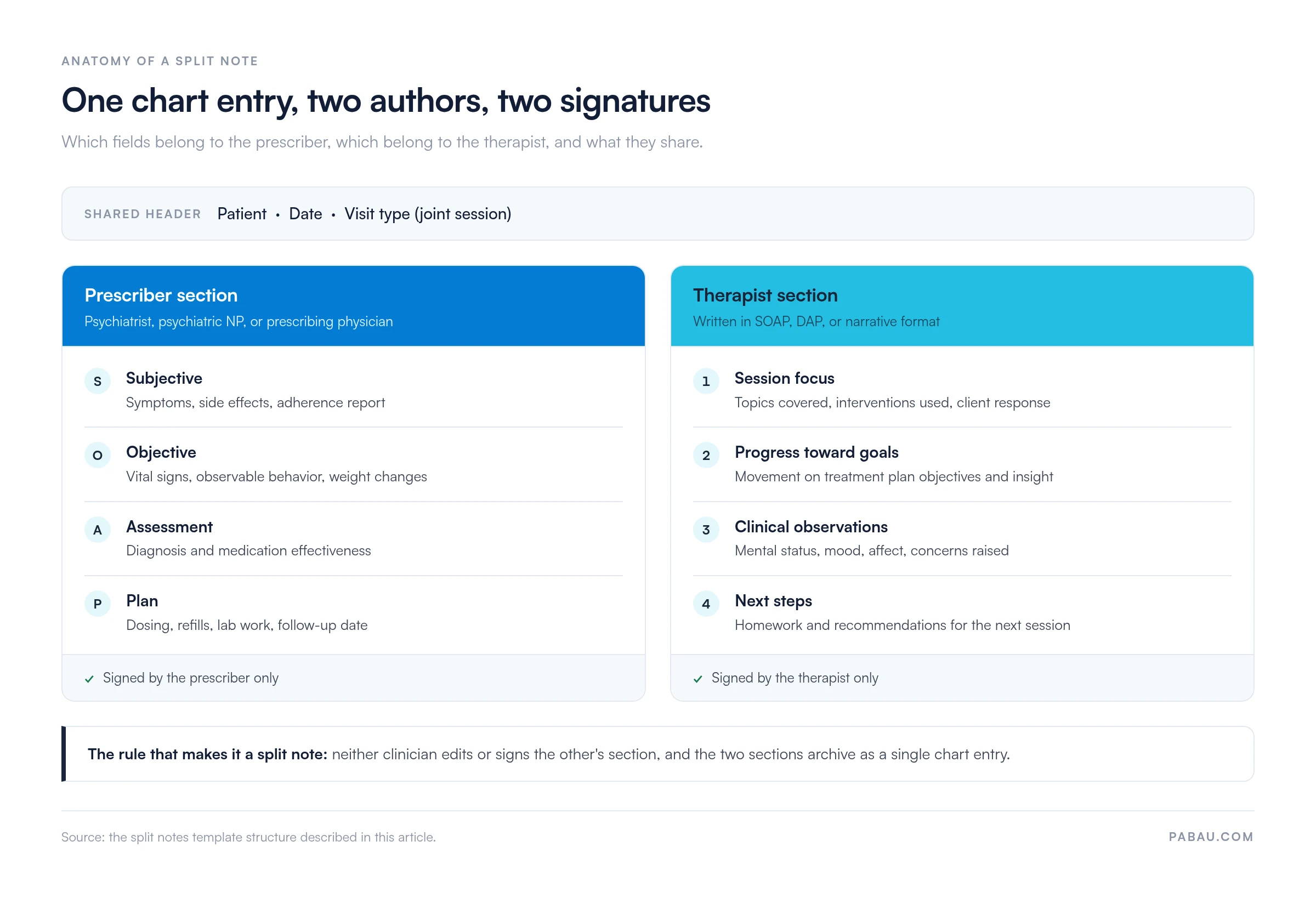
The prescribing clinician is a psychiatrist, a psychiatric nurse practitioner, or a prescribing physician. They document:
The therapist writes their own assessment and plan in whichever format they already use. That might be a mental health SOAP note, a DAP note, or a plain narrative. Whichever they pick, the section covers:
Both sections carry the clinician’s name, credentials, date, and independent signature. That is what establishes accountability. Laid out side by side, the division of labor is easy to see.
The format only holds up if the whole team follows the same protocol. Five steps get you there:
Here is how a finished note reads after a collaborative therapy session:
Patient: Jane D. | Date: February 15, 2026 | Visit type: joint psychiatric and therapy session
S: Patient reports improved sleep since the sertraline increase to 100 mg three weeks ago. Denies suicidal or homicidal ideation. Notes persistent social anxiety in group settings but feels more confident at work. No new side effects.
O: Alert, oriented, appropriate affect. Sits upright, good eye contact. Vital signs stable. No tremor noted. Weight stable since the last check.
A: Major depressive disorder, currently in partial remission. Generalized anxiety disorder responding well to the current regimen. Monitor for breakthrough anxiety symptoms.
P: Continue sertraline 100 mg daily. Refill for three months. No lab work needed at this visit. Follow-up in six weeks. Patient to call if any mood or medication concern arises.
Signed: Dr. Sarah Chen, MD | February 15, 2026 | 14:47
Focus: This session addressed workplace anxiety and social skills in group meetings. We practiced cognitive reframing for the anxious thoughts that arrive before team presentations.
Progress: Jane continues to move toward her goal of greater confidence in professional settings. She presented to her team last week and reported only mild anxiety, 6 out of 10, down from 8. She names this as meaningful progress.
Observations: Mood brighter than last session. Maintains good insight into her anxiety triggers. Engaged actively in role-play exercises. No safety concerns. Attending regularly and completing homework.
Next steps: Continue weekly sessions. Homework is to attend one social event outside work and journal the anxiety levels and coping strategies used. Next session will deepen the exposure-based work.
Signed: Michael Torres, LCSW | February 15, 2026 | 14:52
Two clinicians contributing to one encounter raises a question HIPAA does not answer for you. Both authored part of the medical record, so both may have access, depending on how your practice sets its policy.
Talk to your legal advisor and your EHR vendor about configuring the format to meet your state licensing board’s requirements.
When two clinicians bill for the same patient session, the payer rules decide what gets paid:
The distinction in the first row matters. Codes 90832, 90834 and 90837 are standalone psychotherapy codes with no evaluation and management component. A prescriber who does both in one visit bills the E/M code and adds 90833, 90836 or 90838 on top.
Before you bill: check the payer rules for the encounter, or use claims management software to flag the conflict before the claim goes out. Billing both clinicians where only one is allowed produces a denial and a compliance problem.
Four mistakes account for most of the trouble practices run into with this format:
Practices that keep the format consistent tend to build the routine into their therapy practice management software rather than relying on memory. They document straight after the session, train every clinician on the same layout, and audit a sample of notes each quarter. State board requirements and payer policies both shift, so the protocol needs revisiting as the practice grows.
Training a new clinician on that layout is easier with a guided notes handout, which lists the section headings and leaves the detail blank.
In a lot of collaborative practices, the two halves of a joint session end up in two places. The prescriber writes in the EHR, the therapist keeps a separate progress note, and someone reconciles them later.
Practice management software like Pabau keeps both sections in the same chart entry. Role-based access means each clinician opens only their own half. The prescriber cannot overwrite the therapist’s observations, and the therapist cannot alter the medication plan.
Each clinician signs their own section digitally, with a timestamp and an audit trail behind it. The finished note files into the patient’s chart as one entry, sitting chronologically alongside every other record. When an auditor or a payer asks who made a clinical decision, the answer is already in the file.
So your team stops reconciling paperwork at the end of the day. A co-treated session stays defensible without anyone chasing a second signature.

Pabau gives each clinician their own section, their own signature, and a shared audit trail, so collaborative notes stop needing manual reconciliation.

Split notes are worth the setup only where two clinicians genuinely share an encounter. If your prescriber and therapist see the patient on separate days for separate reasons, keep separate notes and skip the protocol entirely.
Where the format does apply, it earns its keep in the two places documentation usually fails. One is an audit asking who made a clinical decision. The other is a claim where two clinicians billed the same date of service. Both questions answer themselves when each section carries its own author and signature.
The trade-off is discipline. The format only works if both clinicians write the same day and neither touches the other’s section. Get that habit in place and the template handles the rest. Book a demo to see how Pabau holds both sections in one chart entry with independent signing.

Need a note format for solo sessions? Mental health note template covers the fields a single-clinician progress note has to carry.
Writing up psychotherapy sessions? Progress notes for psychotherapy walks through what belongs in each section and what payers look for.
Handling the medication side of the visit? Psychiatric evaluation template structures the assessment a prescriber completes before treatment starts.
Choosing software for a prescribing practice? Psychiatry EHR sets out what matters when medication management and therapy share one system.
Prefer a shorter note format? DAP note explains the data, assessment and plan structure, and when it beats SOAP.
Split notes are clinical records created by two professionals for the same patient session, usually a prescriber and a therapist. Each one authors and signs their own section, and the two sections file as a single chart entry.
A split note has two distinct sections. The prescriber section covers subjective, objective, assessment and plan, focused on medication and psychiatric evaluation. The therapist section covers session focus, progress, clinical observations and recommendations. Each carries the clinician’s name, credentials, date and independent signature.
Use them when you co-treat a patient with a prescriber in a single session. They also apply in group practices where several clinicians see the same client regularly. A payer that requires separate documentation from each clinician for one encounter is another trigger.
A regular progress note is written by one clinician and carries one clinical perspective. A split note is written when two clinicians treat a patient in the same session. Each authors an independently signed section inside one record, which keeps their assessments and their accountability separate.
They are not universally required, but they are strongly recommended when a psychiatrist and therapist co-treat a patient. The format clarifies accountability, supports insurance billing rules, and meets state licensing board standards. Requirements vary by state and payer, so verify your own obligations.
In a group practice, several clinicians document their own contribution to a shared session. Role-based EHR access lets each one view and edit only their section. That creates clear accountability while the whole team can still see every clinical perspective in the record.