Fertility clinic marketing: Strategies that attract & convert patients
Fertility clinic marketing is how a fertility practice attracts, educates, and c...

Last Updated: Oct 14, 2026
Health and wellness marketing is how a practice promotes its treatments and clinical expertise to win and keep patients, within healthcare’s trust and compliance rules. For most independent practices, four channels do the heavy lifting.
They are local SEO, fresh reviews, automated email recalls, and a deliberate referral system. Paid ads and social media help too, but they convert best once those foundations are in place.
The pressure to get this right keeps growing. According to the Global Wellness Institute, the global wellness economy passed $5.6 trillion in 2022 and is still growing. That means more practices competing for the same patients.
This guide covers the channels, compliance rules, and KPIs that practice owners and managers need to build a marketing system that keeps working. If you’re starting from zero, our primer on marketing for clinics covers the basics first.

Health and wellness marketing has to earn trust before it converts, and every claim has to meet HIPAA and FTC standards.
Local SEO, content marketing, email campaigns, and social media deliver the highest return for most wellness practices.
HIPAA requires explicit patient authorization before you use patient data for marketing, including email retargeting.
Track the referral source of every new patient, then move budget toward the two channels that bring your best patients.
Pabau, the practice management platform we build, automates bookings, follow-ups, and review requests without a separate marketing subscription.
Health and wellness marketing covers every touchpoint between a practice and the people it treats, from first search to fifth visit. That includes:
Unlike product marketing, it works in a space where the buying decision is personal, sometimes vulnerable, and almost always research-heavy. Nobody impulse-buys a physical therapy plan or a wellness program. Patients weigh trust signals, clinical credentials, and peer reviews. They also want to know the practice understands their problem.
Three forces shape this landscape:
Wellness marketing fails when practices apply retail marketing logic to a clinical setting. The funnel looks similar on paper, but the psychology and the rules are different.
Four differences matter most:
Wellness practitioners who understand these constraints build more efficient marketing systems. Those who ignore them waste budget on campaigns that convert poorly or attract regulatory attention.
Most wellness practices run on limited marketing budgets and even less time. The strategies below are ranked by typical return on effort for independent and small group practices.
Educational content positions your practice as the expert a patient trusts before they even call. Picture a physical therapy practice that publishes a practical guide to managing lower back pain at a desk. That guide ranks for relevant searches, earns backlinks, and pre-qualifies patients who already believe in the approach.
Content formats that work well for wellness practices include:
Aim for one substantive piece per month. Consistency matters more than volume, and it compounds into meaningful organic traffic over 12 to 18 months. Our guide to healthcare content marketing covers planning and production in more depth.
Most wellness bookings start with a local search, such as “physical therapy near me,” “med spa in Austin,” or “acupuncture in Denver.” Local SEO is the highest-leverage marketing activity for practices that serve a defined area.
Three priorities for local SEO:
Each social platform does a different job. Instagram and TikTok build brand awareness and familiarity with your treatments. Facebook drives community engagement and ad reach with an older audience. LinkedIn matters mainly for professional referral development.
For most wellness practices, Instagram is the primary platform, and short-form video outperforms static images on every metric. A 30-second clip of a treatment, a team introduction, or a patient education point reaches more prospective patients than a promotional graphic. To map a month of posts across platforms, start from our social media marketing plan template.
One rule applies on every platform. Never share identifiable patient information or treatment outcomes without explicit written consent that meets HIPAA standards.
Email remains one of the most cost-effective retention channels for healthcare and wellness businesses. Industry benchmarks suggest healthcare campaigns consistently beat retail on open rates, because patients have a reason to read messages from their provider.
Effective wellness email sequences include:
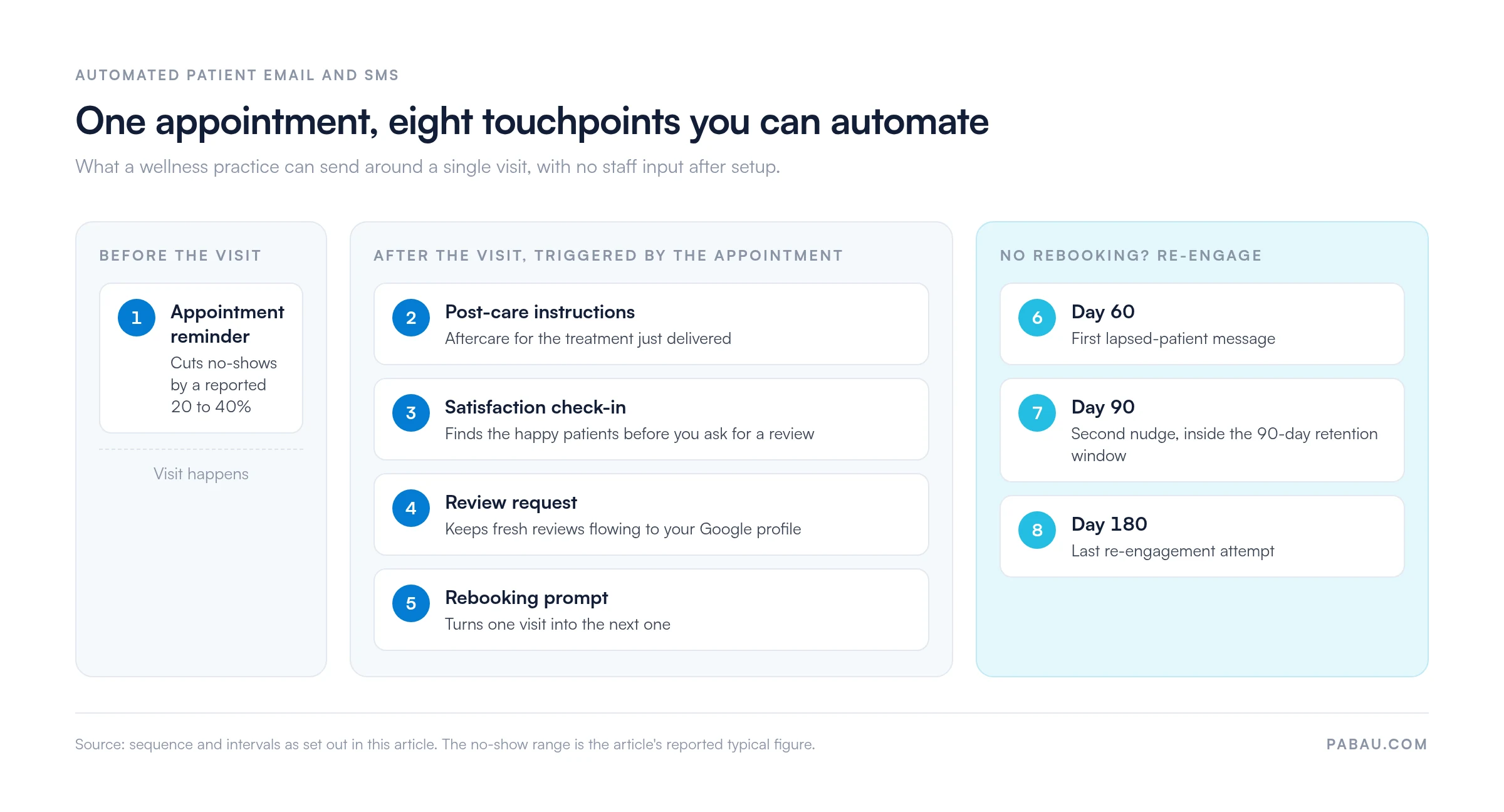
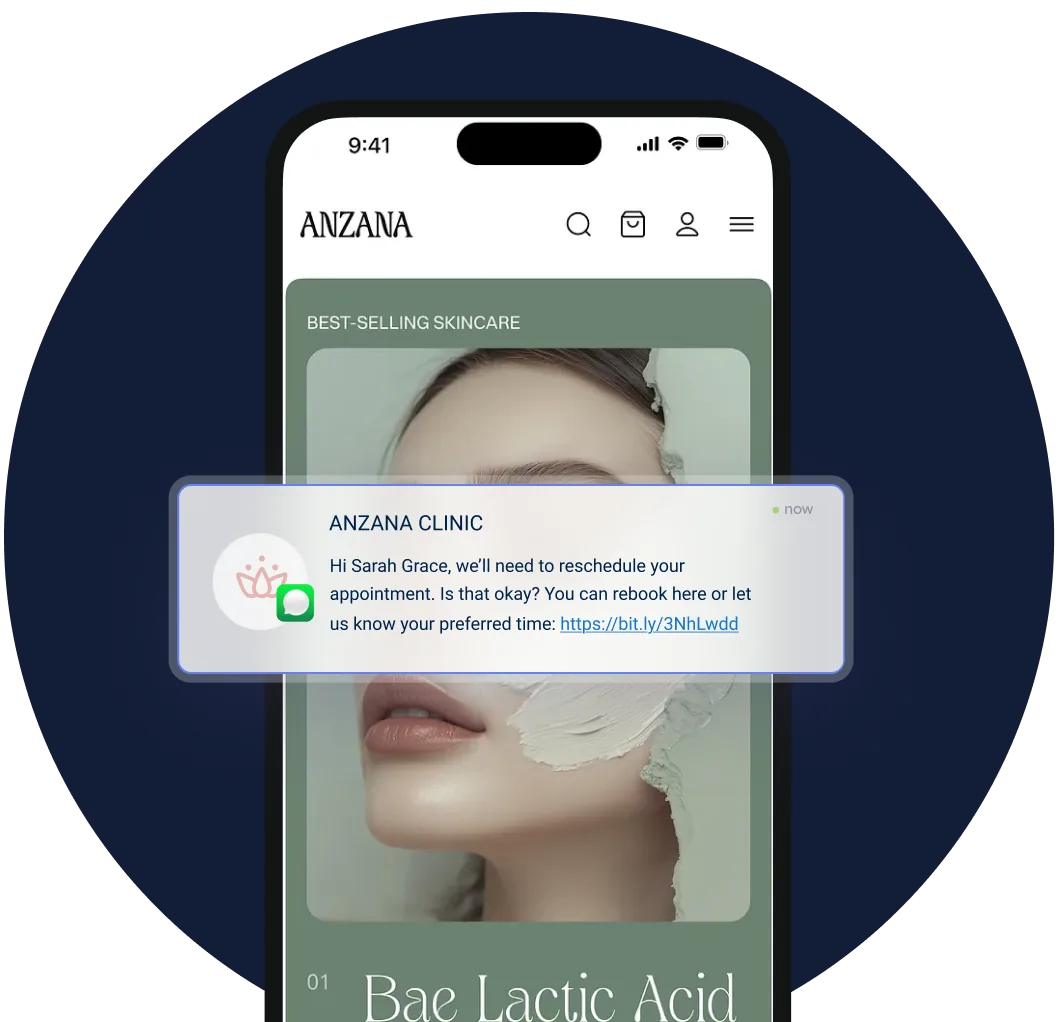
Pabau’s automated email and SMS campaigns handle all four without manual scheduling. Mapped around a single visit, those messages add up to eight touchpoints, and none of them needs a staff member to send it.
Google Ads and Meta Ads work for wellness practices, but they need more careful setup than general retail campaigns. Google’s healthcare advertising policy requires certification for certain ad categories, and Meta restricts targeting by health condition.
Three tactics tend to work:
Three others tend to get ads rejected:
Paid channels attract. Referrals convert. The most profitable wellness practices run referral generation as a deliberate system, with incentives, tracking, and a clear moment to ask. For a structured approach, our guide to patient acquisition strategies covers paid and organic acquisition in depth.
Three referral levers worth building into your marketing system:
Track the referral source for every new patient. After 90 days, you’ll have data showing which channels deliver your highest-value patients. Move budget from the weakest channels to the top two. Two or three sources often bring in 70 to 80% of high-value new patients, and those sources are usually underfunded.
Compliance is where marketing mistakes turn into liability, so check these rules before you launch a campaign.
The core requirements for US-based wellness practices:
UK-based practices face equivalent rules under the Advertising Standards Authority (ASA) and GDPR for email marketing. The UK also restricts advertising for prescription-only medicines and certain aesthetic treatments.
A wellness marketing plan without measurement is a cost center. With measurement, it becomes an investment you can optimize. These are the key performance indicators (KPIs) that matter for practice owners:
Review these metrics monthly, not quarterly. In a small practice, a campaign heading the wrong way for 90 days is a material cost.
Most marketing plans in a wellness practice break down at the follow-up stage. On a busy afternoon, the post-care email goes out late, the review request is forgotten, and a lapsed patient never hears from you.
Practice management software fixes that by automating the touchpoints that follow every appointment. Pabau builds marketing software for practices into the same system as your calendar and patient records, so campaigns run on live appointment data. Across the patient lifecycle, that covers:
The result is a marketing system that runs between appointments, so your team spends its time with patients instead of chasing them.

Automated recalls, review requests, email campaigns, and online booking run from one platform, with no separate marketing subscription.

Start where effort compounds. For most wellness practices, that means a complete Google Business Profile, a review request after every visit, and recalls to patients who are due back.
Hold off on paid ads until those foundations convert well, and check every claim against HIPAA and FTC rules before it goes live. The trade-off is speed. Organic channels take months to pay off, but they keep paying once they do.
From there, measure monthly and move budget toward the two sources that bring your best patients. Book a demo to see how Pabau automates recalls, reviews, and follow-ups so your team can focus on patient care.

Need a step-by-step plan for the year? Marketing plan for private practice walks through goals, budgets, and channel planning for independent practices.
Want more first-time inquiries? Healthcare lead generation strategies covers capture forms, follow-up speed, and the channels that bring in new patients.
Ready to turn happy patients into referrals? How to build a patient referral program shows how to set incentives and automate the ask.
Building relationships with local physicians? Physician referral marketing explains how specialist practices earn and keep professional referrals.
Is your schedule still showing empty slots? How to get more patients lays out nine strategies that fill a practice calendar.
Health and wellness marketing is the promotion of clinical services, wellness treatments, and healthcare expertise to attract and keep patients. It uses channels and messaging that meet compliance rules, build trust, and respect how sensitive health decisions are. Unlike general consumer marketing, it can’t convert without credibility and ethical claim standards in place first.
For small practices with limited budgets, three channels deliver the best return. They are local SEO (especially Google Business Profile optimization), a consistent review request system, and automated email recalls. Together they cover discovery, trust, and retention without much ongoing spend. Content marketing compounds over 12 to 18 months, so start early, even at one post per month.
Start by defining your main patient persona and their decision journey. Then pick the two or three channels where that patient spends time. Set a 90-day goal, such as 15 new patients per month from organic channels, and give each channel a realistic budget. Use the KPIs in the measurement table above as your baseline. Review monthly and move budget to the channels with the lowest CPA and highest retention.
Local SEO, Instagram, and email marketing consistently outperform other channels for most wellness practices. Google Ads and Meta Ads help scale a practice that already converts well from organic channels. They cost more, though, and need compliance knowledge to run safely. Referral programs and professional referral networks bring the highest-lifetime-value patients at the lowest acquisition cost, but they take longer to build.
HIPAA requires covered entities to get explicit written patient authorization before using protected health information for marketing. Appointment reminders and care-related messages don’t need authorization. Promotional campaigns based on a patient’s diagnosis, treatment history, or health status do. Breaking this rule is both a regulatory breach and a serious reputational risk.