Free patient financial agreement template for practices
A financial agreement is the form a patient signs before treatment to confirm wh...

2
Last Updated: Oct 23, 2026

A nurse satisfaction survey collects structured feedback on six workplace dimensions, from staffing and workload through to leadership, pay, and career development.
Measuring satisfaction supports retention and burnout prevention, and Magnet recognition expects both the data and a documented action plan.
Validated instruments like Press Ganey, the Index of Work Satisfaction, and the Nurse Satisfaction Scale shaped the wording in our template.
Share the results and your named priorities within four weeks of closing, or participation drops the next time you ask.
Practice management software like Pabau turns the survey into a digital form and keeps each follow-up action on someone’s schedule.
The template carries six categorized sections of Likert-scale questions, covering work environment, workload, leadership, pay, development, and team collaboration. It also includes guidance on scoring the responses and reading the results by unit.
Download templateA nurse satisfaction survey asks nursing staff to rate their work environment, workload, leadership, pay, and development on a fixed scale. Run once or twice a year, it gives you trend data instead of anecdotes from whoever speaks up loudest.
The template above is ready to send. Below it you get the question bank by category, the three validated instruments the wording draws on, and a fielding calendar you can copy.
What decides whether the survey was worth running is what happens after it closes. Nurses remember whether anyone reported back. So the four-week reporting window and the action-planning framework get as much space here as the questions do.
A nurse satisfaction survey is a structured feedback tool that measures how nursing staff experience their work environment, leadership, workload, pay, and career development. Unlike a generic employee survey, it asks about the clinical and operational conditions that drive nursing fulfillment or burnout.
The questions use a Likert scale, rating agreement from strongly disagree to strongly agree, so opinions turn into numbers you can track. Administered annually or twice a year, they give leaders trend data to compare units, benchmark against peers, and test whether a retention push worked.
The same survey runs in a hospital unit and in a nurse-led IV therapy clinic. It fits a behavioral health practice where psychiatric nurses carry the caseload just as well. Team size changes how you report the results, not which dimensions you ask about.
Nursing staff satisfaction shapes retention, safety, and recruitment. The American Nurses Association links nurse burnout to higher turnover, more clinical errors, and reduced patient safety. Organizations that measure satisfaction and act on the findings have something concrete to show at recruitment and at Magnet review.
Three reasons healthcare leaders prioritize the measurement:
Small practices are not exempt from any of this. A nurse practitioner running a three-person team has fewer people to lose, so a single resignation costs proportionally more.
Effective surveys measure six dimensions that healthcare workforce research keeps returning to. Read the third column as the reason each one earns a place in the questionnaire.
The template includes five to seven Likert-scale questions for each dimension. The samples below show how the wording works; the file carries the full set, ready to send.
Three validated instruments dominate nurse satisfaction measurement in healthcare. The template borrows item wording from the peer-reviewed research behind all three.
Our template borrows item wording from all three frameworks. You get a fast deployment with no licensing cost, and the questions still read the way a validated instrument phrases them.
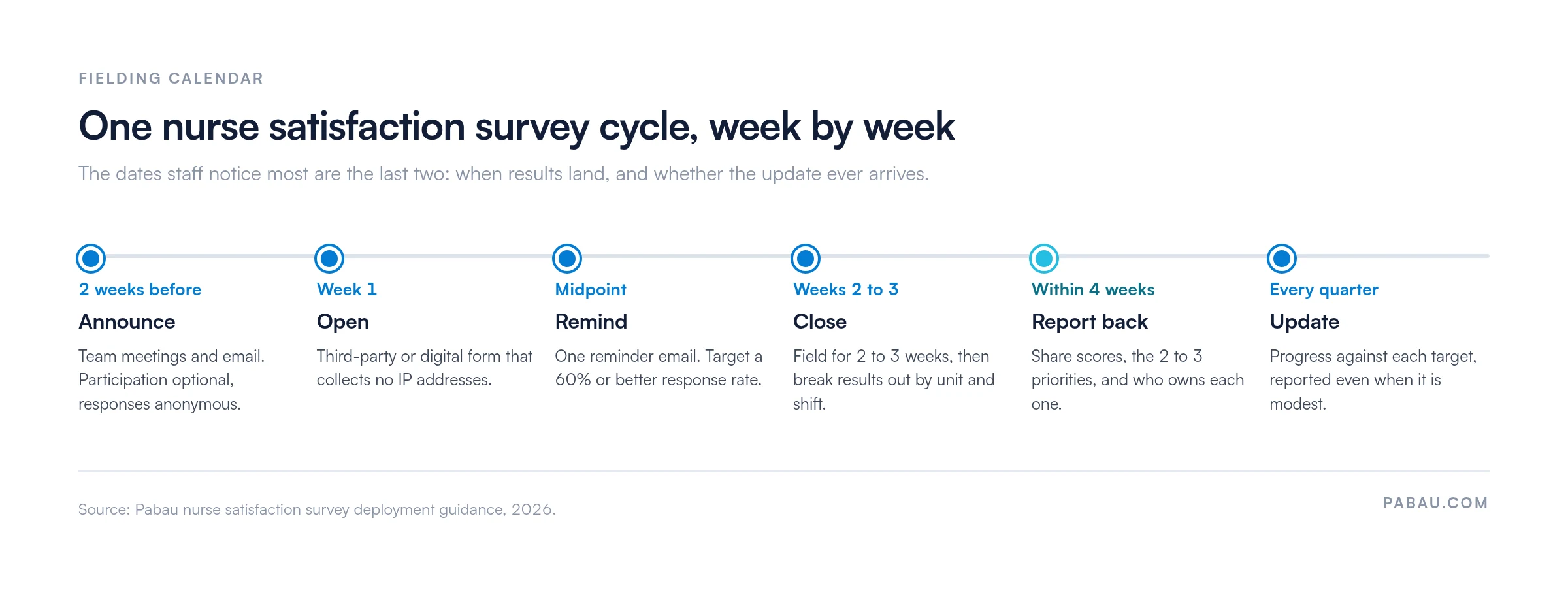
Fielding comes down to timing, anonymity, and what you promise about the results. The calendar below is the shape of one cycle, from the announcement through to the quarterly update.
If you also field a patient satisfaction survey, keep the two cycles a month or two apart. Nurses should not be chasing patient responses while answering questions about their own workload.
Survey data earns its keep only when it changes something. The usual failure is a report of top-line numbers followed by no visible action, which teaches staff that answering honestly was pointless.
A framework for the four weeks after the survey closes:
Leadership scores usually split by manager rather than by unit, which makes them awkward to publish and easy to bury. A leadership style quiz gives supervisors a lower-stakes way to see how they come across before the coaching conversation starts.
Read the work environment scores next to the same quarter’s incident reports, and the workload scores next to overtime. Where individual nurses are close to burning out, a personal wellness plan gives the manager something concrete to own.
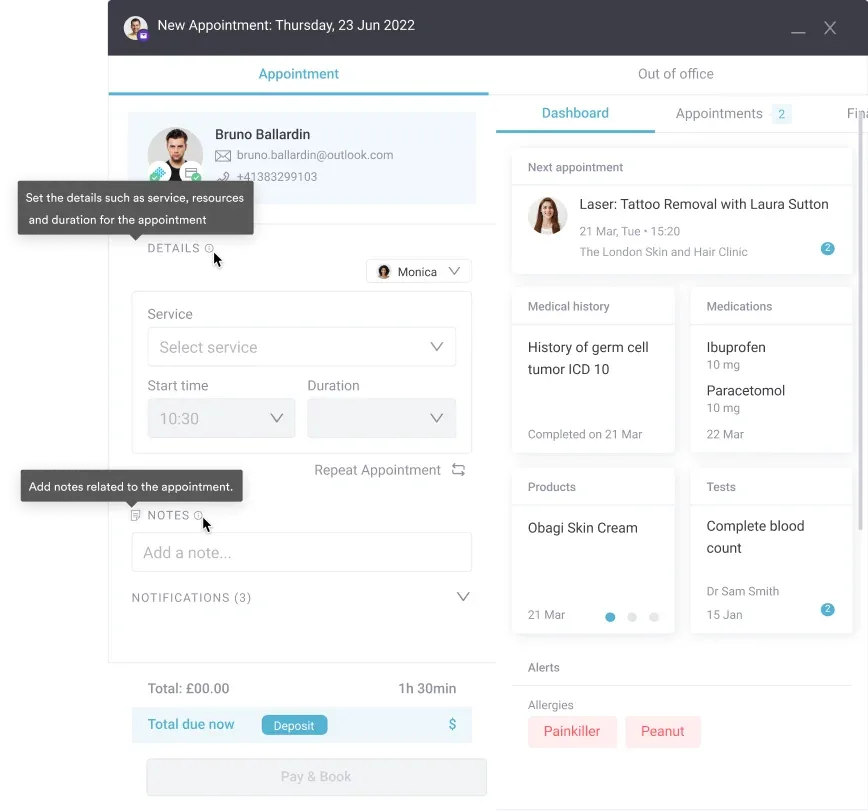
Most practices run the survey in one tool, hold the results in a spreadsheet, and track the promises nowhere. Practice management software like Pabau closes that loop, because the follow-up actions sit where the schedule and the staff records already live.
Build the questionnaire as a digital form and send it to the team. Then keep the commitments that come out of it on a schedule rather than in an inbox. Team management records who owns each priority, and automated reminders chase the quarterly check-in so a manager does not have to remember it.
The other half of the job is the workload that produced the low score. Scheduling, treatment notes, and patient reminders in one system remove some of the admin nurses complain about. That is the reasoning behind a digital-first group like Esteem Life Medical Group running its clinical and business records on one platform.

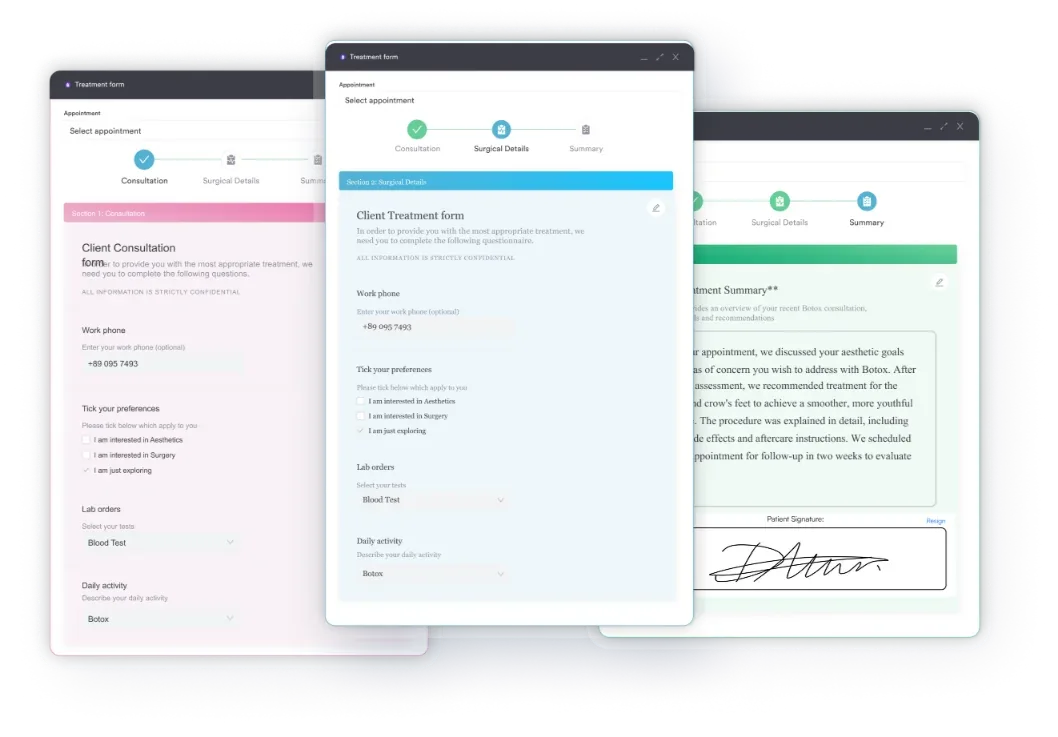
Pabau’s digital forms collect the survey, and team management keeps each priority with a named owner and a quarterly check-in. Your nurses see the actions land instead of hearing the results once.

Running the survey is the easy half. The organizations that hold onto nurses publish two or three priorities and name who owns them. Then they report back on the schedule they announced up front.
If you can commit to only one change this cycle, make it the four-week report-back. Nurses will forgive a slow fix long before they forgive silence.
So download the template, field it, and book the reporting date before the survey opens. Book a demo to see how Pabau collects the survey and keeps every follow-up action on someone’s schedule.

Handling one nurse rather than a whole unit? Employee counseling form documents the conversation and the next steps you both agreed.
Onboarding new nurses this quarter? Nurse brain sheet gives them a shift structure to work from on day one.
Want the patient side of the picture? How to capture patient feedback covers the timing and channels that get responses.
Seeing the same strain in your therapists? Therapist burnout signs and prevention lists the early markers and what helps.
Need a care plan your staff can hand over? Ineffective breathing pattern care plan shows the format nurses expect at handoff.
A nurse satisfaction survey is a structured feedback tool that measures how nursing staff experience their work environment, leadership, pay, workload, and development opportunities. It uses Likert-scale questions to turn those views into numbers. Most organizations field it annually or twice a year to track trends and shape retention plans.
Annual or twice-yearly is the norm. An annual cycle gives you trend data and enough room to act between rounds. Twice-yearly suits organizations pursuing Magnet recognition, which want evidence of sustained measurement and improvement.
Press Ganey is a healthcare experience measurement vendor with a validated nurse satisfaction instrument. It offers national benchmarking, trend tracking, and psychometric validation, which suits large health systems. Smaller organizations often get comparable question quality from a free template.
Peer-reviewed research links nurse satisfaction to lower clinical error rates, better patient safety, and higher patient satisfaction scores. Burnout costs attention and slows clinical decisions, and the effect turns up in care quality.
The IWS is a validated instrument measuring six dimensions: pay, autonomy, task requirements, organizational policies, social interaction, and status. It gives you a research-backed frame for nurse satisfaction. Mid-sized organizations and private practices use it often.
Target the two or three dimensions with the lowest scores. Common interventions include revising staffing models, coaching managers, and benchmarking pay against your region. Widening development opportunities and opening a regular channel between leadership and clinical staff also help.