Panama shift schedule: Free 2-2-3 template
The Panama shift schedule is a 2-2-3 rotation that keeps a practice staffed arou...

1
Last Updated: Oct 6, 2026

In short, the free quiz is a one-page printable form with 10 questions, and every question offers three answers.
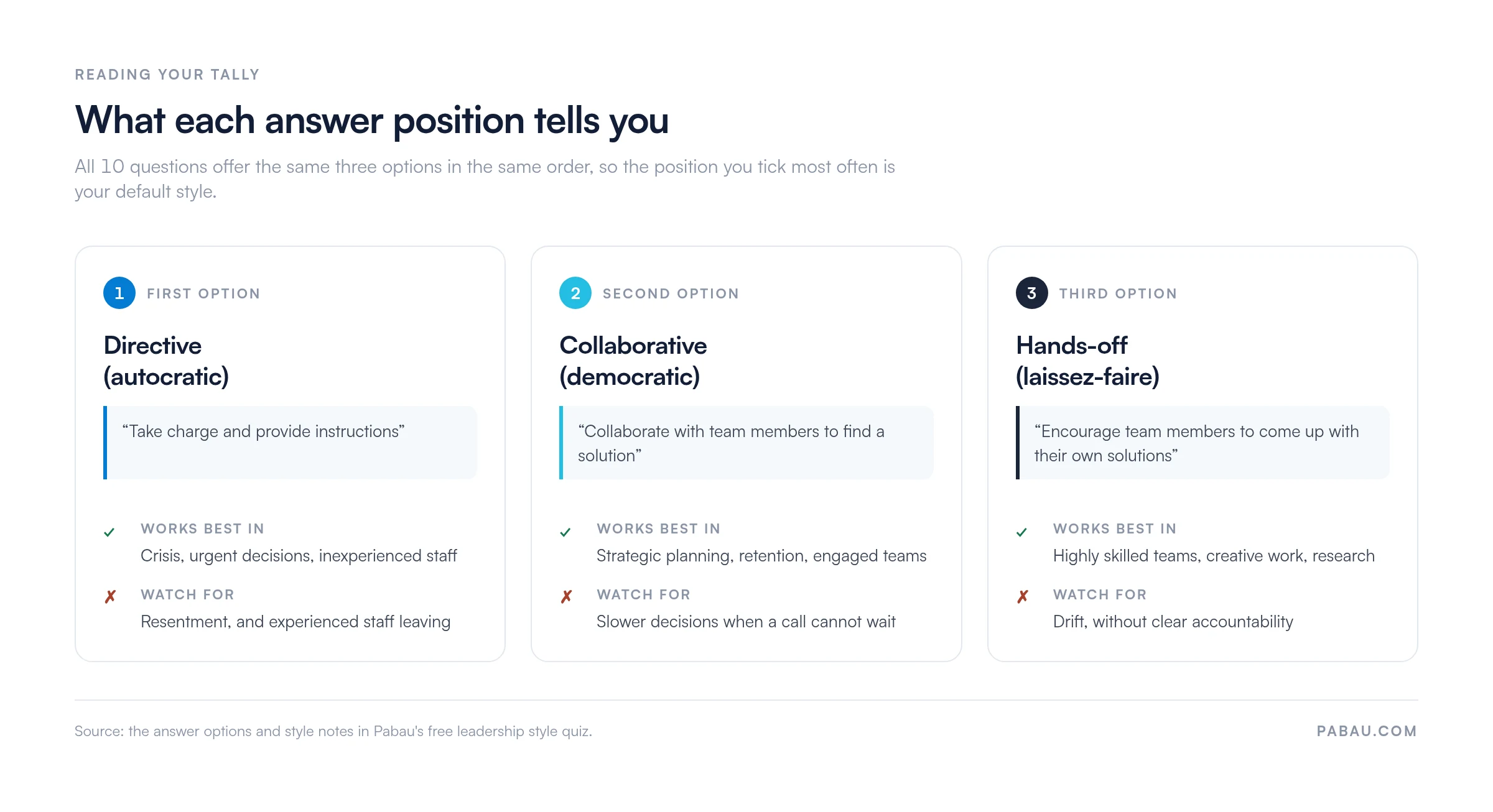
Your answers point to three leadership styles, which are directive (autocratic), collaborative (democratic), and hands-off (laissez-faire).
The form ends with a single Total Score box, so you tally your own answers and read the pattern yourself.
Leadership research describes four further styles, and this page covers all seven so you can place your result in context.
As a result, practice management software like Pabau gives a leadership style structure through clear roles, shared calendars, and team messaging.
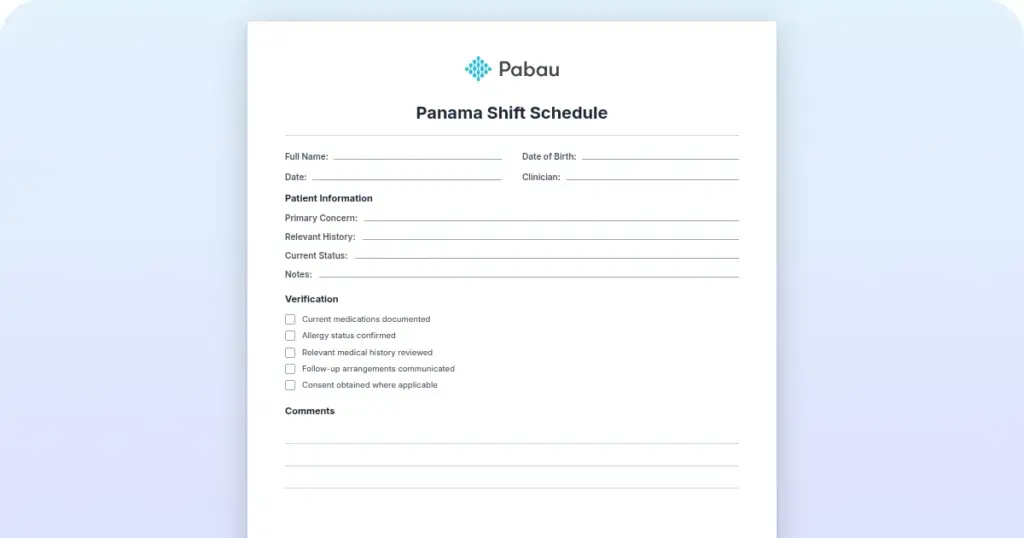
A one-page printable quiz with 10 questions about decisions, feedback, crises, goals, and meetings. Specifically, each question offers three answers, one directive, one collaborative, and one hands-off. Then print it, tick one answer per question, and tally your choices in the Total Score box.
Download templateA leadership style is easy to name in theory. In practice, though, it is harder to say what you do when the schedule slips, a room is short-staffed, and a patient is waiting. That is why a short, honest questionnaire gets you to that answer faster than another article about leadership theory.
This page gives you a free printable quiz plus the context to read your result. In fact, the quiz itself is deliberately simple, with 10 questions and three answer choices each. From there, the sections below explain what those choices mean and what to do with the pattern you see.
A leadership style quiz is a short self-assessment that shows how you tend to make decisions, direct people, and respond under pressure. Specifically, it asks you to pick between typical responses to everyday situations, rather than to rate your own skill out of five.
A personality test describes who you are. By contrast, a leadership assessment describes how you lead. As a result, that difference matters in a practice, where your default approach shapes how staff feel at work and shows up later in burnout and turnover.
The download is a single printable page with 10 questions. In each case, you get three answers and tick the one closest to what you would really do. The options always run in the same order, so the pattern is easy to count at the end.
The 10 questions cover challenges, team settings, decision making, feedback, and crisis response. They also cover goal setting, communication style, mistakes, your definition of leadership, and how you behave in meetings.
In addition to fields for your name, the date, and your occupation, the page includes a Total Score box at the bottom. There is no scoring key printed on the form, so the tally and its meaning are yours to work out.
Print the quiz, answer all 10 questions in one sitting, then count how many answers you took from each of the three positions. In other words, the largest count is your default style.
In fact, each position suits a different moment and carries its own blind spot. The three columns below set them side by side, so you can read your tally without flipping between sections.
To start, two cautions are worth stating plainly. First, the form carries no scoring key, so treat your tally as a prompt for reflection rather than a validated score. Second, it also covers three styles only, so the four other styles described below sit outside the questions.
In practice, the quiz is most useful when a team takes it together. Ask each lead to answer for themselves, then compare tallies in one meeting. After all, differences in how two managers handle the same crisis explain more friction than most staff surveys do.
In total, leadership research commonly describes seven styles. The quiz above measures three of them, and the rest are worth knowing because most practice leaders borrow from them without naming them. Ultimately, knowing where you sit is the first step toward effective team management.
In short, every style carries blind spots. Autocratic leaders move fast, but they create resentment and lose experienced staff. Similarly, democratic leaders build loyalty at the cost of slower decisions. Transformational leaders, meanwhile, inspire change, yet they often overestimate how ready the team is.
Laissez-faire leaders develop independence, but they risk drift without clear accountability. Likewise, servant leaders create psychological safety and can still struggle with hard decisions. In turn, coaching leaders develop talent over time, which costs hours you have to protect.
Meanwhile, transactional leaders drive clear results and can flatten engagement in the process. Overall, aim to notice when your default has become a liability, rather than to erase the weakness itself. Then name the approach your practice needs this quarter.
Practice leadership differs from corporate or sales management. Specifically, you balance clinical judgment, where staff expertise has to be trusted, against business accountability for budgets, compliance, and patient safety. As a result, that double duty reshapes which styles hold up.
Directive approaches work during emergency protocols, but they alienate clinicians who trained for autonomy. Meanwhile, democratic and coaching styles suit teams where staff hold specialized knowledge, from a therapy practice to a speech therapy team. Similarly, servant leadership sits naturally alongside patient-centered care.
Even so, record-keeping accountability and outcome measurement still need a transactional element for compliance. In fact, the strongest practice leaders combine all four habits. In practice, they plan democratically, take control in a crisis, coach during development, and put the patient first when a call is close.
Your style also shapes who you hire, who stays, and what energy patients pick up from the team. For example, a practice run on command and control attracts compliance-focused staff. In contrast, one run on coaching attracts clinicians who want to grow, which shows up in patient outcomes.
Your leadership style reflects your emotional intelligence. Specifically, that covers awareness of your own triggers and empathy for the constraints your staff work under. It also covers the ability to regulate your response under stress. As a result, leaders with high EI notice when a default style is backfiring and adjust.
Self-awareness is what makes the quiz worth taking, because a rushed or flattering answer only fools you. Empathy, meanwhile, shapes how you read the result, since the same behavior lands differently for a new hire and a senior clinician. In turn, regulation is what turns the result into better patient engagement.
Knowing your tally is step one. Acting on it is step two. Once you can see which of the three answer types you reached for most often, work through three questions.
Then use practice workflows and automation to hold the change in place. If you are building collaborative habits, put a structured team huddle in the calendar. If your directive streak needs softening, add one-on-one check-ins that ask how someone is doing, not only what they finished.
In practice, a leadership style only exists in how the week runs. Practice management software like Pabau carries that structure for you, so your intent reaches the team without a daily reminder from you.
For example, if your tally leans directive, shared calendars and role-based permissions make it obvious what each person owns. Similarly, if it leans collaborative, team messaging and shared notes let you gather input before a decision instead of after it.
Likewise, if it leans hands-off, automated workflows and reporting give your team room while you keep sight of the week. Either way, each version buys the same outcome. Specifically, you get fewer dropped handovers, fewer decisions that stall while people wait for you, and less of your day spent chasing status.
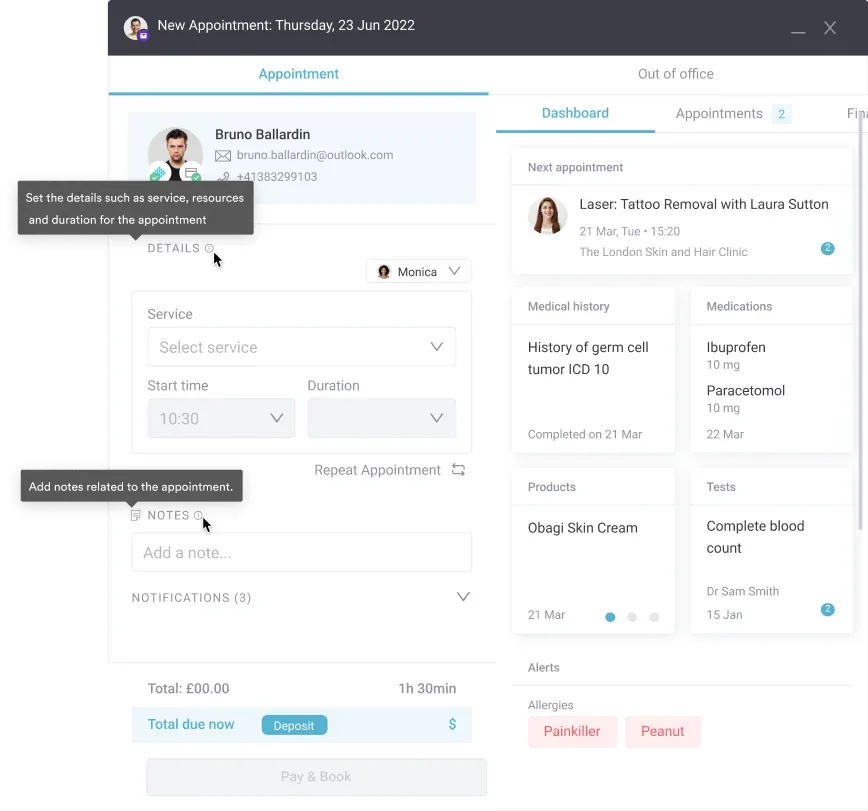

Pabau’s team management and communication tools help you apply your leadership style consistently, whether you lead through clear direction, collaboration, or trusted autonomy.

Your team already reads your leadership style in how you decide, delegate, and respond when a day goes wrong. In fact, the label you would give it matters far less than that pattern. That is why this quiz makes the pattern visible in about five minutes, using 10 questions and three plain choices.
Print it, answer it honestly, and count your three totals before you interpret the result. Then pick one behavior to change this month and tell your team what you are changing. From there, book a demo to see how Pabau turns that decision into a routine your team can rely on.

Ready to formalize your next review? Annual review template comes with sample comments, SMART goal examples, and ready-to-use review questions.
Ready to turn a weakness into a plan? Performance improvement plan gives you a documented structure for goals, support, and review dates.
Comparing tallies as a leadership team? Meeting notes template keeps the decisions and the owners on the record after the discussion ends.
Wondering when directive leadership earns its place? Crisis communication plan sets out who speaks and who decides when a practice hits an incident.
Looking at the wider operating picture? Medical practice operations covers the systems your leadership style has to run through day to day.
Leadership research commonly names seven styles. Specifically, they are autocratic, democratic, transformational, laissez-faire, servant, coaching, and transactional. The free quiz on this page measures three of them, namely the autocratic, democratic, and laissez-faire styles.
Print the quiz above and answer its 10 questions. Specifically, every question offers three options, one directive, one collaborative, and one hands-off. Then count how many of each you chose, and the largest count shows your default style.
Yes. Your natural default tends to stay consistent, but you can develop other styles through deliberate practice, feedback, and mentoring. In fact, many experienced leaders shift their approach as the practice grows. Overall, the quiz reflects your current tendency, not a fixed personality.
There is no single best style. Instead, effective practice leaders blend approaches, planning democratically and taking control in a crisis. They also coach during development, and put the patient first when a call is close.
Yes. The quiz above downloads as a one-page PDF at no cost, and no account is needed. In addition, it holds 10 questions and a Total Score box, so you print it and fill it in by hand.