Getting along with siblings worksheet
A getting along with siblings worksheet is a printable that helps children and t...

1
Last Updated: Oct 23, 2026

A personal wellness plan is a written record of a patient’s health goals and the physical, mental, emotional, and lifestyle actions that support them.
This template is a blank three-page clinical form, so you complete it with the patient rather than hand it over as a workbook.
It captures patient details, a baseline health assessment of weight, height, BMI, and blood pressure, then one short-term and one long-term goal.
Four planning sections cover physical health, mental health, emotional well-being, and lifestyle, and a progress tracking section sets the follow-up.
Practice management software like Pabau turns the same form into a digital version that files itself against the client record.
A blank three-page clinical form for building a wellness plan with a patient. It covers patient details, a baseline health assessment, short-term and long-term goals, physical, mental, emotional and lifestyle plans, progress tracking, and a signature line.
Download templateA personal wellness plan is a written record of a patient’s health goals and the actions you agreed on to reach them. Its job is to outlive the appointment. Goals discussed out loud fade within a few weeks, but goals written down come back to the next review with a date attached.
The template here is the clinical version of that document. It runs to three blank pages you complete with the patient, and it closes with a signature line. That makes it a record of an agreement rather than a workbook to take home.
The sections below follow the form itself, from the baseline numbers on page one to the review date at the end.
A personal wellness plan is a written document that sets out a person’s health goals and the actions behind them.
In a practice it holds a baseline assessment, the agreed goals, the planned actions, and a review date. So it works as a clinical record, and the review has something concrete to check against.
The scope reaches well past diet and exercise. It covers how a person sleeps, moves, thinks, connects with others, and handles stress.
The World Health Organization constitution defines health as complete physical, mental, and social well-being, not merely the absence of disease. Writing that down is what makes it reviewable at the next appointment.
For practitioners in wellness and integrative practices, the plan doubles as clinical documentation. It shows what the patient asked for, and that your recommendations were built around it. The next visit then starts from something concrete instead of a blank page.
The download runs to three pages and nothing is pre-filled, so it is ready to complete in front of a patient. Here is what each section asks for.
The form stays short on purpose. It records what you and the patient agreed, so the reflective work happens in conversation or on a separate sheet.
Two sibling templates cover that ground. The wellness wheel worksheet handles self-rating, and the goal setting worksheets break SMART goals down further.
The form gives you four planning boxes, but the conversation behind them covers seven dimensions.
This framework is widely used in healthcare and wellness coaching, and it keeps the plan from collapsing into diet and exercise.
Each dimension has to land in one of the four boxes on the form. The map below shows which goes where, and it is worth reading before you write anything down.
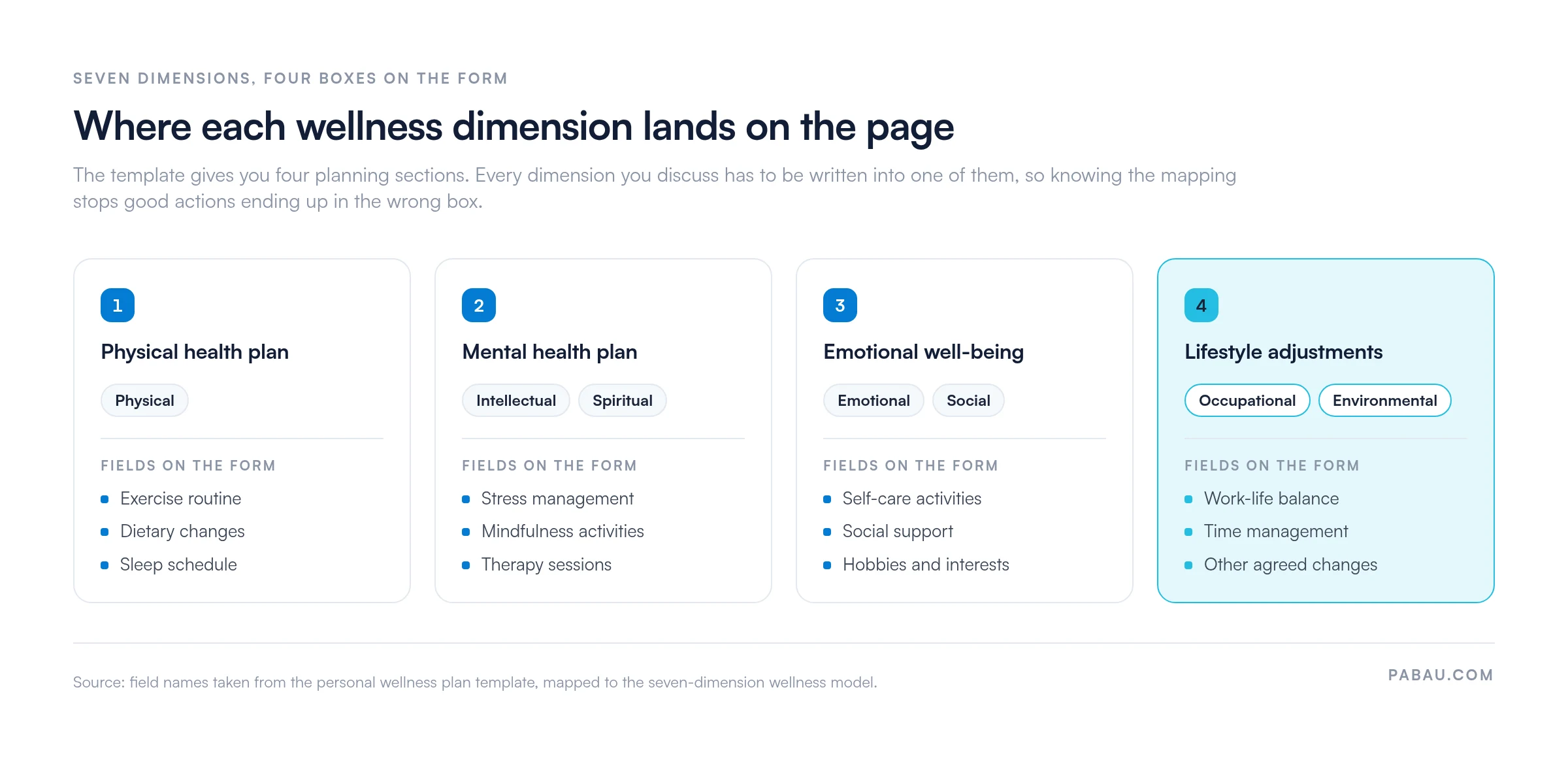
That mapping matters most for the dimensions with no box of their own. If a patient’s weakest area is occupational, the action still belongs under work-life balance or time management. Write it anywhere else and the review will not find it.
The two goal boxes are small, so the thinking has to happen before you reach them. A short self-assessment shows where the patient is strong and which dimension deserves attention first.
Practitioners who ask for a self-rating first tend to write better goals. A plan built on assumptions rarely survives the first difficult week.
With the self-assessment done, the form itself moves quickly. Check three things before you start.
Fill in weight, height, BMI, and blood pressure first. These four numbers give you something objective to recheck at the review, and they often reframe the conversation on their own.
Use the free-text box for anything else you measured, plus conditions, medications, and allergies. Reference bands differ for younger patients, so keep a pediatric vital signs chart to hand.
You get two boxes, so choose carefully. Use the short-term box for the next 8 to 12 weeks and the long-term box for the year ahead.
“Exercise more” and “feel happier” cannot be tracked, so write both as SMART goals. That means specific, measurable, achievable, relevant, and time-bound.
The four planning sections are where a goal becomes a routine. Each one answers the same question. What is this patient doing next week?
A goal of walking 30 minutes five days a week becomes a list in the exercise routine box. That list names a Monday morning walk, a Wednesday lunchtime walk, and a Saturday walk with a friend.
“Mindfulness” on its own is not a plan. “Ten minutes of breathing before the school run” is one. Personalized treatment planning works the same way, turning goals into visits, home exercises, and diet changes the client can carry out.
Every plan meets a busy week, an illness, or a stretch of low motivation. The form has no obstacle box, so write the likely barrier and its workaround into the lifestyle adjustments section. “Too tired to exercise after work” becomes “walk before work, with a friend for accountability”. A wellness practice offering repeat treatments needs the last visit detail available at the next booking.
Doing this in the room separates a plan that survives from one that quietly stops. Patient compliance strategies rely on the same move, and practitioners who solve barriers with the patient see better follow-through.
Use the progress tracking section to fix the next review date before the patient leaves. Note whether they will keep a wellness journal, then list the metrics you plan to recheck.
Complete the signature line with your name and the date. That signature turns a conversation into an agreement you can both refer back to.
Stress, anxiety, low mood, and unprocessed trauma undo good physical habits faster than a missed workout ever does. That is why the template gives mental health and emotional well-being separate sections.
Stress management, mindfulness activities, and therapy sessions sit in the mental health plan. Self-care, social support, and hobbies sit under emotional well-being, which is where connection and rest belong. Between reviews, our wellness worksheets let patients rate mood, stress, and sleep from 1 to 10, so you can see what shifted.
In a mental health practice, the plan becomes a shared document between client and therapist, reviewed each session. Practitioners who write session notes to a set structure, such as a PIRP note, find the review quicker. The goals and the notes already line up.
The SAMHSA National Helpline is a free, confidential service, open 24 hours a day, for anyone who needs mental health support now.
The progress tracking section exists to stop that happening. Four habits keep it working.
Record what changed as well, including energy, sleep, mood, weight, and any lab results. A progress note template keeps that history in a consistent shape. A colleague picking the patient up can then see what worked and what did not.
Plenty of wellness plans never get signed, and they read as advice. The signature records that the plan was agreed together. That is what a colleague needs to see when they pick the patient up months later.
Functional medicine practitioners, integrative health practices, weight loss programs, mental health providers, and fitness coaches all work from the same document.
Completing it with the client signals partnership too. The client feels heard, and you open the next appointment with an agenda instead of a blank page.
A printed plan works until the patient loses it or the next practitioner cannot find it. Practices then end up with two versions, one in a folder and one half-remembered in the notes. The review starts with reconstruction instead of progress.
Practice management software like Pabau removes that step. You can rebuild this template as a digital form the patient completes before the appointment.
Every answer files straight to the client record. Baseline weight, height, BMI, and blood pressure then sit beside the treatment notes and the booking history.
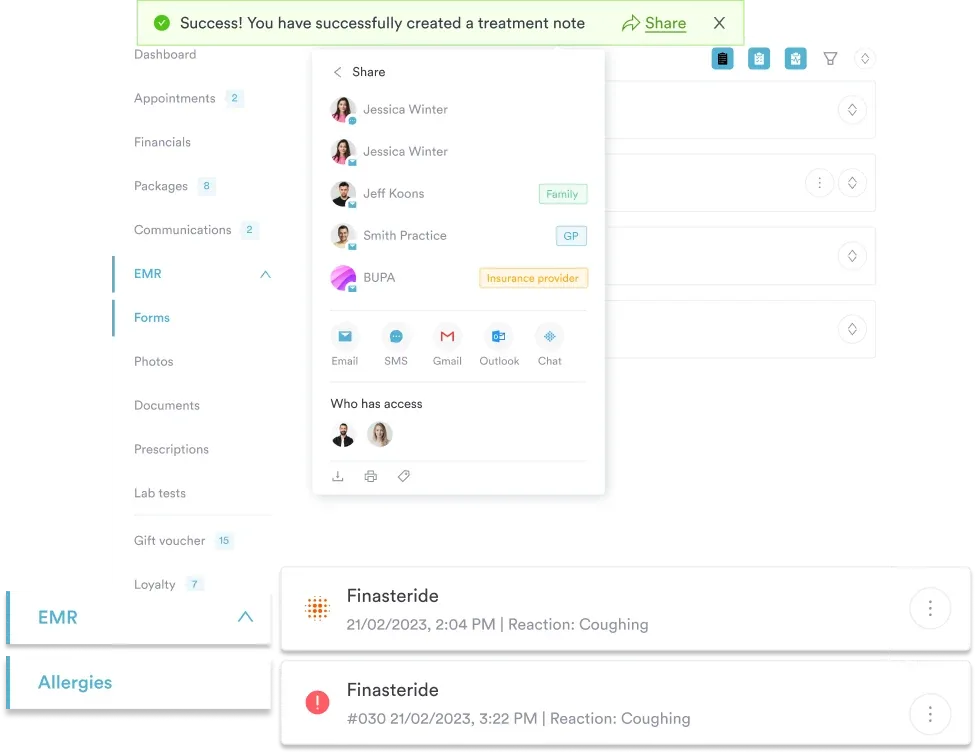
The follow-up then looks after itself. You book the review appointment from the same screen, and automated reminders go out before it. Clients can check their own plan through the client portal instead of emailing to ask.
A digital-first longevity clinic made the same move, and now runs its forms, charting, and patient records in one place.

Pabau turns your wellness plan into a digital form that files itself against the client record, then books and reminds the follow-up review automatically. Nothing gets retyped and nothing gets chased.

This template earns its place by being short. Three blank pages, completed in front of the patient and signed at the end, do more than a twenty-page workbook. The workbook goes home and rarely comes back.
The trade-off is that it assumes a practitioner in the room. Scoring, reflection, and weekly detail happen in conversation or on a separate sheet, never in the form. Print it, treat it as the record of what you agreed, and hold the review date as the part that cannot slip.
Once you are running these plans across a full client list, the admin is what breaks first. Book a demo to see how Pabau keeps each wellness plan, its baseline numbers, and its review appointment on one client record.

Offering reflexology as part of the plan? foot reflexology chart lists six common foot trigger points and their linked symptoms for quick reference during sessions.
Adding an exfoliation treatment to the plan? full body exfoliation aftercare guide covers post-treatment steps, recovery timeline, product recommendations, and contraindication flags for clinic teams.
Want a single planner for tracking it all? health and wellness planner combines habit tracking, nutrition logging, fitness progress, and sleep monitoring in one planner.
Asked clients to keep a journal? Wellness journal gives them a structure for the entries between reviews.
Choosing software to run this on? Wellness clinic software compares the platforms that store plans, forms, and follow-ups together.
No. A care plan is built around a diagnosis and the treatment for it, so it manages a condition. A wellness plan starts from what the patient wants to change, and it covers prevention, habits, and quality of life. Many patients hold both, and the two should agree on sleep, activity, and diet.
No, it is not a contract, and it commits the patient to nothing enforceable. The signature records that you discussed the plan and agreed it together. That still counts, because a signed and dated plan sits in the record as evidence of shared decision-making if your notes are ever reviewed.
Treat it like any other clinical record. In the US that means HIPAA-compliant storage with access controls, covered by the same consent as the rest of the chart. Loose paper copies are the weak point, so scan or rebuild the form inside your records system rather than leaving it in a drawer.
Any practitioner working inside their own scope, including physicians, nurses, dietitians, physical therapists, and health coaches. The limits sit on the recommendations, not on the document. Exercise prescription after a cardiac event, or any change to medication, belongs to the clinician who owns that part of the patient’s care.