Newborn feeding schedule: How much and how often by week
A newborn feeding schedule is a framework for how often and how much a baby eats...

Last Updated: Oct 13, 2026
A private practice nurse practitioner (NP) can open their own practice in most US states, and the state’s practice authority tier decides how soon.
The American Association of Nurse Practitioners (AANP) lists 27 states plus DC as full practice, where an established NP needs no physician agreement. Twelve states are reduced practice and 11 are restricted.
The tier is only half the answer. Nine full practice states still make a new NP log up to 3,600 hours, or up to three years, before going solo. Some restricted states, like Florida and Virginia, offer an hours-based route out. We call that timeline the Practice Authority Clock, and we’ve mapped it state by state below.
Demand is on your side. The Bureau of Labor Statistics projects nurse practitioner jobs will grow 41% between 2025 and 2035, one of the fastest rates of any occupation. This guide covers what a nurse in private practice has to handle: state rules, the business plan, startup costs, credentialing, and daily operations.

A private practice nurse practitioner can work without a physician agreement in 27 states plus DC, once any transition period is complete.
The Practice Authority Clock ranges from no transition period in 17 full practice states to 6,240 supervised hours in Arkansas and Oklahoma.
Florida, California, Virginia and Illinois aren’t full practice states, but each offers an hours-based route to independent practice.
Your NPI, EIN and Medicare enrollment are free and DEA registration costs $888, so lease, insurance and credentialing runway drive your startup costs.
Payer credentialing typically takes two to six months per insurer, so submit every application at once, well before opening day.
Yes, nurse practitioners can own a private practice in all 27 full practice states and DC, and in most other states with a physician agreement.
So can a nurse practitioner open their own practice without a doctor? In a full practice state, yes, once you’ve cleared any transition period. Can a nurse practitioner have a private practice in a reduced or restricted state? Yes, but a collaborating or supervising physician has to be part of it.
Can a nurse practitioner open their own clinic, like a med spa, instead of a primary care office? Yes, under the same license, entity and agreement rules as any other practice. The AANP sorts every state into one of three tiers:
Those tiers describe where a state starts. Several restricted states now let an experienced NP earn independence. Check the clock for your state before you sign a lease or recruit a collaborating physician. That check is the first step in how to open your own clinic as a nurse practitioner, and it decides the rest of your timeline.
Twenty-seven states plus DC allow NPs to practice independently, though nine of those states require a supervised transition period first.
The Practice Authority Clock below pairs each state’s AANP tier with the hours or years to log first. After that, you can practice, or prescribe, without a physician agreement. We checked each threshold against the state statute or board of nursing in September 2026.
| State | AANP tier (May 2026) | Practice Authority Clock | What it unlocks |
|---|---|---|---|
| Colorado | Full | 750 hours of prescribing mentorship | Full prescriptive authority |
| South Dakota | Full | 1,040 hours under a collaborative agreement | Solo practice |
| Maryland | Full | 18 months with a mentor, for first-time NPs only | Solo practice |
| Nebraska | Full | 2,000 hours under a transition-to-practice agreement | Solo practice |
| Nevada | Full | 2 years or 2,000 hours | Schedule II prescribing without a physician protocol |
| Connecticut | Full | 3 years and 2,000 hours in collaboration | Solo practice |
| Massachusetts | Full | 2 years of supervised practice | Independent prescribing |
| Vermont | Full | 24 months and 2,400 hours | Solo practice |
| New York | Full | 3,600 hours | Practice without a written agreement, currently through July 1, 2030 |
| Florida | Restricted | 3,000 supervised hours in the past 5 years, plus graduate pharmacology and diagnosis coursework | Autonomous practice in primary care only |
| Illinois | Reduced | 4,000 clinical hours plus 250 hours of continuing education | Full practice authority |
| California | Restricted | 3 years or 4,600 hours as a 103 NP, then 3 more years | 104 NP status, which allows practice outside a group setting |
| Virginia | Restricted | 3 years full-time, or 5,400 hours | Autonomous practice designation |
| Arkansas | Reduced | 6,240 hours under a collaborative agreement | Application for full independent practice |
| Oklahoma | Restricted | 6,240 hours of supervised prescribing | Independent prescriptive authority |
| Texas | Restricted | No clock | A physician agreement for as long as you prescribe |
| 17 states plus DC | Full | None | Solo practice from licensure |
| Maine | Full | 24-month rule repealed in February 2026 | Board of Nursing is setting a mentorship standard |
The 17 no-clock states are Alaska, Arizona, Delaware, Hawaii, Idaho, Iowa, Kansas, Minnesota and Montana. The rest are New Hampshire, New Mexico, North Dakota, Oregon, Rhode Island, Utah, Washington and Wyoming. Plotted on one scale, the spread between the fastest and slowest routes to independence is easier to see:
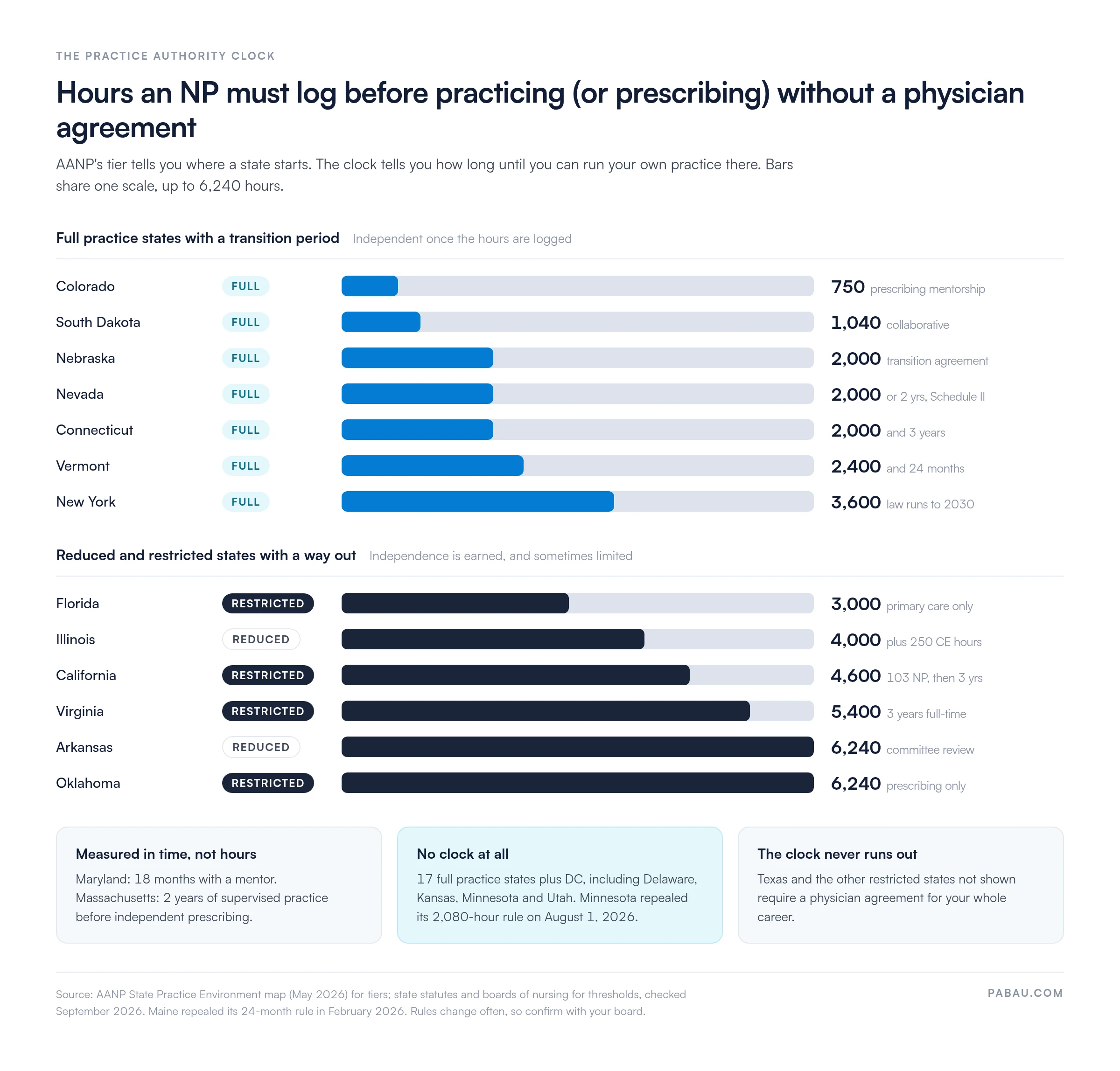
Three patterns stand out once you read the clock this way:
Hours logged in another state usually count toward the clock, but each board sets its own proof rules. Keep signed attestations from every collaborating physician as you go, since most boards ask for them when you apply.
Once you know where your state sits on the clock, four legal pieces decide your opening date. The four are scope of practice, licenses, your business entity, and any physician agreement.
Your state’s scope of practice laws set what you can do without physician oversight. The Practice Authority Clock above shows how long any transition lasts. Read the statute itself, not a summary, because the details matter. Nevada’s clock only covers Schedule II prescribing, for example, and Florida’s autonomy stops at primary care.
Your state Board of Nursing is the final word on current rules. If your plan sits near a boundary, like aesthetics or controlled substances, an hour with a healthcare attorney costs far less than a board complaint.
At a minimum, you’ll need three credentials before you can see and bill patients:
Some states add their own layer, such as a prescriptive authority certificate or a filed physician agreement. Your Board of Nursing lists what applies before you can prescribe.
Can a nurse practitioner own their own practice as the only owner? In most states, yes, and the entity you choose shapes your taxes and liability. Here’s what to handle on the business side:
You need a collaborating or supervising physician in every reduced and restricted state, and in full practice states until your transition hours are complete.
That’s the practical answer to whether a nurse practitioner can open their own practice without a doctor. In Texas, for example, NPs need a prescriptive authority agreement under Texas Occupations Code §157.0512. The agreement must list the drugs you can prescribe, a consultation plan and an emergency plan.
Even in full practice states, collaboration can come back for specific services. Controlled substance protocols, hospital privileges and some payer contracts may still ask for a named physician. Sign the agreement before you open, and put the fee, chart review schedule and termination notice in writing.
A nurse practitioner business plan sets out your services, patients, costs and break-even point, and lenders expect one before approving startup financing.
A business plan for a nurse practitioner also forces decisions early. Your state’s clock, for example, tells you whether the plan needs a collaborating physician’s fee in year one. For a private practice NP, it’s also the document partners and future hires read to understand where the practice is going.
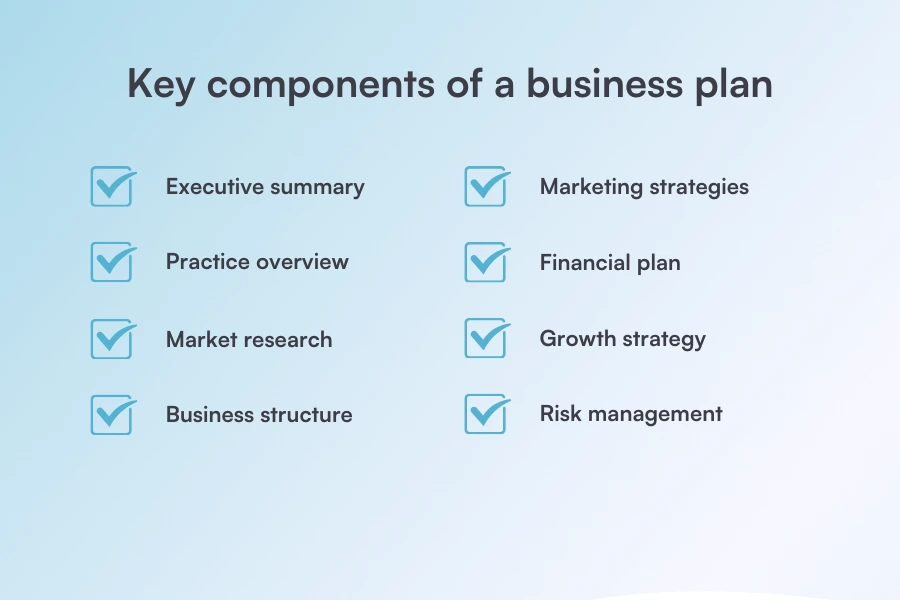
A complete nurse practitioner clinic business plan works through eight building blocks:
The practice overview is where nurse practitioner business ideas get tested. A cash-pay model like weight management, aesthetics or direct primary care skips most payer credentialing. An insurance-based family practice has broader demand but a slower start.
Setting up covers four decisions: where you see patients, how the space is equipped, which software runs it, and who you hire.
Your first big decision is how you’ll see patients: in an office, by telehealth, or both. The answer depends on your specialty, your patients, and your state’s telehealth rules.
A physical office needs three zones that work together:
Buy equipment for the services in your business plan, not for the ones you might add later. Exam tables and diagnostic tools come first. NPs focused on geriatric or rehab-adjacent care might also stock supplies for structured movement programs, such as seated exercises for patients with limited mobility.
Choose an EHR for private practice that also handles scheduling, billing and telehealth, meets HIPAA requirements, and supports the insurers you plan to credential with.
Check four points before you sign a contract:
You don’t have to buy a stand-alone EMR and a separate practice management tool. Pabau, the practice management platform we build, combines clinical records with scheduling, payments and patient communication. Pabau’s pricing scales with users and locations, and every subscription includes every feature.
Many NP practices open with one front-desk hire, or none, and add a medical assistant once the schedule fills. Recruit for your practice’s values and patient care standards as much as for experience.
Train every hire on your intake process, your software and your escalation rules before the first patient arrives. Short refreshers every quarter keep the patient experience consistent as the team grows.
The federal filings are cheap, and the expensive parts of opening are your space, insurance and the months you wait for payers to pay. Plan cash for all three before you sign a lease.
Medical practice startup costs split into fixed filing fees you can price today and quote-based costs set by your state, specialty and lease.
| Cost item | What it costs | Where the figure comes from |
|---|---|---|
| NPI number | $0 | CMS NPPES |
| EIN | $0 | IRS |
| Medicare enrollment (CMS-855I) | $0 application fee for NPs | CMS |
| DEA registration | $888 per three-year term | DEA fee schedule |
| LLC or PLLC formation | $125 in Florida, $300 in Texas | State filing offices |
| Malpractice insurance | Quote-based | Varies by specialty, state and claims history |
| Practice management software and EHR | Monthly subscription | Scales with users and locations |
| Space, build-out and equipment | The widest range of any line | Set by your lease and specialty |
| Operating runway | Two to six months of expenses | Matches the typical credentialing wait below |
The CMS enrollment guide confirms that non-physician practitioners pay no Medicare application fee. The DEA charges practitioners $888 for each three-year registration. Together, the mandatory federal filings cost less than $900.
That’s why the runway line matters most. An NP private practice that bills insurance pays rent from day one but may not collect from a payer for months. A cash-pay practice can open with a smaller cushion.
Separate your business and personal finances before the first payment comes in:
Clean books keep you compliant with tax law and show you cash flow week by week. They also make tax season far less painful.
If you accept insurance, billing and coding become a daily task. Payers have strict claim rules, and small mistakes lead to delays, denials or lost revenue.
Insurance credentialing typically takes two to six months per payer for an NP, and it stretches toward a year when applications stall.
That range explains why published estimates disagree, with some quoting 60 to 180 days and others almost a year. Medicare contractors typically quote about 45 to 60 days for an online PECOS application. Commercial plans that follow NCQA standards must decide using verifications no older than 120 days, a limit that took effect in July 2025.
Five factors decide where you land in that range:
Once you’re approved, negotiate reimbursement rates and track every renewal date. If you’d rather skip payers entirely, a direct-pay or membership model is worth modeling in your business plan.
Daily operations run on four systems: patient records, your software stack, written admin protocols and telehealth. Some owners hand the business side to a management service organization (MSO) so they can focus on patient care.
A patient management system holds each patient’s records, appointment history and signed documents, like a patient agreement, in one place. One record means fewer transcription errors and less time spent searching between appointments.
That holds whether you run a solo practice or manage a team of five. The front desk, the biller and the clinician all work from the same file.
A practice run by one NP depends on software more than a large group does, because nobody else is covering the admin. Three systems matter most:
These don’t need to be three separate systems that you connect yourself. An all-in-one platform keeps the appointment, the note and the invoice attached to the same patient.
Write standard operating procedures for the tasks that repeat every day:
Written protocols let a new hire cover the front desk on day two. When admin tasks pile up, a simple prioritization tool like an Eisenhower matrix helps you decide what needs attention today and what can wait.
A telehealth system lets you:
Whether telehealth is your whole model or an add-on, use a HIPAA-compliant platform that writes the visit into the same patient record.
Once the license and legal paperwork for your nurse practitioner private practice are sorted, you’re still running a small business. Most NPs didn’t train to also be a scheduler, biller and IT department, and a solo practice rarely has anyone else to do it.
Pabau brings scheduling, patient records, billing and telehealth into one system. A booking, an invoice and a treatment note for the same patient are one click apart. That holds whether you run a solo primary care practice or add medical aesthetics alongside it.
When we onboard a new practice, we set up booking rules, intake forms and reminders before the first appointment goes in the calendar. Changing them later means re-sending forms to every patient already booked. After setup, appointment confirmations, balance reminders and pre-visit paperwork go out automatically, so you’re not doing them between patients or after hours.

Pabau brings scheduling, patient records, billing and telehealth into one platform. You spend less time on admin and more time with patients as your practice grows.

Opening a practice as a nurse practitioner is as much a timing decision as a clinical one. Your state’s clock sets the earliest date you can practice alone. Credentialing sets the earliest date an insurer pays you.
Work backward from both dates. Start payer applications while you finish your transition hours, and budget the gap as runway rather than hoping it closes fast. The private practice nurse practitioner who plans for the wait opens on time.
The trade-off worth remembering is that a slower clock state isn’t a dead end. Florida, Virginia and California all have routes out. Book a demo to see how Pabau runs scheduling, records, billing and telehealth from one system as your NP practice grows.

Weighing whether independence is worth it? Why UK doctors are choosing private practice looks at how going solo changes a provider’s income, schedule and patient relationships.
Planning a membership model instead of billing insurance? What is concierge medicine? explains how retainer-based practices price, staff and run their patient panels.
Comparing systems before you sign a contract? Primary care software solutions compares seven platforms on charting, labs, billing and pricing.
Need a checklist for preventive care visits? Annual physical exam checklist by age covers medical history review, vital signs, lab ordering, and preventive screening by age.
Yes, in every full practice state once any transition hours are complete. In reduced or restricted states, you can still own a practice, but you’ll need a collaborating or supervising physician.
Yes, in 27 states plus DC, which AANP classifies as full practice. Nine of those states require a transition period first, from 1,040 hours in South Dakota to 3,600 hours in New York. Florida, California, Virginia, Illinois, Arkansas and Oklahoma offer hours-based routes out of physician oversight.
Absolutely. Nurse practitioners own and run practices across the country, from family primary care to med spas. The key is picking the right business structure, such as an LLC or PLLC. You also need to meet your state’s licensing and collaboration rules before you open the doors.
Choose a practice management platform that keeps charting, scheduling, billing and telehealth in one patient record, with HIPAA safeguards and onboarding support. Pabau, the practice platform we build, covers all four, and every subscription includes every feature. Compare at least two vendors on how they handle your payer mix before you sign.
No. Texas is a restricted practice state, so NPs need a prescriptive authority agreement with a delegating physician for as long as they prescribe. Unlike Florida or Virginia, Texas has no hours-based route to independence. You can still run your own practice, as long as that agreement stays in place.
No national survey tracks what NP practice owners earn, so treat any single figure with caution. The benchmark is the BLS median for all nurse practitioners, $132,300 in May 2025. Owners keep what’s left after rent, staff, insurance and software, so first-year income is often lower. Patient volume, payer rates and overhead decide whether you beat that median.
Not nationally. The BLS projects nurse practitioner employment will grow 41% from 2025 to 2035, adding about 137,800 jobs. Competition for employed roles is tighter in some metro areas, so check local demand in your business plan’s market research.