Head to toe assessment cheat sheet: Printable nursing guide
A head to toe assessment cheat sheet gives you one fixed order at the bedside, s...

2
Last Updated: Oct 23, 2026
A psychosis spectrum test is a short clinical screening tool that checks for hallucinations, delusions, disorganized thinking, negative symptoms, and functional decline. It tells a clinician whether someone needs a full psychiatric assessment, not which diagnosis they have.
Schizophrenia alone affects about 1 in 300 people worldwide, according to the World Health Organization. Many of them reach care only after a long delay. A well-chosen screen shortens that delay and steers people toward the right service.
Below, we cover the five domains these tools measure, the conditions on the spectrum, how clinicians act on results, and where the tests fall short.

A psychosis spectrum test is a screening tool, not a diagnostic instrument. It flags potential symptoms for further clinical assessment.
The test measures five domains: positive symptoms (hallucinations, delusions), negative symptoms (withdrawal, flat affect), disorganized thinking, cognitive difficulties, and functional decline.
Validated instruments include the CAPE, PRIME Screen, and SIPS. Results must always be interpreted by a qualified clinician.
Early screening during the prodromal phase can shorten the time between symptom onset and first treatment, which shapes long-term outcomes.
A psychosis spectrum test looks for the symptoms and functional changes that point to a psychotic disorder, or a rising risk of one. It does not produce a diagnosis.
Instead, it builds a structured picture of how many domains are affected and how strongly. The assessing clinician then uses that picture to decide whether further psychiatric evaluation is warranted.
The word “spectrum” matters here, because psychosis is not a single condition. Under the DSM-5-TR (American Psychiatric Association), schizophrenia spectrum and other psychotic disorders span several diagnoses.
They share core features but differ in duration, severity, and the mood or cognitive symptoms that come with them. A good screen picks up symptoms across this whole range, not only at the most severe end.
Most validated instruments assess five core areas, summarized in the table below.
The psychosis spectrum is the full range of diagnoses in which psychotic symptoms are a core or defining feature.
Psychosis itself is not a diagnosis. It is a symptom cluster of hallucinations, delusions, and disorganized thinking that blurs the line between inner experience and outside reality.
The WHO’s ICD-11 and the DSM-5-TR both group psychotic disorders along a spectrum. In clinical practice, the boundaries between conditions are often less clear-cut than their labels suggest.
The major conditions on that spectrum include:
Duration does much of the sorting between the first three diagnoses on that list, as the chart below shows.
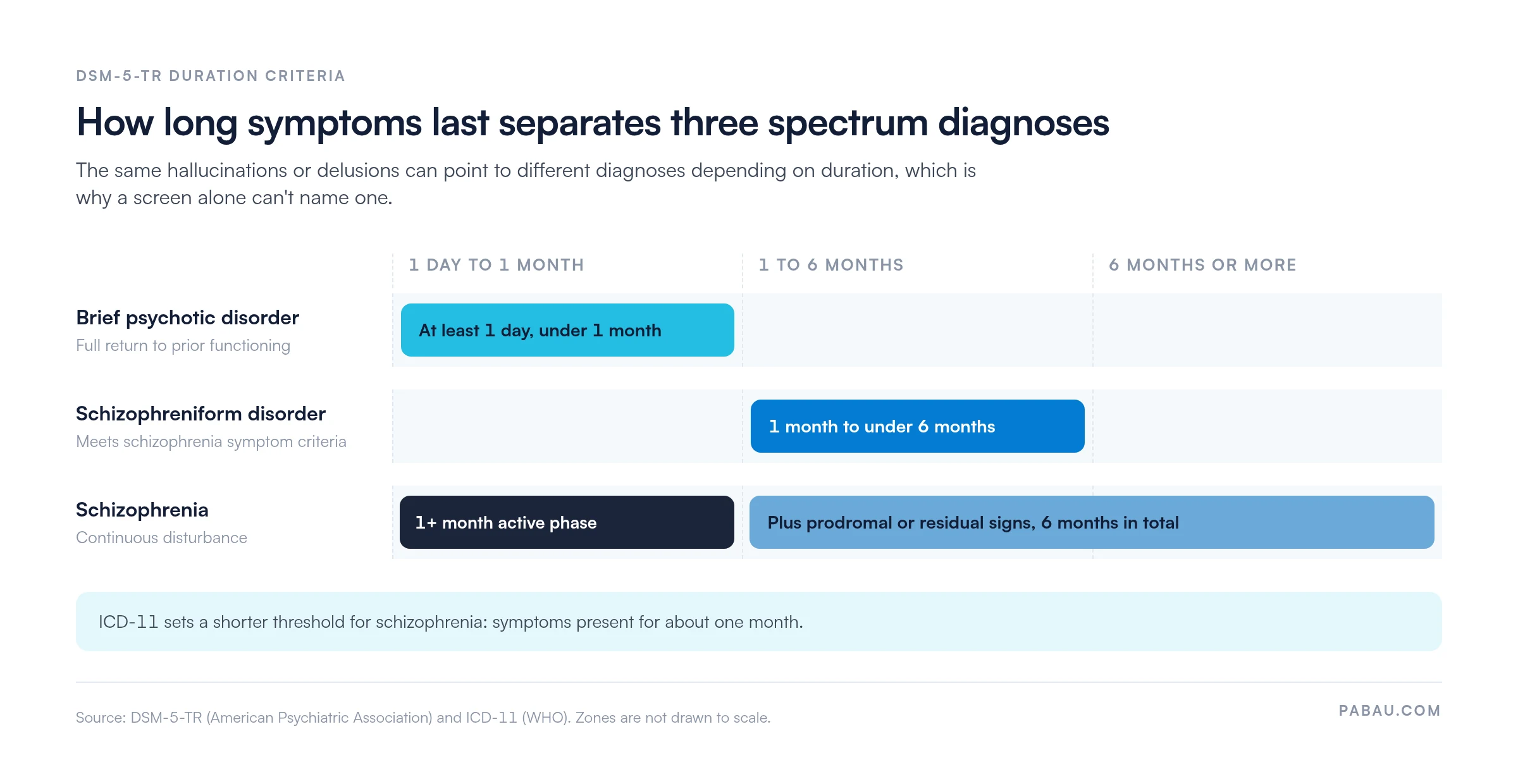
A psychosis spectrum test scores each of the five domains in the table above. Knowing how each one shows up helps clinicians read a positive screen correctly.
Positive symptoms are additions to normal experience: perceptions or beliefs that aren’t rooted in shared reality.
Auditory hallucinations, meaning voices that others can’t hear, are the most common. Visual hallucinations, tactile sensations, and olfactory disturbances also occur. Delusions range from persecutory beliefs (“someone is following me”) to referential thinking (“that news broadcast was sending me a message”) to grandiose convictions.
Screening items for positive symptoms ask how often respondents have had unusual perceptions or strongly held beliefs that others disagree with. Both frequency and distress are scored. Isolated, low-frequency experiences without distress carry different clinical weight than persistent, distressing ones.
Negative symptoms are subtractions from normal function. They are often more disabling than positive symptoms and much harder to recognize. To untrained observers, they can look like depression, laziness, or introversion.
The core negative symptoms are:
Instruments such as the CAPE-42 capture negative symptoms through items about feeling emotionally numb, struggling to speak, or losing interest in activities. High negative-symptom scores, combined with a declining functioning history, can be as clinically significant as high positive-symptom scores.
Disorganized thinking shows up mostly in how a person talks. Replies drift off topic, ideas connect loosely, or the reasoning stops making sense to the listener. Screening items ask whether thoughts feel jumbled or hard to control, and whether others struggle to follow what the person says. Reports from family members can add detail that a self-report misses.
Cognitive impairment in psychosis spectrum disorders typically affects working memory, processing speed, and sustained attention.
These deficits are often present before the first psychotic episode, which makes them useful early indicators on a screen. A person may report trouble concentrating in conversations, difficulty following complex instructions, or a sense that their thinking has “slowed down.”
Functional decline is where the other four domains show up in daily life. Picture a student who starts missing lectures, a professional who stops managing basic self-care, or a sociable adult who withdraws from family. These patterns often come months or years before anyone presents to psychiatric services.
One of the most valuable uses of a psychosis spectrum test is spotting the prodromal phase. This is the period of attenuated, sub-threshold symptoms that often comes months or years before a first full psychotic episode.
Finding it early is the goal of Early Intervention in Psychosis (EIP) programs. These run across NHS services in the UK and through EPINET-affiliated programs in the US. Our guide to the 5 stages of psychosis explains where the prodrome sits in the wider course of illness.
Prodromal warning signs are easy to miss in isolation. Taken together on a screening tool, a pattern emerges. Common early indicators include:
The attenuated psychosis syndrome describes exactly this state, and the DSM-5-TR lists it as a condition for further study. A positive screen in someone with these sub-threshold symptoms should prompt referral to a specialist early intervention service. Watching and waiting is the wrong response.
In first-episode psychosis, the time from symptom onset to first treatment averages one to two years in many health systems. Better early screening shortens that delay. That is the strongest argument for making it a routine part of mental health assessment.
A psychosis spectrum test is usually given at an intake or assessment appointment. It typically follows a referral that raises concerns about psychosis, unusual beliefs, or perceptual experiences. The workflow generally runs in five steps:
Documented screening results become a key part of the patient record. A psychiatric evaluation template captures the screening data alongside the clinical reasoning that follows it, so the next clinician sees both.
Knowing the limits of a psychosis spectrum test matters as much as knowing what it measures. These boundaries apply whichever validated instrument you use.
It cannot diagnose. A screening test can show that a person’s symptom profile warrants further assessment. It cannot assign a DSM-5-TR or ICD-11 diagnosis. That requires a full evaluation by a qualified psychiatrist or psychologist. They combine the screening result with history, a mental status examination, and physical investigation where indicated.
It cannot rule out other causes. Many conditions produce psychosis-like symptoms without being primary psychotic disorders. These include bipolar disorder or major depression with psychotic features, autoimmune encephalitis, temporal lobe epilepsy, and substance-induced states.
Cannabis deserves special attention, especially in adolescents. A 2016 study in the American Journal of Psychiatry followed 1,009 teenage boys from age 13 to 18. Each year of regular cannabis use raised their later odds of subclinical paranoia and hallucinations. A screening tool cannot separate cannabis-induced symptoms from primary psychosis without clinical context.
It is not a severity measure. A positive screen does not show how severe the disorder is or predict its course. Two people with identical total scores may have very different presentations and trajectories.
Online self-assessments carry extra risks. Free online “psychosis tests” vary enormously in how well they are validated. Instruments built for clinical use shouldn’t be interpreted by patients without clinical support. A high score on a self-administered tool is not a diagnosis, and a low score does not rule out a developing disorder.
Psychosis is a symptom cluster, and schizophrenia is one specific diagnosis. That distinction shapes how you read a psychosis spectrum test result.
Psychosis means hallucinations, delusions, or severely disorganized thinking. It can occur in schizophrenia, but also in bipolar disorder, severe depression, the postpartum period, and substance-induced states.
The DSM-5-TR lists five core symptoms of schizophrenia: delusions, hallucinations, disorganized speech, grossly disorganized or catatonic behavior, and negative symptoms.
A diagnosis requires at least two of those five for at least one month. At least one of them must be delusions, hallucinations, or disorganized speech. Continuous signs of disturbance must also last at least six months.
A psychosis spectrum test will flag symptoms that are consistent with schizophrenia, but it cannot confirm that diagnosis. Its purpose is to show whether someone needs a full psychiatric evaluation, not to predict which diagnosis they will receive.
Screening is most useful for people with a clinical reason to be assessed. NICE guidance on psychosis and schizophrenia in adults recommends prompt specialist assessment for anyone at increased risk. That covers people with distress or declining function plus attenuated psychotic symptoms, and those with a first-degree relative with psychosis.
Groups worth considering for screening include:
A clinician in a psychiatry practice will meet many of these groups routinely. What helps most is a consistent process for when to screen, how to give the tool, and how to act on the result.
If a patient scores positively on a psychosis spectrum test but presents with prominent mood symptoms, give a structured bipolar screening tool alongside it. The overlap between bipolar disorder with psychotic features and schizoaffective disorder is one of the most common differential diagnosis challenges in outpatient psychiatry.
In many practices, screening still happens on paper or in a standalone form tool. Scores then get typed into notes by hand, and the original answers sit apart from the assessment that follows.
Pabau, the therapy practice management software we build, moves the screen into the booking flow. Patients complete digital intake forms before the appointment, and their answers land straight in the patient record.
Because forms, notes, and appointments share one mental health EMR, the clinician sees scores and history side by side. Repeat screens build up over time, so you can tell whether symptoms are easing or getting worse.
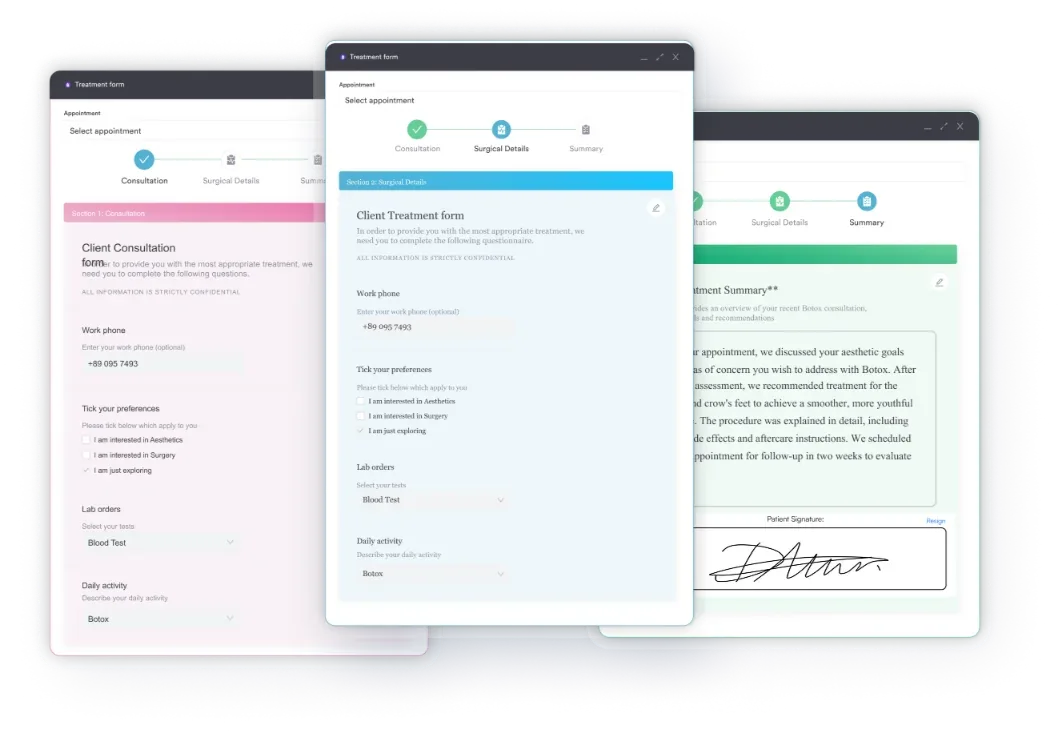

Pabau helps mental health and psychiatry practices manage intake forms, structured assessments, and patient records in one place. See how it works for your team.

A psychosis spectrum test earns its place by getting the right people to a specialist sooner, with a structured starting point for the assessment.
If you see young adults, people with a family history of psychosis, or heavy cannabis users, build a screen into intake. Don’t wait for symptoms to become obvious. Pick one validated instrument, agree on the score that triggers review, and make sure every positive result leads to a named next step.
Screens are built to be sensitive, so some positives will turn out to be mood, substance, or trauma presentations. That is the price of catching early psychosis, and a good differential process absorbs it. Book a demo to see how Pabau keeps screening forms, scores, and follow-up notes in one patient record.

Assessing fixed false beliefs? Delusional disorder DSM-5 criteria walks through the diagnostic criteria with a ready-to-use assessment template.
Screening for mood symptoms alongside psychosis? Bipolar spectrum diagnostic scale template helps you check for bipolar features before settling on a psychotic disorder.
Supporting a patient who hears voices? Coping with auditory hallucinations worksheet gives patients practical strategies to use between sessions.
Structuring the follow-up assessment? Psychiatry interview guide covers the structure, questions, and documentation for a full psychiatric interview.
Planning care after a schizophrenia diagnosis? Schizophrenia nursing care plan sets out nursing diagnoses and interventions you can adapt for each patient.
It screens five domains: positive symptoms, negative symptoms, disorganized thinking, cognitive difficulties, and functional decline. The result shows whether a full psychiatric evaluation is warranted.
No. It identifies whether symptoms are present and whether further assessment is warranted. A formal diagnosis requires a full evaluation by a qualified psychiatrist or psychologist.
The Community Assessment of Psychic Experiences is a 42-item self-report questionnaire. It rates positive, negative, and depressive experiences, scoring each item for frequency and for distress.
The PQ-16 is a 16-item version of the Prodromal Questionnaire. It screens help-seeking patients for an at-risk mental state, and six or more endorsed items is a common cut-off for further assessment.
The Structured Interview for Psychosis-Risk Syndromes is a clinician-led interview, not a self-report form. Trained raters use it after a positive screen to confirm whether someone meets risk-syndrome criteria.
Online versions of tools like the CAPE exist, but their scores need clinical interpretation. A high score is not a diagnosis, and a low score doesn’t rule one out. If you’re worried, speak to a doctor.
Anyone scoring above the instrument’s validated threshold should arrange a clinical review promptly. Intense distress, self-harm risk, or rapidly declining function calls for an urgent referral to psychiatric services.