Nitrates medication list
A nitrates medication list is a point-of-care reference that sets out the main c...

Last Updated: Oct 6, 2026
An ototoxic medication list is a clinical reference of drugs that can damage hearing or balance, grouped by drug class, risk level, and reversibility. The highest-risk groups are aminoglycoside antibiotics, platinum chemotherapy such as cisplatin, and loop diuretics. Salicylates, NSAIDs, antimalarials, and vancomycin carry lower or more variable risk.
More than 200 medications carry documented ototoxic warnings. Audiology and ENT practices, pharmacists, and prescribers use this template to screen patients before high-risk therapy starts. It also gives them one place to record baseline audiometry and every monitoring test that follows.
A ready-to-use clinical reference for audiology and prescribing practices. It covers drug classes, risk levels, cochlear vs. vestibular effects, monitoring intervals, and a patient-facing risk factors checklist.
Download template
Ototoxic medication lists catalog drugs by class, risk level, and reversibility, so high-risk patients are flagged before treatment starts.
Aminoglycosides, cisplatin, and loop diuretics carry the highest risk of cochlear and vestibular damage.
ASHA recommends baseline audiometry before ototoxic treatment, monitoring during therapy, and follow-up after the last dose.
A confirmed 20 dB drop at one frequency, 10 dB at two adjacent frequencies, or lost responses at three consecutive frequencies warrants referral.
Practice software such as Pabau keeps screening forms, audiograms, and monitoring dates on one patient record.
An ototoxic medication list identifies drugs that damage the cochlea or the vestibular system. The result can be sensorineural hearing loss, tinnitus, vertigo, or balance problems.
The list groups medications by how they cause harm. Aminoglycosides destroy outer hair cells through free radical generation, loop diuretics disrupt the stria vascularis, and platinum compounds trigger hair cell death. It also records whether the hearing loss is usually reversible or permanent.
Practices use it to flag high-risk patients before a drug starts, order baseline hearing tests, and schedule serial audiometry. Testing intervals follow guidance from the American Speech-Language-Hearing Association (ASHA) and the American Academy of Audiology (AAA).
The table below summarizes the main ototoxic drug classes, the part of the ear each one usually affects, and how often the damage reverses.
Step 1: Download the template PDF. Open it in your clinical documentation system, or print it for paper-based screening.
Step 2: Review the drug class table and cross-reference every medication the patient takes or is about to start. Mark the risk level (high, moderate, or low) and whether the effect is reversible or permanent.
Step 3: Use the risk factors checklist to identify conditions that amplify ototoxic exposure. These include renal impairment, pre-existing hearing loss, concurrent ototoxic drugs, age, and cumulative dose.
Step 4: Schedule baseline audiometry, including extended high-frequency testing, before the drug starts. Prioritize patients at high risk or on more than one ototoxic drug.
Step 5: Record the baseline result and the planned monitoring dates in the patient record. Keep the completed template as evidence of patient counseling and of monitoring that follows best-practice guidance.
Aminoglycosides (gentamicin, tobramycin, amikacin, streptomycin, neomycin, kanamycin) cause dose- and duration-dependent cochlear hair cell death. Vestibular damage affects a meaningful proportion of patients, and the rate varies by drug. Gentamicin is the most vestibulotoxic. Hearing loss from aminoglycosides is usually permanent and starts at the high frequencies.
Loop diuretics (furosemide, ethacrynic acid, bumetanide, torsemide) can cause rapid, often reversible tinnitus and hearing loss. Risk rises with high doses and rapid infusion rates. Ethacrynic acid carries the highest ototoxic risk in this class. Given alongside aminoglycosides, loop diuretics amplify the damage synergistically.
Platinum-based chemotherapy can cause cumulative, usually permanent high-frequency sensorineural hearing loss. Cisplatin is the main concern, carboplatin carries a lower risk, and oxaliplatin rarely affects hearing. Cisplatin-related hearing loss affects a substantial share of patients, and the share is higher in children.
Oncology teams can write the audiology schedule into each patient’s cancer nursing care plan, so baseline and follow-up tests line up with chemotherapy cycles.
Salicylates and NSAIDs (aspirin, ibuprofen, naproxen) cause dose-dependent tinnitus that is usually reversible at therapeutic doses. Aspirin is the most recognized example, and its tinnitus often resolves within 48 hours of reducing or stopping the dose.
Antimalarials (quinine, chloroquine, hydroxychloroquine) and vancomycin, a glycopeptide antibiotic, carry documented cochlear and vestibular risk. The risk is highest when kidney function is impaired. Hydroxychloroquine use in rheumatology and lupus care may warrant audiological review where hearing symptoms occur.
For rheumatology patients, the RA medication list and SLE medication list track hydroxychloroquine alongside their other long-term therapies.
Certain patient characteristics sharply increase ototoxic risk, even at standard doses.
ASHA and AAA guidance recommends baseline audiometry before ototoxic treatment starts in high-risk patients. Testing should cover frequencies up to 8 kHz, plus extended high-frequency testing up to 20 kHz where available.
Timing depends on the drug class. For aminoglycosides, ASHA recommends a baseline within 24 hours of the first dose, regular monitoring during therapy, and post-treatment follow-up.
For cisplatin, ASHA recommends a baseline before treatment, monitoring before or around each cycle, and follow-up after treatment ends. Follow-up matters because hearing loss can appear after the last dose. Loop diuretic monitoring may be less frequent unless high doses or rapid infusion are used.
The chart below maps that schedule against the shifts that count as significant under ASHA’s 1994 guideline.
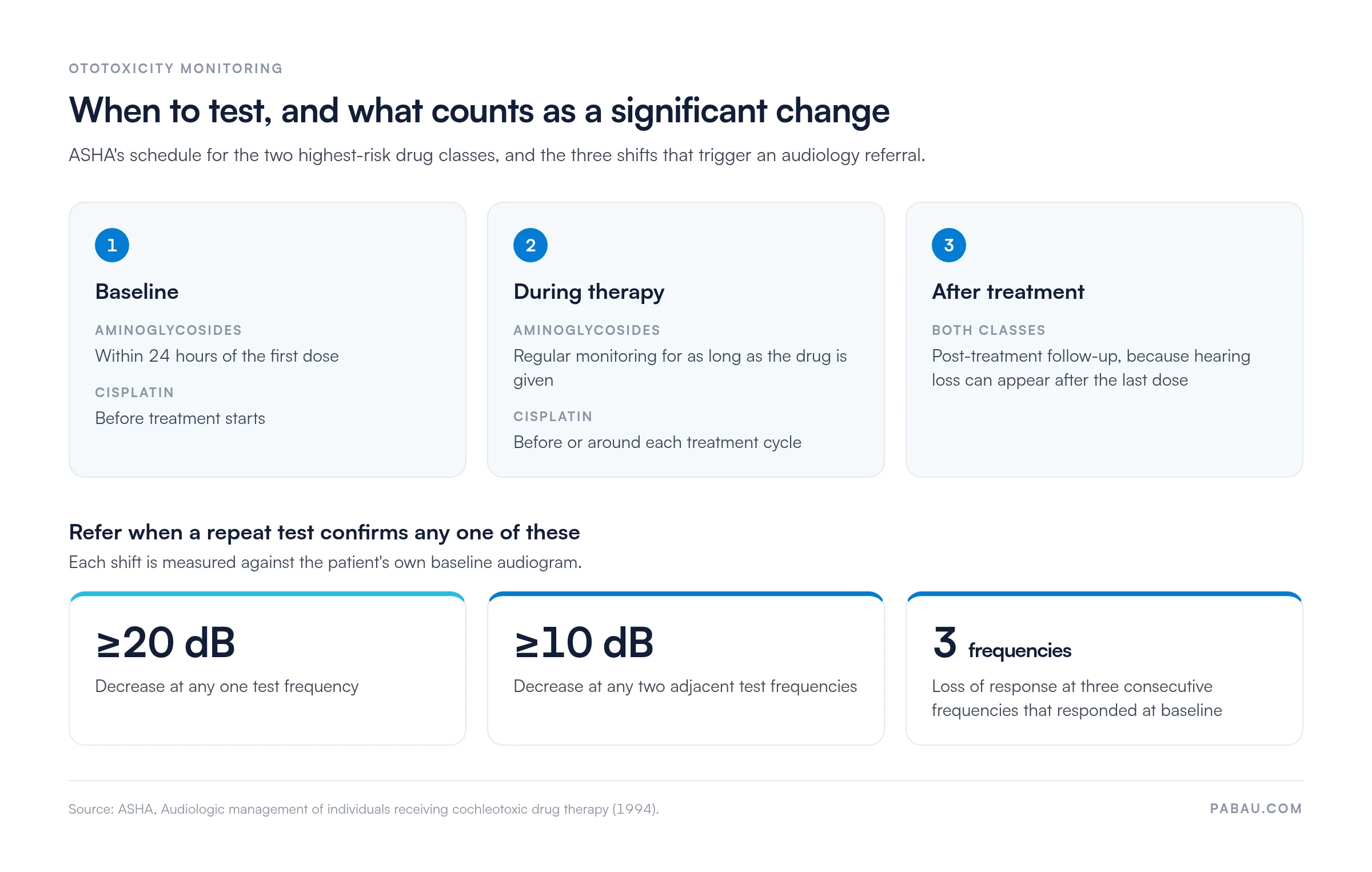
Under that guideline, a change is significant when a repeat test confirms any of these shifts from baseline:
A significant change triggers referral to audiology. The prescriber then decides whether to adjust the dose, switch drugs, or stop treatment.
Audiology practices use the template for intake screening and baseline documentation. It helps them spot patients on ototoxic regimens quickly and book the right monitoring.
Pharmacists use the list during medication reviews, especially in hospitals, long-term care facilities, and polypharmacy cases. Those are the settings where several ototoxic drugs are most likely to be co-prescribed. A drug card for each high-risk agent keeps dosing and contraindications at hand.
Prescribers, including physicians, physician assistants, nurse practitioners, and midwives, use it as a counseling aid before high-risk therapy starts. It also documents informed consent and monitoring expectations in the patient record.
A systematic list makes it less likely that ototoxic exposure goes unnoticed. Baseline audiometry gets ordered before the drug starts, instead of being found missing after a threshold shift.
Documented screening and monitoring dates show best-practice compliance during audits and quality reviews. Clinicians can show they identified the risk, counseled the patient, and scheduled serial testing on time.
For patients, structured documentation spells out which symptoms need an urgent audiology referral. Tinnitus, muffled hearing, and vertigo are the main ones, and prompt reporting avoids delays in changing the dose.
Flag patients taking two or more ototoxic medications at the same time, because the combined risk is significantly higher than either drug alone. Audit your current patient list for these combinations, then prioritize baseline audiometry and shorter monitoring intervals.
Every patient starting an ototoxic medication should have a baseline audiogram in the clinical record. Record the test date, the frequency range tested, and any pre-existing hearing loss or tinnitus.
Document monitoring dates, referral thresholds, and the symptom-reporting advice you gave when the drug started. That record protects the practice if ototoxicity is found later and a liability claim follows.
Ototoxic monitoring often lives in three places at once. The screening checklist is on paper, the test dates sit in a spreadsheet, and the audiograms are filed somewhere else. A missed retest only surfaces when someone cross-checks all three.
Pabau, the practice management platform we build, brings those pieces into one patient record. Its patient intake software collects current medications before the first visit. The audiologist sees a gentamicin or cisplatin course before testing begins.
Each baseline audiogram, follow-up appointment, and referral letter then sits on the patient’s timeline in Pabau’s medical records management tools. Automated SMS and email reminders bring patients back for every scheduled retest.
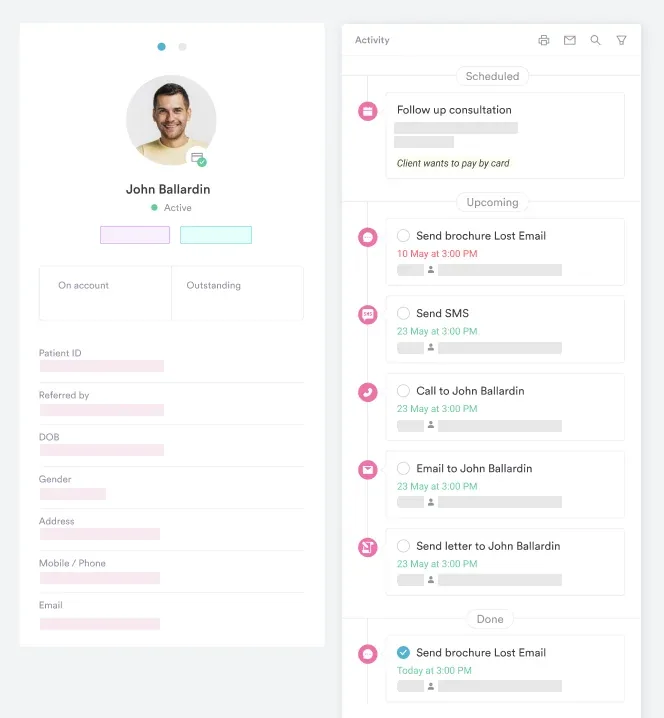

Pabau brings intake forms, audiogram records, and automated retest reminders into one patient record. Your team spots a missed monitoring test before an auditor or a patient does.

Start with the patients already on your books. Run current medication lists against the template, flag anyone on two ototoxic drugs or with impaired kidney function, and book their baselines first.
The payoff is timing. A shift caught at the high frequencies leaves the prescriber room to change course. One found after the patient notices muffled speech usually comes too late to reverse.
Serial testing does cost audiology time. Spend it on aminoglycosides and cisplatin, and rely on symptom reporting for lower-risk drugs such as NSAIDs.
Book a demo to see how Pabau keeps baselines, retest dates, and referral notes on one record for your audiology team.

Treating patients with rheumatoid arthritis? RA medication list groups each drug by class with its dose, monitoring labs, and review date.
Managing lupus patients on hydroxychloroquine? SLE medication list organizes lupus drugs by class, with dosing and monitoring for each.
Need a quick reference for each high-risk drug? Drug card template fits dose, contraindications, and nursing notes for one drug onto a two-page card.
Caring for patients on cisplatin? Cancer nursing care plan sets out assessment, diagnoses, goals, interventions, and evaluation for oncology patients.
Moving screening records off paper? Best clinical documentation software compares six platforms by practice type, from AI scribes to all-in-one systems.
More than 200 medications carry documented ototoxic potential. They include aminoglycosides (gentamicin, tobramycin), loop diuretics (furosemide), platinum chemotherapy (cisplatin, carboplatin), salicylates and NSAIDs (aspirin, ibuprofen), antimalarials (quinine, hydroxychloroquine), and vancomycin. Download the template for a full reference organized by drug class and risk level.
Yes. Loop diuretics such as furosemide, ethacrynic acid, and bumetanide, used for hypertension and heart failure, can cause dose-dependent tinnitus and hearing loss. The effect is often reversible. Risk is higher with rapid infusion, high doses, or a concurrent aminoglycoside, so those patients warrant baseline audiometry.
It depends on the drug class. Salicylates, NSAIDs, and loop diuretics often cause tinnitus or hearing loss that resolves once the drug is stopped or the dose is reduced. Aminoglycosides and cisplatin typically cause permanent sensorineural hearing loss. Vancomycin ototoxicity is variable and dose-dependent.
ASHA recommends baseline audiometry, including extended high-frequency testing, before ototoxic treatment starts. Aminoglycoside patients get a baseline within 24 hours of the first dose, then regular monitoring and post-treatment follow-up. Cisplatin patients are tested before or around each cycle and after treatment. A 20 dB shift at one frequency, 10 dB at two adjacent frequencies, or lost responses at three consecutive frequencies triggers audiology referral.
Early ototoxicity shows up as tinnitus, difficulty hearing in noisy places, muffled hearing, or balance problems such as vertigo and dizziness. Patients on aminoglycosides or cisplatin should report these symptoms immediately. Serial audiometry can detect threshold shifts before the patient notices any change in hearing.