Ototoxic medication list
An ototoxic medication list is a clinical reference of drugs that can damage hea...

1
Last Updated: Oct 6, 2026
A nitrates medication list is a point-of-care reference that sets out the main clinically used nitrates with their brand names, formulations, doses, and indications. Those nitrates are nitroglycerin for acute angina relief, plus isosorbide mononitrate and isosorbide dinitrate for angina prevention.
All three release nitric oxide, which relaxes vascular smooth muscle and lowers cardiac workload. Prescribers use the list to catch the interactions that matter most, especially PDE5 inhibitors and riociguat. It also helps them schedule doses around a nitrate-free interval that prevents tolerance.
This guide covers dosing, side effects, contraindications, and special populations for each drug. The PDF version is ready to print or adapt for your practice.
A ready-to-use clinical reference covering the main clinically used nitrates, their classifications, dosing forms, and prescribing guidance. Keep it at hand for rapid checks during patient care.
Download template
Nitrates are vasodilators that work by releasing nitric oxide, causing smooth muscle relaxation and reducing cardiac workload in angina and heart failure.
Three nitrates cover most clinical use: nitroglycerin for acute relief, plus isosorbide mononitrate and isosorbide dinitrate for long-acting prevention.
Nitrates are absolutely contraindicated with PDE5 inhibitors (sildenafil, tadalafil, vardenafil) and riociguat, because the combination can cause severe, life-threatening hypotension.
Nitrate tolerance develops with continuous exposure, so long-acting regimens need a daily nitrate-free interval of 8-12 hours to keep working.
Patients using sublingual nitroglycerin should call emergency services if chest pain has not improved 5 minutes after the first dose.
Nitrates are a class of vasodilator medications that reduce cardiac oxygen demand and improve coronary blood flow by relaxing vascular smooth muscle. They release nitric oxide (NO), which activates guanylate cyclase and raises cyclic GMP, triggering smooth muscle relaxation.
Clinically, nitrates are used in four main settings:
Patients with angina rarely take a nitrate alone. Most also take antiplatelet medications and other cardiovascular drugs, so review the whole medication list before adding one.
The following table lists the main clinically used nitrates by generic name, brand names, formulation, and primary indication. For the wider set of heart drugs these patients often take, use the cardiovascular medication list.
A few less common agents sit outside this table. They include nitroglycerin ointment, buccal nitroglycerin, inhaled amyl nitrite, and nicorandil, a nitrate-like drug prescribed in the UK.
Short-acting nitrates provide rapid vasodilation for acute symptom relief. Nitroglycerin remains the standard choice, with onset within 1-3 minutes when given sublingually or as a spray. Sublingual tablets dissolve under the tongue, while sprays offer faster absorption in some patients. The transdermal patch is a sustained-release form and is not used for acute relief.
For acute angina, prescribe sublingual nitroglycerin 0.3-0.6 mg as needed. If pain has not improved 5 minutes after the first dose, the patient should call emergency services. They may then repeat the dose every 5 minutes, up to 3 doses in total.
Nitrolingual spray delivers 0.4 mg per metered spray. The dose is 1-2 sprays (0.4-0.8 mg), following the same 5-minute rule.
Isosorbide mononitrate and isosorbide dinitrate are used for chronic angina prevention. Isosorbide mononitrate is preferred for many patients because it bypasses first-pass hepatic metabolism, giving more predictable blood levels. Extended-release formulations (Imdur 30-240 mg daily) provide steady coverage through the day.
To prevent nitrate tolerance, plan a nitrate-free interval of 8-12 hours each day. Extended-release isosorbide mononitrate is taken once daily in the morning, usually 30-120 mg. Immediate-release isosorbide mononitrate is taken twice daily, for example 20 mg on waking and 20 mg about 7 hours later.
Clinicians classify nitrates by pharmacokinetic profile to match patient needs and prevent tolerance.
Most adverse effects stem from vasodilation and are often dose-related and self-limited.
Knowing the absolute and relative contraindications protects patients from serious harm.
Nitrate tolerance is a loss of drug efficacy that develops with continuous exposure to long-acting nitrates. The mechanism involves depletion of cofactors needed for nitric oxide generation and activation of oxidative-stress pathways that degrade NO.
To prevent tolerance, build a daily nitrate-free interval of 8-12 hours into the schedule, usually overnight. Each long-acting regimen gets there differently, as the schedule below shows.
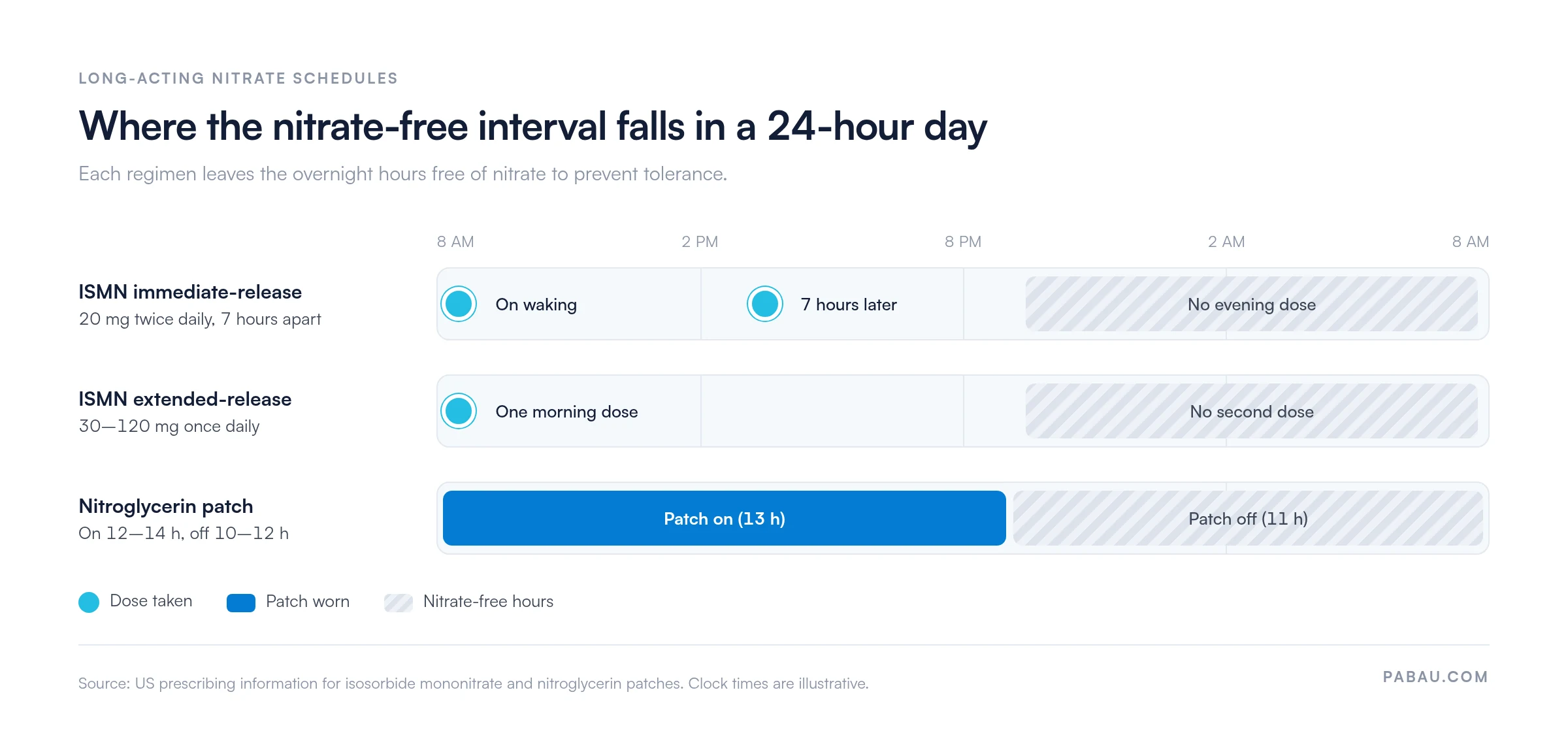
The break lets vascular enzymes regenerate the cofactors nitrates depend on, restoring drug sensitivity. Monitor patients for tolerance by asking about symptom recurrence after weeks of stable control. If tolerance develops, lengthen the nitrate-free interval or switch formulations temporarily before resuming.
Pregnancy: The FDA retired its pregnancy letter categories in 2015. The old Category C label for nitrates meant adequate human studies were lacking, and it did not indicate a proven teratogenic risk. Use nitrates only when angina cannot be controlled by other means, such as beta-blockers or calcium-channel blockers.
Older adults: Older patients are more sensitive to nitrate-induced hypotension and headache. Start with lower doses and titrate slowly. Monitor sitting and standing blood pressure, and assess fall risk in frail patients taking antihypertensives such as ACE inhibitors.
Renal impairment: Isosorbide mononitrate does not need dose adjustment in renal disease, because renal excretion is minimal. Isosorbide dinitrate and nitroglycerin are metabolized mainly by the liver, so use caution in severe liver disease.
The renal concern with IV nitroglycerin is propylene glycol, which some formulations contain. High-dose or prolonged infusions can cause propylene glycol toxicity, so monitor closely when kidney function is poor.
Before starting any nitrate, document baseline blood pressure, heart rate, and renal function. Screen patients explicitly for PDE5 inhibitor and riociguat use. Record the nitrate-free interval strategy in the patient record so the whole team understands the dosing intent.
Use digital forms to capture contraindication checks and adverse-effect monitoring at every visit. Weight loss and metabolic practices should ask the same questions at intake, because obesity raises coronary risk. Their weight loss practice software can hold that medication history next to the treatment plan.
Educate patients on correct sublingual nitroglycerin use. They should sit or lie down first, let the tablet dissolve under the tongue without swallowing it, and expect a mild burning sensation.
Tell patients to keep tablets tightly capped in the original glass bottle and to replace them by the label expiry date. Tablets moved to a plastic pill box or left uncapped lose potency sooner. Give written instructions on emergency care: If pain has not improved 5 minutes after the first dose, call emergency services before taking further doses.
In many practices, the PDE5 question is asked verbally and the nitrate-free schedule lives in a free-text note. When a covering prescriber sees the patient, neither answer is easy to find.
Pabau, the practice management platform we build, moves those checks onto intake forms that patients complete before the visit. Their answers about current medications, including PDE5 inhibitors and riociguat, land in the patient record next to the treatment history.
Pabau’s prescription management tools keep each nitrate order, dose, and schedule in that same record. Any prescriber can then confirm the dosing intent and the contraindication screen before writing the next prescription.

Pabau’s digital forms and patient records capture medication history, PDE5 screening, and adverse effects before each visit. Book a demo to see the workflow.

Nitrate prescribing tends to fail at three points. A PDE5 inhibitor or riociguat goes unnoticed, a regimen has no overnight break, or the patient is unsure when to call for help. Each one is preventable with a question asked at the right moment.
Build those three checks into the form you use at every visit, and the list does its job at the point of prescribing. The cost is a few extra questions per appointment, which is small next to treating nitrate-induced hypotension.
Download the template above, adapt it to your formulary, and keep it beside the prescribing screen. Book a demo to see how Pabau keeps medication screening and nitrate dosing notes together in one patient record.

Prescribing nitrates alongside blood thinners? Anticoagulant medication list sets out the anticoagulants most often co-prescribed with cardiac drugs.
Managing lipids in the same patients? Cholesterol medication list covers statins and other lipid-lowering therapy for patients with coronary disease.
Want a double-check list for risky drugs? High-alert medication list flags the medications that cause the most harm when given in error.
Dispensing extended-release tablets? Medication do-not-crush list shows which modified-release forms must be swallowed whole.
Advising angina patients on diet? Cardiac diet plan gives patients a heart-healthy eating plan to take home.
Nitrates are vasodilators that release nitric oxide, which relaxes vascular smooth muscle and reduces cardiac workload. Short-acting forms such as sublingual nitroglycerin relieve acute chest pain within minutes. Long-acting forms such as isosorbide mononitrate and isosorbide dinitrate prevent angina attacks.
No. Aspirin is a salicylate and antiplatelet agent, not a nitrate. Aspirin prevents clot formation, while nitrates relax blood vessels. Patients often confuse the two because both may be prescribed for acute coronary syndromes.
Headache is the most common side effect, affecting up to about half of patients. Flushing, dizziness from low blood pressure, and reflex tachycardia are also common. Headache often eases within days of starting treatment. Hypotension is the most serious effect, so check blood pressure when starting therapy or raising the dose.
Continuous nitrate exposure causes tolerance, a loss of drug effect. It happens because vascular enzymes run short of the cofactors needed to generate nitric oxide. A daily nitrate-free period of 8-12 hours, usually overnight, lets those cofactors regenerate and keeps the drug working.
Nitrates are absolutely contraindicated with PDE5 inhibitors (sildenafil, tadalafil, vardenafil) and with riociguat, because the combination can cause severe hypotension. They are also avoided in right ventricular infarction. Relative contraindications include systolic blood pressure below 90 mmHg and severe aortic or mitral stenosis. Screen every patient for these medications before prescribing.
Nitrates can be used in pregnancy when angina cannot be controlled by other means. The FDA retired its pregnancy letter categories in 2015. The old Category C label for nitrates only meant adequate human studies were lacking. Weigh the maternal benefit against the limited data, and involve obstetric cardiology.
Replace sublingual nitroglycerin by the expiry date on the label. Nitrostat tablets stay stable to that date when kept tightly capped in the original glass bottle. Tablets moved to a plastic pill box, or left uncapped, lose potency sooner and should be replaced earlier. Store them at room temperature, away from moisture.
Short-acting nitrates, such as sublingual nitroglycerin and spray, act within 1-3 minutes and last about 30 minutes, so they treat acute angina. Long-acting nitrates take 30-60 minutes to work and last 8-12 hours, which suits prevention. Only long-acting and transdermal nitrates need a daily nitrate-free interval. As-needed sublingual doses do not.