Sulcus Test: Shoulder Instability Assessment
The sulcus test is an orthopedic special test that checks for inferior glenohume...

3
Last Updated: Oct 22, 2026
A bike riding exercise plan is a week-by-week schedule that moves you from your current fitness toward a set goal. That goal might be heart health, weight loss or endurance. This one runs four weeks, with three rides a week on Monday, Wednesday and Saturday.
Weeks 1 and 2 build an aerobic base with 20- to 30-minute rides at a conversational pace. Weeks 3 and 4 swap one steady ride for an interval session, and the other four days are rest or easy active recovery.
The plan works on an outdoor bike or a stationary one. Download the printable version below to log each ride and see how your effort changes.
A printable 4-week cycling schedule with a blank weekly planner, a ride-by-ride workout log and a progress tracker. Fill in duration and effort for each ride, on an outdoor or stationary bike.
Download template
A bike riding exercise plan is a structured weekly schedule that progresses from base fitness to intervals, with rest days built in for recovery.
Cycling is low-impact cardiovascular exercise that improves aerobic fitness and burns calories without the joint stress of running.
Beginners do best with three rides a week, starting at 20–30 minutes of steady effort before adding intervals in weeks 3 and 4.
Weekly ride time climbs from 65 to about 100 minutes, so repeat the cycle with longer rides to reach the CDC’s 150-minute target.
Download the free template above, print it, and adjust the duration and intensity to your current fitness and available time.
Yes. Cycling is low-impact cardiovascular exercise that strengthens your heart and lungs without the repetitive stress of running.
The CDC physical activity guidelines recommend 150 minutes of moderate-intensity aerobic activity per week for adults. A structured plan helps you hit that target week after week. Spread over five days, that comes to 30 minutes a day. A 30 minute exercise plan turns that daily half hour into goals with target dates and scheduled reviews.
Pick your main goal first, because it shapes how hard, how long and how often you ride.
If a physical therapist or trainer supervises you, ask them to record a baseline on a fitness assessment form before week 1. That gives you a measured starting point to compare against when the cycle ends.
The core plan runs four weeks and works on an outdoor or stationary bike. Weeks 1 and 2 lengthen each ride slightly, then weeks 3 and 4 add intensity through intervals.
Riders without a plan tend to repeat the same distance at the same effort every week, and their fitness stalls. Raising duration first and intensity second gives your body a steady reason to adapt.
Key principles: Warm up for five easy minutes and cool down for five easy minutes. Aim for a cadence of 90–100 pedal revolutions per minute (RPM) on an outdoor bike, and smooth, controlled resistance on a stationary one. Rest days mean walking, stretching or very easy spinning under 50 watts.
Low-intensity endurance rides build aerobic fitness and bike handling. Every session is at a conversational pace (zone 2).
Weeks 3 and 4 add one interval session while keeping the long steady ride. Intervals raise aerobic power and calorie burn.
Add up the rides and the progression is gentler than it looks. Scheduled ride time climbs from 65 minutes in week 1 to 80 in week 2, then 98–103 in weeks 3 and 4. That is still below the CDC’s 150-minute weekly target, which is why the plan is built to repeat with longer rides.
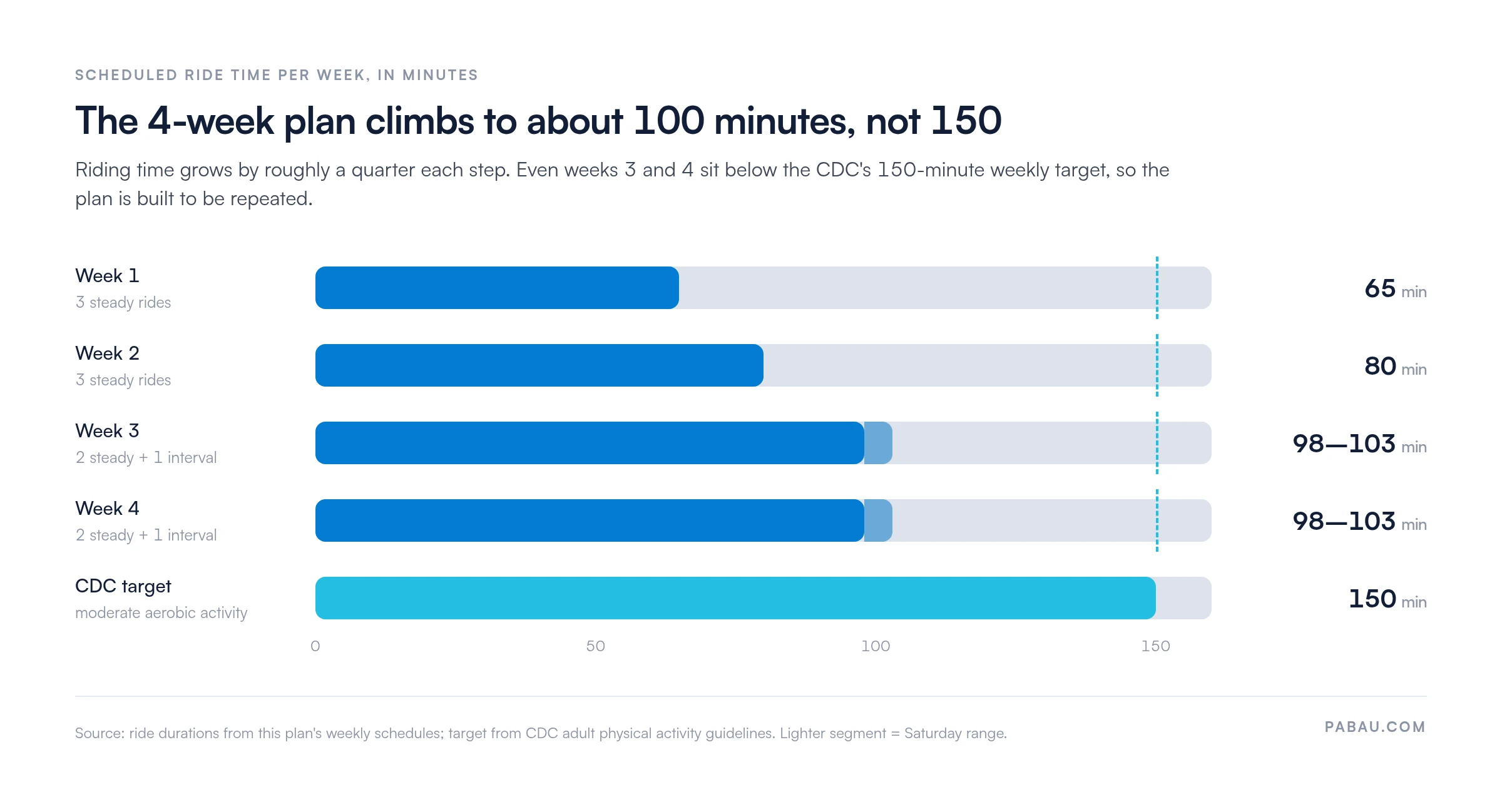
The 4-week structure works the same way on a stationary bike. Only the resistance and cadence targets shift slightly, and an indoor bike makes your effort easier to repeat precisely.
Short on time? This standalone 30-minute session gives you a full aerobic workout on an outdoor or stationary bike.
It fits a lunch break or a morning routine. With the intensity controlled, it gives a similar cardiovascular stimulus to a longer steady ride.
Weight loss on a bike needs a calorie deficit from your diet plus enough aerobic work. Two session types do most of the job.
A typical weight-loss week combines three zone 2 rides of 25–45 minutes with one 38-minute interval session. That adds up to roughly 113–173 minutes, so the longer version clears the CDC’s 150-minute target. Paired with a 300–500 calorie daily deficit, this typically produces 1–2 pounds of weight loss per week.
New riders often push too hard too soon, then burn out or get injured. These principles keep the first month safe.
Cycling is one of the safest exercises for older adults. It’s low impact, the effort scales easily, and it’s simple to modify. The same 4-week plan works with these adjustments.
Cycling is a seated exercise, so it does little to train balance. Pair the rides with balance exercises for seniors on rest days to cover the fall-prevention work the bike leaves out. Upper-body and bone-loading strength stay untouched too, so slot a 6-week strength plan into the non-riding days.
The printable PDF gives you a blank 4-week schedule, a workout log and a progress tracker.
Many physical therapy practices still hand patients a printed plan and hope it comes back filled in. By the follow-up visit, the sheet is lost or half-completed, and the therapist is guessing at adherence.
Pabau, the practice management platform we build, keeps the plan with the patient. Its physical therapy EMR stores each patient’s exercise plan, progress notes and treatment notes in one patient record.
Automated workflows send the plan after the appointment and remind patients before their review. Patients who already follow a home exercise program can get the cycling plan alongside it, so each prescription sits in one place.
The review appointment then starts from the patient’s logged rides rather than their memory, so you can set week 5 in minutes.

Pabau stores exercise plans and progress notes in the patient record and automates follow-up reminders. You review each patient’s progress at a glance and adjust the plan sooner.

Start with the base weeks, even if they feel too easy. The first month is deliberately gentle, and finishing it builds the habit that every later cycle depends on.
When the four weeks are done, judge them by your log rather than by one good or bad ride. If week 4 felt manageable, repeat the plan with longer rides until you reach 150 minutes a week.
If you’re a physical therapist prescribing the plan, the log is your best evidence of adherence. Book a demo to see how Pabau helps you prescribe, track and follow up on exercise plans with your patients.

Want a strength plan to pair with your rides? Beginner workout plan for women lays out a 4-week strength routine for new exercisers.
Working with older riders? Resistance training for seniors covers safe strength work for older adults.
Need options for patients who can’t ride yet? Seated exercises offers chair-based routines for people with limited mobility.
Setting heart rate zones clinically? Cardiopulmonary exercise testing explains how to read CPET results.
For beginners, 3 rides per week is ideal. It builds fitness without overtraining. Each ride is 20-30 minutes. If you have more time, add a 4th easy day (very low intensity). Never ride hard more than twice per week.
Yes. Cycling burns 200-300 calories per 30 minutes at moderate intensity, and zone 2 rides preferentially burn fat. Combined with a calorie deficit (eating fewer calories), 3-4 rides per week typically produces 1-2 pounds of weight loss weekly.
Aerobic fitness improvements appear within 2-3 weeks (you’ll notice easier breathing). Visible body composition changes take 4-8 weeks with consistent riding and diet. Strength and endurance gains continue improving for months.
You can ride daily, but intensity must be low. Keep most rides to easy effort (zone 2, 60-70% max HR). Riding hard every day causes overuse injury and burnout. A better pattern is 3 hard/moderate days, 2-3 easy days, 1-2 complete rest days per week.
5-minute warm-up (easy), 18 minutes of 3-minute hard efforts (4 repeats) with 1.5-minute easy recoveries between, then 7-minute cool-down. This session is in the article above and delivers aerobic benefit in a short timeframe.
No. Cycling is low-impact and generally knee-friendly. Pain arises from poor bike setup (seat height/position), too-rapid progression, or pre-existing knee issues. Start with 20 minutes 3 days per week, ensure proper fit, and progress slowly. Consult a physical therapist if pain occurs.