CCSD Code 22023: EMG and nerve conduction studies billing guide
CCSD code 22023: Definition and clinical context CCSD code 22023 is the procedur...

Last Updated: Nov 4, 2026
Q4128 is the HCPCS Level II code for Flex HD, or AlloPatch HD, per square centimeter (add-on, list separately in addition to primary procedure). Both products are human acellular dermal matrices made from donated skin by MTF Biologics, and one unit equals 1 cm² of product.
Q4128 sits among dozens of Q41xx skin substitute codes that look nearly identical on a charge-entry screen. EZDerm, a porcine matrix, is a separate code, Q4136. Wastage is the second trap. For Medicare dates of service from January 1, 2026, CMS pays Q4128 as an incident-to supply. You bill only the cm² applied, with no JW or JZ modifier.
Let Pabau's smart automation suggest the right codes, reduce claim denials, and keep your practice compliant—effortlessly.
Automate repetitive tasks and focus on what matters most—your patients.
Reduce coding errors and ensure compliance with the latest regulations.
Clean claims, fewer denials, and faster reimbursements.
Powerful insights and reporting to help your practice thrive.
HIPAA compliant SOC 2 certified GDPR-compliant Trusted by 4,000+ clinics worldwide

HCPCS Code Q4128 reports Flex HD or AlloPatch HD, human acellular dermal matrices from MTF Biologics, per square centimeter.
One unit equals 1 cm² of product, and EZDerm is a porcine product billed under Q4136, not Q4128.
For Medicare dates of service from January 1, 2026, bill only the cm² applied on one line, with no JW or JZ modifier.
Q4128 covers the product only, so the application is billed separately with a CPT code matched to wound site and size.
For 2026, CMS pays non-BLA skin substitutes, including Q4128, as incident-to supplies, and only the applied amount is payable.
HCPCS Code Q4128 is the Medicare billing code for Flex HD or AlloPatch HD, two human acellular dermal matrices, reported per square centimeter. The table below gives coders its key billing attributes.
Confirm your MAC’s current fee schedule before you submit, as payment rates change every year.
The official HCPCS descriptor for Q4128 is “Flex HD, or AlloPatch HD, per square centimeter (add-on, list separately in addition to primary procedure).” Both products are acellular dermal matrices made from donated human skin by MTF Biologics. Processing removes the cells and leaves a collagen scaffold that the patient’s own tissue grows into.
FlexHD is best known from reconstructive surgery, while AlloPatch HD is positioned for wound and soft-tissue repair. Both brands share one code, so either name on the invoice leads to Q4128. According to the Centers for Medicare and Medicaid Services HCPCS overview, Level II codes report products, supplies, and services that CPT does not cover.
Q4128 covers only the product. It does not cover the act of applying the graft. The application procedure is billed separately with a CPT code, which is what the descriptor’s “add-on” wording points to. Submitting Q4128 without a matching procedure code is a frequent billing error.
Medicare coverage of skin substitutes for chronic wounds depends on documented failure of conservative treatment. Indications that MAC policies commonly accept include:
Non-covered uses include cosmetic procedures, acute traumatic wounds without documented treatment failure, and wound types excluded under the governing LCD. Billing Q4128 for a wound type your MAC’s policy does not list is both a coverage risk and a compliance exposure.
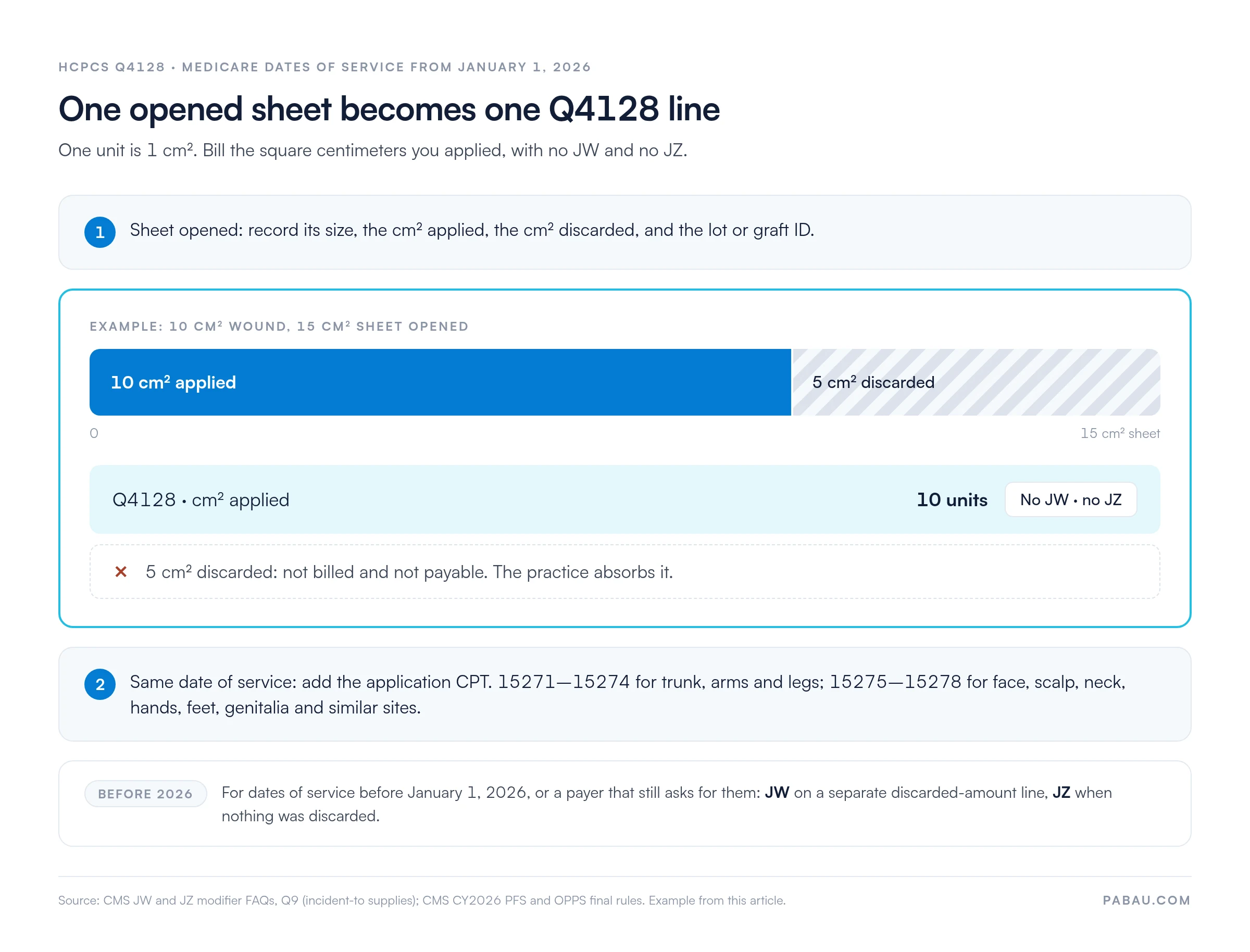
One unit of HCPCS Code Q4128 equals one square centimeter of Flex HD or AlloPatch HD. For Medicare dates of service from January 1, 2026, bill the applied amount on one claim line, with no wastage modifier. Product opened and discarded is not billable, so the practice absorbs it whenever the sheet is larger than the wound bed.
Report whole units only, and check your payer’s rounding rule for partial square centimeters. Payers may also apply per-encounter quantity limits. Because these limits vary by MAC and commercial payer, verify the maximum billable units before charge entry.
For Medicare dates of service from January 1, 2026, Q4128 takes no wastage modifier. CMS now pays non-BLA skin substitutes, including Flex HD and AlloPatch HD, as incident-to supplies. The CMS JW and JZ modifier FAQs (question 9) say JW and JZ are not appropriate for incident-to supplies.
Discarded amounts of those supplies are not payable by Medicare. Some MACs, such as First Coast, reject 2026 claims that carry either modifier.
Dates of service before 2026, or payers that still require them. Medicare required JW on discarded amounts from January 1, 2017, and JZ from July 1, 2023. Under that method, the applied amount went on one line and any discarded amount on a second line with JW. Some commercial payers may still use it, so check each payer’s policy.
For 2026 Medicare claims, bill one Q4128 line for the applied cm² and nothing for the discarded amount. A 10 cm² wound treated from a 15 cm² sheet bills 10 units, and the 5 discarded units are not billable. The diagram below walks one opened sheet through that claim.
Q4128 is a supply code. It describes what was used, not what was done. Payers expect a matching application code on the same date of service, chosen by anatomical site and total wound surface area.
A diabetic foot ulcer therefore takes 15275 or 15277. A venous leg ulcer under 100 cm² takes 15271, plus 15272 for each additional 25 cm². Infants and children use the 1% of body area thresholds in place of the square-centimeter ones.
Debridement of the same wound before application (CPT 11042–11047, 97597, 97598) is included in 15271–15278 and is not separately reportable under NCCI. Debridement of a different wound or site may be reported with modifier 59 or XS and separate documentation.
The Q41xx series holds dozens of skin substitute codes with nearly identical structure. The most damaging mix-up for Q4128 is EZDerm, a porcine product with its own code. The table below lists the codes most often confused with Q4128 and how to tell them apart.
The tissue-source column is the fastest check at charge entry. If the product invoice names a human dermal matrix, confirm the brand before choosing among Q4128, Q4116, and Q4107.
Run a quarterly audit on Q41xx charges. Flag any Q4128 claim where the product name or lot number in the clinical note is not Flex HD or AlloPatch HD. Cross-coding to the wrong Q41xx code is a recurring audit finding in skin substitute billing.
Medicare coverage for HCPCS Code Q4128 is governed by your MAC’s Local Coverage Determination, where it has an active one. The AAPC HCPCS code lookup shows where Q4128 sits in the code set, but the controlling document is always your MAC’s active policy. The LCD in effect on the date of service controls coverage.
Coverage criteria commonly required under MAC policies include:
Payment rules changed too. For 2026, CMS pays non-BLA skin substitutes, including 361 HCT/P products like Flex HD and AlloPatch HD, as incident-to supplies.
Medicare pays them at a single national rate per square centimeter when used with a covered application procedure, in both office and hospital outpatient settings. Only the product applied to the wound is payable. Verify the current rate rather than relying on an older price list.
Some MACs, such as CGS, Novitas, and First Coast, publish a skin substitute LCD. Check whether yours does. CMS and the MACs withdrew the new DFU and VLU skin substitute LCDs on December 24, 2025, before their January 1, 2026 start date. Retrieve the current policy from your MAC’s website, since third-party summaries may cite a superseded version.
Original Medicare does not generally require prior authorization for Q4128, but this varies by jurisdiction and program. CMS’s WISeR prior authorization model, which includes skin substitutes, runs in six states: Arizona, New Jersey, Ohio, Oklahoma, Texas, and Washington.
Skin substitute review applies only where the MAC has an active skin substitute LCD. That covers the Novitas states (Texas, Oklahoma, and New Jersey) and CGS in Ohio, but not Noridian’s Arizona and Washington. Check your MAC’s announcements before the first application.
Commercial and Medicare Advantage plans are a different matter. Many require prior authorization for skin substitute products. Failing to obtain it before applying Flex HD or AlloPatch HD is a common non-clinical cause of denial in this code range. Record the authorization number in the chart and on the claim before submission.
Where you apply Flex HD or AlloPatch HD affects how much Medicare pays. The facility versus non-facility distinction applies to the companion CPT application code, and the setting decides who bills the product. Use the CMS Physician Fee Schedule search to look up the current year’s rate for your setting.
In the hospital outpatient setting, the facility bills Q4128 and is paid separately for the product as an incident-to supply. The physician practice bills only the professional CPT service, at the facility rate. ASCs are also paid for the product as an incident-to supply, so confirm the rate with the facility’s coding team.
Many Q4128 denials trace back to the chart rather than the code. The chart must support every element Medicare and commercial payers evaluate during post-payment review. Good medical billing compliance starts with the clinical note, not the claim form.
The diagnosis code on the Q4128 claim must match a wound type covered under the governing LCD. The wrong ICD-10-CM code generates a denial even when the clinical indication is legitimate. The table below lists common supporting codes, so cross-reference it against the covered-code list in your MAC’s active LCD.
Diabetic foot ulcer codes such as E11.621 also need an L97 code for the ulcer site and depth. Codes describing acute traumatic wounds or cosmetic procedures do not establish medical necessity for Q4128. Using a non-covered diagnosis is both a denial trigger and a compliance risk.
Q4128 denials tend to repeat. The denial reason codes on these claims cluster around six fixable errors, listed in the table below. Effective denial management for a wound care practice starts with these patterns.
Coding references describe what Q4128 is, but many Q4128 errors happen at charge entry inside the practice’s own system. Three system-level errors come up again and again:
Build a five-point Q4128 checklist into your workflow. Confirm the product is Flex HD or AlloPatch HD and that a 2026 Medicare claim carries no JW or JZ. Then check for a 1527x CPT on the same date, units that match the applied cm², and a covered ICD-10 code.
Pabau, the practice management platform we build, handles the claim side of this workflow. Its claims management software checks each claim for missing or invalid details before it leaves the system. It verifies US eligibility through Claim.MD before the visit and stores prior authorization cases against the booking.
Once a claim is out, Pabau tracks it from pending to paid. A rejected claim is flagged as needing action, with a link to the field that needs correcting. Payments are then matched to invoices from electronic remittance advice files, so short-paid Q4128 lines stand out.

Pabau checks every claim for missing or invalid details before it leaves the practice. It then tracks the claim to payment and flags rejections.

Accurate Q4128 billing starts with the product name on the invoice. Flex HD and AlloPatch HD are human dermal matrices. Confusing them with a porcine product such as EZDerm sends the claim to the wrong code. Get the product right, then the applied units, the site-matched CPT code, and the diagnosis follow from the chart.
For 2026, drop JW and JZ from Medicare Q4128 claims, since only the applied amount is payable. Then confirm whether your MAC has an active skin substitute LCD. That check decides the coverage criteria you document against and whether WISeR prior authorization applies.
A practice that bills Q4128 regularly should build this checklist into its charge template, so the system enforces it on every claim. To see how Pabau checks and tracks claims from submission to payment, book a demo with the team.

Need a broader overview of how claims move through the system? Revenue cycle management guide walks through the full claim lifecycle from charge capture to remittance posting.
Getting repeated denials on wound care claims? Clean claim submission standards explains the technical and documentation requirements that determine whether a claim processes without rejection.
Want to understand what clearinghouses do with your HCPCS claims? Medical claims clearinghouse explainer covers how claims are validated and routed before reaching the payer.
HCPCS Code Q4128 reports Flex HD or AlloPatch HD per square centimeter. Both are human acellular dermal matrices made from donated skin by MTF Biologics. The code covers the product only, and the application procedure is billed separately.
No. EZDerm is a porcine acellular dermal matrix billed under Q4136. Q4128 is reserved for Flex HD and AlloPatch HD, which are human-derived. Billing EZDerm as Q4128 is miscoding and a likely denial.
One unit of Q4128 equals one square centimeter of product. For Medicare dates of service from January 1, 2026, bill only the applied amount on one line, with no JW or JZ. Discarded product is not billable, so a 10 cm² wound treated from a 15 cm² sheet bills 10 units.
For Medicare dates of service from January 1, 2026, neither is used on Q4128. CMS pays it as an incident-to supply, and its JW/JZ FAQ says the modifiers are not appropriate for incident-to supplies. Before 2026, Medicare required JW from January 1, 2017, and JZ from July 1, 2023. Some commercial payers may still require them.
Use 15271–15274 for the trunk, arms, and legs, and 15275–15278 for the face, scalp, neck, hands, feet, genitalia, and similar sites. In the 25 cm² pairs (15271/15272, 15275/15276) the first code covers the first 25 cm² and the add-on each additional 25 cm². For total wound area of 100 cm² or more, use the 100 cm² pairs (15273/15274, 15277/15278).
The most frequent reasons are a JW or JZ modifier on a 2026 Medicare claim and the wrong Q41xx code for the product. Exceeded unit limits, weak conservative-therapy documentation, and a non-covered ICD-10 diagnosis follow. Each is preventable with a pre-submission checklist.