CCSD code XR940: Foreign body retrieval billing guide
CCSD code XR940 is the UK private healthcare code for retrieval of a foreign bod...

Last Updated: Nov 26, 2026
T2102 is the CCSD code for laparoscopic repair of recurrent inguinal hernia – unilateral. It covers a keyhole repair of a groin hernia that has come back on one side after an earlier repair there.
A first-time laparoscopic repair on one side is T2002, and a recurrent laparoscopic repair on both sides is T2112. UK private insurers expect pre-authorisation and an operative note that records the earlier repair.
Let Pabau's smart automation suggest the right codes, reduce claim denials, and keep your practice compliant—effortlessly.
Automate repetitive tasks and focus on what matters most—your patients.
Reduce coding errors and ensure compliance with the latest regulations.
Clean claims, fewer denials, and faster reimbursements.
Powerful insights and reporting to help your practice thrive.
HIPAA compliant SOC 2 certified GDPR-compliant Trusted by 4,000+ clinics worldwide

CCSD Code T2102 covers a laparoscopic repair of a recurrent inguinal hernia on one side, after an earlier repair on that same side.
A first-time laparoscopic repair on one side is T2002, and a laparoscopic recurrent repair on both sides is T2112.
An operative note that never mentions the earlier repair lets the insurer pay the claim at the lower T2002 tariff.
A laparoscopic recurrent repair that needs mesh may now map to T2022, so check the current schedule before choosing T2102.
Get pre-authorisation from Bupa, AXA Health or Aviva before the operation, because correct coding cannot rescue an unauthorised procedure.
CCSD Code T2102 is the code for laparoscopic repair of recurrent inguinal hernia – unilateral. AXA Health’s 2018 schedule notice lists T2102 under exactly that narrative. Each part of the narrative is a code-selection criterion, and the notes have to support all four before T2102 goes on a claim.
The CCSD (Clinical Coding & Schedule Development) group maintains the schedule for the UK independent healthcare sector. It publishes codes and narratives, while each insurer sets its own fees and bundling rules. Verify T2102 against the current schedule before billing, because narratives and rules change between editions. Our CCSD codes for practices library lists the neighbouring procedures.
Laparoscopic repair of a recurrent inguinal hernia is technically harder than a primary repair. The earlier operation leaves adhesions, scar tissue and distorted anatomy in the preperitoneal space. That is the space a laparoscopic surgeon has to work in.
Surgeons often prefer laparoscopy after an earlier open repair, such as a Lichtenstein or plug repair. The laparoscopic route reaches the hernia through an undisturbed tissue plane and avoids the scarred front of the groin. If exploration finds no recurrent hernia but a torn groin muscle or tendon, the repair falls under code T7972 instead.
Adhesiolysis can take up much of the dissection in a recurrent case. Whether it is paid separately or bundled into T2102 depends on the insurer. AXA Health’s 2018 schedule notice, for example, lists T4300 in its unbundling rules for T2102. Document every adhesion encountered and the technique used to release it.
Both TEP (totally extraperitoneal) and TAPP (transabdominal preperitoneal) repairs fall under T2102. The T2102 narrative names a laparoscopic approach without naming a technique, so coders do not switch codes between the two. Newer mesh-specific narratives, covered below, may change the code for some of these repairs.
The operative note should still name the approach. Coding does not depend on it, but Bupa, AXA Health and other insurers may ask for clinical details during claim review. A note reading only “laparoscopic inguinal hernia repair performed” gives the insurer grounds to ask for more information before paying.
Inguinal hernia repair codes in CCSD chapter 11 turn on three questions. Is the repair first-time or recurrent, was it laparoscopic, and was it one side or both? A wrong answer to any of them miscodes the claim. US coding splits the same way, with US CPT code 49521 for an open recurrent repair of an incarcerated or strangulated hernia.
The riskiest choice sits on the approach axis. A laparoscopic recurrent repair coded T2100 instead of T2102 drops the laparoscopic qualifier the narrative requires. The other common slip is the episode. If the note never records the earlier repair, the insurer can treat the operation as a first-time T2002 repair. Bupa’s tariff for T2002 is lower, at £329 against £369 for T2102.
Verify these codes against the current CCSD technical guide before billing, because narratives are revised periodically. The matrix below sets the four recurrent codes side by side, with the two fallbacks that catch most claims.
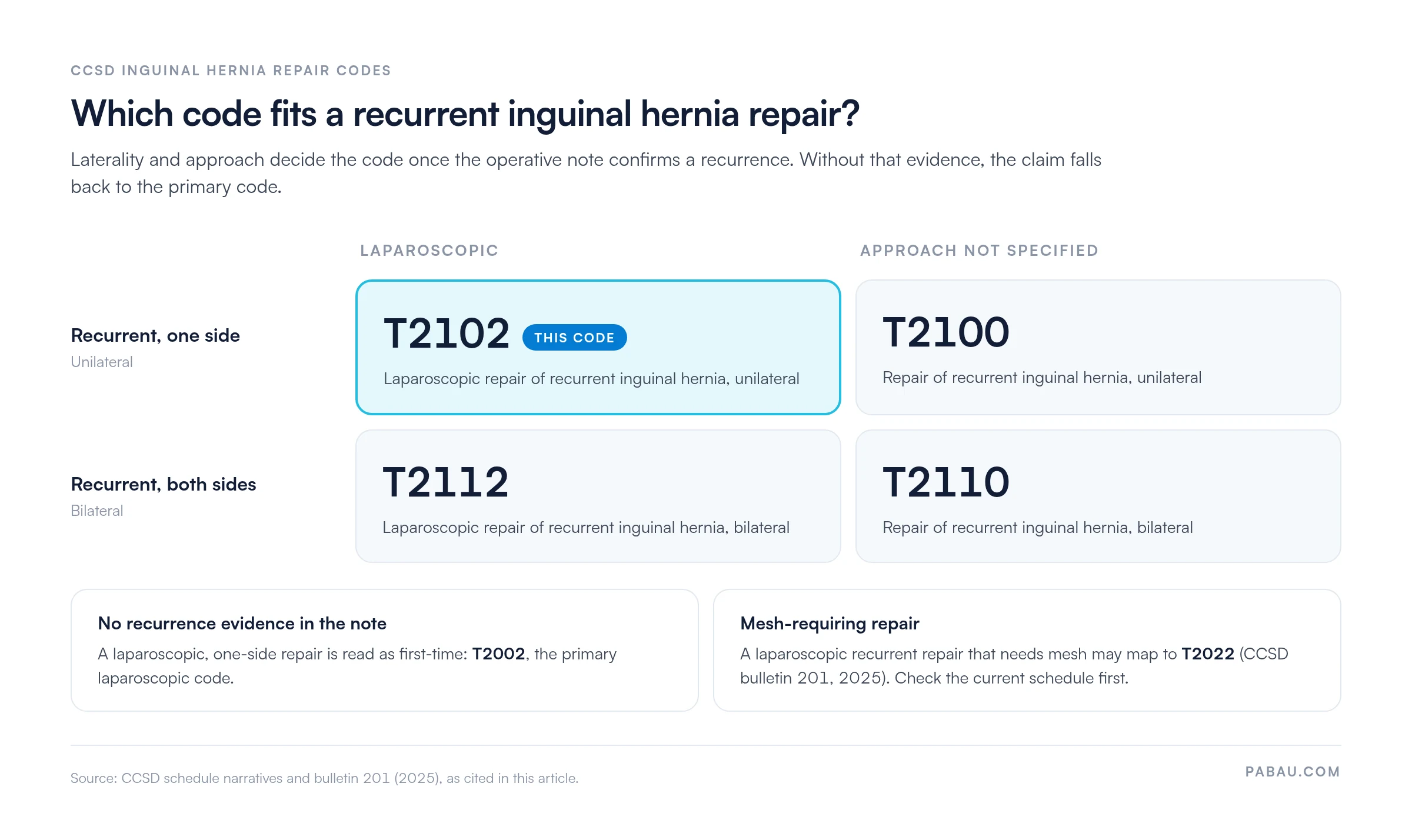
The operative note must state that the surgeon found evidence of the previous repair. Recording that the hernia is recurrent is not enough on its own. Useful phrases include “previous Lichtenstein repair scar noted” or “mesh from prior TEP repair encountered during dissection”. A referral letter can confirm it too, for example “right inguinal hernia repair performed [month/year]”. A pre-operative diagnosis of “recurrent inguinal hernia” will not carry the claim if the operative note does not back it up.
Before the procedure, attach the original surgical report or discharge summary from the first repair to the patient’s file. If that document is unavailable, ask the referring consultant or GP to confirm the date and type of the previous repair in writing. It takes two minutes before the list and prevents a claim downgrade weeks later.
A complete T2102 claim bundle documents each part of the narrative: laparoscopic, recurrent, inguinal and unilateral. The elements below should all be on file before submission.
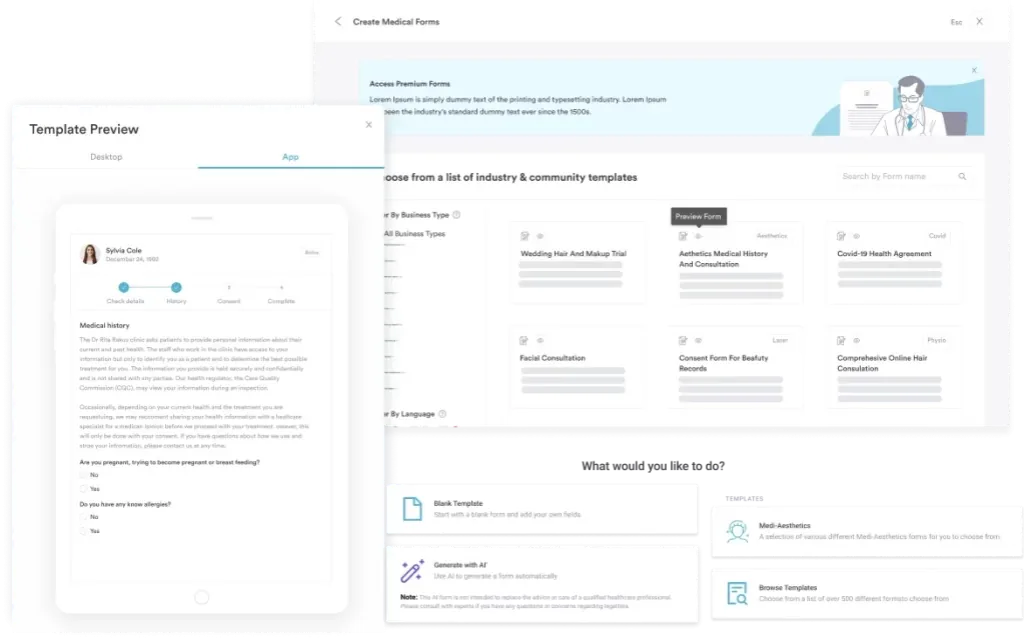
Recording the operative note on a structured digital form, rather than in free text, makes a missing element easier to spot after a busy list. Pabau, a practice management platform, includes digital forms that can hold an operative-note style form against the patient record.
Missing recurrence evidence causes more claim downgrades than any other documentation fault. Without it, the insurer pays the claim as a first-time laparoscopic repair, T2002. The next most frequent fault is a discharge summary that says “hernia repair” instead of repeating the narrative that matches the code.
T2102 is an elective procedure, and the major UK private medical insurers require pre-authorisation before it goes ahead. A T2102 claim without a valid authorisation reference almost always goes unpaid, even when the coding and documentation are correct. The Bupa CCSD codes guide covers how Bupa handles CCSD-coded procedures in more detail.
Each insurer updates its authorisation rules and fee schedule on its own timetable. Check current requirements on the insurer’s provider portal before the procedure date. Record the authorisation reference against the appointment as well, so it travels with the claim instead of getting lost between theatre and billing.
T2102 claims are denied for predictable reasons, and each one traces back to a documentation or process step that can be fixed before submission.
Whether mesh supply and extra intraoperative steps can be billed alongside T2102 depends on each insurer’s bundling rules for the current schedule year.
The schedule itself now separates some of these repairs by mesh. The incisional hernia narratives make the same distinction, and repair code T2500 covers an open incisional repair not requiring mesh. CCSD bulletin 201 (2025) added T2022, a laparoscopic recurrent unilateral repair requiring mesh. A companion narrative, T2014, covers repairs not requiring mesh, and T2102 is listed as an older narrative under review. Check the current schedule before choosing between T2102 and T2022 for a repair that needed mesh.
When bundling is unclear, check the insurer’s fee schedule directly. The Healix fee schedule guidelines and similar insurer guidance set out unbundling rules by CCSD code group. Claiming a bundled item separately never increases payment. It gets that line rejected and can flag the whole claim for audit.
T2102 applies only when the operative note confirms a laparoscopic recurrent repair on one side. When both sides are recurrent and both are repaired laparoscopically in the same session, T2112 is the correct code. T2110 covers a bilateral recurrent repair with no laparoscopic qualifier.
One side may be recurrent while the other is a first-time hernia. Insurers handle this mix differently, so confirm the coding with the insurer’s billing guidance in advance. Some want the higher-complexity code alone, while others accept T2002 and T2102 on the same claim for the separate sides. Document each side in the operative note with its own laterality, episode type and mesh details.
If a bilateral repair is planned but only one side is completed, submit T2102, not T2112. The second repair might be abandoned because of adhesions or patient stability, for example. Code from what was performed, because a T2112 claim for a one-sided procedure will be picked up on audit.
Billing T2102 takes several steps before a claim can go out. The practice obtains pre-authorisation, records the reference, completes the operative note, attaches evidence of the earlier repair and applies the insurer’s bundling rules. When those steps sit in separate inboxes and spreadsheets, one of them slips.
With Pabau’s private practice claims software, practices can record authorisation references against appointments and submit claims through Healthcode and BUPA. The reference recorded at booking stays with the appointment, so the billing team does not chase it after the operation.
Pabau’s digital forms keep the operative note and consent on the same patient record. When an insurer queries the claim, the documents it asks for are already in one place.
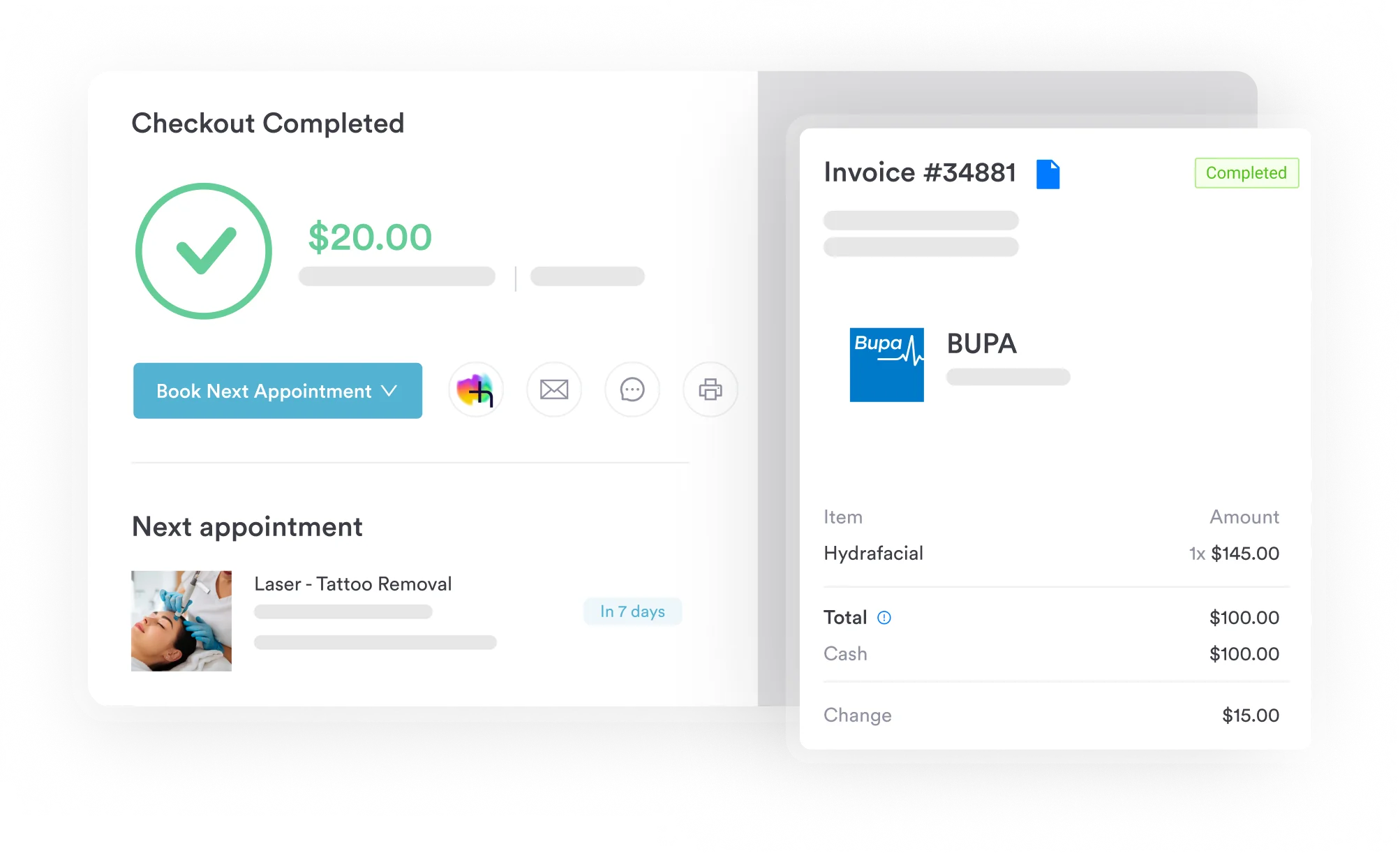

Pabau lets UK private practices record authorisation references against appointments and submit claims through Healthcode and BUPA. Your T2102 claims go out with the authorisation already on file.

The deciding fact for T2102 is the earlier repair. Laterality and approach are rarely disputed, but a missing reference to the previous operation moves the claim to T2002 and a lower tariff.
So capture that evidence before the list, not after the claim comes back. Secure authorisation with the reference recorded, and check whether a mesh repair now belongs under T2022. A practice that does those three things turns T2102 from a frequent query into a routine claim.
Book a demo to see how Pabau keeps authorisation references and insurer claims together for UK surgical practices.

Need a full reference for Bupa procedure coding? Pabau’s Bupa CCSD codes guide covers the insurer’s fee schedule structure, authorisation workflows and common coding errors.
Coding a first-time laparoscopic repair? CCSD code T2002 covers the primary laparoscopic inguinal hernia repair that undocumented T2102 claims fall back to.
Comparing billing tools for a UK practice? Best medical billing software in the UK compares billing systems for UK private practices.
Looking to cut claim rework across your practice? Pabau claims management records authorisation references and submits claims through Healthcode and BUPA.
CCSD Code T2102 covers laparoscopic repair of a recurrent inguinal hernia on one side. It applies when a surgeon repairs, by keyhole surgery, a groin hernia that has returned after an earlier repair on that side. The earlier repair may have been open or laparoscopic. TEP and TAPP techniques both fall under T2102, although a mesh-requiring repair may now map to T2022.
T2102 is the laparoscopic recurrent repair on one side. T2100 is the recurrent repair with no approach specified, so it lacks the laparoscopic qualifier. T2002 is for a first-time laparoscopic unilateral repair. If the operative note never mentions the earlier repair, the insurer can pay the claim at the T2002 tariff.
Yes. T2102 is elective surgery, and the major UK private medical insurers, including Bupa, AXA Health and Aviva, require pre-authorisation before it is carried out. Without an authorisation reference, the claim almost always goes unpaid, however well it is coded and documented.
It depends on the insurer and the schedule year. Some UK private insurers include mesh in the T2102 surgical fee, while others allow a separate implant line. Check the insurer’s bundling rules before adding one, because a bundled item billed separately is rejected. CCSD bulletin 201 (2025) also added T2022 for laparoscopic recurrent repairs requiring mesh, so check the current schedule first.