CPT code 21011: Excision of soft tissue tumor of the face
CPT code 21011: Official descriptor and procedure overview CPT code 21011, as pu...

Last Updated: Oct 8, 2026
Q4116 is the HCPCS Level II code for alloderm, per square centimeter (add-on, list separately in addition to primary procedure).
It applies when AlloDerm is the skin substitute product used, and each documented square centimeter counts as one unit. For CY2026, Medicare pays skin substitute products as incident-to supplies at a single rate of $127.14 per square centimeter.
Coverage runs through LCD L35041, which sets the medical necessity criteria for lower extremity chronic non-healing wounds. Two documentation items decide most claims: the wound measurement taken on the application date, and the record of failed conservative care.
Let Pabau's smart automation suggest the right codes, reduce claim denials, and keep your practice compliant—effortlessly.
Automate repetitive tasks and focus on what matters most—your patients.
Reduce coding errors and ensure compliance with the latest regulations.
Clean claims, fewer denials, and faster reimbursements.
Powerful insights and reporting to help your practice thrive.
HIPAA compliant SOC 2 certified GDPR-compliant Trusted by 4,000+ clinics worldwide

HCPCS code Q4116 describes AlloDerm, an acellular dermal matrix billed per square centimeter of wound area covered.
For CY 2026, Medicare pays most skin substitute products as incident-to supplies at a flat $127.14 per square centimeter.
LCD L35041 sets the medical necessity criteria, including documented wound measurements, failed conservative care, and a covered ICD-10 diagnosis.
Unit miscalculation and missing wound-size documentation are the two most common denial triggers on Q4116 claims.
Capturing wound measurements in structured fields at the point of care keeps the billed units defensible in an audit.
HCPCS code Q4116 describes AlloDerm, per square centimeter. It belongs to the HCPCS Level II Q-code series maintained by the Centers for Medicare & Medicaid Services (CMS).
That series covers supplies and products not adequately described by CPT codes. Q4116 is the correct code when AlloDerm is applied as a skin substitute and billed by wound surface area.
Coders meet Q4116 in wound care, reconstructive surgery, and burn treatment settings. The per-square-centimeter unit structure builds measurement into the code definition. Measure the wound wrong and the units are wrong with it.
AlloDerm is an acellular dermal matrix derived from donated human tissue. During processing, donor cells are removed while the extracellular matrix structure is preserved.
The result is a biological scaffold that the patient’s own cells can repopulate. It supports wound closure and tissue reconstruction without the immunogenic risk of a traditional allograft.
Plastic surgeons, wound care specialists, and burn teams use AlloDerm across a range of reconstructive and reparative indications. Knowing what the product does helps coders apply Q4116 accurately and document clinical necessity in terms the payer accepts.
AlloDerm is a regulated human tissue product subject to FDA oversight. Coders should avoid documentation language that implies cosmetic or off-label use. Coverage turns on medical necessity and the appropriate diagnosis, not on product performance claims.
Billing Q4116 correctly comes down to two things. You need to know how to count units, and you need to know which modifiers your payer expects. Getting either wrong is the fastest route to a denial.
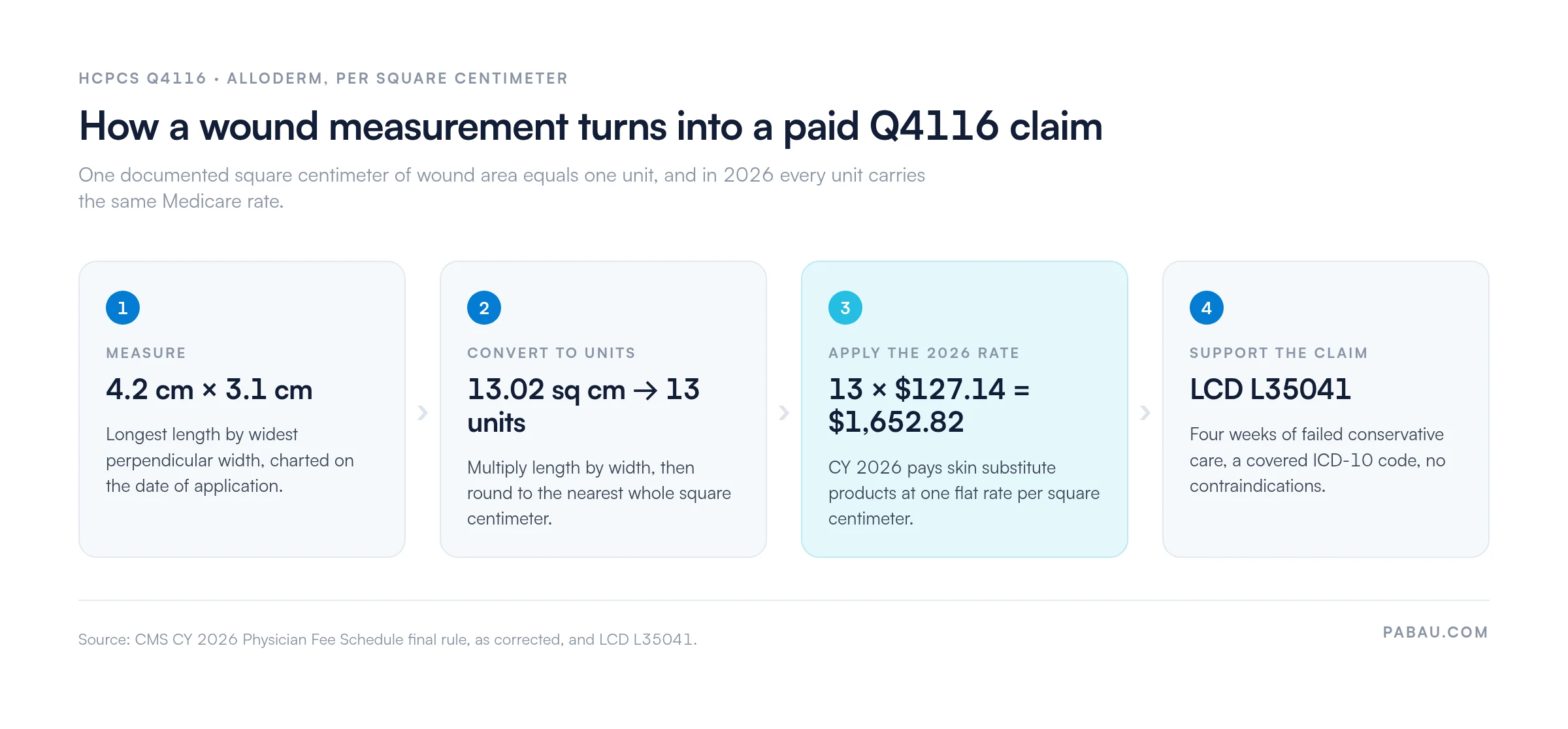
Each unit of Q4116 equals one square centimeter of wound area covered. Measure the wound at its longest length and widest perpendicular width, both in centimeters. Multiply length by width to get the approximate wound area. Round to the nearest whole square centimeter.
Example: A wound measuring 4.2 cm x 3.1 cm = 13.02 sq cm. Bill 13 units of Q4116.
The product code never travels alone on the claim. The application procedure is billed separately, and for a leg wound of this size that is usually CPT code 15271. The wound area you document drives the units on one line and the procedure code on the other.
Document the exact measurements in the medical record at the time of application. CMS and commercial payers treat the wound measurement as the primary audit trigger. If it is not in the chart, the units are not defensible.
Structured intake and treatment forms are the practical fix, because a required field cannot be skipped the way a free-text note can.
Modifier use on Q4116 claims depends on place of service and payer. The table below covers the modifiers most often required by Medicare and the major commercial payers.
Check with your Medicare Administrative Contractor (MAC) for jurisdiction-specific modifier requirements. MAC policies vary, and the wrong modifier combination is a common denial driver. Treat modifier selection as a pre-submission checkpoint rather than something you correct after a denial arrives.
Audit Q4116 claims quarterly. Pull every submission and compare the billed units against the wound measurements in the chart. Flag any claim where the measurement predates the date of application. That one review catches most unit miscalculations before a payer audit finds them.
CMS changed how it pays for skin substitutes in 2026. Under the CY 2026 Physician Fee Schedule final rule, products such as AlloDerm are paid as incident-to supplies rather than as biologicals. The rate is one figure per square centimeter, the same for every product, in both the physician office and the hospital outpatient department.
That figure is $127.14 per square centimeter. A technical correction in November 2025 revised it down from the $127.28 the final rule first published. Product-specific average sales price (ASP) pricing no longer applies in either setting.
The change lands hardest on practices that built their expectations around the old ASP rates. A high-cost product and a low-cost product now pay the same per square centimeter. The unit count, and therefore the wound measurement, carries the whole payment.
The chain from the tape measure to the payment is short, and every link in it is a documentation step.
Verify the current figure before each billing cycle. Rates and methodology both change on January 1, so check the CMS Physician Fee Schedule lookup tool or the AAPC HCPCS code reference. A claim priced from last year’s schedule invites partial payment or a recoupment request.
Flag every Q4116 claim where the units exceed 20 for a second review before submission. Large wounds are legitimate, but high unit counts attract pre-payment review from MACs. Confirming that the measurement is complete and contemporaneous takes minutes and prevents months of appeals.
Medicare coverage for HCPCS code Q4116 is governed by LCD L35041, Application of Bioengineered Skin Substitutes to Lower Extremity Chronic Non-Healing Wounds.
The LCD sets out when AlloDerm is medically necessary and names the non-covered indications. Its scope is the lower extremity, so an application at another body site is judged under your MAC’s other applicable policies.
Most commercial payers model their own AlloDerm coverage policies closely on this LCD framework, which is why the same documentation usually satisfies both.
To satisfy LCD L35041, the claim must reflect that the patient’s wound meets all of the following conditions. Missing documentation for any single item is grounds for denial.
The LCD also bears on prior authorization. Medicare does not universally require prior authorization for Q4116, but many commercial payers do, particularly Aetna and Blue Cross Blue Shield plans.
Check the specific plan before applying AlloDerm in a non-emergency setting. Confirming authorization before the procedure costs far less than appealing after it.
Aetna considers AlloDerm medically necessary for chronic non-healing wounds when the LCD-equivalent criteria are met, per Clinical Policy Bulletin 0244. Bulletin versions are revised, so verify the current one before you submit.
Aetna treats certain cosmetic and off-label applications as experimental or investigational. Blue Cross Blue Shield plans follow similar frameworks, but the detail varies by regional affiliate.
Q4116 claims must be paired with a covered ICD-10 diagnosis code from the LCD L35041 covered diagnoses list. The table below shows the codes paired most often in wound care and reconstructive surgery. Always verify against the current fiscal year ICD-10-CM edition.
Use the most specific code available. Payers deny claims submitted with unspecified codes when a more specific laterality or stage code exists. ICD-10-CM codes diabetic ulcers by foot site and pressure injuries by location and stage, so defaulting to an unspecified code is a preventable denial.
AlloDerm is one of many skin substitute products in the Q4100 series. When the product applied is not AlloDerm, Q4116 is the wrong code. The table below covers the codes coders confuse with it most often. For the wider series, work from our HCPCS code reference and match the product name in the procedure note.
Human origin alone does not settle the code. GammaGraft, a gamma-irradiated human skin allograft, bills under Q4111 rather than Q4116.
Billing Q4116 when a different skin substitute was applied is a miscoding error with audit and recoupment consequences. Match the HCPCS code to the product lot number documented in the operative or procedure note.
Wound care billers see the same Q4116 rejection reasons over and over. Six patterns account for most of them, and all six are documentation problems rather than coding problems.
Build denial review into a recurring audit cycle. Working each rejection in isolation costs more staff time than reviewing a month of Q4116 claims in one sitting.
Most practices bill Q4116 from two records that never meet. The wound measurement sits in the clinical note, the units sit in the billing system, and somebody retypes one into the other. Each retype is a chance to bill 15 units for a 13 unit wound.
Practice management software like Pabau keeps both in the same record. Wound length, width, and area are captured in a structured treatment form at the point of care. The claim is built from that record, so the billed units and the charted measurement come from one number.
That is also what an audit asks for. When a MAC requests documentation on a Q4116 claim, the evidence sits on the encounter already.
The measurement, the application date, the diagnosis, and the product details are all in one place. Practices that streamline claims management this way spend far less time rebuilding a record after the fact.

Pabau connects wound measurement capture, treatment notes, and claim submission in one workflow. Your billing team has the documentation it needs before the claim goes out.

Q4116 is a simple code with an unforgiving unit rule. The 2026 flat rate makes the measurement matter more than the product. The same dollar figure now attaches to every square centimeter you can document.
So the work sits upstream of the claim. Measure on the day of application, record the failed conservative care, pair a covered diagnosis, and confirm what your MAC expects on modifiers. A claim built that way rarely needs an appeal.
Book a demo to see how Pabau captures wound measurements and builds Q4116 claims from the same patient record.

Applying a different acellular dermal matrix? HCPCS code Q4107 covers GraftJacket, the product coders most often mistake for AlloDerm.
Billing a living bilayered skin substitute instead? HCPCS code Q4101 covers Apligraf, which carries its own unit and coverage rules.
Working through repeated skin substitute rejections? Denial management in healthcare covers how to bring denial rates down and run appeals efficiently.
Want to see where coding sits in the wider cycle? Revenue cycle management explains each step from charge capture through payment posting.
HCPCS code Q4116 is the Level II code for AlloDerm, billed per square centimeter of wound area covered. AlloDerm is an acellular dermal matrix derived from donated human tissue. The code is used in wound care, burn treatment, and reconstructive surgery.
For CY 2026, Medicare pays most skin substitute products, Q4116 included, at a single rate of $127.14 per square centimeter. The product is paid as an incident-to supply rather than as a biological, in both the physician office and the hospital outpatient department. Verify the current figure with the CMS Physician Fee Schedule lookup tool before submitting.
Common modifiers are KX for confirmed LCD criteria and AW for an item furnished with a surgical dressing. GA covers an ABN on file, and GZ flags an item expected to be denied as not medically necessary. Modifier requirements vary by MAC jurisdiction, so confirm with your own Medicare Administrative Contractor before submitting.
Medicare does not universally require prior authorization for Q4116, but many commercial payers do, including Aetna and BCBS plans. Always verify authorization requirements for the specific plan before applying AlloDerm in a non-emergency setting, because retrospective appeals on non-authorized claims rarely succeed.
The AlloDerm HCPCS code is Q4116, and it cannot be substituted for another skin substitute product. GraftJacket is billed as Q4107, Apligraf as Q4101, and Oasis wound matrix as Q4102. The product applied must match the HCPCS code selected, verified against the lot number in the procedure note.
Four items support the claim. You need wound measurements in centimeters taken on the date of application, plus four weeks of documented conservative treatment failure. You also need a covered ICD-10 diagnosis and a product lot number matching the code billed. Missing any single element is grounds for denial under LCD L35041.