HCPCS Code Q4175: Billing, coverage, and documentation guide
HCPCS Code Q4175: Code Description and Product Identity HCPCS Code Q4175 is the ...

Last Updated: Nov 20, 2026
Q4130 is the HCPCS Level II code for Strattice TM, a porcine acellular dermal matrix, billed per square centimeter. It is an add-on supply code, so it always sits beside the procedure code for applying or implanting the graft.
One unit equals one square centimeter of product used. Most denials trace to missing wound measurements, the wrong companion CPT, or a missing payer-required modifier.
Let Pabau's smart automation suggest the right codes, reduce claim denials, and keep your practice compliant—effortlessly.
Automate repetitive tasks and focus on what matters most—your patients.
Reduce coding errors and ensure compliance with the latest regulations.
Clean claims, fewer denials, and faster reimbursements.
Powerful insights and reporting to help your practice thrive.
HIPAA compliant SOC 2 certified GDPR-compliant Trusted by 4,000+ clinics worldwide

HCPCS code Q4130 reports Strattice TM, a porcine acellular dermal matrix, in units of one square centimeter of product.
Q4130 is an add-on supply code, so it always goes on the claim with the procedure that placed the product.
Since January 2026, Medicare pays for skin substitutes used in the office as incident-to supplies at one flat rate of about $127 per sq cm.
If the governing LCD or payer requires modifier KX, omitting it can trigger a denial.
Pabau’s claims management software sends electronic claims through Claim.MD in the US and stores wound measurements and photos against the visit.
HCPCS code Q4130 is the Level II code for Strattice TM, per square centimeter. Strattice is an FDA-cleared acellular dermal matrix made from pig skin by LifeCell, now part of AbbVie. The code is still active in the CMS HCPCS quarterly files for 2026.
The official descriptor ends with “add-on, list separately in addition to primary procedure.” That wording matters. Q4130 pays for the material only, and it never stands alone on a claim. A procedure code for placing the graft always sits beside it.
One warning before you go further. Older references, including an earlier version of this page, tied Q4130 to SurGraft and FlexHD. FlexHD now bills under Q4128, and SurGraft has its own code too. Check any template or charge sheet built from those sources.
Most billers meet Q4130 on wound care claims, but Strattice was built as a surgical tissue matrix. Surgeons use it to reinforce soft tissue in breast reconstruction, abdominal wall and hernia repair, and other reconstructive work.
That range changes the coding. When Strattice is laid on a wound surface, the procedure comes from the 15271-15278 application family. When a surgeon implants it to reinforce tissue, the add-on CPT 15777 usually describes the work instead.
Setting changes it too. In an inpatient or hospital operating room, the product is normally part of the facility’s payment rather than a separate physician line. Q4130 earns its own claim line mostly in office and outpatient wound care.
Here is the path a clean office claim follows, step by step. Each hand-off is a place where a detail can drop out.
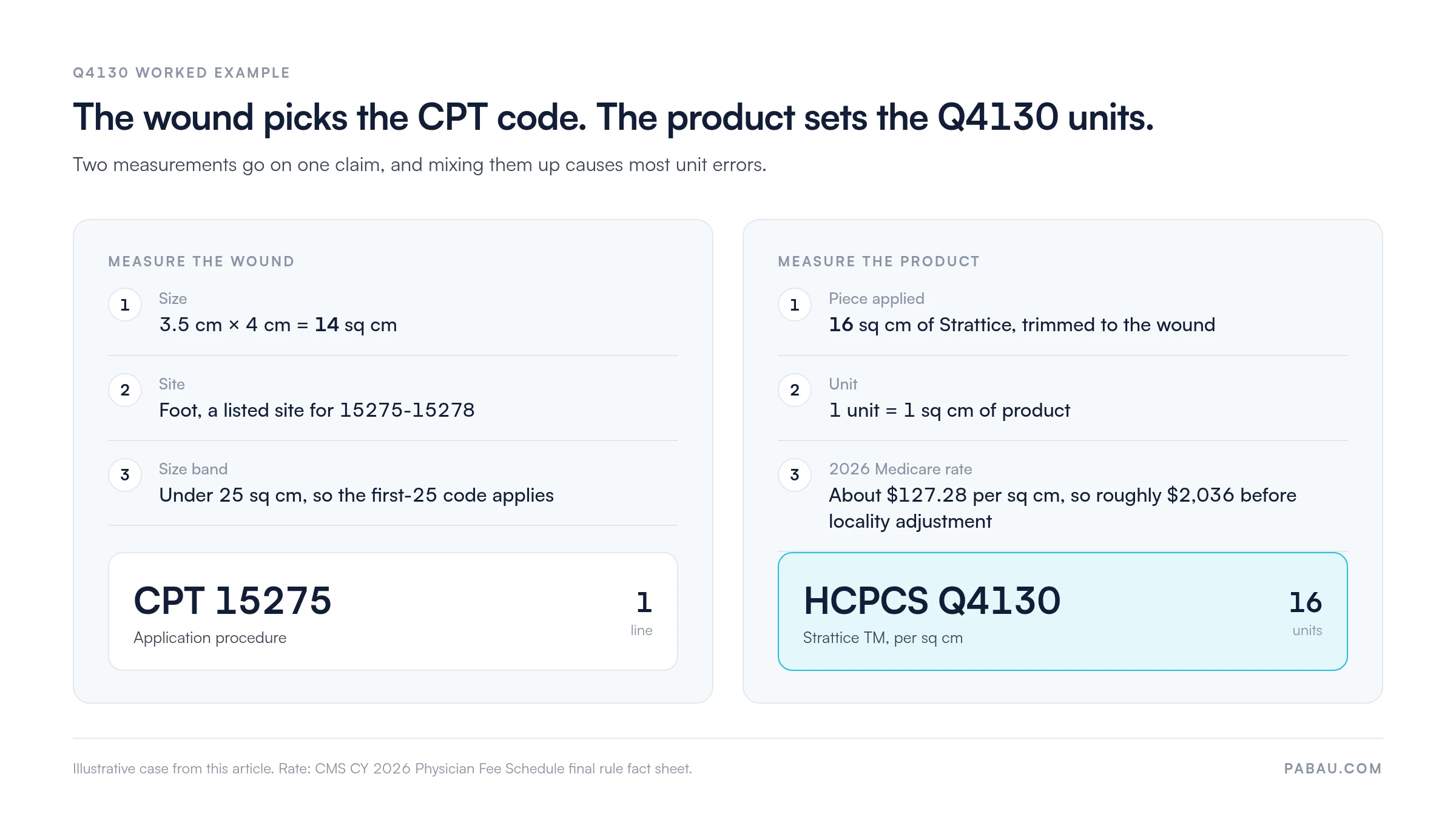
Two different measurements drive this claim, and mixing them up causes most unit errors. Q4130 units count the square centimeters of Strattice used. The application CPT is chosen from the wound’s surface area and location.
Take an illustrative case, laid out side by side below. A diabetic foot ulcer measures 3.5 cm by 4 cm, so 14 sq cm. The surgeon trims and applies a 16 sq cm piece. The procedure is 15275, because the foot is a listed site and the wound is under 25 sq cm. Q4130 goes on the claim with 16 units.
Size the sheet to the wound. Payers compare the product billed with the wound documented, and a large mismatch invites a records request. Ask your MAC how it wants any discarded portion reported for 2026.
Codes 15271-15272 and 15275-15276 apply when the total wound area is under 100 sq cm. The 15273 and 15277 families take over once it reaches 100 sq cm. A foot ulcer coded as 15271 instead of 15275 is a site mismatch that payer edits pick up.
Make sure the POS on the claim matches where the work happened. A physician claim that lists Q4130 in a facility setting can come back as included in another payment.
Medicare has no national coverage determination for skin substitutes. Coverage follows the legacy LCD that each Medicare Administrative Contractor (MAC) still runs. Two new skin substitute LCDs, L39756 and L39764, were withdrawn on 24 December 2025, before their 1 January 2026 start date.
So the rules depend on your jurisdiction. Look up your MAC’s current policy and billing article in the CMS Medicare Coverage Database. Common criteria include a wound that has failed a period of standard care, measurements at each visit, and limits on the number of applications.
Payment changed at the same time. The CY 2026 Physician Fee Schedule final rule reclassified skin substitutes as incident-to supplies when used in a covered application. In the office and hospital outpatient settings they now share one rate, which CMS puts at approximately $127.28 per square centimeter. Published figures vary slightly between sources, and locality adjustments move the paid amount further.
Applied to the 16-unit example above, that is roughly $2,036 for the product before adjustments. Check your locality’s figure in the fee schedule rather than relying on a national number.
Prior authorization is a payer-by-payer question. Commercial plans and Medicare Advantage plans often require it, and some cover Strattice only for certain indications. Confirm it before the first application of each episode.
Medical billing compliance for skin substitutes depends on notes written at the visit, not rebuilt after a denial. A complete Q4130 record holds these items.
No modifier goes on Q4130 by default. The right one depends on the payer’s policy and on whether the patient signed an Advance Beneficiary Notice (ABN).
KX deserves a check on every claim. If the governing LCD or payer requires KX, omitting it can cause a denial. Adding it without notes that meet each criterion creates an audit risk instead.
Every skin substitute product has its own code, and clinical similarity does not let you swap them. These are the codes most often mixed up with Q4130.
Q4100, the old “not otherwise specified” code, was deleted on 31 December 2025. Its job now falls to Q4431, Q4432 and Q4433, split by the product’s FDA pathway. None of them should replace Q4130 when Strattice is the product applied.
Check the CMS HCPCS file every quarter, not only in January. Skin substitute codes are added, revised and deleted often. Rebuild any charge sheet line that still maps Strattice to an old code or product name.
Repeated CO-197 denials point to an authorization tracking problem, not a coding one. Read the remark codes on the remittance alongside each CARC, because they often name the missing item. Our guide to denial codes in medical billing explains the full set.
For the wider workflow, denial management in healthcare covers how to sort denials by root cause and stop them repeating.
The mistakes that slip through most often are predictable.
Skin substitute claims fail when the wound notes, photos and product details sit in different places. The biller then codes from memory, and the MAC’s records request exposes it.
Pabau, a practice management platform with built-in claims management software, stores wound measurements and photos against the visit. Your team codes the claim from the same record the clinician completed, so the units and notes line up.
In the US, claims go out electronically through Claim.MD, with eligibility checks and remittance posting in the same system. When a denial does come back, the supporting record is already attached to the visit.
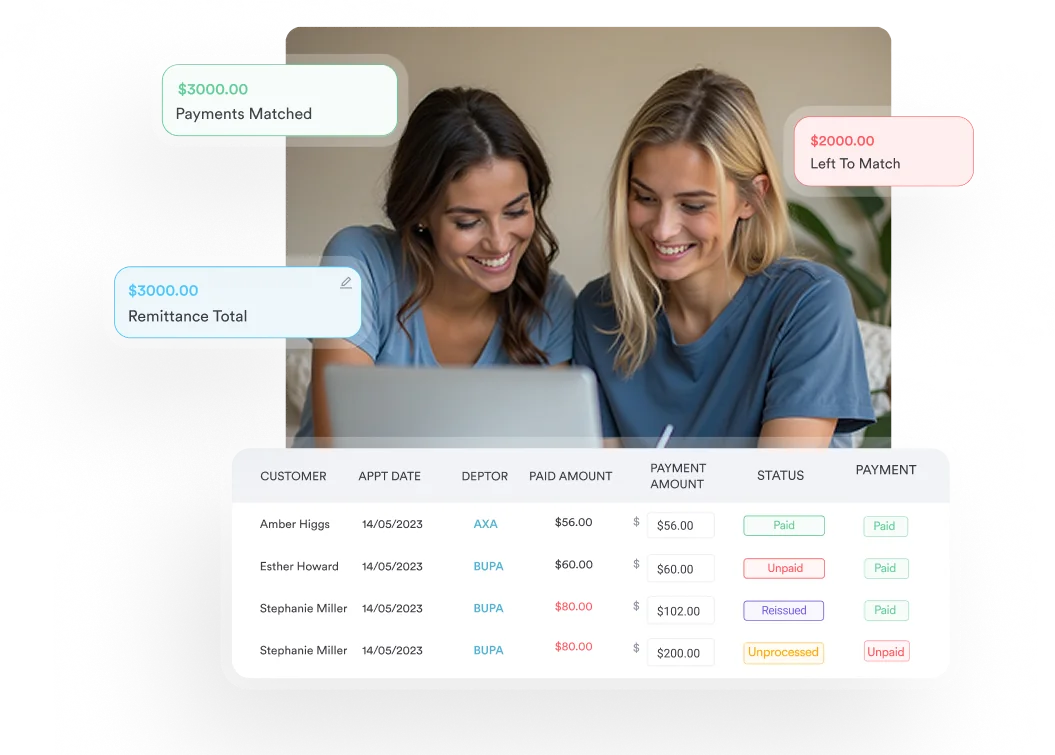

Pabau stores wound measurements and photos against the visit and sends electronic claims through Claim.MD in the US. Your team codes Q4130 from the same notes an auditor would read.

Q4130 is a narrow code with a lot riding on it. Get the product right first, because a Strattice claim built on another product’s code fails however good the notes are.
After that, the 2026 changes are where to spend your attention. Coverage now depends on your MAC’s legacy policy, and the product pays at a flat rate. Check both before the next application rather than after the first denial.
Pabau keeps the measurements, photos and claim on one visit record. Book a demo to see how Pabau supports skin substitute billing for wound care practices.

Want a clean claim on the first pass? Clean claim submission outlines the data elements every payer checks before adjudication.
Comparing Strattice with a human-derived matrix? HCPCS code Q4116 covers AlloDerm billing per square centimeter.
Billing FlexHD on the same day? HCPCS code Q4128 explains how FlexHD and AllopatchHD are coded.
Looking at cash flow across your claims? Revenue cycle management shows where claims slow down between visit and payment.
Billing another skin substitute at the 2026 flat rate? HCPCS code Q4127 covers Talymed, billed per square centimeter.
Yes. Strattice is processed porcine dermis with the cells removed, leaving a collagen scaffold. Some patients decline animal-derived products for religious or personal reasons, so record that conversation in the consent note.
No. Both come from LifeCell, but AlloDerm is made from donated human skin. AlloDerm bills under Q4116, while Strattice bills under Q4130.
Q4100 was deleted on 31 December 2025. Q4431 now covers PMA products, Q4432 covers 510(k) products and Q4433 covers 361 HCT/P products, each not otherwise specified.
No. Medicare excludes cosmetic surgery, so Strattice used in a purely cosmetic procedure is not covered. Breast reconstruction after mastectomy is reconstructive, so check the payer’s policy for that case.
Only when the visit is significant and separately identifiable from the application. Codes 15271-15278 carry a zero-day global period, so a routine wound check that day is bundled. Append modifier 25 to the E/M code when the notes support it.