

HCPCS Code Q4175: Billing, coverage, and documentation guide
HCPCS Code Q4175: Code Description and Product Identity HCPCS Code Q4175 is the ...

Last Updated: Nov 20, 2026
Q4146 is the HCPCS Level II code for Tensix, per square centimeter, an add-on code billed in addition to the primary skin substitute application procedure. Payer policies describe TenSIX as an acellular dermal matrix for chronic wounds such as diabetic foot ulcers and venous leg ulcers.
Since January 1, 2026, Medicare pays Q4146 as an incident-to supply at a single rate of $127.14 per square centimeter. Claims need the units of product applied, the right application CPT or G code, and the documentation the payer requires.
Let Pabau's smart automation suggest the right codes, reduce claim denials, and keep your practice compliant—effortlessly.
Automate repetitive tasks and focus on what matters most—your patients.
Reduce coding errors and ensure compliance with the latest regulations.
Clean claims, fewer denials, and faster reimbursements.
Powerful insights and reporting to help your practice thrive.
HIPAA compliant SOC 2 certified GDPR-compliant Trusted by 4,000+ clinics worldwide

HCPCS Code Q4146 reports TenSIX, a skin substitute billed per square centimeter of product applied, as an add-on to the application procedure.
Bill units for the product applied, rounded to whole square centimeters under your MAC’s policy, because wound size only drives the application code.
From January 1, 2026, Medicare rejects Q4146 claims that carry JW or JZ, and discarded product is not payable at all.
Medicare now pays Q4146 as an incident-to supply at a single CY2026 rate of $127.14 per square centimeter.
Pabau, the practice management platform we build, keeps wound measurements and lot numbers on the patient record and submits US claims electronically.
HCPCS Code Q4146 is the Level II code for Tensix, per square centimeter, an add-on code billed in addition to the primary application procedure. CMS publishes the code and its official descriptor in its quarterly HCPCS code files.
Like other codes in the Q4100 series, Q4146 identifies one named product, FDA-regulated as a tissue product, device or biologic. CMS can retire or reassign these codes, so check the current mapping in the latest CMS HCPCS release before billing. Architect, for example, is a 510(k)-cleared device billed under Q4147.
Medicare Part B and most commercial payers that follow Medicare conventions recognize the code. It is billed in the physician office, the ambulatory surgical center (ASC) and the hospital outpatient department (HOPD).
Since January 1, 2026, Medicare pays skin substitutes such as Q4146 as incident-to supplies rather than as drugs or biologicals. The office is paid under the Physician Fee Schedule (PFS), and facilities under the Outpatient Prospective Payment System (OPPS) and the ASC payment system.
Q4146 is billed when TenSIX is applied to a chronic, non-healing wound that has not closed with conservative care. Typical indications are diabetic foot ulcers (DFUs), venous leg ulcers (VLUs) and other chronic full-thickness or partial-thickness wounds.
Payers generally do not cover it for acute traumatic wounds, surgical wounds healing by primary intention, or stage 1 and 2 pressure injuries.
Billing Q4146 for an unsupported wound type carries risk. It can expose the practice to False Claims Act liability if documentation does not support medical necessity. Match the clinical note to the indication before the code goes on the claim.
Units for Q4146 are billed per square centimeter (sq cm) of product applied to the wound. Wound size does not set the units. It only drives the choice of application code. Liquid skin substitutes use a different unit, and HCPCS code Q4174, for example, is reported per 0.25 cc. The same brand in sheet form, PalinGen or PalinGen Xplus, reports per square centimeter under sheet code Q4173.
Measure the product you applied, calculate its area, then round to whole square centimeters under your MAC’s policy. Many MACs round fractions of 0.5 sq cm or more up and smaller fractions down.
Never bill for the full size of the product sheet if only part of it was applied. Medicare pays nothing for discarded product, so the units on the claim are the units on the wound. Overbilling units is an audit flag that the Office of Inspector General (OIG) has cited in its skin substitute oversight work.
Q4146 pays for the product, not the procedure, so the application goes on the same claim. Sheet products take a CPT code from the 15271-15278 range. From January 1, 2026, a non-sheet product takes G0681-G0684 instead. Payer policies list TenSIX as an acellular dermal matrix, so confirm the form of the product you applied before choosing a range.
Within 15271-15278, the code depends on where the wound sits and on its surface area. The trunk, arms and legs use one set of codes, and the face, scalp, hands, feet and genitalia use another.
Diabetic foot ulcers under 100 sq cm usually fall under 15275 or 15276, since the foot is a designated anatomical region. A leg ulcer of the same size starts at 15271 instead. Document the exact wound location in the procedure note to justify the CPT selection.
From January 1, 2026, Q4146 is a non-BLA skin substitute paid as an incident-to supply, so the drug wastage modifiers no longer fit. First Coast and Noridian guidance says claims carrying JW or JZ are rejected. Discarded product is not payable at all.
Record the product lot number, the area applied and any product discarded in the procedure note. The note backs the units billed, even though the discarded portion earns nothing.
Audit your charge entry template for Q4146. If it still defaults JZ or JW onto the line, every 2026 claim built from it will be rejected. Remove both, and add JC or JD only where your MAC asks for it.
Every Q4146 claim needs at least one ICD-10-CM code for the wound type documented in the clinical record. A diagnosis code that does not match the wound description in the notes fails a documentation review.
The E11.621 page covers the type 2 diabetic foot ulcer code in more depth. Where a covered-diagnosis list still applies, it sits in your MAC’s own policy, and lists vary between MACs such as CGS, Palmetto GBA and Noridian.
Coverage for Q4146 depends on whether your MAC still has a skin substitute Local Coverage Determination (LCD). The new DFU and VLU skin substitute LCDs were withdrawn on December 24, 2025, before they took effect.
Only some legacy MAC policies remain, such as those from Novitas, First Coast and CGS. Confirm the policy for your jurisdiction in the Medicare Coverage Database.
Where a legacy policy applies, its criteria govern the claim. Where none does, medical necessity still rests on the record. That means the wound’s history, the conservative care tried and the reason a graft was chosen.
Prior authorization for Q4146 varies by payer. Some Medicare Advantage and commercial plans require it before the first application, while others review documentation with the claim. Check the payer’s authorization portal before treating, and record the authorization number on the claim when you obtain it.
Inadequate documentation is the leading reason Q4146 audits end in an overpayment demand. Payers expect a complete clinical record that supports every element of the claim. Digital wound measurement forms can standardize this capture at the point of care.
Reviewing medical billing compliance practices before each claim cycle reduces the risk of documentation-related denials and prepares the practice for a post-payment audit.
Q4100 is the skin substitute “not otherwise specified” (NOS) code. It is used only when no specific Q4xxx code exists for the product applied. Defaulting to Q4100 when a specific code like Q4146 is available is an audit risk. Payers expect the most specific code, and OIG has flagged NOS code overuse in skin substitute audits.
The most common denial codes on skin substitute claims fall into predictable patterns. Reviewing your team’s denial management workflows for Q4146 against the 2026 rules prevents repeat losses.
Medicare appeals follow a five-level process. For most Q4146 denials, the first step is a redetermination request submitted to the MAC within 120 days of the initial determination. Gather the clinical record, wound photographs, the product invoice with lot number, and any MAC policy language that supports coverage.
If the redetermination upholds the denial, a qualified independent contractor (QIC) reconsideration is the second level. An Administrative Law Judge (ALJ) hearing, the Medicare Appeals Council and federal district court follow. Document every appeal submission with a tracking number and confirmation of receipt.
Before submitting a Q4146 appeal, check which MAC policy, if any, was in effect on the date of service. Skin substitute rules changed sharply on January 1, 2026, and the version governing the denied claim is the one that matters.
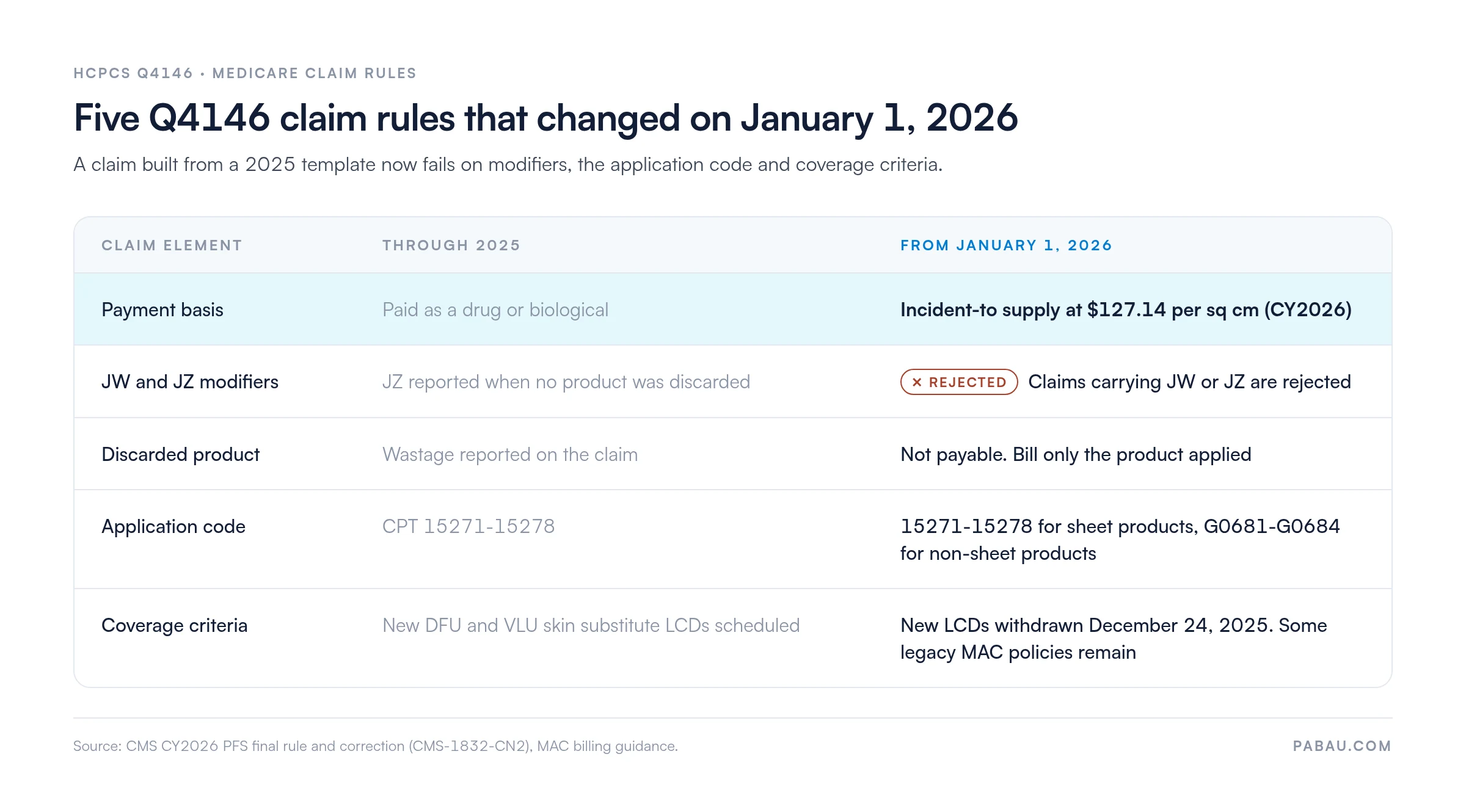
For CY2026, Medicare pays Q4146 as an incident-to supply at a single rate of $127.14 per square centimeter. CMS confirmed that figure in a correction to the 2026 PFS final rule, which replaced the $127.28 first published. The office rate is geographically adjusted under the PFS, and facilities are paid the same rate through OPPS and the ASC payment system.
The rate is one of five claim rules that changed together on January 1, 2026, as the comparison below shows.
Commercial payers typically reimburse at a percentage of the Medicare allowable or at a separately negotiated rate. Check your payer contracts and use the AAPC HCPCS code lookup and PGM Billing HCPCS tool to verify the current descriptor and payment context.
The claim form and payment pathway for HCPCS Code Q4146 differ by place of service. Using a wound care superbill configured for each setting avoids mixing claim elements that belong in different settings.
In the office, one physician often applies the graft and bills for the product. The professional claim (CMS-1500) then captures both Q4146 and the application code. In HOPD, the facility and professional components are billed separately. Confirm the billing separation with your compliance team to avoid duplicate payment issues.
Q4146 claims rise or fall on details recorded at the chair: the product area, the lot number and the application code. In Pabau, staff record wound measurements and lot numbers on the patient record, beside the procedure note.
Pabau supports insurance billing as well. In the US, our claims management software submits claims electronically and tracks them through to the remittance.
Your coders still choose the modifiers and units. The difference is that every billed unit traces to a measurement on the record the claim came from.

Pabau keeps wound measurements and lot numbers on the patient record, and US practices submit claims electronically from the same system.

Q4146 billing changed more on January 1, 2026 than in the years before it. The product is now a supply paid at one national rate, and wastage modifiers get the line rejected. Coverage runs through whatever legacy policy your MAC keeps.
So the work moves upstream, into the template and the procedure note. Strip JW and JZ from the charge template, and bill units from the product rather than the wound. Then match the application code range to the product’s form. Those three changes stop the denials that the claim itself causes.
Book a demo to see how Pabau keeps wound measurements and lot numbers on the record your Q4146 claims are built from.

Need a broader overview of how claims move through a clearinghouse? Medical claims clearinghouse guide explains how electronic claims are validated, routed, and adjudicated before reaching the payer.
Want to understand what makes a claim clean before submission? Building a clean claim covers the data elements payers check at intake and how to satisfy them every time.
Looking for a workflow to manage electronic remittance after a Q4146 claim pays? Electronic remittance advice (ERA) explained walks through reading 835 files and posting payments correctly.
HCPCS Code Q4146 reports TenSIX, a skin substitute product applied to chronic wounds such as diabetic foot ulcers and venous leg ulcers. It is a Level II HCPCS code maintained by CMS. It is billed per square centimeter of product applied, alongside an application code from 15271-15278 or, for non-sheet products, G0681-G0684.
Q4146 identifies a specific named skin substitute product, while Q4100 is the “not otherwise specified” code used only when no specific Q4xxx code exists. Using Q4100 when Q4146 applies is an audit risk flagged by OIG. Always bill the most specific code.
Multiply the length by the width of the product applied, in centimeters, to get its area in sq cm. Then round to whole square centimeters under your MAC’s rule, commonly rounding up at 0.5 sq cm. Bill the product applied, never the full sheet, because discarded product is not payable.
Medicare Part B pays Q4146 as an incident-to supply, at $127.14 per square centimeter in CY2026. Coverage depends on whether your MAC still has a skin substitute LCD, since the new DFU and VLU LCDs were withdrawn on December 24, 2025. Confirm your MAC’s policy in the CMS Medicare Coverage Database.
Prior authorization for Q4146 varies by payer. Some Medicare Advantage and commercial plans require it before the first application, and others review documentation with the claim. Confirm the requirement with the specific payer before treating.
Since January 1, 2026, a JW or JZ modifier on the line gets the claim rejected. Other common causes are unsupported medical necessity, unit counts that do not match the product applied, and the wrong application code range. Missing prior authorization, a wrong place-of-service code and thin wound documentation round out the list.





