

CCSD Code D1010: Radical mastoidectomy including meatoplasty
CCSD Code D1010: Definition and clinical scope CCSD Code D1010 is the UK private...

Last Updated: Nov 25, 2026
K0852 is the HCPCS Level II code for power wheelchair, group 3 very heavy duty, sling/solid seat/back, patient weight capacity 451 to 600 pounds.
It is a no-power-option base. A very heavy duty chair that runs power tilt, recline or a standing system codes to K0860 or K0863. A captain's chair codes to K0853. Medicare requires prior authorization before delivery.
Let Pabau's smart automation suggest the right codes, reduce claim denials, and keep your practice compliant—effortlessly.
Automate repetitive tasks and focus on what matters most—your patients.
Reduce coding errors and ensure compliance with the latest regulations.
Clean claims, fewer denials, and faster reimbursements.
Powerful insights and reporting to help your practice thrive.
HIPAA compliant SOC 2 certified GDPR-compliant Trusted by 4,000+ clinics worldwide

K0852 bills a Group 3 very heavy duty power wheelchair with a sling or solid seat/back and a 451 to 600 pound weight capacity.
K0852 is a no-power-option base. A very heavy duty base that runs power tilt, recline or a standing system codes to K0860 or K0863 instead.
Medicare’s power mobility LCD covers a very heavy duty base for patients weighing 428 to 600 pounds, so record the measured weight.
Medicare has required prior authorization for K0852 nationwide since September 1, 2018, plus a face-to-face encounter and a written order before delivery.
Pabau, a practice management platform, keeps the evaluation notes, signed order and authorization decision on one patient record, so the claim matches the file.
HCPCS code K0852 is the Level II code for a Group 3 very heavy duty power wheelchair with a sling or solid seat/back. The chair is rated for patients weighing 451 to 600 pounds, and the base has no power seating option. CMS publishes the official descriptor and the code’s payment conditions in its DMEPOS master list entry for K0852.
Three attributes place a chair in K0852, and each one has a neighbor code. The performance group is 3, the weight tier is very heavy duty, and the seat is sling or solid. Change any one of them and the code changes.
K0852 belongs to the no-power-option series, K0848 to K0855. Those eight codes differ only by weight tier and seat type. The power-option codes start at K0856.
K0852 covers the power wheelchair base, built to Group 3 performance standards and rated to carry 451 to 600 pounds. Group 3 is the tier Medicare reserves for patients whose mobility limitation comes from a neurological condition, myopathy or a congenital skeletal deformity.
Seat and back cushions, positioning accessories and other options are billed on their own lines with their own HCPCS codes. They do not change the base code.
Most K0852 coding errors involve a chair that differs in one attribute: weight tier, seat type or power-option capability. Each of those chairs has its own code.
Medicare covers K0852 under LCD L33789, Power Mobility Devices, when the patient meets the general power wheelchair criteria and the Group 3 criteria. The treating practitioner’s notes and the specialty evaluation have to show each one.
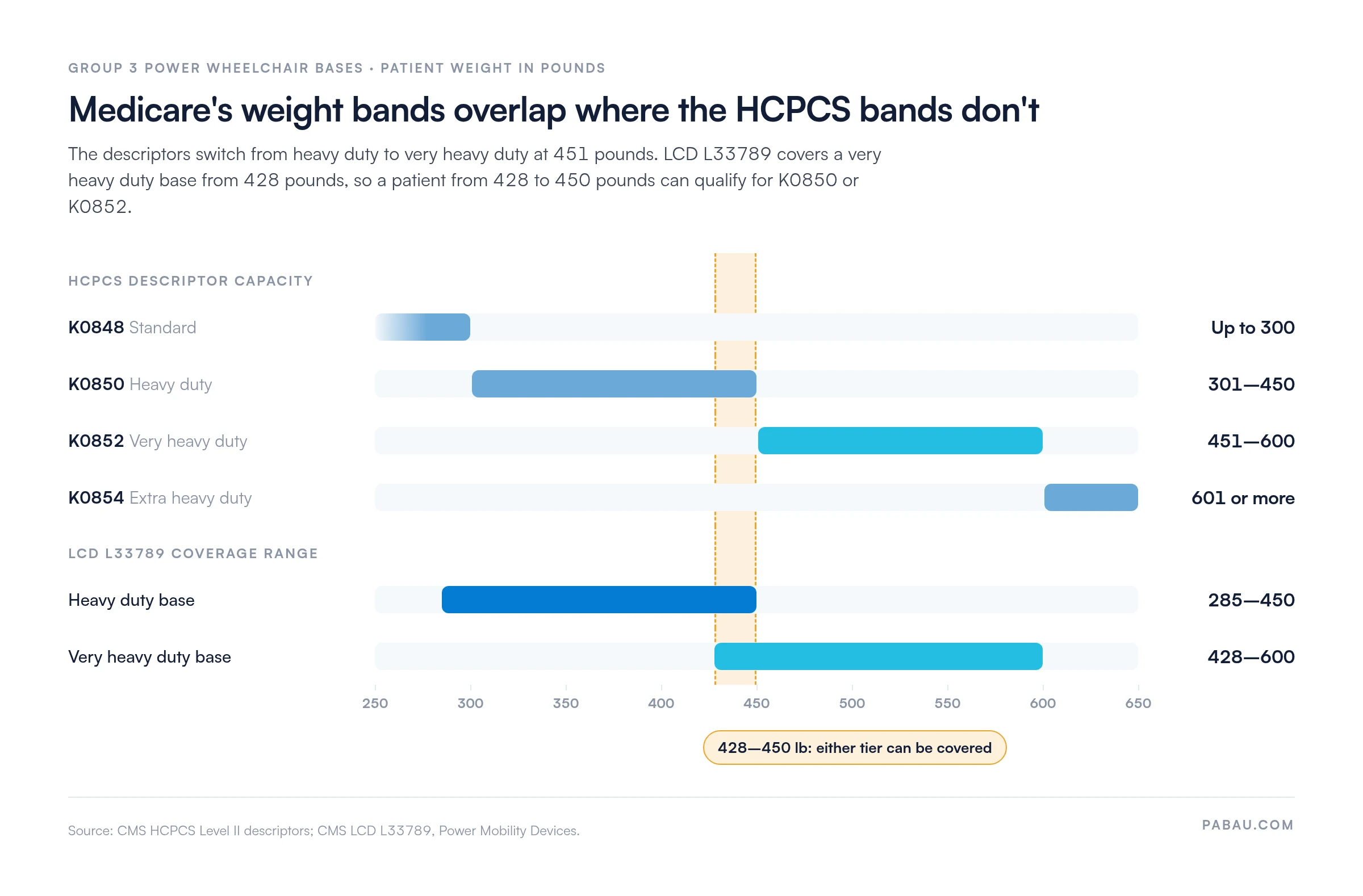
The LCD’s weight ranges do not match the descriptor’s. A very heavy duty base is covered for patients weighing 428 to 600 pounds, and a heavy duty base for 285 to 450 pounds. A patient between 428 and 450 pounds can qualify for either tier. The chart below lines up both sets of bands.
Record the measured weight and the date it was taken in the evaluation. The tier on the claim has to follow that number.
CMS lists K0852 as needing a face-to-face encounter and a written order prior to delivery, effective April 17, 2023. Each document below has to be in the file before the chair is delivered. A medical billing compliance review should check every one.
Check four items before every K0852 delivery. They are the documented weight, the PDAC listing for the base model, the signed order date and the authorization decision. One missing item can turn a paid claim into a recoupment at audit.
Medicare has required prior authorization for K0852 nationwide since September 1, 2018, according to the CMS master list. Medicare.gov lists it among the power wheelchairs that require prior authorization before Medicare pays.
The supplier sends the request and supporting documents to the DME MAC, which returns a provisional affirmation or a non-affirmation. Each decision carries a unique tracking number (UTN), and the claim must report it.
A claim submitted without a prior authorization decision is denied. A non-affirmed request can be resubmitted with more documentation, but the decision itself cannot be appealed. A provisional affirmation does not rule out later medical review of the claim.
K0852 is one of 17 Group 3 power wheelchair codes, K0848 to K0864. Three attributes separate them: weight tier, seat type and power-option capability. The table shows the codes nearest K0852, using the official HCPCS descriptors.
Code the base by what it can accommodate, as the PDAC lists it, not by the options the patient uses. A very heavy duty base that can run power tilt is K0860 even if tilt is never ordered. If the patient does not meet the power-option criteria, Medicare denies that base as not reasonable and necessary.
Seat type splits the codes the same way. Fit the same very heavy duty base with a captain’s chair and it bills as K0853.
Modifiers on a K0852 claim report coverage status and the payment method. Requirements vary by DME MAC jurisdiction and change with policy updates. Confirm the current list with your DME MAC before billing.
KU is a competitive bidding program modifier. CMS applies it to accessories and seat and back cushions furnished with Group 3 complex rehabilitative bases, K0848 to K0864. Add it to those accessory lines only where that bidding-program rule applies.
Medicare Part B pays 80% of the approved amount for K0852 after the annual Part B deductible. The patient owes the remaining 20% coinsurance unless a secondary payer covers it.
The allowed amount comes from the CMS DMEPOS fee schedule, which CMS updates each year and sets by state. Look up the current rate for the patient’s state before you quote a cost.
Group 3 coverage requires a mobility limitation caused by a neurological condition, myopathy or congenital skeletal deformity. The diagnosis on the claim has to show that cause, and the evaluation has to tie it to the patient’s MRADLs. The codes below are common examples, not a payer list.
Check every code against the current ICD-10-CM release before submission. G35 and G20 are no longer billable as three-character codes, so each claim needs the subcode the record supports. The official CMS HCPCS reference confirms the base code itself.
K0852 denials follow predictable patterns. A denial management strategy built around the table below catches most of them before submission.
A clean K0852 claim follows the sequence below. Shortcuts in steps 2 to 5 are where most post-payment audit recoupments start.
A clean claim on the first pass is faster than an appeal cycle.
Set a reminder 60 days before your DMEPOS accreditation renewal. A supplier without active accreditation on the delivery date cannot bill Medicare for the chair.
A K0852 file is usually assembled from several places: the practitioner’s notes, the therapist’s evaluation, the signed order and the authorization letter. A missing weight or a late signature often surfaces only when an auditor asks for the file.
Pabau keeps those documents on one patient record. Digital forms capture the measured weight, the evaluation findings and the order date in structured fields. Pabau’s claims management software then builds the claim from that record, so the code and modifiers match the file.
Claim status and payer responses sit beside the documentation. When a denial arrives, your billing team can trace it to the document that caused it and fix the next claim before it goes out.

Pabau links the face-to-face notes, specialty evaluation and signed order to the claim. The weight tier and code you bill match what the record shows.

K0852 is a weight-tier code. The coding decision starts with the patient’s measured weight, the seat type and what the base can power. Those facts decide between K0850, K0852, K0853, K0860 and K0863.
Once the code is right, payment depends on paperwork in the right order. The face-to-face encounter, the specialty evaluation, the signed order and the prior authorization all come before delivery. Checking them before the chair ships costs far less than defending them in an audit.
Pabau keeps that record and the claim in one place. Book a demo to see how it tracks K0852 documentation from the first evaluation to payment.

Need a deeper dive into denial prevention? Denial management in healthcare covers the full appeal and prevention workflow for DME and other claim types.
Want to understand the broader billing process? What is revenue cycle management explains how individual code claims fit into end-to-end collections.
Billing compliance keeping you up at night? Medical billing compliance outlines the documentation and audit-readiness standards that protect DME suppliers.
Preparing a prior authorization request? The prior authorization process walks through each step from the request to the payer’s decision.
HCPCS code K0852 covers a Group 3 very heavy duty power wheelchair with a sling or solid seat/back. It is rated for patients weighing 451 to 600 pounds, and the base has no power seating option. Medicare covers it under LCD L33789 when the patient meets the power wheelchair and Group 3 criteria.
K0852 and K0856 differ in weight tier and power options. K0852 is a very heavy duty base for 451 to 600 pounds with no power option. K0856 is a Group 3 standard base for patients up to 300 pounds with a single power option. The very heavy duty single-power-option code is K0860.
No. The descriptor gives a 451 to 600 pound capacity. LCD L33789, however, covers a very heavy duty base for patients weighing 428 to 600 pounds. Record the measured weight in the evaluation so the tier on the claim follows it.
Yes. Medicare has required prior authorization for K0852 nationwide since September 1, 2018. The supplier submits the request to the DME MAC and needs a provisional affirmation before delivery. A claim submitted without a prior authorization decision is denied.
Most K0852 claims carry a payment modifier, such as RR for rental, NU for a new purchase or UE for used equipment. Capped rental claims add KH, KI or KJ by rental month. KX goes on only when every LCD L33789 criterion is met, and GA, GZ or GY apply when a denial is expected. KU is a competitive bidding modifier for accessories furnished with a Group 3 base. Confirm current modifiers with your DME MAC.
Group 3 coverage needs a mobility limitation due to a neurological condition, myopathy or congenital skeletal deformity. Common examples are multiple sclerosis (G35.A to G35.D), ALS (G12.21), spastic quadriplegic cerebral palsy (G80.0), Parkinson’s disease (G20.A1 and related codes) and paraplegia (G82.20). Code to the highest specificity the record supports.
Medicare Part B pays 80% of the approved amount after the annual Part B deductible, and the patient pays 20% coinsurance. The allowed amount comes from the CMS DMEPOS fee schedule, which varies by state and changes each year. Check the current file before billing.




