Pabau Engage inbox

Pabau Engage is here: every patient conversation in one inbox.

Learn more
Book a demo Book a demo
☰
CPT Code

CPT code 67999 – Unlisted eyelid procedure


Code Definition

67999 is the CPT code for unlisted procedure, eyelids. It reports an eyelid procedure that no specific Category I or Category III CPT code describes.

Typical uses include atypical eyelid reconstructions and non-automated meibomian gland treatments such as iLux. No RVU is assigned, so the payer prices each claim against a comparable code you cite. Unlisted-code claims draw manual review, so documentation quality drives payment.

Section
10004-69990 Surgery
Subsection
65091-68899 Eye and ocular adnexa
Code range
67700-67999 Eyelids
Billable
No
Code also known as
eyelid unlisted code, unlisted ophthalmic eyelid procedure, eyelid surgery unlisted
Save time. Improve accuracy. Get paid faster.
Automate coding with Pabau

Let Pabau's smart automation suggest the right codes, reduce claim denials, and keep your practice compliant—effortlessly.

  • AI-powered code suggestions
  • Real-time compliance checks
  • Faster claims, fewer denials
Why practices choose Pabau
Save hours every week

Automate repetitive tasks and focus on what matters most—your patients.

Improve accuracy

Reduce coding errors and ensure compliance with the latest regulations.

Get paid faster

Clean claims, fewer denials, and faster reimbursements.

Grow with confidence

Powerful insights and reporting to help your practice thrive.

HIPAA compliant SOC 2 certified GDPR-compliant Trusted by 4,000+ clinics worldwide

Key takeaways

Key takeaways

CPT code 67999 covers eyelid procedures that no specific CPT code describes, and it closes the 67700-67999 eyelid range.

Every 67999 claim needs a special report and a comparable CPT code.

Payment is benchmarked to the comparable code’s allowable, because 67999 has no fee schedule rate.

Common denial triggers include a missing prior authorization, a missing special report and a cosmetic determination.

Pabau’s claims management, with Claim.MD, submits claims electronically and tracks their status and payments.

CPT code 67999: Definition and when to use it

CPT code 67999 is the official unlisted procedure code for eyelids, with the AMA descriptor “Unlisted procedure, eyelids.” It belongs to the Surgery/Ophthalmology section and sits at the terminus of the eyelid procedure range (67700-67999). Use it only when a more specific eyelid code does not accurately describe the procedure performed.

The Centers for Medicare and Medicaid Services (CMS) and commercial payers treat unlisted codes differently from specific codes. There is no pre-set payment rate, no Relative Value Unit (RVU), and no automatic adjudication. Every claim requires manual medical review by the payer’s clinical team.

When 67999 is appropriate:

  • The procedure is a non-automated meibomian gland treatment, such as iLux, which the AAO directs to 67999
  • The procedure is intense pulsed light (IPL) for meibomian gland dysfunction, with no dedicated code
  • The eyelid reconstruction is so atypical that no listed code captures the complexity, approach, or anatomical scope
  • A newly cleared device or technique has no Category I code yet. Check Category III (0xxxT) codes first, and use 67999 only if none describes the service
  • Multiple distinct unlisted steps are performed that cannot be correctly combined under any existing code

Using 67999 when a specific code exists is a compliance error. That includes Category III codes, so LipiFlow, for example, is reported with 0207T rather than 67999. If CPT 67904 (external levator resection or advancement for ptosis) describes the procedure, bill 67904. Defaulting to the unlisted code to avoid documentation requirements increases audit risk and frequently triggers recoupment demands.

Frontalis suspension is another listed repair that rules out the unlisted code. When the surgeon suspends the lid from the frontalis muscle using suture or banked fascia, 67901 describes the procedure, not 67999.

The decision path below shows the order to rule codes out before 67999 becomes the right answer.
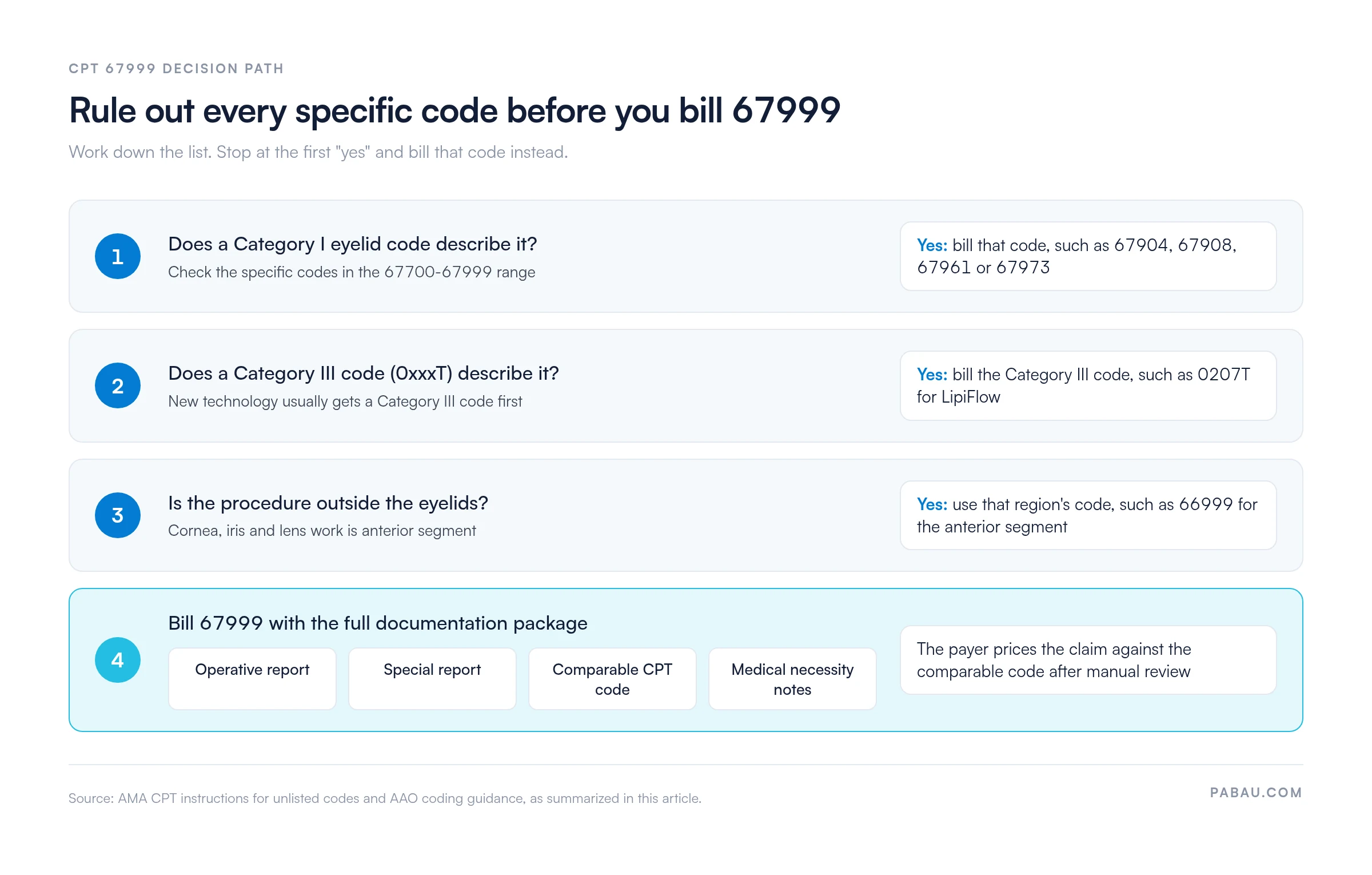
Four-step decision path for CPT 67999
67999 is the last stop, reached only after Category I, Category III and other-region codes are ruled out. Based on AMA CPT unlisted-code instructions and AAO guidance.

Procedures commonly billed under CPT 67999

Several categories of eyelid treatment fall under 67999 because no Category I or Category III code describes them. One common exception sits in the first row.

Procedure category Common examples Billing note
Meibomian gland treatments iLux and similar non-automated devices; LipiFlow automated thermal pulsation LipiFlow has its own Category III code, 0207T, so bill that instead of 67999. The AAO points iLux and similar non-automated devices to 67999. Most MACs and payers do not cover these treatments.
IPL for dry eye disease Intense pulsed light targeting meibomian glands Coverage varies by MAC jurisdiction; LCD review essential before billing
Atypical eyelid reconstruction Complex flap repairs not captured by 67961-67975 Document why existing reconstruction codes are insufficient
Novel device-based eyelid procedures Newly FDA-cleared eyelid treatment devices Check Category III (0xxxT) codes first, and use 67999 only if none describes the service. Name the device in the special report.
Eyelid procedures with unusual complexity Combinations or modified approaches without a matching specific code Modifier 22 may be considered; verify payer policy before appending

Before reaching for 67999, coders must confirm that no specific eyelid code captures the procedure. These are the codes most commonly confused with the unlisted option.

CPT code Descriptor Use instead of 67999 when…
67904 Repair of blepharoptosis; (tarso) levator resection or advancement, external approach Levator resection or advancement is performed via an external approach
67908 Repair of blepharoptosis; conjunctivo-tarso-Müller’s muscle-levator resection (e.g., Fasanella-Servat) A posterior Müller’s muscle-levator resection, such as Fasanella-Servat, is performed
67961 Excision and repair of eyelid, involving lid margin, up to 1/4 of lid Eyelid margin excision and primary repair is performed within this scope
67973 Reconstruction of eyelid, full thickness by transfer of tarsoconjunctival flap from opposing eyelid; total eyelid, lower, one stage or first stage The whole lower lid is rebuilt with a tarsoconjunctival flap from the upper lid, in one stage or as the first stage
67974 Reconstruction of eyelid, full thickness by transfer of tarsoconjunctival flap from opposing eyelid; total eyelid, upper, one stage or first stage The whole upper lid is rebuilt with a tarsoconjunctival flap from the lower lid, in one stage or as the first stage
66999 Unlisted procedure, anterior segment of eye The procedure involves the anterior segment (cornea, iris, lens), not the eyelids
67999 Unlisted procedure, eyelids No specific eyelid code accurately describes what was performed

A common source of confusion is 66999 vs. CPT code 67999. CPT 66999 covers the anterior segment of the eye, while 67999 is specific to the eyelids. Billing 66999 for an eyelid procedure is anatomically incorrect and will generate a denial.

Documentation requirements for CPT code 67999

CPT code 67999 requires more supporting documentation than any specific eyelid code. The American Medical Association’s instructions for unlisted codes specify that a medical billing compliance-grade submission must include four core elements.

  1. Operative report: A complete narrative of the procedure, including surgical technique, anatomical site, instruments used, and any complications.
  2. Special report: A separate written justification explaining why no specific CPT code exists for this procedure (see below).
  3. Comparable CPT code: The specific existing code that most closely resembles the procedure in time, skill, and complexity. This drives the reimbursement calculation.
  4. Medical necessity documentation: Clinical notes, photographs (particularly for eyelid cases), visual field results, and any prior treatment records establishing why the procedure was required.

Payers can deny or return a 67999 claim that arrives without all four elements. Make sure your clean claim submission checklist includes each item before the claim leaves the practice.

What is a special report and how to write one for 67999

A special report is a written narrative that explains, in clinical terms, why the procedure performed falls outside the existing CPT code set. The AMA requires it for all unlisted code submissions.

A compliant special report for CPT code 67999 includes these elements:

  1. Procedure description: What was done, step by step, in plain clinical language
  2. Time and effort: Total operative time, complexity of the dissection, and any unusual technical demands
  3. Equipment and materials: Device or technology used, and why it is not captured by a specific code
  4. Comparable code reference: Name the specific CPT code used as the pricing benchmark and explain the clinical similarity
  5. Why no specific code applies: A concise statement that no current CPT code adequately describes the procedure performed

Keep the special report to one page. Payer reviewers are clinicians, so clear narrative helps more than bullet points alone. Attach it as a separate document labeled clearly in the claim submission package.

Modifiers used with CPT code 67999

Modifiers communicate additional clinical information about a procedure to the payer. Several modifiers apply to 67999, and selecting the wrong one, or omitting a required one, is a fast path to denial.

Modifier Meaning When to use with 67999
LT Left side Unilateral procedure on the left eyelid
RT Right side Unilateral procedure on the right eyelid
50 Bilateral procedure Same procedure performed on both eyelids in a single session
22 Increased procedural services When the procedure required substantially more work than the comparable code reflects; verify payer policy before use with unlisted codes
52 Reduced services Procedure was terminated or reduced at physician discretion
78 Unplanned return to OR for related procedure Repeat eyelid procedure during the global period for a related complication
79 Unrelated procedure during postoperative period A different, unrelated eyelid procedure performed during another code’s global period

Laterality modifiers (LT, RT) are required by CMS whenever the procedure involves a paired anatomical structure. Omitting them on a unilateral eyelid claim causes an immediate processing error at Medicare. Modifier 22 applicability to unlisted codes is uncertain and varies by payer, so confirm the specific payer’s policy before appending it.

Prior authorization requirements for CPT 67999

Prior authorization requirements vary by payer and plan year. Many commercial payers and Medicare Advantage plans require pre-authorization for unlisted codes, including CPT code 67999, so check each payer’s policy. Original Medicare does not require prior authorization for 67999.

What a prior auth request for 67999 typically needs:

  • The proposed procedure description in clinical language
  • The comparable CPT code you plan to use for pricing reference
  • Diagnosis code(s) supporting medical necessity
  • Clinical notes documenting failure of conservative treatment options
  • Operative plan or procedure protocol (for device-based treatments, the device name and FDA clearance status)

Frame the prior auth request around medical necessity, not procedure novelty. Payers approve based on clinical indication. Emphasizing the device brand or technique name without tying it to a diagnosis and documented treatment failure makes approval less likely.

Pro Tip

Submit the prior authorization request with the special report attached, not just the PA form. Reviewers who see the full clinical narrative and the comparable code upfront have what they need to decide. That reduces back-and-forth requests for additional information.

Reimbursement and fee schedule for CPT code 67999

CPT code 67999 has no entry in the CMS Physician Fee Schedule. Reimbursement is determined by the comparable CPT code submitted with the claim. The payer takes the allowable amount for that comparable code and pays 67999 at the same or a similar rate, subject to manual review.

This means the comparable code selection directly controls how much the practice gets paid. Selecting a code that underrepresents the procedure’s complexity results in underpayment. Selecting one that overstates it exposes the practice to a billing compliance finding.

Does Medicare cover CPT code 67999?

Yes, Medicare can cover CPT code 67999, but only for reconstructive eyelid procedures that meet medical necessity criteria. Those criteria sit in the Local Coverage Determination (LCD) issued by the relevant Medicare Administrative Contractor (MAC). Cosmetic eyelid procedures are not covered regardless of how they are documented.

Key Medicare-specific rules for 67999:

  • Manual medical review: CMS requires manual review for all unlisted CPT code claims. Automatic adjudication does not apply.
  • LCD applicability: Check the MAC jurisdiction’s LCD for eyelid procedures before billing. Most MACs and payers do not cover meibomian gland treatments such as iLux, LipiFlow or IPL.
  • Reconstructive vs. cosmetic: The operative note must clearly document functional impairment (e.g., visual field defect, corneal exposure) to support the reconstructive determination. Cosmetic services are statutorily excluded, so the practice may bill the patient. A voluntary ABN or notice of non-coverage is best practice.
  • Appeal rights: Medicare denials are appealable through the five-level appeals process. Include the special report and a clinical letter of necessity in the redetermination request.

Common reasons CPT 67999 claims are denied

Unlisted-code claims draw manual review, so documentation quality drives payment. The usual denial reasons for CPT code 67999 are predictable and preventable.

  • Missing special report: The most common denial trigger. Many practices submit the operative note alone and assume it satisfies the unlisted code requirement.
  • No comparable CPT code cited: Without a pricing reference code, payers have no basis to price the claim. It goes to denial or is returned as incomplete.
  • Missing or expired prior authorization: Submitting 67999 without obtaining the required pre-auth, or billing after the authorization expiry date.
  • Cosmetic determination: The clinical documentation does not adequately support a reconstructive or functional indication. Payers default to cosmetic denial when documentation is ambiguous.
  • Insufficient medical necessity: Conservative treatment failure is not documented. Payers expect to see what prior treatments were tried and why surgical intervention became necessary.
  • Incorrect or missing laterality modifiers: Omitting LT or RT on a unilateral claim, or appending modifier 50 when the procedure was unilateral.
  • Comparable code mismatch: The comparable code cited does not have a clinically defensible resemblance to the procedure performed.

How to appeal a denied CPT 67999 claim

A denied 67999 claim is recoverable in most cases. The appeal succeeds when the submission package is stronger than the original claim.

  1. Identify the denial reason code: Pull the Explanation of Benefits (EOB) or remittance advice. The CARC (Claim Adjustment Reason Code) tells you exactly what the payer found missing.
  2. Gather supporting documentation: Compile the operative report, special report, comparable code justification, and all clinical notes supporting medical necessity.
  3. Write a clinical letter of medical necessity: A physician-signed letter addressed to the payer’s medical director, explaining the clinical rationale in clear, non-technical language.
  4. Reference the comparable code’s allowable: State the comparable CPT code and its published Medicare rate or payer-specific allowable. Then argue that 67999 deserves equivalent reimbursement given clinical parity.
  5. Submit within the timely filing window: Most commercial payers allow 60-180 days from the denial date for appeal. Medicare redetermination requests must be filed within 120 days of the initial determination.

A structured denial management workflow follows each denied 67999 claim through the appeals cycle. Tracking recovery rates by denial reason shows patterns before they become revenue problems.

ICD-10 codes commonly paired with CPT 67999

The diagnosis code submitted alongside CPT code 67999 must support medical necessity. Payers match the ICD-10-CM code to the procedure’s clinical context. A mismatch between the diagnosis and the unlisted eyelid procedure is a fast denial trigger. Our ICD-10-CM code reference lists the full descriptor and laterality for each eyelid diagnosis.

ICD-10-CM code Description Commonly paired when…
H02.401 Unspecified ptosis of right eyelid Atypical ptosis repair not captured by 67904-67908
H04.123 Dry eye syndrome of bilateral lacrimal glands Meibomian gland treatments billed under 67999 (iLux, IPL) for dry eye disease
H00.012 Hordeolum externum right lower eyelid Atypical or recurrent eyelid gland treatment not covered by excision codes
H02.811 Retained foreign body in right upper eyelid Complex foreign body removal requiring an unlisted approach
C44.112 Basal cell carcinoma of skin of right upper eyelid Eyelid tumor reconstruction where no specific reconstruction code applies
H02.32 Blepharochalasis, right lower eyelid Eyelid edema/blepharochalasis treatment without a matching specific code

Always confirm ICD-10-CM codes against the CDC/NCHS ICD-10-CM tool for the current fiscal year. Eyelid condition codes are specific to laterality (right, left, bilateral) and eyelid position (upper, lower). Unspecified laterality codes are accepted by some payers but increase the risk of medical necessity scrutiny at Medicare.

Billing tips to maximize reimbursement for CPT 67999

Unlisted procedure billing rewards preparation, because a systematic pre-claim workflow keeps 67999 claims from stalling in review. These are the highest-impact steps to take before the claim leaves the practice, grounded in medical billing fundamentals and ophthalmology-specific payer behavior.

  1. Identify the comparable code before the procedure: The physician should name the closest code before surgery so the special report is written with the comparison already embedded.
  2. Build a 67999 documentation template: Create a practice-specific checklist: Operative note, special report, comparable code citation, ICD-10 diagnosis codes, and prior auth confirmation. A superbill formatted for unlisted codes ensures no field is skipped at charge entry.
  3. Obtain prior auth before the procedure: Retroactive authorization is rarely granted. If the payer denies prior auth, verify coverage options before you proceed. For cosmetic services, which Medicare excludes by statute, a voluntary ABN or notice of non-coverage is best practice.
  4. Use the AAPC Codify CPT lookup to confirm no specific code was introduced in the current year update: New Category I codes are assigned annually. A procedure billed under 67999 in a prior year may have acquired a specific code since then.
  5. Set realistic patient expectations on coverage: Cosmetic procedures billed under 67999 are not covered by Medicare or most commercial plans. Collect patient financial responsibility at time of service for procedures where coverage is uncertain.
  6. Track denials by comparable code: If 67999 claims citing one comparable code keep getting denied, that payer may not accept the code. Adjust the comparable code selection and document the rationale for compliance purposes.

Use the FastRVU 2026 RVU lookup to verify the work, practice expense, and malpractice RVUs for any comparable code before submission. Its Medicare allowable gives the practice a published rate to benchmark payer offers against.

How claims management software supports CPT 67999 billing

An unlisted eyelid claim often moves through several systems. The operative note lives in the EHR and the special report in a shared folder. Claim status sits in a payer portal that someone checks by hand.

Pabau, the practice management platform we build, keeps clinical notes, photos and invoices in the patient record. Its claims management software, with Claim.MD, submits claims electronically and tracks their status and payments.

Your team can then see which 67999 claims are pending, paid or denied without logging into each payer portal. Patterns show up sooner too, such as one payer repeatedly rejecting a particular comparable code.
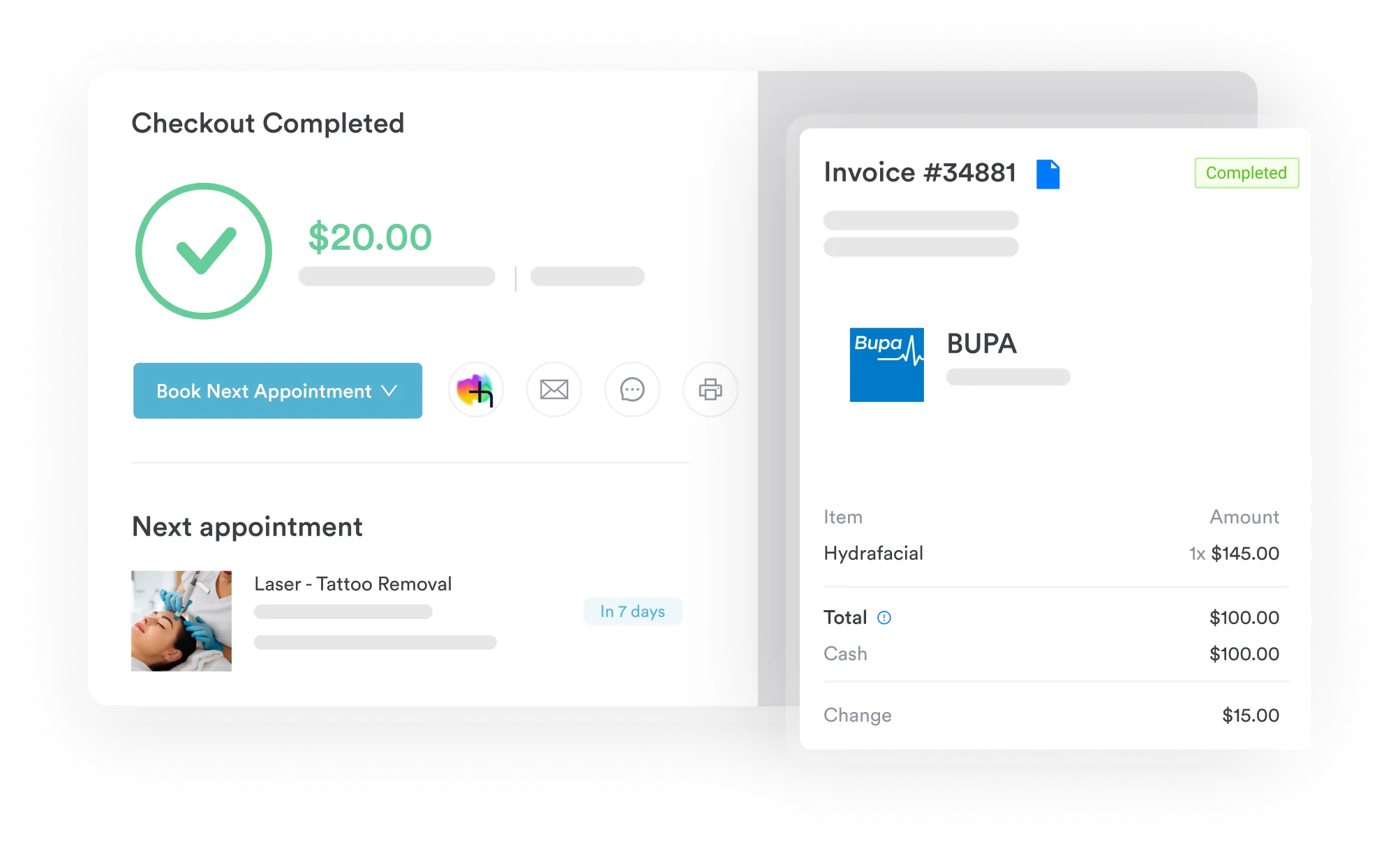
Pabau checkout screen next to a completed patient invoice
Pabau records each payment against the patient invoice, so your team can see what has been settled on an unlisted eyelid procedure.

Track unlisted eyelid claims to payment

Pabau keeps clinical notes and claims together. Its claims management, with Claim.MD, submits claims electronically and tracks their status and payments.

Pabau claims management dashboard for ophthalmology billing

Conclusion

CPT code 67999 is one of the highest-maintenance codes in ophthalmology billing. With no fee schedule rate behind it, each claim is paid on the strength of its documentation.

So treat 67999 as the last code you reach for. Rule out Category I and Category III codes first, and choose the comparable code before surgery. Then send the special report with the prior auth request, so the reviewer sees the whole case at once.

The trade-off is more work before the procedure in exchange for fewer appeals after it. Book a demo to see how Pabau submits and tracks your unlisted eyelid claims from submission to payment.

Continue your research

Continue your research

Need to understand how medical claims clearinghouses work for unlisted codes? Medical claims clearinghouse guide explains how electronic claim routing and payer edits catch errors before manual review.

Want to reduce the time unlisted code claims spend in the denial queue? Electronic remittance advice (ERA) guide walks through how ERA files surface CARC denial reasons so your team can act on them faster.

Looking for coding guidance on how to structure a compliant billing workflow? Revenue cycle management overview covers the end-to-end process from charge capture through payment posting.

Frequently asked questions

What is CPT code 67999 used for?

CPT code 67999 reports unlisted procedures on the eyelids when no specific CPT code describes the procedure. Common uses include non-automated meibomian gland treatments such as iLux, intense pulsed light for dry eye disease, and atypical eyelid reconstructions. Check Category III codes first, since LipiFlow, for example, is reported with 0207T.

What modifiers are required when billing CPT 67999?

Laterality modifiers LT (left) or RT (right) are required by CMS for unilateral eyelid procedures. Modifier 50 applies for bilateral same-session procedures. Modifier 22 (increased procedural services) may apply when the procedure took substantially more work than the comparable code reflects. Its use with unlisted codes varies by payer, so verify it first.

What are the most common reasons CPT 67999 claims are denied?

The top denial reasons are a missing special report, no comparable CPT code, and a missing or expired prior authorization. Payers also deny for a cosmetic determination, thin medical necessity documentation, and incorrect or absent laterality modifiers. Addressing all six elements before submission eliminates the most common denial patterns.

What is the difference between CPT 66999 and CPT 67999?

CPT 66999 is the unlisted procedure code for the anterior segment of the eye (cornea, iris, ciliary body, lens area). CPT code 67999 is specific to the eyelids. They are anatomically distinct codes covering different surgical territories. Billing 66999 for an eyelid procedure is an error that will result in denial.
×