

HCPCS Code E0272: Foam rubber mattress billing guide
HCPCS Code E0272: official descriptor and code overview HCPCS Code E0272 is the ...

Last Updated: Nov 6, 2026
67700 is the CPT code for blepharotomy, drainage of abscess, eyelid. It covers an incision into the lid margin or lid structures to drain an abscess, and it carries a 10-day global period.
An abscess confined to the overlying skin is coded 10060 instead, and full chalazion excision is 67800. Most payers also want RT or LT, plus an E1 to E4 eyelid modifier, on every 67700 claim.
Let Pabau's smart automation suggest the right codes, reduce claim denials, and keep your practice compliant—effortlessly.
Automate repetitive tasks and focus on what matters most—your patients.
Reduce coding errors and ensure compliance with the latest regulations.
Clean claims, fewer denials, and faster reimbursements.
Powerful insights and reporting to help your practice thrive.
HIPAA compliant SOC 2 certified GDPR-compliant Trusted by 4,000+ clinics worldwide

CPT code 67700 reports blepharotomy with drainage of an eyelid abscess. Chalazion excision (67800) and skin-level incision and drainage (10060) are separate codes.
Most payers want a laterality modifier (RT or LT) on every 67700 line, and many also want an eyelid modifier from E1 to E4.
Abscess of eyelid (H00.03-) maps most directly to the 67700 descriptor, with hordeolum, chalazion and blepharitis codes as further support.
In 2026, CPT 67700 carries 1.37 work RVUs, a 10-day global period and a national non-facility Medicare payment of about $280.57.
Pabau’s claims management checks each 67700 claim for missing or invalid details before it goes out through the Claim.MD clearinghouse.
CPT code 67700 is the code for an incision into the eyelid to drain an abscess. The AMA’s CPT code set gives it the official descriptor Blepharotomy, drainage of abscess, eyelid. It sits in the Surgery section, under Eyelids, in the 67700-67715 incision range.
The surgeon incises the eyelid margin or lid structures to drain an abscess, infected cyst, or other obstructive collection. Expressing the meibomian glands needs no incision, so it does not qualify. Chalazion excision (67800) removes the whole lesion instead of draining it. Medicare assigns 67700 a 10-day global period.
CPT code 67700 is medically necessary when conservative treatment (warm compresses, topical antibiotics, lid hygiene) has failed and the eyelid lesion requires surgical drainage. The CDC/NCHS ICD-10-CM tool lists the following codes as primary supporting diagnoses.
The “x” stands for the final digit, which records the eye and the eyelid:
A truncated code without that final digit is a frequent cause of rejection under Medicare Part B.
What appears in the operative or procedure note determines whether the claim survives review. These are the elements payers look for when adjudicating CPT code 67700.
A note that only says “I&D of eyelid lesion performed without complication” is not enough. Reviewers need the structure drained, eyelid margin or overlying skin, to confirm that 67700 is the right code and 10060 is not.
Four nearby codes cover the eyelid or the skin over it, and each one describes a different job. The table below applies the key distinctions from the AAPC CPT code reference.
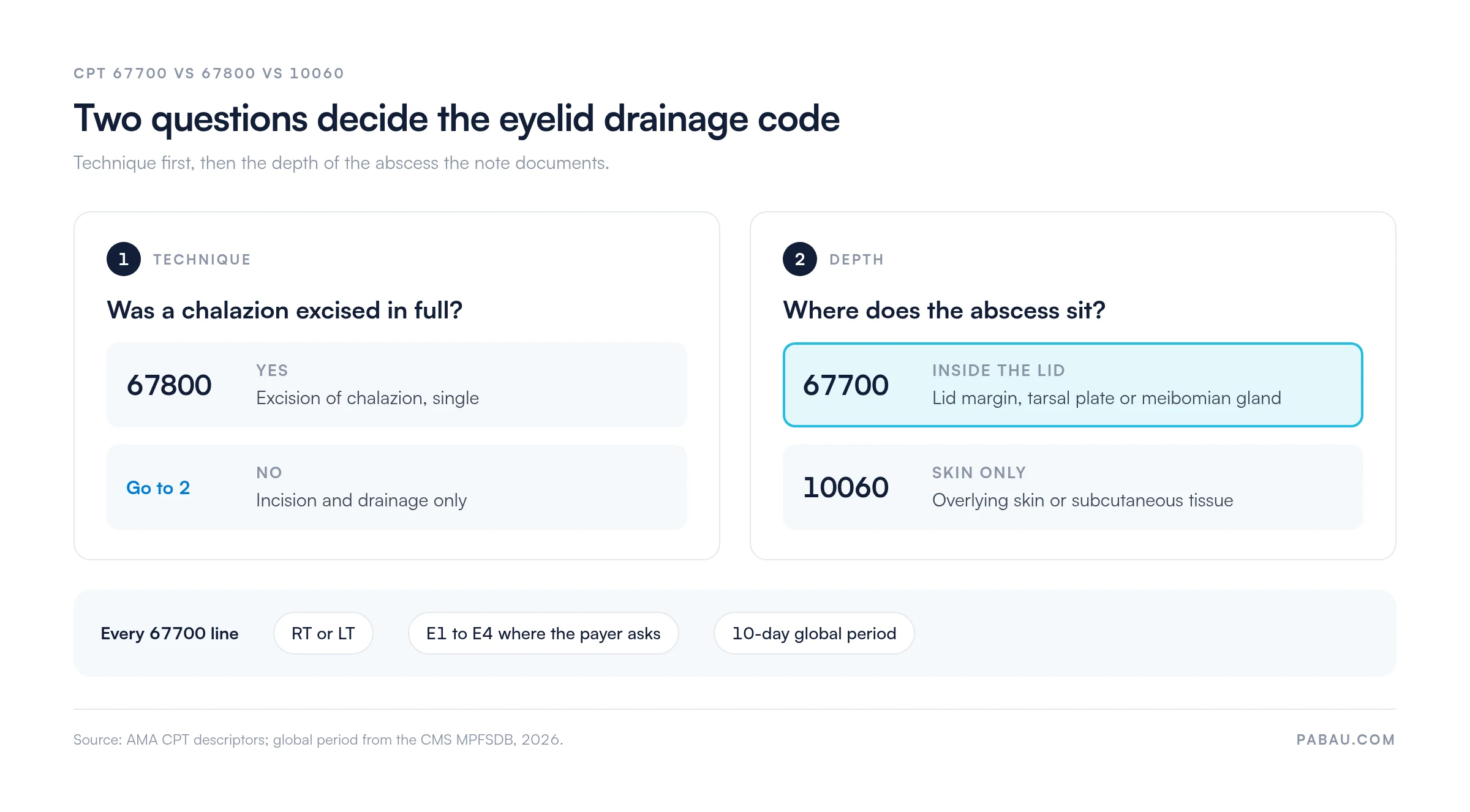
The 67700 vs 10060 routing rule: When the abscess involves the lid margin, tarsal plate, or meibomian gland structures, 67700 is correct. When the infection stays in the overlying skin or subcutaneous periorbital tissue, 10060 applies. Document the exact anatomical depth to protect this distinction under audit.
Put together, the choice comes down to two questions, asked in the order the chart below shows.
Check the NCCI edit pairs before 67700 shares a claim with another eyelid code. CMS updates the National Correct Coding Initiative tables every quarter. A same-day E/M billed without modifier -25 is a common and preventable denial.
CPT code 67700 needs a laterality modifier on every claim. Most payers also want the eyelid modifier, E1 to E4, that names the lid treated.
Bilateral billing: When drainage is performed on both eyes in the same session, many practices report 67700-50 on a single line. Some MACs want two line items with RT and LT instead, so check your MAC’s policy before submitting.
Medicare’s bilateral surgery rule typically pays 150% of the single-procedure rate. Confirm the bilateral indicator for 67700 in the CMS Physician Fee Schedule lookup before quoting a rate.
The figures below come from the 2026 CMS Physician Fee Schedule, at a conversion factor of $33.4009. RVUs and payment amounts change every year, so confirm them in an RVU lookup before quoting a rate to a provider or patient.
CPT 67700 carries a 10-day global period (indicator 010) in the CMS Medicare Physician Fee Schedule Database (MPFSDB). Related post-operative visits within those 10 days are included in the procedure payment. Visits after the window closes may be billed separately.
Prior authorization requirements for CPT code 67700 vary by payer. 67700 is not on Medicare Part B’s prior authorization list for surgical services. Under standard Part B policy, prior auth is generally not required. Commercial payers are another matter.
Always verify prior authorization requirements directly with each payer before the date of service. A denied PA claim for 67700 is difficult to overturn retroactively.
These are the submission errors that most often get a 67700 claim denied. Each one comes back as one of the denial codes a practice can track to its source.
Each of these errors is visible before the claim leaves the practice. A pre-submission check of the modifier, the laterality digit and the code-to-site match catches them. Good denial management workflows then turn repeat patterns into permanent process fixes rather than one-off appeals.
Run through this list before each 67700 claim goes out. Medical billing compliance for surgical eyelid codes depends on documentation habits as much as on code selection.
Coders aren’t the only people who need these rules. Medical billing fundamentals help the whole practice team spot a note that falls short of what a 67700 claim requires.
A medical claims clearinghouse that checks claims against payer rules before transmission adds a final safety net. Getting a clean claim out the first time is always faster than working a denial through appeals.
Audit the 67700 claims your practice submitted in the previous 90 days, once a quarter. Filter for any claim with a blank modifier field. A blank-modifier claim that paid means the payer missed the error, and a later audit may not. Fix the claim template, not only the individual claim.
Many practices still code 67700 from a paper note or a separate EHR, then rekey it into a billing tool. Each handoff is a chance to drop the eyelid modifier or truncate the diagnosis code.
Pabau, the practice management platform we build, keeps the procedure note and the claim in the same patient record. Its claims management software scrubs every claim for missing or invalid details before it leaves Pabau. Claims then go out as CMS-1500s through the Claim.MD clearinghouse to thousands of payers.
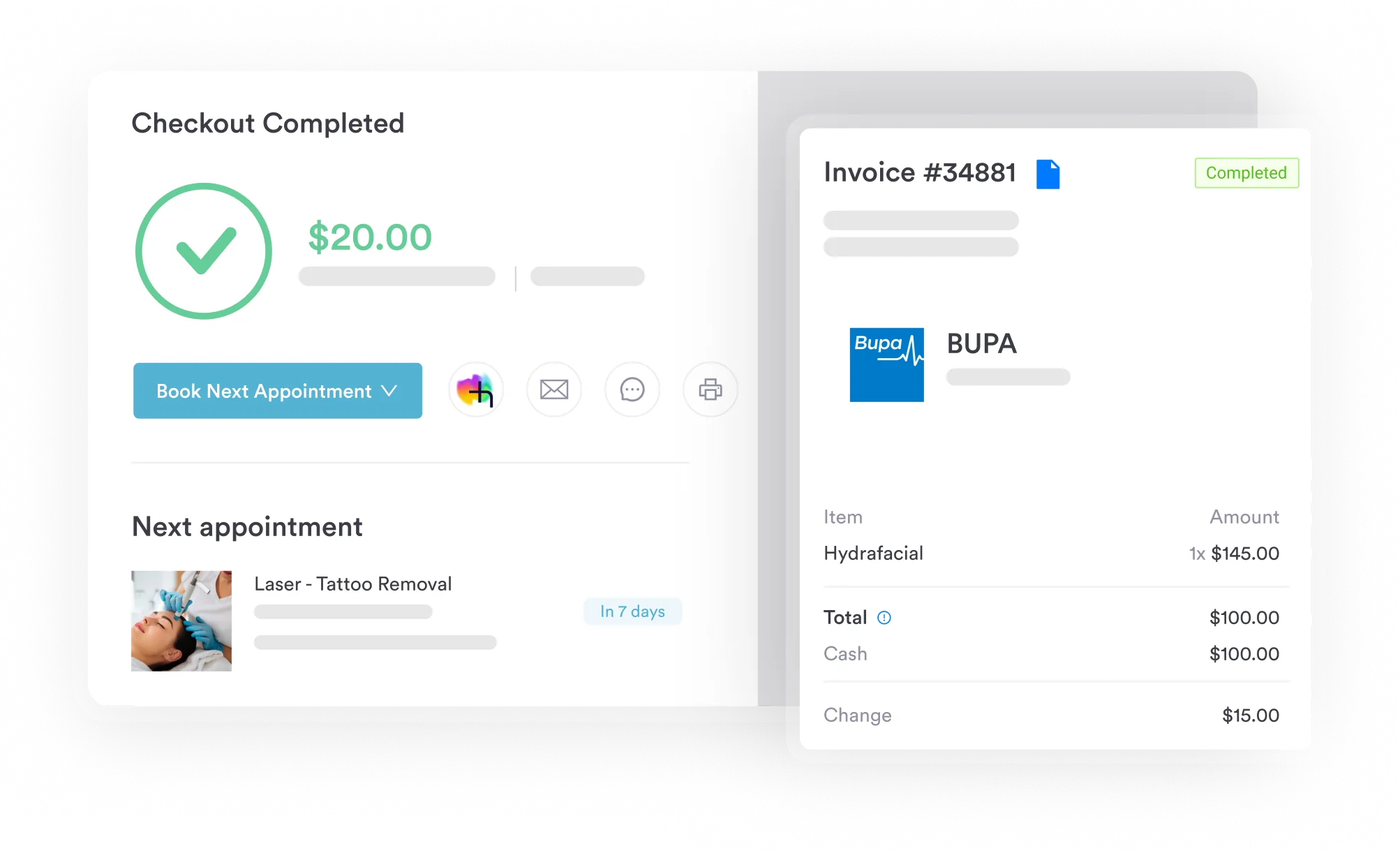
Eligibility is checked before the visit, and each claim’s status sits on one dashboard. When a payer rejects a claim, Pabau shows the reason so your team can correct it and resubmit. Payments then settle straight from the electronic remittance advice (ERA) file.

Pabau’s claims management scrubs each claim for missing or invalid details, sends it through Claim.MD, and tracks it to payment. See how it handles eyelid procedure billing.

CPT code 67700 is a quick procedure and an easy one to bill wrongly. Two facts decide the claim: where the abscess sat and which lid was drained. Both have to be in the note before the claim goes anywhere.
So write the anatomical depth into every procedure note, and treat the modifier field as required. A 10060 swap or a missing E modifier then never reaches the payer. It costs a minute per note, which is far cheaper than an appeal.
Book a demo to see how Pabau turns an eyelid procedure note into a scrubbed, trackable claim.

Need a claims submission workflow that catches modifier errors automatically? Building a clean claim covers the validation steps that prevent 67700 denials before they happen.
Want to understand how clearinghouse validation works end to end? Electronic 837 file submission explains how claims are structured and validated on the way to the payer.
Looking for guidance on remittance processing after a 67700 claim pays? Electronic remittance advice (ERA) covers how to read 835 files and reconcile payments against the claim.
Removing an eyelid lesion instead of draining it? CPT code 67840 covers excision of an eyelid lesion other than a chalazion.
CPT code 67700 covers blepharotomy with drainage of an eyelid abscess. The surgeon incises the eyelid margin or lid structures to drain an infected or obstructive collection. It does not cover chalazion excision (67800), meibomian gland expression, or drainage of a superficial periorbital skin abscess (10060).
CPT 67700 describes incision and drainage of an eyelid abscess, while CPT 67800 describes excision of a chalazion. The difference is the technique. 67700 drains the lesion, and 67800 removes it in full. Never report both codes for the same lesion in the same encounter.
CPT 67700 applies when the abscess involves the eyelid margin or lid structures, such as the tarsal plate or meibomian glands. CPT 10060 applies when the abscess stays in the overlying skin or subcutaneous periorbital tissue. Document the anatomical depth in the operative note to defend the choice under payer review.
Most payers want a laterality modifier, RT or LT, plus an eyelid modifier. The eyelid modifiers are E1 upper left, E2 lower left, E3 upper right, and E4 lower right. Same-session drainage of both eyes usually takes modifier -50, though some MACs want two lines with RT and LT. A same-day E/M code needs modifier -25. Modifier -59 separates 67700 from another eyelid procedure where NCCI edits apply.
Yes. When drainage is performed on both eyes in the same session, modifier -50 is typically appended. Medicare’s bilateral surgery rules generally pay 150% of the single-procedure rate. Check the bilateral indicator in the current CMS MPFSDB, as some MACs require two line items with RT and LT instead.
CPT 67700 has a 10-day global period in the CMS Medicare Physician Fee Schedule Database. Related post-operative visits within those 10 days are included in the procedure payment and are not billed separately.
Medicare Part B does not typically require prior authorization for CPT 67700. Medicare Advantage plans and commercial payers often do. Their rules vary by plan, by state, and by whether conservative treatment was documented, so verify with the payer before the date of service.
The most common reasons are a missing or wrong laterality or eyelid modifier, and 10060 used instead of 67700 for a lid-structure procedure. Thin medical necessity documentation and a same-day E/M code without modifier -25 also cause denials. A pre-submission checklist prevents each of them.
The note records the indication, the eye and eyelid treated, the anesthetic, and the incision site and technique. It also describes the material drained, the wound closure, and the postoperative plan. A vague line such as “I&D of eyelid lesion” without anatomical detail will not satisfy payer review.




