

CPT Code 52352: Ureteroscopic stone removal billing guide
CPT Code 52352: Official descriptor and procedure overview CPT Code 52352 descri...

Last Updated: Oct 30, 2026
44005 is the CPT code for enterolysis (freeing of intestinal adhesion) (separate procedure). It covers open lysis of intestinal adhesions through a laparotomy, while laparoscopic enterolysis is reported with 44180. Peritoneal adhesions are the leading cause of small bowel obstruction in the United States. General surgery practices encounter 44005 regularly, across open abdominal, OB-GYN, and urology cases.
Coders often get this code wrong, mostly because of its "separate procedure" designation. CCI bundling edits also govern when it can be reported alongside a concurrent abdominal operation.
Let Pabau's smart automation suggest the right codes, reduce claim denials, and keep your practice compliant—effortlessly.
Automate repetitive tasks and focus on what matters most—your patients.
Reduce coding errors and ensure compliance with the latest regulations.
Clean claims, fewer denials, and faster reimbursements.
Powerful insights and reporting to help your practice thrive.
HIPAA compliant SOC 2 certified GDPR-compliant Trusted by 4,000+ clinics worldwide

CPT code 44005 describes open lysis of intestinal adhesions (enterolysis), while laparoscopic intestinal adhesiolysis is reported with 44180.
The ‘separate procedure’ designation means 44005 cannot be billed when adhesiolysis is integral to another concurrent abdominal procedure performed at the same session.
CCI bundling edits pair 44005 with dozens of primary abdominal codes. Modifier 59 or XS overrides an edit only when the procedures are distinct and fully documented.
Medicare’s national facility total for 44005 is about 30.5 RVUs, and the code carries a 90-day global period.
In Pabau’s practice software, claim validation checks 44005 claims for missing or invalid details before Claim.MD submits them to US payers.
CPT code 44005 describes “enterolysis (freeing of intestinal adhesion) (separate procedure),” which is the American Medical Association’s official descriptor for open lysis of intestinal adhesions. The code sits in the intestinal surgery subsection (44005-44799) of the CPT codebook and applies only to the open approach.
Laparoscopic intestinal adhesiolysis is reported with 44180 instead. 58660 is not an alternative, because it covers laparoscopic lysis of adhesions around the fallopian tubes and ovaries.
The procedure addresses peritoneal adhesions, bands of scar tissue that form after abdominal surgery, infection, or inflammation. When these bands constrict or kink the small bowel, they cause pain, partial obstruction, or complete small bowel obstruction requiring surgical intervention.
A defensible 44005 claim starts with the operative report. Coders should confirm each element below is present before billing. Thin operative documentation is a common reason Medicare administrative contractors (MACs) deny or audit adhesiolysis claims.
The operative report must support clean claim requirements by capturing five core elements:
When adhesiolysis accompanies another procedure, the documentation must show which kind it was. A necessary prerequisite is integral and not separately billable, while a distinct operative undertaking may be.
The “separate procedure” designation means CPT code 44005 is billable only when lysis of intestinal adhesions is the main or sole reason for surgery. Sometimes a surgeon frees adhesions only to reach the operative site for a different primary procedure. In that case, 44005 is integral to that procedure and must not be reported.
The AMA’s CPT codebook explains why. Separate procedure codes “are commonly carried out as an integral part of a total service and, as such, do not warrant a separate identification.”
In everyday medical billing, the test is simple. Would the adhesiolysis have been performed if the primary procedure were not being done? If not, it is integral and should not be coded. The flow below adds the NCCI check that decides whether a separately reported 44005 gets paid.
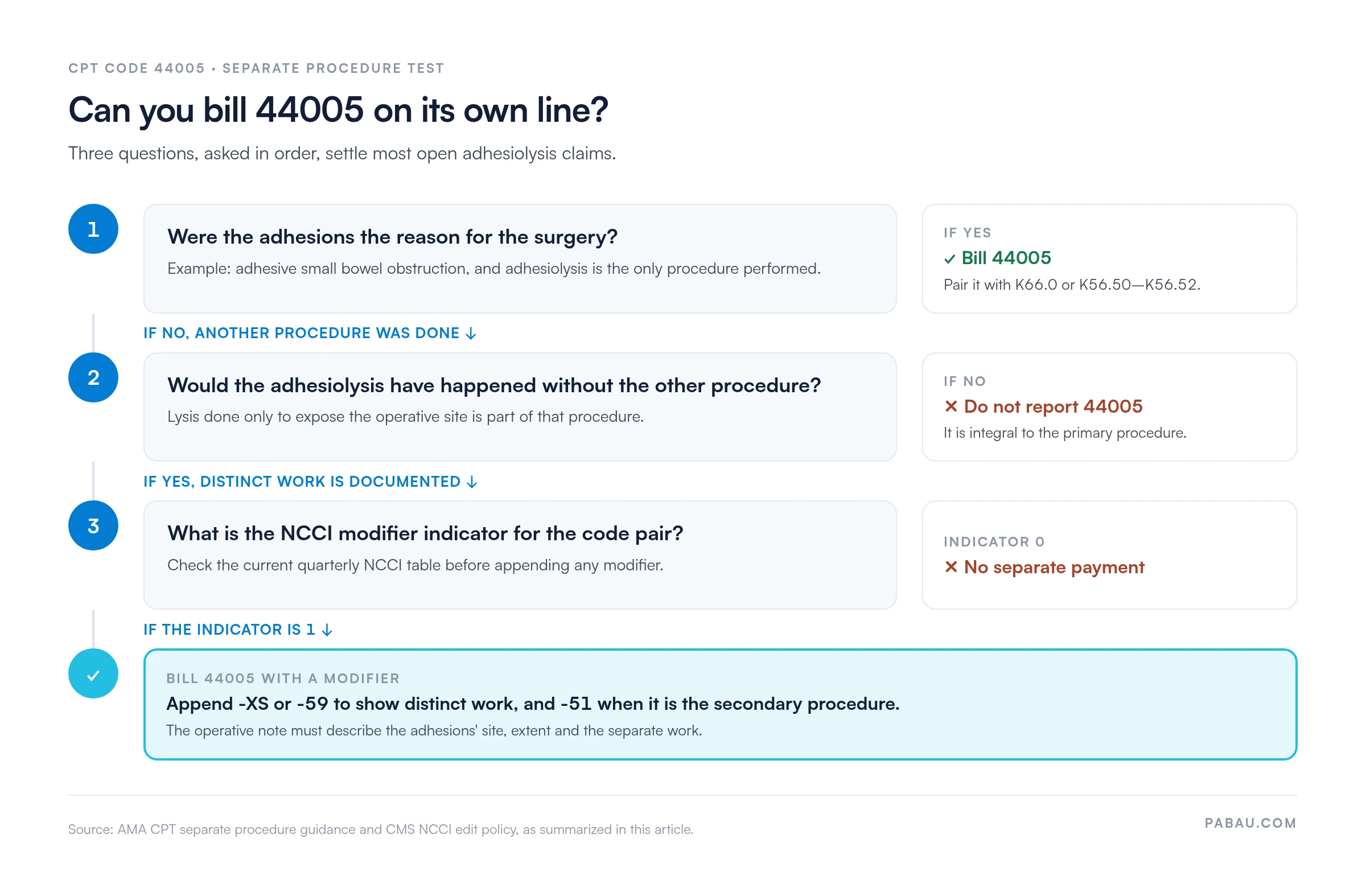
The National Correct Coding Initiative (NCCI) maintains bundling edits for CPT code 44005. In most of them, 44005 is the column-two (component) code paired with a primary abdominal procedure.
When both codes are billed together, 44005 is denied unless a valid modifier overrides the edit. The NCCI tables update quarterly, so verify current edit pairs in the CMS NCCI edit tables before submitting.
Important: An edit indicator of “1” means a modifier can override the bundle if the clinical circumstances support it. An indicator of “0” means the bundle is absolute and no modifier will produce separate payment. Always verify the indicator for the specific code pair in the current quarterly NCCI table before appending a modifier.
CPT code 44005 covers only the open approach to intestinal adhesiolysis. Several related codes are frequently misapplied, and payers often catch cross-approach billing during claims review. Laparoscopic intestinal adhesiolysis is 44180. The two gynecologic codes below are contrasts only, since neither covers intestinal adhesions.
An OB-GYN surgeon may free pelvic adhesions around the tubes and ovaries in the same session as open intestinal adhesiolysis. Two codes may then apply: 58740 for the adnexal work and 44005 for the intestinal work. Document each site separately and append modifier 51 to the secondary procedure.
Every claim for CPT code 44005 requires a diagnosis code that establishes medical necessity. Payers check that the ICD-10 code reflects a condition for which adhesiolysis is a clinically appropriate intervention. An unrelated or nonspecific diagnosis usually leads to a denial.
Medicare reimbursement for CPT code 44005 is calculated from the CMS Physician Fee Schedule (PFS) using relative value units (RVUs). Because PFS rates update annually and vary by geographic locality, all figures below are approximate benchmarks based on the national facility rate.
Billing teams should verify current payment amounts using the FastRVU 2026 RVU lookup tool or the CMS Physician Fee Schedule search.
These values are approximate. Geographic locality adjustments (GPCI) can shift the final allowed amount substantially. Urban markets like San Francisco or New York typically pay above the national rate, while rural localities may fall below it. Practices submitting claims for CPT code 44005 should reference the specific MAC jurisdiction rates rather than relying on national averages.
Four modifiers come into play regularly when billing CPT code 44005. Using the wrong modifier, or omitting one when documentation supports it, is a direct contributor to claim denials and underpayment. Per guidance from the AAPC CPT coding resources, each modifier has a specific application threshold.
Fraud risk advisory: Appending modifier 59 or XS to override a CCI edit, when the procedures are not distinct, is improper billing. It can trigger an OIG audit or recoupment. Apply these modifiers only when the clinical record supports their use.
Denials for CPT code 44005 tend to cluster around five causes. The remittance advice names each one with a claim adjustment reason code (CARC), and decoding those denial codes tells you which cause applies. A structured denial management process then turns each fix into a repeatable step.
Medicare generally does not require prior authorization for CPT code 44005 as an inpatient or ASC procedure. Medicare Administrative Contractors do vary in their medical necessity criteria. Checking the relevant MAC’s Local Coverage Determination (LCD) before billing protects against post-payment audit.
Other payers set their own rules, so check each one before scheduling elective surgery.
Before scheduling elective adhesiolysis, verify the patient’s payer policy by running real-time eligibility through your clearinghouse. Confirm whether prior authorization is required and document the auth number in the claim. A five-minute check prevents a weeks-long denial and appeal cycle.
In many surgical practices, 44005 errors surface only when the remittance comes back. A coder then rebuilds the claim, adds the missing modifier or documentation, and files an appeal weeks after surgery.
Pabau’s claims management catches errors earlier by validating each claim for missing or invalid details before submission. Claim.MD, our US clearinghouse partner, then submits electronic claims to thousands of US payers and runs real-time eligibility checks.
Your team can run that eligibility check when the surgery is booked, so coverage questions are settled before the operative date. Coders spend their time reviewing claims rather than reworking denials.

Pabau validates each claim for missing or invalid details before submission, then sends it through the Claim.MD clearinghouse to thousands of US payers.

Treat 44005 as a code each claim has to earn. Before billing it, ask whether the adhesiolysis would have happened without the other procedure, then check the NCCI indicator for every code pair.
If the operative note names the adhesions as the reason for surgery, bill 44005 with confidence. If it describes them as access, leave the code off. A smaller claim today costs less than a recoupment after an audit.
Pabau can validate claims for missing or invalid details before submission, so fewer 44005 claims come back for rework. Book a demo to see how it fits your surgical billing workflow.

Need guidance on how clearinghouse submission works? Medical claims clearinghouse explains how payer validation, EDI routing, and CARC denial codes interact during claims processing.
Submitting 837P files for surgical procedures? 837 electronic claim file covers the transaction format requirements for professional claims, including loop and segment rules relevant to surgical billing.
Want to reduce overall surgical denial rates? Electronic remittance advice (ERA) explains how 835 ERA files carry CARC denial codes that inform your appeal strategy for 44005 and other surgical procedures.
CPT code 44005 is the procedure code for open enterolysis, the surgical freeing of intestinal adhesions from the abdominal cavity. It applies only to the open (laparotomy) approach. Laparoscopic intestinal adhesiolysis is coded as 44180, while 58660 covers tube and ovary adhesions, not the intestine.
It means CPT code 44005 can only be reported when adhesiolysis is the primary reason for surgery. It cannot be reported when adhesiolysis is an access step for another concurrent abdominal procedure. Billing 44005 alongside a colectomy or hysterectomy where adhesiolysis was performed only for access will result in a bundling denial.
CPT code 44005 carries a 90-day global surgery period, meaning routine pre-operative and post-operative care is bundled into the surgical fee. Services for unrelated diagnoses during those 90 days may still be billed separately with the appropriate modifier.
Yes. Append modifier 51 to CPT code 44005 when it is a secondary procedure in the same session as a higher-value primary abdominal code. The procedures must also be clinically distinct. Most payers apply a 50% reduction to the secondary procedure when modifier 51 is present.
The primary supporting diagnosis codes are K66.0 (peritoneal adhesions), K56.50 through K56.52 (intestinal adhesions with obstruction, partial, or complete), and K91.30 (postprocedural intestinal obstruction). Select the most specific code based on operative and imaging findings rather than defaulting to the unspecified K56.50.
A “separate procedure” in CPT is a procedure the AMA has designated as commonly performed as part of a more comprehensive service. When performed alone or for a distinct purpose, it is separately reportable. When performed as part of or incidental to another procedure, it is bundled and should not be billed separately. CPT code 44005 carries this designation explicitly in its descriptor.



