HCPCS Code Q4185: Cellesta flowable amnion billing guide
HCPCS Code Q4185: definition and official descriptor HCPCS Code Q4185 is the Lev...

Last Updated: Nov 20, 2026
44050 is the CPT code for reduction of volvulus, intussusception, internal hernia, by laparotomy. It covers the open reduction of a twisted, telescoped, or internally herniated bowel segment through an abdominal incision, without resecting bowel.
The code sits in the Intestines (Except Rectum) range, 44005-44799, and carries a 90-day global surgical period under Medicare. A reduction completed laparoscopically is not 44050, and a resection of non-viable bowel is reported with its own code.
Let Pabau's smart automation suggest the right codes, reduce claim denials, and keep your practice compliant—effortlessly.
Automate repetitive tasks and focus on what matters most—your patients.
Reduce coding errors and ensure compliance with the latest regulations.
Clean claims, fewer denials, and faster reimbursements.
Powerful insights and reporting to help your practice thrive.
HIPAA compliant SOC 2 certified GDPR-compliant Trusted by 4,000+ clinics worldwide

CPT code 44050 covers the open reduction of volvulus, intussusception, and internal hernia by laparotomy, so a fully laparoscopic reduction is not billable under it.
K56.2 (volvulus), K56.1 (intussusception), and the K56.69- codes for other intestinal obstruction are the primary ICD-10-CM pairings that establish medical necessity.
Modifier 59 carries high audit risk on 44050, so use it only when a separately documented, distinct procedure was performed in the same session.
Pabau’s claims management software submits 44050 claims through the Claim.MD clearinghouse, checks eligibility before surgery, and tracks claim status and ERA remittances.
CPT code 44050 is the code for reduction of volvulus, intussusception, internal hernia, by laparotomy, which is an open reduction of an obstructed bowel segment.
New York Medicaid’s procedure code manual lists it under that exact descriptor, in the Intestines (Except Rectum) section. The descriptor comes from the AMA’s CPT code set, and because it names laparotomy, the code never applies to a reduction completed laparoscopically.
Three distinct intestinal conditions fall within this code’s scope:
The code covers the surgeon’s reduction of the obstruction through an open laparotomy. It does not include bowel resection. If the surgeon finds necrotic bowel and resects it, a resection code replaces or joins 44050, depending on what was performed. The AMA coding resources carry the full intestinal surgery code family and its guideline notes.
Knowing where the CPT code 44050 bundle starts and stops prevents under-coding, which misses separately billable services. It also prevents over-coding, which triggers NCCI bundling denials.
Taken together, these boundaries come down to two questions the operative note must answer. The first is how the abdomen was entered, and the second is whether the reduced bowel stayed in place.
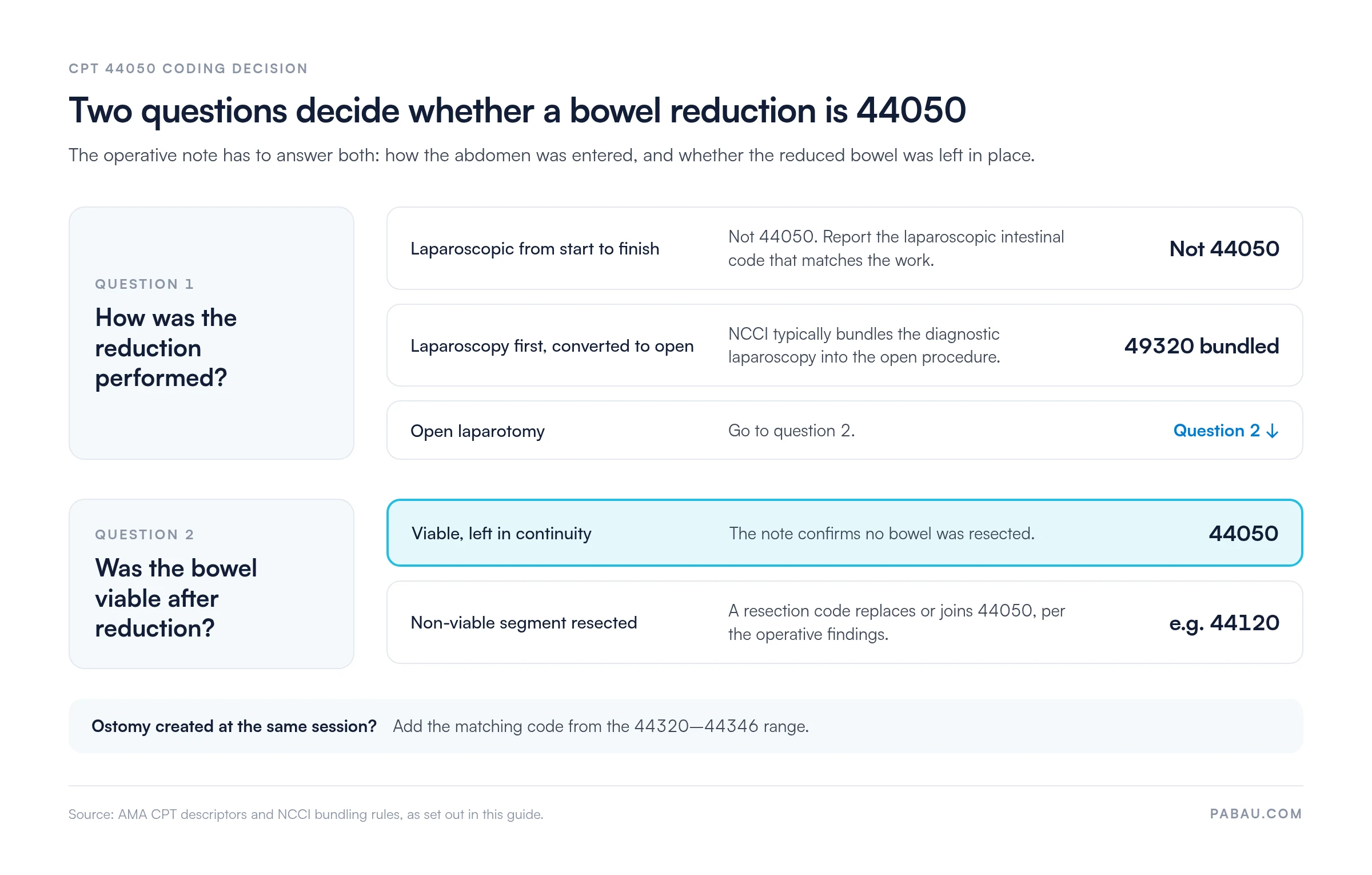
A coder reviewing an operative report for CPT code 44050 should see documentation confirming each of the following stages. Missing any element can result in a medical necessity denial or a request for additional records.
A clean claim submission for 44050 needs an operative report specific enough for an auditor to confirm the procedure without requesting more records. A vague line such as “bowel obstruction relieved” names no type, approach, or viability finding, and it invites post-payment review.
Run a documentation checklist against the operative report before submitting 44050. Confirm the note states the open approach, names the obstruction type, describes the reduction technique, and assesses bowel viability. It should also confirm that no resection was performed, or that the resection is coded separately. A missing element found before submission costs minutes, while one found after a denial costs days.
Medical necessity for CPT code 44050 is established by the ICD-10-CM diagnosis code reported alongside it. Payers match the procedure to the diagnosis. A code that does not map to an intestinal obstruction needing open reduction generates a diagnosis-procedure mismatch denial.
Always assign the most specific ICD-10-CM code supported by the operative report and attending physician documentation. Some Medicare Administrative Contractors (MACs) require the primary diagnosis to match the procedure category precisely.
Reporting a K56.69- code when the operative report documents sigmoid volvulus (K56.2) can trigger a specificity query or denial. Coders should confirm the final diagnosis with the attending surgeon before submission.
CPT code 44050 modifiers follow standard surgical modifier rules. The table below covers the four modifiers most commonly applied to intestinal surgery codes in this range.
Modifier -22 on CPT code 44050 is a consistent OIG audit target. Apply it only when the operative report contains objective, measurable evidence of increased work. That means an operative time at least 50% above the typical benchmark.
Specific descriptions of dense adhesions, a prior radiation field, or morbid obesity complicating the reduction also qualify. A note that says merely “difficult case” does not meet the threshold.
Medicare reimbursement for CPT code 44050 is calculated from relative value units (RVUs) published annually in the CMS Physician Fee Schedule. Dollar amounts change each year with the conversion factor. Verify the current-year fee schedule before quoting a reimbursement figure to a provider or patient.
The RVU structure for 44050 reflects major abdominal surgery complexity. The three components are work RVUs (the physician’s clinical effort), practice expense RVUs (overhead), and malpractice RVUs.
The final allowed amount is the total RVUs, adjusted by the geographic practice cost index (GPCI) for the locality, multiplied by the annual conversion factor. Use the FastRVU 2026 RVU lookup tool to retrieve current work RVU, practice expense RVU, and malpractice RVU values by locality for 44050.
Facility and non-facility rates differ significantly for 44050. The facility rate (hospital inpatient or outpatient) reflects reduced practice expense because the facility bears overhead costs. When billing from a physician practice performing the procedure in a hospital setting, use the facility fee schedule rate. Submitting the non-facility rate for a hospital-based case is a common overpayment that creates repayment liability on audit.
The 90-day global surgical period folds routine post-operative visits and care into the 44050 payment. They cannot be billed separately unless a significant, separate problem needs a new, documented E/M service.
Several intestinal surgery codes sit close to CPT code 44050 in both the code range and clinical context. Knowing where each code’s scope begins and ends prevents upcoding and misdirected bundling denials. See the AAPC Codify CPT lookup for full descriptor text and official guidelines for each code below.
The National Correct Coding Initiative (NCCI) publishes quarterly tables of procedure code pairs. They govern which pairs Medicare pays together and which it bundles into a single payment.
Knowing the NCCI edits for CPT code 44050 protects legitimate reimbursement and limits unbundling audit exposure. Sound medical billing compliance means checking the NCCI tables at the start of each calendar quarter, because the edits update regularly.
NCCI edits come in two types. Column one/column two edits treat one code as a component of the other. Mutually exclusive edits cover codes that should not logically be performed together. For 44050, the most common bundling conflicts arise with these codes:
Unbundling, the practice of billing component services separately to increase reimbursement, is a federal False Claims Act exposure risk. Recovery Audit Contractors (RACs) and Medicare’s Comprehensive Error Rate Testing (CERT) program actively flag unbundled intestinal surgery claims. Every separate service billed alongside 44050 requires a clinical reason that can be defended in a medical record review.
CPT code 44050 denials fall into six main patterns. Each has a prevention step that billing teams can build into the pre-submission workflow. Solid denial management workflows catch most of them before the claim leaves the practice.
Prior authorization requirements for CPT code 44050 vary by payer, plan type, and MAC jurisdiction. What holds for Medicare may not hold for a commercial plan in the same state.
Medicare does not require prior authorization for CPT 44050 as a standard rule. The procedure is typically performed in an emergency or urgent surgical context, which exempts it from most prior authorization programs.
However, some Medicare Advantage plans (Part C) operate their own prior authorization programs separate from traditional Medicare, and these vary by plan. Always verify with the specific Medicare Advantage plan rather than assuming traditional Medicare rules apply.
Commercial payers often exempt emergency surgical procedures from prior authorization, but each payer defines “emergency” for itself. A same-day urgent admission for sigmoid volvulus may qualify as an emergency under most plans.
An elective-appearing surgical booking for a known recurrent volvulus patient may require pre-authorization. When in doubt, check the payer’s authorization portal and document the clinical urgency in the medical record.
Use detailed superbill documentation for 44050 cases. ICD-10 codes, modifier rationale, and operative findings on the superbill cut the back-and-forth with the payer’s clinical reviewers and speed up adjudication. Medical necessity documentation sent with the claim works better than a reply to a denial.
An emergency laparotomy for volvulus leaves the billing team with an operative note, a diagnosis, and a 90-day global period to track. When those sit in separate systems, the coder re-keys the procedure and eligibility gets checked by phone after surgery.
Pabau, the practice management platform we build, keeps the clinical record and the claim in one place. Its surgical claims software sends 44050 claims electronically through the Claim.MD clearinghouse as CMS-1500/837P claims. It runs real-time eligibility checks before surgery, tracks claim status, and posts ERA remittances back to the billing record.
Secondary claims go out from the same screen once the primary payer has paid. The billing team sees a rejected 44050 claim the day its status comes back, while the operative note is still fresh. The modifier rationale or viability statement it needs goes in before resubmission.

Pabau’s claims management software submits 44050 claims through the Claim.MD clearinghouse, checks eligibility before surgery, and tracks each claim through to ERA posting. See how it handles surgical claims from operative note to payment.

A 44050 claim stands or falls on two lines of the operative note. One states how the abdomen was entered, and the other says whether the reduced bowel stayed in place. Read the note for both before coding, and query the surgeon when either is missing.
The trade-off to remember sits with 44005 and 49320. Billing either alongside 44050 can be legitimate, but only a note that describes separate work survives a medical record review. Where the note does not, report 44050 alone and let the global package absorb the rest.
Book a demo to see how Pabau sends 44050 claims through Claim.MD, checks eligibility before surgery, and tracks every claim to ERA posting.

Need to see how a clearinghouse handles surgical claims? Claim.MD clearinghouse guide explains how electronic submission, eligibility checks, and remittance tracking work together on surgical claims.
Confused about when an 837 file is required? 837 electronic claim file guide covers transaction format requirements for inpatient and outpatient surgical procedure submissions.
Need to read the remittance on a denied surgical claim? Electronic remittance advice (ERA) guide shows how to interpret ERA reason codes to fix recurring denial patterns on surgical claims.
Billing a diagnostic laparoscopy before conversion? CPT code 49320 covers the descriptor, bundling rules, and modifiers for a diagnostic laparoscopy.
CPT code 44050 is an open surgical procedure code covering reduction of volvulus, intussusception, and internal hernia by laparotomy. It is used when a surgeon manually reduces an intestinal obstruction through an open abdominal incision without resecting the bowel.
No. CPT 44050 applies only to open (laparotomy) procedures. If the reduction was performed entirely laparoscopically, 44050 is not the correct code. There is currently no AMA-designated laparoscopic equivalent for this specific reduction procedure.
Only in limited circumstances. A diagnostic laparoscopy (49320) may be billed separately with modifier -59 or the matching X-modifier. That applies only when it was a separate, distinct decision made before converting to an open reduction under 44050. NCCI edits typically bundle 49320 into the primary open procedure when both occur in the same session without documented distinct rationale.
CPT 44005 covers enterolysis (freeing of intestinal adhesions), while CPT 44050 covers reduction of a mechanical obstruction such as volvulus or intussusception. When enterolysis is performed as a component step of the reduction, NCCI edits bundle 44005 into 44050. Separate billing of 44005 is permitted only when distinct, additional adhesiolysis work is documented beyond the standard access required for the reduction.
The primary ICD-10-CM codes that establish medical necessity for CPT 44050 are K56.2 (volvulus) and K56.1 (intussusception). Other intestinal obstruction is reported with K56.690, K56.691, or K56.699. Always assign the most specific code the operative report supports. An unspecified obstruction code, used when the note documents a specific type, can trigger a specificity denial.
Traditional Medicare does not require prior authorization for CPT 44050. The code typically covers emergency or urgent surgical presentations that fall outside standard prior authorization programs. Medicare Advantage plans vary: Verify prior authorization requirements directly with the specific plan before assuming traditional Medicare rules apply.