HCPCS Code J1110: Dihydroergotamine mesylate injection billing guide
HCPCS Code J1110: Official descriptor and drug overview HCPCS Code J1110 is the ...

Last Updated: Oct 29, 2026
44320 is the CPT code for colostomy or skin level cecostomy, performed through an open approach. It covers creating a large bowel stoma, or opening the cecum to skin level without a tube.
Medical coders and colorectal billing teams use 44320 in emergencies like perforated diverticulitis, trauma and obstructing colorectal cancer. Approach documentation decides between 44320 (open) and 44188 (laparoscopic), so the operative note has to name the approach.
Let Pabau's smart automation suggest the right codes, reduce claim denials, and keep your practice compliant—effortlessly.
Automate repetitive tasks and focus on what matters most—your patients.
Reduce coding errors and ensure compliance with the latest regulations.
Clean claims, fewer denials, and faster reimbursements.
Powerful insights and reporting to help your practice thrive.
HIPAA compliant SOC 2 certified GDPR-compliant Trusted by 4,000+ clinics worldwide

CPT 44320 covers open colostomy or skin-level cecostomy, while a laparoscopic approach is reported with CPT 44188.
The operative report must state the open approach and the stoma type to support the claim.
K57.xx (diverticulitis), C18.x (colon cancer) and K56.xx (obstruction) are among the most common ICD-10 pairings.
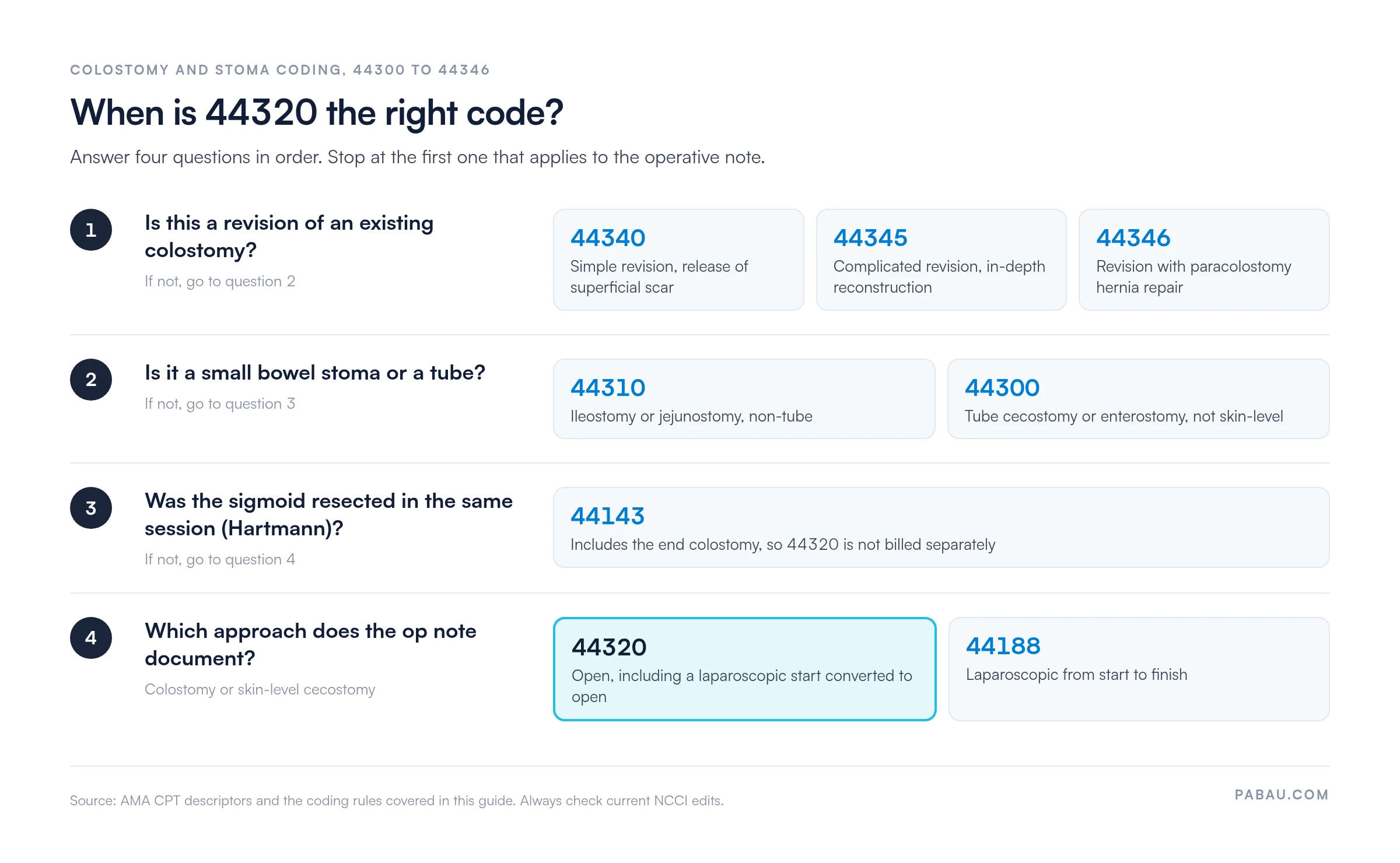
A revision of an existing colostomy is coded 44340, 44345 or 44346, never 44320.
Pabau’s claims software scrubs each claim for missing or invalid details before submission, and US eligibility checks run through Claim.MD.
CPT code 44320 is an open surgical procedure code in the intestinal surgery range (44300-44346), covering colostomy or skin-level cecostomy. The AMA’s CPT code set assigns 44320 the official descriptor: Colostomy or skin level cecostomy.
Two distinct procedures fall under this single code. A standard colostomy brings a segment of the colon, such as the sigmoid, transverse or descending colon, through the abdominal wall. A skin-level cecostomy opens the cecum to skin level without a tube. Both are coded 44320 only when performed through an open laparotomy. If the surgeon performs the procedure laparoscopically, code 44188 applies instead.
Colorectal surgeons perform open colostomies across a range of urgent and elective indications. Each indication maps to a distinct ICD-10 family. The ICD-10 code you pair with 44320 is what establishes medical necessity for the payer.
The most common clinical scenarios where 44320 is the correct code:
Emergency colostomies performed during the same operative session as a bowel resection require careful attention to NCCI bundling edits. When stoma creation accompanies a resection, payers may bundle 44320 into the resection code. Verify the current NCCI edit table for the specific resection code pair before submitting a multi-code claim.
Surgical approach is the sole determinant between these two codes. CPT 44320 covers open colostomy only; CPT 44188 covers laparoscopic colostomy. The operative note must state the approach explicitly. Coders may not infer it from other documentation, and payers have no obligation to assume an open approach when the note is silent.
Surgeons sometimes start laparoscopically and convert to open because of adhesions, bleeding or poor visualization. The operative report must then document the conversion and the reason. The claim is submitted with CPT 44320 (the open code), not 44188. Billing 44188 after a documented conversion misreports the procedure and invites a payer audit.
CPT 44320 sits in a tightly packed range of colostomy, enterostomy, and stoma revision codes. Misassigning to an adjacent code, especially 44310 or one of the revision codes, is a common error in colorectal billing.
The most consequential distinction is that 44320 is for stoma creation. Once a colostomy exists, a simple revision is 44340, a complicated revision 44345, and paracolostomy hernia repair 44346. Billing 44320 for a revision misreports the service, because no new stoma was created. The decision path below puts the whole family in the order a coder should rule codes out.
Every 44320 claim needs a diagnosis code that establishes why the colostomy was medically necessary. The ICD-10 selection depends on the underlying pathology documented in the operative report and the admitting diagnosis.
Select the most specific ICD-10 code that reflects the documented pathology. Z93.3 (colostomy status) identifies patients who already have a colostomy. It does not justify the creation procedure and should never be the primary diagnosis on a 44320 claim.
Document the precise anatomical segment (sigmoid, transverse, descending) and the stoma type (end vs loop) in the operative note. Vague language like ‘colostomy created’ leaves payers unable to confirm that the procedure matches the billed code. That is a common cause of 44320 documentation denials.
The operative report is the most important document supporting a 44320 claim. To meet clean claim requirements, the op note for a surgical code like this should address each element below before submission.
For payers requiring prior authorization on elective colostomies, the auth request must reference the ICD-10 primary diagnosis and, where required, supporting imaging or endoscopy reports. Emergency colostomies typically qualify for retrospective authorization, but the admitting diagnosis documentation must align with the ICD-10 code on the claim.
A superbill that captures approach, stoma type and diagnosis at the time of service saves coders from chasing the surgeon for those details weeks later.
Modifier selection on 44320 claims depends on the clinical circumstances. Every modifier below interacts with NCCI edits, so check the edit pair before appending one. If your team is new to medical billing fundamentals, start with how a claim moves from encounter to payment.
CMS introduced the X-modifiers (XE, XS, XP, XU) as more specific alternatives to modifier 59. When you bill 44320 alongside a bowel resection and need to bypass an edit, confirm which the payer accepts. Using the wrong one is a common technical denial.
The Hartmann procedure is a sigmoid resection with end colostomy and closure of the rectal stump. It is a common emergency scenario for a misbilled 44320 and a bundling denial. The procedure has two surgical components, the sigmoid resection and the end colostomy creation.
How to sequence the codes correctly for a Hartmann procedure:
Practices billing colorectal surgery volume should review their NCCI edit exposure on resection-plus-stoma claims quarterly. Bundling rules change, and a combination that was separately payable in one year may be bundled in the next.
CPT 44320 denials cluster around three failure points: approach documentation, NCCI bundling and prior authorization. Structured denial management tracks each denial reason by code and payer, so you can see which failure costs the practice most. Our guide to medical billing denial codes explains the CARC codes you’ll see on a denied remittance.
Submitting through a clearinghouse adds a validation step before the payer sees the claim. In the US, Pabau runs eligibility checks through Claim.MD and scrubs each claim for missing or invalid details before submission. A claim missing an authorization code is flagged at that point, not weeks later on a denial. The Claim.MD clearinghouse guide explains how eligibility checks and ERA settlement work.
CPT 44320 carries substantial work RVU values reflecting the complexity of major abdominal surgery. The CMS Physician Fee Schedule lookup tool provides current year-specific payment rates and RVU values by Geographic Practice Cost Index (GPCI) locality. Rates vary by location and change annually. Verify against the current MPFS before using a figure in financial modeling or appeals correspondence.
The table below breaks down the RVU components behind the payment. Pull current-year values from FastRVU or the CMS MPFS lookup.
The 90-day global period means routine follow-up visits within 90 days of a 44320 procedure are included in the surgical payment. They are not separately billable.
Services outside the global package need a modifier that shows why they are payable. Use modifier 24 for an unrelated E/M visit and 79 for an unrelated procedure. Use 78 when a related complication brings the patient back to the OR.
Run a quarterly audit of all 44320 claims submitted alongside resection codes. Pull the NCCI edit table for each resection code pair and confirm whether modifier 59 or an X-modifier was required. Unbundling denials on surgical claims often hide in the EOB for months before a coder identifies the pattern.
Without claims software, a coder checks each 44320 claim by hand. They read the op note, confirm the approach and diagnosis, then key the claim into a separate clearinghouse portal. A missing authorization code or an invalid field often surfaces only when the denial comes back.
Pabau, the practice management platform we build, runs that check inside its claims management software. Claim validation scrubs each claim for missing or invalid details before submission and flags any claim missing an authorization code. In the US, eligibility checks run through Claim.MD, and ERA files can be settled when the payer responds.
Your coder still decides between 44320 and 44188. What changes is that an incomplete claim stops before submission, so it gets fixed before the payer sees it rather than on appeal.

Pabau’s claim validation checks each claim for missing or invalid details before submission, and US eligibility checks run through Claim.MD. Fewer avoidable denials reach your billing team.

CPT code 44320 pays when the operative note supports it. Approach documentation decides between 44320 (open) and 44188 (laparoscopic), and the stoma type and ICD-10 pairing have to match what the surgeon documented.
The step worth taking now is a pre-submission check on every 44320 claim. Confirm the approach language, rule out a same-session 44143, and check the NCCI edit pair before adding 59 or an X-modifier. Repeat the NCCI review each quarter if you bill colorectal surgery regularly, because edit pairs change.
Revisions are the other trap worth remembering, since 44340, 44345 and 44346 never become a 44320. Book a demo to see how Pabau flags incomplete surgical claims before they reach the payer.

Planning an elective colostomy? Prior authorization process walks through requesting and tracking payer approval before surgery.
Need to understand how clearinghouse claim routing works? Medical claims clearinghouse guide explains how electronic claims flow from practice to payer and where errors get caught.
Building an appeal for a bundled surgical claim? Denial management in healthcare covers how to track, appeal and prevent denied claims.
CPT code 44320 covers open colostomy or skin-level cecostomy. It is the surgical creation of a large bowel stoma at the abdominal wall through an open laparotomy. It applies to end colostomies, loop colostomies, and diverting colostomies performed through an open incision. Laparoscopic colostomy creation uses CPT 44188 instead.
No. Laparoscopic colostomy creation is reported with CPT 44188, not CPT 44320. Code 44320 is open approach only. If a surgeon starts laparoscopically and converts to open, submit the claim with CPT 44320. The operative note should document the reason for the conversion.
Yes. The official AMA descriptor for 44320 explicitly includes both colostomy and skin-level cecostomy. Skin-level cecostomy, where the cecum is brought to skin level without a tube, is distinct from tube cecostomy, which is coded under CPT 44300. When the cecostomy involves a tube rather than a skin-level opening, use 44300 instead of 44320.
The operative report must document five elements. These are the surgical approach (state open laparotomy explicitly), the colon segment involved, the stoma type, the clinical indication and the stoma maturation technique. Missing approach language is a common documentation deficiency behind 44320 denials.