

HCPCS Code L0472: Hyperextension TLSO billing guide
HCPCS code L0472: Official descriptor and device definition HCPCS code L0472 des...

Last Updated: Nov 5, 2026
44950 is the CPT code for an open appendectomy, the removal of the appendix through an abdominal incision. Its AMA descriptor is simply "Appendectomy," and it sits in the Excision Procedures on the Appendix subsection (44950-44960).
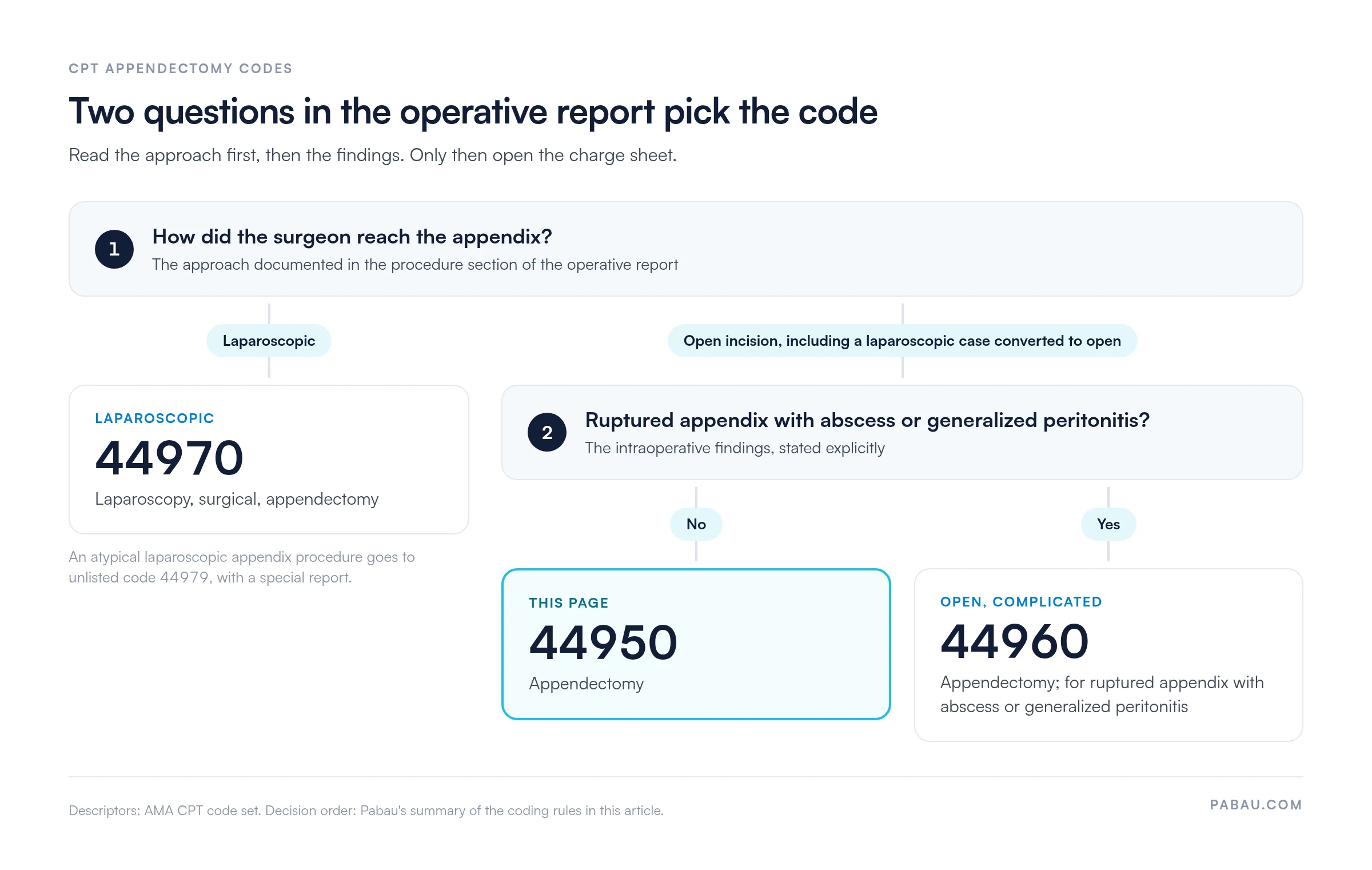
Two details in the operative report decide whether 44950 is correct. A laparoscopic approach moves the claim to 44970. A ruptured appendix with abscess or generalized peritonitis moves it to 44960.
Let Pabau's smart automation suggest the right codes, reduce claim denials, and keep your practice compliant—effortlessly.
Automate repetitive tasks and focus on what matters most—your patients.
Reduce coding errors and ensure compliance with the latest regulations.
Clean claims, fewer denials, and faster reimbursements.
Powerful insights and reporting to help your practice thrive.
HIPAA compliant SOC 2 certified GDPR-compliant Trusted by 4,000+ clinics worldwide

CPT Code 44950 describes an open appendectomy, performed through a traditional incision. Laparoscopic removal is coded under 44970 instead.
The operative report’s approach and findings decide the code. Open removal is 44950, open removal of a ruptured appendix with abscess or generalized peritonitis is 44960, and laparoscopy is 44970.
K35.80 (unspecified acute appendicitis) is a common ICD-10 pairing, but payer LCDs may restrict the covered diagnosis codes, so verify before billing.
Pabau’s claims management software submits 44950 claims through the Claim.MD clearinghouse and posts remittances against the patient record.
CPT Code 44950 is the surgical procedure code for an open appendectomy, the removal of the appendix through an open incision.
Its American Medical Association (AMA) descriptor is simply “Appendectomy.” The code sits in the Digestive System Surgery section of the CPT code set, under Excision Procedures on the Appendix (44950-44960).
Because the descriptor is a single word, the operative report carries the coding decision. 44950 fits an open appendectomy performed as the primary procedure, or for its own indication.
When the appendix comes out during another abdominal surgery, payer bundling policy decides whether it pays at all, as the incidental appendectomy section below explains.
The AMA revises the CPT code set every year, and CMS resets RVUs annually, so check both against the current editions.
Understanding the procedure steps helps coders verify that the operative report supports 44950 rather than a higher-complexity code or the laparoscopic alternative. An open appendectomy follows a consistent surgical sequence that must be reflected in the documentation.
If the surgeon finds a ruptured appendix with abscess or generalized peritonitis, the encounter is coded 44960, not 44950. The operative note must state the open approach, the presence or absence of perforation, and the clinical indication. A note that leaves the approach unclear is a frequent cause of 44950 denials.
Coders often confuse 44950 with its two neighbors, 44960 and 44970. The documented approach and the intraoperative findings decide which one is correct, so read both before you select a code.
The chart below puts those two questions in the order a coder should ask them: approach first, then findings.
Conversion from laparoscopic to open: When a surgeon converts from laparoscopic to open during the same encounter, bill 44950 (the completed open approach), not 44970. The operative report must document the conversion and the reason. Some payers require modifier -22 when the conversion significantly increases operative time and complexity.
When you review an operative report for appendectomy coding, find three things in the first paragraph. Look for the approach (open or laparoscopic), the findings (intact, perforated, abscess), and the specimen disposition. Those three elements decide whether the claim goes out as 44950, 44960, or 44970, so check them before anything else.
Every 44950 claim requires a supporting ICD-10-CM diagnosis code that documents the medical necessity for the procedure. The diagnosis must match the clinical findings in the operative report and the physician’s documented indication for surgery.
Medicare Administrative Contractors (MACs) can issue Local Coverage Determinations (LCDs) that narrow the covered diagnosis list for 44950. Check the LCD for your jurisdiction before billing an elective or recurrent appendicitis case.
A modifier on a 44950 claim tells the payer the procedure differed from the standard encounter in a documented way. Each one needs support in the operative report or the medical record. A modifier submitted without that support invites a post-payment audit.
Modifier -22 carries the highest risk of downgrade or denial when it lacks support. Payers expect the operative note to state why the work was substantially greater than typical, and operative time alone does not prove it. Include a brief addendum or cover letter that quantifies the extra work.
Every 44950 claim needs a complete operative report behind it. Medicare and commercial payers may request the note at any stage of the revenue cycle. A missing element is the fastest path to denial or recoupment.
A surgical superbill that lists the appendectomy family (44950, 44960, 44970) beside the common ICD-10 pairings cuts wrong-code picks at the point of service. High-volume surgical teams can go further and match each operative report to its procedure code before the claim goes out.
Medicare reimbursement for CPT Code 44950 is set each year through the Medicare Physician Fee Schedule (MPFS). The code’s Relative Value Units (RVUs) are multiplied by the annual conversion factor.
The result is then adjusted by the Geographic Practice Cost Index (GPCI) for each MAC locality, so payment varies by location.
Use the CMS Physician Fee Schedule lookup tool to retrieve the exact 2026 reimbursement amount for your locality. The FastRVU 2026 RVU lookup also provides work RVU, practice expense, and malpractice RVU values searchable by CPT code and location.
Denials on 44950 cluster around a predictable set of documentation and code-selection errors. Most are preventable if operative report review happens before submission rather than after the denial arrives.
Review your denial management workflows after each denial cycle to spot patterns across the surgical coding team. Then match the CARC reason code on the ERA against the medical billing denial codes to see what to correct before you resubmit.
If your team tracks clean claim submission rates, add 44950 to the monitored codes and review its denial rate monthly.
Run a monthly denial report filtered to CPT 44950 and sort by denial reason code. The top two or three CARC codes usually point to one recurring documentation problem, in either the operative report language or the ICD-10 pairing. One team training session can fix it for the whole billing cycle.
Two edge cases cause more trouble than a standard acute appendicitis claim. The first is an incidental (prophylactic) appendectomy performed during another procedure. The second is an elective case that needs prior authorization.
Incidental appendectomy: When the appendix comes out during another abdominal surgery, such as a hysterectomy, many payers bundle it into the primary procedure. That includes most Medicare MACs, which deny a separate 44950 line. The bundling rule comes from payer policy, so check each payer’s own wording.
Separate payment needs a distinct medical necessity in the operative note, such as a suspicious appearance or adhesions involving the appendix. Some commercial carriers then pay with modifier -59 and a supporting note, while others deny the line outright. Verify the specific payer policy before billing it separately.
Prior authorization: Emergency appendectomies for acute appendicitis confirmed on imaging are almost always exempt under commercial payers’ emergency care carve-outs. Elective cases, recurrent appendicitis, and incidental removal are not. Check authorization rules against the patient’s specific plan, since plan-level rules can differ from the carrier’s general policy.
If a case sits between emergency and elective, document the clinical urgency clearly in the record. A missing authorization often leads to a denial that is hard to overturn. That makes insurance eligibility verification at scheduling a key step for surgical billing teams.
On many surgical billing teams, the operative note and the claim live in different systems. Someone reads the approach, the findings and the pathology line, then re-keys them into a claim form. Each hand-off is a chance to bill 44950 for a laparoscopic case, or to pair the wrong K35 code.
Pabau, the practice management platform we build, keeps the clinical record and the claim in one place. Its claims management software submits claims electronically through the Claim.MD clearinghouse, which connects to thousands of US payers. Electronic remittance advice (ERA/835) comes back against the same patient record, so payments reconcile without manual keying.
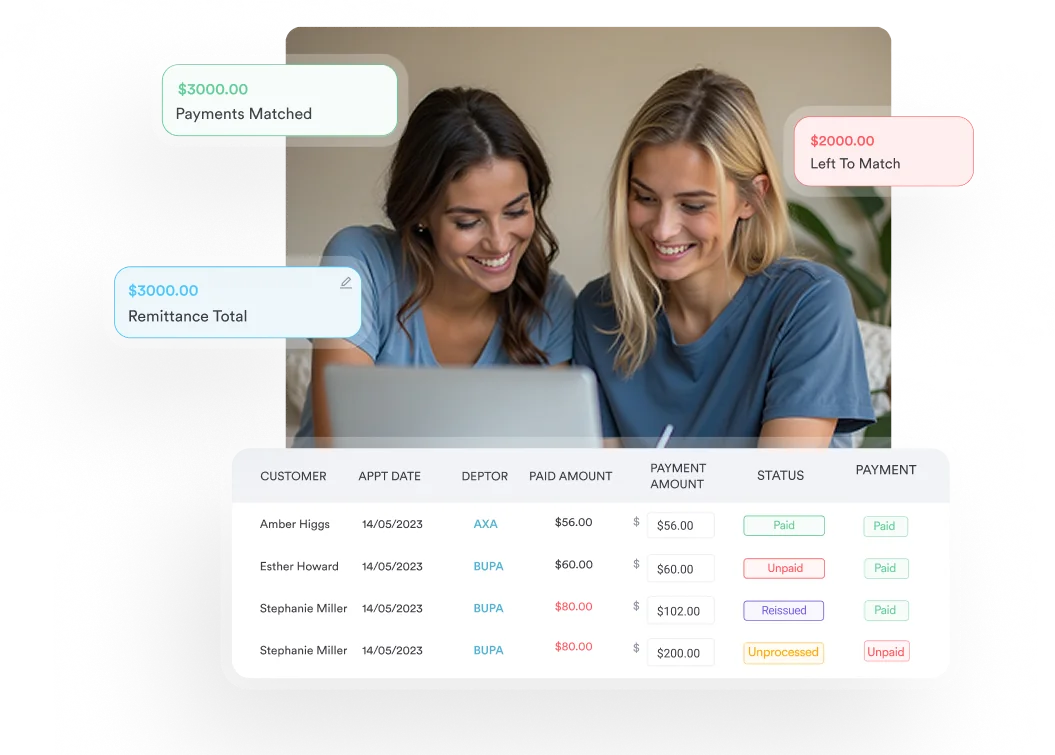
Your team sees a rejected 44950 claim the day the payer returns it, while the operative note is still fresh. Waiting for month-end reconciliation turns the same fix into a cold case.

Pabau keeps the clinical record and the claim in one system, submits 44950 claims through the Claim.MD clearinghouse, and posts remittances against the patient record.

On an open appendectomy, the code is decided in the operating room and recorded in the note. Read the approach first, then the findings, and only then choose between 44950, 44960 and 44970. Coding in that order keeps modifier -22 and appeals for the cases that genuinely need them.
Give the diagnosis the same care. K35.80 is an unspecified code, so a note that names perforation, gangrene or peritonitis supports a more specific K35 code and a cleaner claim.
Pabau’s integration with Claim.MD connects surgical billing teams to thousands of US payers for electronic submission, eligibility checks and ERA-based reconciliation. Book a demo to see how Pabau keeps operative notes and surgical claims in one workflow.

Need a clearinghouse for surgical claims? Claim.MD clearinghouse review explains how the clearinghouse routes claims to thousands of US payers and returns ERA files for reconciliation.
Tracking down the reason behind a denial? Understanding electronic remittance advice walks through how to read ERA 835 files and extract CARC denial codes from surgical claims.
Acuity missing from the record? ICD-10 code K37 covers unspecified appendicitis, the fallback when the note does not state acuity.
CPT Code 44950 is the AMA’s procedure code for an open appendectomy, the surgical removal of the appendix through a traditional incision. It sits under Excision Procedures on the Appendix (44950-44960) in the Digestive System Surgery section.
CPT 44950 is for an open appendectomy through a traditional incision. CPT 44970 is for a laparoscopic appendectomy using trocars. The documented surgical approach decides which applies, so never use 44950 when the note describes a laparoscopic technique.
CPT 44960 applies when the operative report documents a ruptured appendix with abscess or generalized peritonitis. If the appendix is intact and there is no abscess or peritonitis, bill 44950. The intraoperative findings section of the operative note is the deciding factor.
Medicare reimbursement for CPT 44950 starts from the 2026 MPFS total facility RVU of 18.13. That figure is multiplied by the annual conversion factor and adjusted by the GPCI. Use the CMS Physician Fee Schedule lookup tool to retrieve the exact rate for your MAC locality.
The most common modifiers with 44950 are -22 for increased procedural services and -51 for multiple procedures in the same session. Modifier -59 marks a distinct procedural service, and -47 covers anesthesia by the surgeon. Each needs operative report documentation to support it.
The usual denial reasons are a code mismatch, thin documentation and missing paperwork. Coders bill 44950 for a laparoscopic case that calls for 44970, or pair the wrong ICD-10 code. Others come from vague operative notes, unbundling without a modifier, or no prior authorization for an elective case.



