

HCPCS Code Q4185: Cellesta flowable amnion billing guide
HCPCS Code Q4185: definition and official descriptor HCPCS Code Q4185 is the Lev...

Last Updated: Nov 20, 2026
44130 is the CPT code for enteroenterostomy, anastomosis of intestine, with or without cutaneous enterostomy (separate procedure). It covers an open operation that joins one loop of intestine to another, usually to bypass an obstruction that cannot be safely removed.
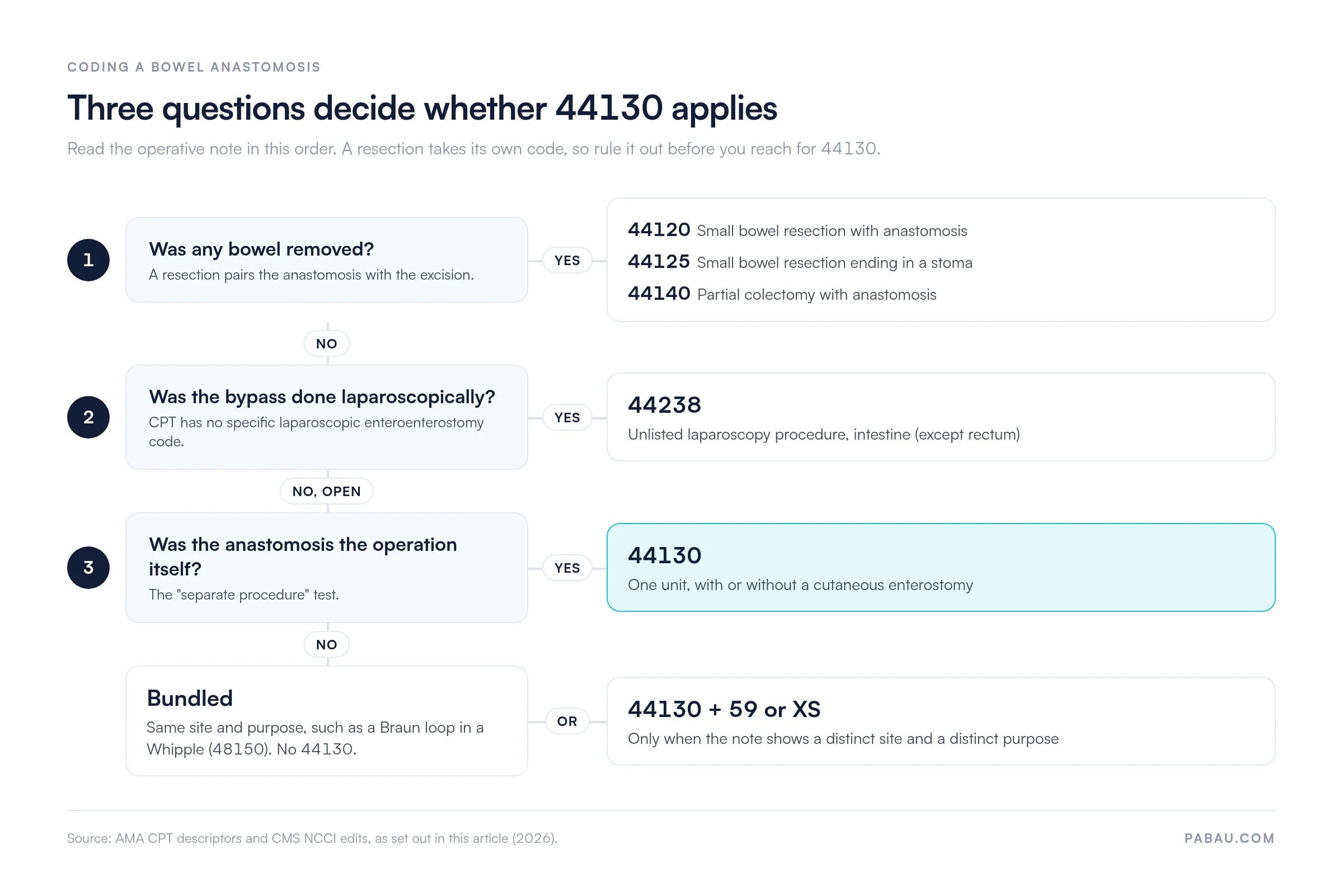
No bowel is resected. Because 44130 is a separate procedure, an anastomosis made during a resection, such as 44120 or 44140, is bundled into that code. A laparoscopic bypass has no specific code and goes to 44238.
Let Pabau's smart automation suggest the right codes, reduce claim denials, and keep your practice compliant—effortlessly.
Automate repetitive tasks and focus on what matters most—your patients.
Reduce coding errors and ensure compliance with the latest regulations.
Clean claims, fewer denials, and faster reimbursements.
Powerful insights and reporting to help your practice thrive.
HIPAA compliant SOC 2 certified GDPR-compliant Trusted by 4,000+ clinics worldwide

CPT code 44130 reports an open enteroenterostomy: one loop of intestine joined to another, with or without a cutaneous enterostomy.
It is a CPT “separate procedure”, so an anastomosis made during a resection or a Whipple is bundled, not billed as 44130.
A small bowel resection with anastomosis is 44120, and a resection ending in a stoma is 44125. Neither is 44130.
44130 is on the 2026 Medicare inpatient-only list, and its 2026 national facility rate is about $1,231 (36.85 RVUs, 90-day global).
Pabau’s claims management software works with the Claim.MD clearinghouse to submit claims, check eligibility, track status, and post remittances.
CPT code 44130 is the billing code for an open enteroenterostomy, a surgical anastomosis that joins one segment of intestine to another.
The official AMA descriptor reads: Enteroenterostomy, anastomosis of intestine, with or without cutaneous enterostomy (separate procedure), as listed in Northwestern Medicine’s surgical CPT code reference.
The operation creates a new connection between two loops of bowel, usually to route intestinal contents around an obstruction. No diseased segment is removed. That is the line between 44130 and the enterectomy codes, which pair a resection with the anastomosis.
Two parts of the descriptor shape almost every coding decision. “With or without cutaneous enterostomy” means a vent or stoma made in the same operation does not change the code. “Separate procedure” means 44130 is reported only when the anastomosis is the main operation, or clearly distinct from the rest of the session.
In an enteroenterostomy, the surgeon leaves the diseased bowel in place and builds a new channel around it. A typical open case runs in this order:
The usual indication is an obstruction that cannot be safely removed. Common examples are an unresectable or metastatic tumor, dense adhesions, and radiation injury to the small bowel. In each case, resection would add risk that a bypass avoids.
If the operative note describes removal of a bowel segment, 44130 is almost certainly the wrong code. The anastomosis then belongs to the resection code that describes the whole operation, such as 44120 for a small bowel resection.
CPT marks a code as a “separate procedure” when the service is usually performed as an integral part of a larger operation. For 44130, that larger operation is often a resection or a pancreatic or gastric reconstruction. The anastomosis is already valued in that bigger code.
The practical test is simple. Was the enteroenterostomy the operation, or a step inside another one? Only the first case supports 44130 on its own.
Modifier 59 is a last resort here. Appending it to every 44130 billed beside another intestinal code is a common audit trigger. Check the current quarterly NCCI procedure-to-procedure table for the exact pair before the claim goes out.
Most 44130 coding errors come from the neighbors in the 44100-44160 range, which all end with an anastomosis or a stoma. The deciding question is nearly always whether bowel was removed. The work RVUs below come from the CMS 2026 Physician Fee Schedule relative value file.
Gastrojejunostomy (43820) is another frequent mix-up. It joins the stomach to the jejunum, while 44130 joins intestine to intestine. A laparoscopic enteroenterostomy has no specific code, so it goes to 44238. When no listed code describes an open intestinal operation at all, the claim goes to unlisted code 44799.
Put together, the choice comes down to three questions about the operative note, asked in the order the chart below sets out.
The diagnosis has to explain why the bowel was bypassed and not resected. Payers look for an obstruction, and for a reason that resection was unsafe or impossible.
For malignant obstruction, code the obstructing tumor, such as C17.9 for a primary small bowel cancer. Then document why resection was not attempted. Radiation injury cases also need the radiation cause coded and documented, alongside the obstruction itself.
CMS values 44130 in the 2026 Medicare Physician Fee Schedule (MPFS). The figures below come from the October 2026 national relative value file. They are national, unadjusted values, so your payment shifts with the geographic practice cost index (GPCI) for your locality.
Qualifying alternative payment model (APM) participants use the higher 2026 conversion factor of $33.5675, or about $1,236.96. Check your locality in the CMS Physician Fee Schedule lookup tool.
The 90-day global splits as 9% preoperative, 81% intraoperative, and 10% postoperative. Those shares set the payment when surgical care is split with modifiers 54 and 55.
44130 is on the Medicare inpatient-only (IPO) list. The October 2026 OPPS Addendum B gives it status indicator C, so a hospital outpatient claim for it is not paid. The surgeon is still paid under the MPFS for an inpatient case reported with place of service 21.
That status is due to change. In the CY 2026 OPPS final rule, CMS began a three-year phase-out of the IPO list, removing 285 mostly musculoskeletal services first. Elimination of the whole list is finalized for January 1, 2029, so check each year’s Addendum B before you assume 44130 is still inpatient only.
The CMS fee schedule indicators for 44130 set which modifiers can pay. It allows standard multiple-procedure reduction, a paid assistant at surgery, and co-surgeons with supporting documentation. Team surgery is not allowed.
Medicare pays an assistant at surgery 16% of the surgeon’s fee schedule amount for codes like 44130. Modifier 22 almost always triggers manual review, so send it only with a clear narrative.
The operative report has to prove two facts. An anastomosis was made, and it was the operation itself, not a step inside a larger one.
For medical necessity, the record should also hold the imaging or findings that confirmed the obstruction. For cancer cases, include the pathology or staging that made resection inappropriate.
Prior authorization rules vary by payer. Medicare fee-for-service does not require it for medically necessary inpatient surgery, but many Medicare Advantage and commercial plans do. A clean claim starts with confirming those rules before the case is scheduled.
Most 44130 denials come from the separate procedure rule or the inpatient-only status. The table maps each pattern to its claim adjustment reason code (CARC) and the first fix.
A denial management workflow treats the bundling denials as preventable. Sorting remittances by medical billing denial codes shows which fix belongs to coding and which to documentation.
Before you code 44130, read the operative note for one word: resection. If any bowel was removed, the anastomosis almost always belongs to the resection code. That single check prevents the most common 44130 denial.
On many surgical billing teams, a 44130 claim is checked by hand. A coder reads the note, decides whether the separate procedure rule applies, and confirms the inpatient admission. Weeks later, someone matches the payment to the fee schedule.
Pabau, the practice software we build, keeps that work beside the patient record. Its claims management software works with the Claim.MD clearinghouse to submit claims, check eligibility, track claim status, and post remittances.
The coder works from the same record the surgeon documented in, not from a re-keyed summary. A denial on a 44130 claim shows up against that patient, so the team can fix it while the case is fresh.

Pabau’s claims management software submits claims through the Claim.MD clearinghouse, checks eligibility, and posts remittances against the patient record. See how it supports complex surgical billing.

CPT code 44130 is a narrow code. It pays for a bypass that stands on its own, and almost never for an anastomosis made during a larger operation. Coders who treat it as a general “bowel joined” code create the bundling denials that follow it.
The fix sits in the operative note. Ask the surgeon to state what was joined, what was bypassed, and why nothing was removed. Then recheck the inpatient-only status each year until the list ends in 2029. Book a demo to see how Pabau keeps surgical documentation and claim submission in one workflow.

Need to understand how clearinghouse submission works for CPT claims? Claim.MD clearinghouse overview explains how 837P files move from your practice to payers and what happens at each stage.
Seeing ERA remittance adjustments you don’t recognize? Electronic remittance advice explained breaks down ERA segment codes, CARC/RARC identifiers, and how to read an 835 transaction.
Want to benchmark your denial rate against industry norms? Medical billing fundamentals covers KPIs for clean claim rates, first-pass resolution, and denial tracking.
Mapping the full path from procedure to payment? Revenue cycle management explained walks through each stage, from charge capture to payment posting.
CPT code 44130 covers an open enteroenterostomy, which joins one segment of intestine to another, with or without a cutaneous enterostomy. It is usually done to bypass an obstruction that cannot be safely removed. No bowel segment is resected.
It means 44130 is reported only when the enteroenterostomy is the main operation, or clearly distinct from other work that day. An anastomosis made during a resection, a colectomy, or a Whipple procedure is bundled into that larger code.
CPT 44120 is a small bowel resection with anastomosis, so a diseased segment is removed and the ends are rejoined. CPT 44130 joins two loops of intestine without removing any bowel. If the note describes a resection, 44130 does not apply.
Yes. The October 2026 OPPS Addendum B lists 44130 with status indicator C, which marks it inpatient only. CMS is phasing out the inpatient-only list, with full elimination finalized for January 1, 2029, so check the status each year.
The 2026 national facility total is 36.85 RVUs, including a work RVU of 21.56. At the $33.4009 conversion factor, that is about $1,230.82 before GPCI adjustment. A non-facility rate is not priced, and the code carries a 90-day global period.
No. CPT has no specific laparoscopic enteroenterostomy code, so a laparoscopic bypass is reported with unlisted code 44238. Send the operative note and a comparable code for valuation, since unlisted codes are priced by the payer.





