HCPCS Code G0163: Skilled nursing observation and assessment
What is HCPCS Code G0163? HCPCS Code G0163 is a deleted Level II code for skille...

Last Updated: Oct 15, 2026
44180 is the CPT code for laparoscopy, surgical, enterolysis (freeing of intestinal adhesion) (separate procedure). It covers laparoscopic lysis of intestinal adhesions when the lysis is the main procedure, or when it takes place at a distinct site or session.
Because of its separate procedure designation, 44180 is bundled into most other laparoscopic procedures done in the same operative field. Claims pair it with an adhesion diagnosis such as K56.51, K56.52 or K66.0, and it carries a 90-day global period.
Let Pabau's smart automation suggest the right codes, reduce claim denials, and keep your practice compliant—effortlessly.
Automate repetitive tasks and focus on what matters most—your patients.
Reduce coding errors and ensure compliance with the latest regulations.
Clean claims, fewer denials, and faster reimbursements.
Powerful insights and reporting to help your practice thrive.
HIPAA compliant SOC 2 certified GDPR-compliant Trusted by 4,000+ clinics worldwide

CPT 44180 describes laparoscopic enterolysis performed as a distinct, separately billable procedure, not as a component of another surgery.
Because of its ‘separate procedure’ designation, 44180 is bundled into other laparoscopic procedures in the same session unless the lysis was at a distinct site.
Modifier 22 requires contemporaneous documentation of unusual complexity, including operative time and a description of adhesion density, before submission.
Practice management software like Pabau submits CPT 44180 claims and tracks their status through its Claim.MD integration.
CPT code 44180 reports laparoscopic enterolysis, the freeing of intestinal adhesions through a laparoscope, when the lysis is the procedure performed that session. The official AMA descriptor reads: Laparoscopy, surgical, enterolysis (freeing of intestinal adhesion) (separate procedure). In fact, that “separate procedure” label is a formal CPT designation, and it controls when the code may be reported on its own. The code sits in the Digestive System surgery section, under laparoscopic procedures on the intestines.
Clinically, intestinal adhesions form after prior abdominal surgery, infection, or inflammation, and can cause bowel obstruction, chronic pain, or infertility. During laparoscopic enterolysis, the surgeon inserts a laparoscope, finds the adhesive bands, and divides them under direct view, usually with sharp dissection or energy devices. As a result, nearly all patients have had prior surgery: a colectomy, hysterectomy, appendectomy, or any procedure that disturbed the peritoneum.
The subsection also matters for NCCI edit lookups. 44180 belongs to the intestinal laparoscopy range (44180-44238), while diagnostic laparoscopy (49320) sits in the abdomen and peritoneum codes.
For a 44180 claim to survive an audit, the operative report must record more than the diagnosis. Payers decide the claim on the operative note alone, so a step the surgeon leaves out can’t support the claim.
The standard sequence has six steps, and each one needs a matching entry in the note for the coder:
Minimum operative note elements for 44180:
If enterolysis took much longer than a typical lysis case, note that clearly. One sentence is enough, such as “adhesiolysis required 90 minutes due to dense vascular adhesions involving the small bowel mesentery.” That line then becomes the basis for Modifier 22, on 44180 or on the primary procedure’s code.
Both CPT 44005 and CPT 44180 describe the same clinical goal, freeing intestinal adhesions, but the surgical approach decides the code. Code 44005 is the open (laparotomy) approach, while 44180 is laparoscopic. Complexity plays no part in the choice. If the surgeon used a laparoscope, bill 44180. If the abdomen was opened instead, bill 44005.
Both codes carry the “separate procedure” parenthetical, so the bundling analysis is the same for either approach. When a case converts from laparoscopic to open in the same session, report the open code only. In short, never bill both.
An open case that also includes a small bowel resection with anastomosis is reported as CPT 44120. Under the same “separate procedure” rule, the lysis folds into that resection. An open stoma takedown with resection and anastomosis falls under CPT 44625, and adhesions freed to reach the stoma bundle into that code.
CPT 49320 describes a diagnostic laparoscopy performed without a surgical intervention. However, any surgical laparoscopy already includes a look at the peritoneal cavity. NCCI edits almost always bundle 49320 into 44180 for that reason, and it cannot be billed separately for the same encounter.
The narrow exception is a fully separate session on a different date of service. If that diagnostic laparoscopy answered a distinct clinical question, 49320 may be separately reportable. NCCI edits are updated quarterly, so check the current pair in the CMS NCCI procedure-to-procedure edits before you submit.
Key rule: If 49320 and 44180 appear on the same claim for the same date of service, expect a bundling denial. Modifier 59 is sometimes used to bypass the edit, but payers will check closely whether the diagnostic scope was a separate and distinct service.
CPT 44180 carries the “separate procedure” parenthetical in the AMA CPT manual. The label marks a procedure that is usually part of a larger service. It should be coded only when done on its own, rather than as part of a broader surgery through the same operative field.
Denials follow when a surgeon performs adhesiolysis during another laparoscopic procedure, such as a colectomy or hysterectomy, and the billing team codes 44180 separately. In that case, the payer treats the adhesiolysis as incidental to the primary procedure. The same check applies to a laparoscopic appendectomy, billed under CPT code 44970, when the surgeon frees adhesions to reach the appendix.
A laparoscopic right colectomy that removes the terminal ileum is billed under 44205, and adhesiolysis in that same operative field stays bundled into it. When the right colectomy is open rather than laparoscopic, the resection code is CPT 44160.
When CPT 44180 can be billed alongside other codes:
However, extra operative time alone does not make 44180 separately reportable. When extensive lysis accompanies another intra-abdominal or pelvic procedure, the NCCI Policy Manual directs Modifier 22 to the primary procedure’s code instead.
Some NCCI edits between 44180 and other laparoscopic codes carry an indicator of “1.” Modifier 59 or an XS/XU modifier can bypass those edits when the clinical facts support it. By contrast, an indicator of “0” means the edit is absolute and cannot be bypassed, and many abdominal code pairs carry one. The decision path below puts those rules in order.
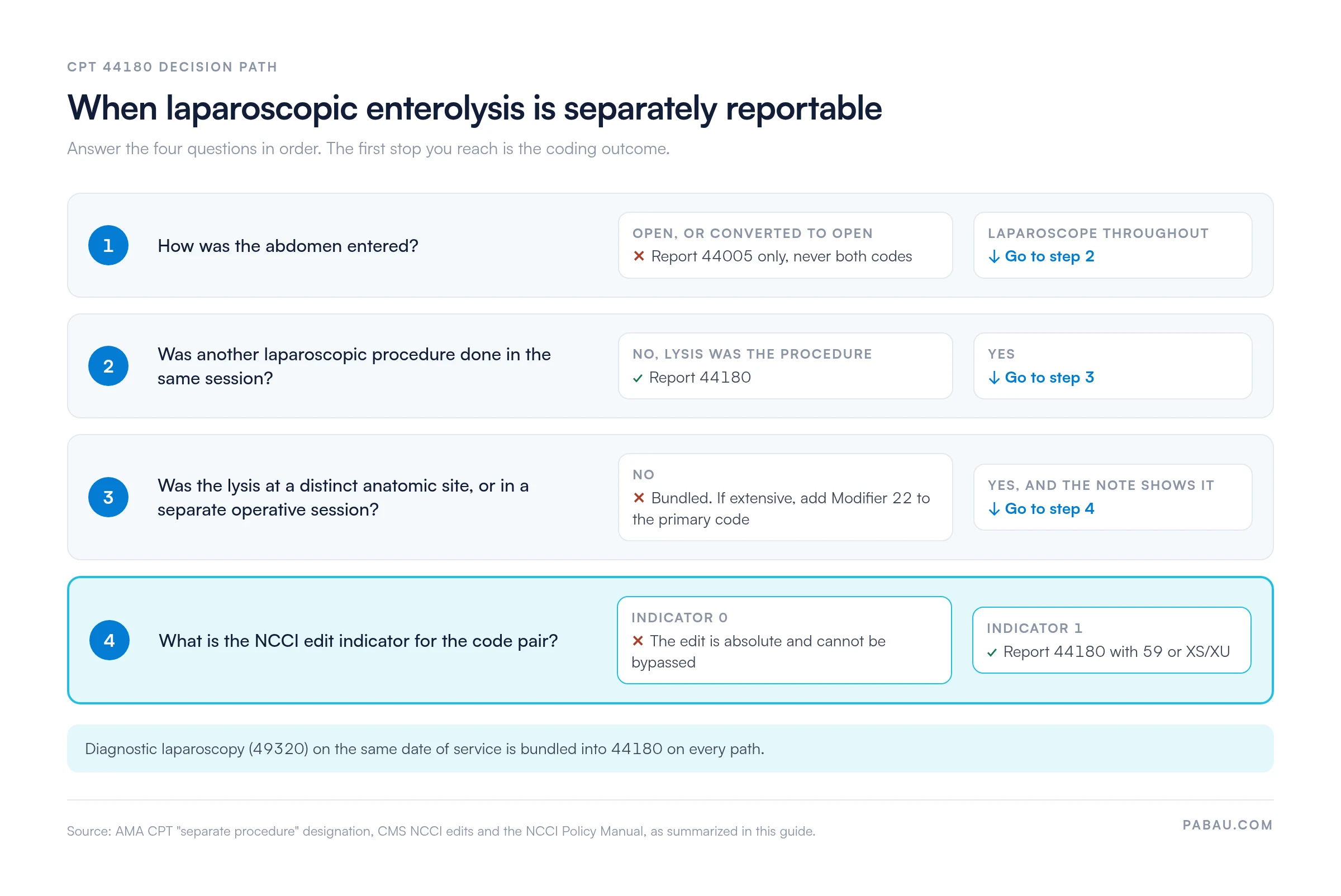
Correct modifier use on laparoscopic enterolysis claims prevents denials. It also supports proper payment when complexity goes beyond the base procedure. Each modifier has a specific trigger and a documentation requirement.
Modifier 22 on 44180 is a valid tool when 44180 is the reported procedure and adhesion complexity is unusual. CPT defines it as “increased procedural services,” and the documentation must support a service substantially greater than the descriptor implies. That is why a flat statement that adhesions were “dense” without operative time data rarely survives audit.
Medical necessity for laparoscopic enterolysis must be supported by an ICD-10-CM code that reflects the clinical picture. In fact, a nonspecific or mismatched diagnosis code is one of the top denial triggers for 44180 claims.
Several commercial payers and Medicare Advantage plans require an obstruction-level code (K56.51 or K56.52) before authorizing elective enterolysis. If the clinical record supports it, code to the highest level of specificity the documentation justifies. Coding K56.50 when the operative note describes a near-complete obstruction leaves reimbursement on the table and may trigger a medical necessity denial. Treat these pairings as documentation guidance for coders.
Medicare pays CPT 44180 under the Physician Fee Schedule, which multiplies relative value units (RVUs) by the annual conversion factor. Each component is then adjusted for locality by the Geographic Practice Cost Index (GPCI). Facility and non-facility rates differ because, outside a facility, the practice bears the practice expense itself.
Practices can look up current rates in the CMS Physician Fee Schedule lookup, filtering by code 44180 and geographic locality. Commercial rates vary by contract, so check them against your payer agreement. Comparing remittance data with expected rates shows underpayment early, before it becomes a pattern.
Always use the current year’s CMS MPFS data for actual dollar amounts. Rates change each year with the conversion factor update and any code-specific RVU changes. CMS publishes each component for 44180 in its annual PFS relative value files.
Medicare fee-for-service does not routinely require prior authorization for CPT 44180, but Medicare Advantage plans often do. Commercial managed care plans vary widely. As a result, a practice that bills 44180 without checking prior auth rules takes on avoidable denial risk.
Payers reviewing an authorization request usually look for four clinical criteria:
Running an eligibility check before you schedule the case shows coverage status and authorization rules in one step.
If the claim is denied for a missing authorization, the appeal needs three items. Include the original authorization criteria, a letter of medical necessity from the operating surgeon, and the supporting clinical documentation. On the 837 electronic claim, the prior authorization number goes in Loop 2300, segment REF*G1, element REF02. A missing or mistyped number there is its own denial category, separate from the authorization itself.
CPT 44180 carries a 90-day global period under the Medicare Physician Fee Schedule, consistent with major surgical procedures. Still, verify this in the current CMS MPFS database, since global period assignments can change during annual rulemaking.
What the global period includes: all routine postoperative evaluation and management visits related to the surgery, postoperative pain management, and uncomplicated wound care.
What is excluded from the global period: three kinds of service may be billed separately. They are E/M visits for an unrelated condition, a return to the operating room for a new complication, and care for a distinct diagnosis.
The key clinical scenario: a patient develops recurrent adhesions causing partial obstruction within the 90-day global period of a prior procedure. If the surgeon returns to the OR to repeat adhesiolysis, Modifier 78 applies. In that case, the claim pays the intraoperative component only, and no new global period starts. Instead, postoperative care for the recurrence falls back into the original global period.
Track the global period start date for every 44180 claim in your practice management system. When a patient returns within 90 days with abdominal symptoms, pull the surgical date before scheduling a follow-up visit. Billing a global-period E/M visit without the correct modifier is one of the most common MAC audit findings for surgical practices.
Most claim denials on laparoscopic enterolysis are predictable and preventable. Indeed, the same patterns show up again and again in surgical coding audits and MAC review findings.
Prevention belongs in intake and coding, before the claim leaves the practice. When a 44180 line is still adjusted, the electronic remittance advice carries the CARC (Claim Adjustment Reason Code) that explains why. Then match it against a guide to decoding claim denial codes to see which category each rejection falls into.
This checklist reflects what MAC reviewers and payer auditors look for when they review 44180 claims. Check the operative record against each element before the claim goes out. After all, compliance in a surgical practice starts with documentation finished before the billing team sees the chart.
A superbill workflow that ties the surgeon’s operative findings to the submitted codes cuts transcription errors between the OR and the claim. In the long run, getting 44180 right the first time, with complete documentation and the correct ICD-10 pairing, is faster than chasing an appeal.
Many surgical billing teams key 44180 claims into one system, check eligibility on a payer portal, and chase claim status by phone. Each handoff is another chance to drop an authorization number or miss a rejection.
Instead, Pabau runs those steps from the patient’s invoice, with streamlined claims management built on its Claim.MD integration. Your team checks eligibility in real time, submits claims electronically, and tracks their status from one dashboard. Before a claim goes out, Pabau checks it for required details such as membership numbers and authorization codes.
ERA remittances post back into the same record, so billers can compare what each payer paid against the expected rate. As a result, fewer 44180 claims stall on a missing authorization number, and the ones needing follow-up are easy to find.

Pabau routes CPT 44180 claims through Claim.MD and tracks their status in one dashboard, so billers can follow each claim to payment.

Before any 44180 claim goes out, settle two questions. Was the lysis the procedure itself, or incidental to another laparoscopic code? And does the operative note prove the answer?
If the lysis stood alone, or sat at a distinct site or session, report it with the right modifier and a note that shows why. If it was incidental, leave 44180 off and let the primary code carry the payment, adding Modifier 22 there when the lysis was extensive. An unsupported Modifier 22 or 59 costs more in audit exposure than it earns.
Book a demo to see how Pabau submits and tracks surgical claims through Claim.MD for your practice.

Need to understand how clearinghouse routing affects CPT claims? Medical claims clearinghouse explained covers how electronic claim routing reduces rejection rates for surgical codes.
Tracking denial patterns across your surgical CPT codes? How Claim.MD clearinghouse works with Pabau walks through real-time eligibility and ERA reconciliation for high-value surgical claims.
Building a surgical billing compliance program? Getting credentialed with insurance companies covers payer enrollment steps that directly affect 44180 authorization and payment routing.
Billing enterolysis during a laparoscopic colectomy? CPT code 44204 covers the partial colectomy code that most often absorbs incidental lysis.
CPT code 44180 covers laparoscopic enterolysis, which is the surgical freeing of intestinal adhesions using a laparoscope. It is designated as a “separate procedure.” That means it is reported on its own only when it isn’t an integral part of a larger laparoscopic procedure in the same operative field.
Modifier 22 applies to 44180 when it is the reported procedure and the adhesions were unusually dense, vascular, or extensive. The lysis must have required substantially more time and complexity than a typical case. The operative note must document adhesion density, the instruments used, and the total operative time. A physician complexity letter explaining why the procedure went beyond a typical case should also go with the claim.
CPT 44180 carries a 90-day global period under the Medicare Physician Fee Schedule. Routine postoperative evaluation and management visits tied to the surgery are included. However, services unrelated to the surgery, or return-to-OR procedures for complications, may be billed separately with the right modifier. A return to the OR within the global period takes Modifier 78.
Yes, in nearly all same-date-of-service scenarios. Because surgical laparoscopy already includes a view of the peritoneal cavity, diagnostic laparoscopy (49320) is considered integral to 44180 and is not separately reportable. However, a separate diagnostic scope on a different date, for a distinct clinical question, may be an exception. Same-day billing of both codes is routinely denied under NCCI edits.