Pabau Engage inbox

Pabau Engage is here: every patient conversation in one inbox.

Learn more
Book a demo Book a demo
☰
CPT Code

CPT code 43860 – Gastrojejunostomy revision


Code Definition

43860 is the CPT code for revision of gastrojejunal anastomosis (gastrojejunostomy) with reconstruction, with or without partial gastrectomy or intestine resection, without vagotomy.

It describes an open operation to rebuild a failed stomach-to-jejunum connection, such as a strictured or ulcerated anastomosis after ulcer surgery or gastric bypass. The same revision with vagotomy is 43865, and both carry a 90-day global period.

Section
10004-69990 Surgery
Subsection
40490-49999 Digestive system
Code range
43500-43999 Stomach
Billable
No
Code also known as
Gastrojejunostomy revision, gastrojejunal anastomosis revision
Save time. Improve accuracy. Get paid faster.
Automate coding with Pabau

Let Pabau's smart automation suggest the right codes, reduce claim denials, and keep your practice compliant—effortlessly.

  • AI-powered code suggestions
  • Real-time compliance checks
  • Faster claims, fewer denials
Why practices choose Pabau
Save hours every week

Automate repetitive tasks and focus on what matters most—your patients.

Improve accuracy

Reduce coding errors and ensure compliance with the latest regulations.

Get paid faster

Clean claims, fewer denials, and faster reimbursements.

Grow with confidence

Powerful insights and reporting to help your practice thrive.

HIPAA compliant SOC 2 certified GDPR-compliant Trusted by 4,000+ clinics worldwide

Key takeaways

Key takeaways

CPT Code 43860 covers open revision of a gastrojejunal anastomosis with reconstruction, without vagotomy, and 43865 is the same revision with vagotomy.

It is not a gastrostomy code. CPT has no gastrostomy revision code, and closure of a gastrostomy is reported with 43870.

In CY2026, 43860 carries 45.39 facility RVUs, about $1,523.63 at the QP conversion factor or $1,516.07 at the non-QP factor.

A 90-day global period applies, so related care in that window is bundled unless modifier 78 or 79 applies.

A laparoscopic gastrojejunostomy revision has no specific code and is reported with unlisted code 43659.

CPT Code 43860: official descriptor and procedure overview

CPT Code 43860 reports an open revision of an existing gastrojejunal anastomosis, rebuilt with reconstruction and without cutting the vagus nerves. AAPC’s General Surgery Coding Alert quotes the full AMA descriptor. Revision of gastrojejunal anastomosis (gastrojejunostomy) with reconstruction, with or without partial gastrectomy or intestine resection; without vagotomy.

The code sits in the Other Procedures on the Stomach range of the digestive system surgery codes. In other words, the surgeon takes down or reshapes a gastrojejunostomy made at an earlier operation and builds a working connection again. In addition, a partial gastrectomy or small bowel resection done as part of that revision is included in the code.

  • Code pair: 43860 without vagotomy, 43865 with vagotomy
  • Approach: open (laparotomy); a laparoscopic revision is reported with unlisted code 43659
  • Global period: 90 days (CMS global indicator 090)
  • Included work: partial gastrectomy or intestine resection when performed
  • Not this code: gastrostomy procedures, which are 43830 to 43832 and closure code 43870

When surgeons revise a gastrojejunostomy

A gastrojejunostomy joins the stomach to the jejunum. For example, surgeons create one during a Roux-en-Y gastric bypass, after a distal gastrectomy, or to bypass a gastric outlet obstruction. A revision is needed when that connection fails.

  • Anastomotic stricture: narrowing that endoscopic dilation has not resolved, causing vomiting and poor intake.
  • Marginal ulcer: a recurrent or non-healing ulcer at the anastomosis, sometimes with bleeding or perforation.
  • Fistula: an abnormal tract, typically between the gastric pouch and the excluded stomach after a bypass.
  • Postgastric surgery syndromes: dumping, bile reflux, or limb obstruction after earlier gastric surgery.
  • Pouch or outlet dilation: an enlarged pouch or anastomosis linked to weight regain after bariatric surgery.

The operative note must document each of the following for the code to hold up on review.

  1. Prior surgery: the operation that created the anastomosis, and about when it was done.
  2. Indication: the specific failure, such as stricture, marginal ulcer, or fistula, and the workup behind it.
  3. Approach: open laparotomy, or a laparoscopic case converted to open.
  4. Revision performed: takedown of the old anastomosis, any resection, and construction of the new one.
  5. Vagotomy status: whether the vagus nerves were divided, since that alone moves the code from 43860 to 43865.
  6. Additional procedures: any other work, with its own site and indication if it is billed separately.

A note that describes only endoscopic dilation, or suture repair of a perforation at the anastomosis, does not support 43860. Dilation has its own endoscopy codes, while a perforation repair is a smaller operation. Instead, the note has to show the anastomosis was revised and rebuilt.

Most 43860 errors come from the vagotomy split, the surgical approach, or the wrong code family.

CPT codeDescriptor (summary)Use whenStatus
43860Revision of gastrojejunal anastomosis with reconstruction; without vagotomyOpen revision with the vagus nerves left intactActive, 90-day global
43865Revision of gastrojejunal anastomosis with reconstruction; with vagotomyOpen revision that also divides the vagus nervesActive, 90-day global
43850, 43855Revision of gastroduodenal anastomosis (gastroduodenostomy) with reconstruction, without or with vagotomyNo longer reportableDeleted January 1, 2022
43820, 43825Gastrojejunostomy, without or with vagotomyFirst-time creation of the anastomosis, not a revisionActive, 90-day global
43848Revision, open, of gastric restrictive procedure for morbid obesity, other than adjustable gastric restrictive deviceOpen revision of the bariatric operation itselfActive, 90-day global
43659Unlisted laparoscopy procedure, stomachLaparoscopic revision of a gastrojejunostomyActive, priced by the contractor
43830-43832, 43870Open gastrostomy, and closure of gastrostomyFeeding-tube procedures, a separate familyActive, 90-day global

Codes 43850 and 43855 were deleted for 2022, so remove them from older charge masters and claim templates.

43860 vs 43848 is the decision that matters on bariatric cases. When the surgeon revises a gastric bypass for weight loss, 43848 usually fits. When the target is a failed anastomosis, such as a stricture or marginal ulcer, 43860 fits. Let the documented indication decide.

CPT has no gastrostomy revision code. Open gastrostomy is 43830 to 43832, and closure is 43870. The decision path below follows the order of an operative note.
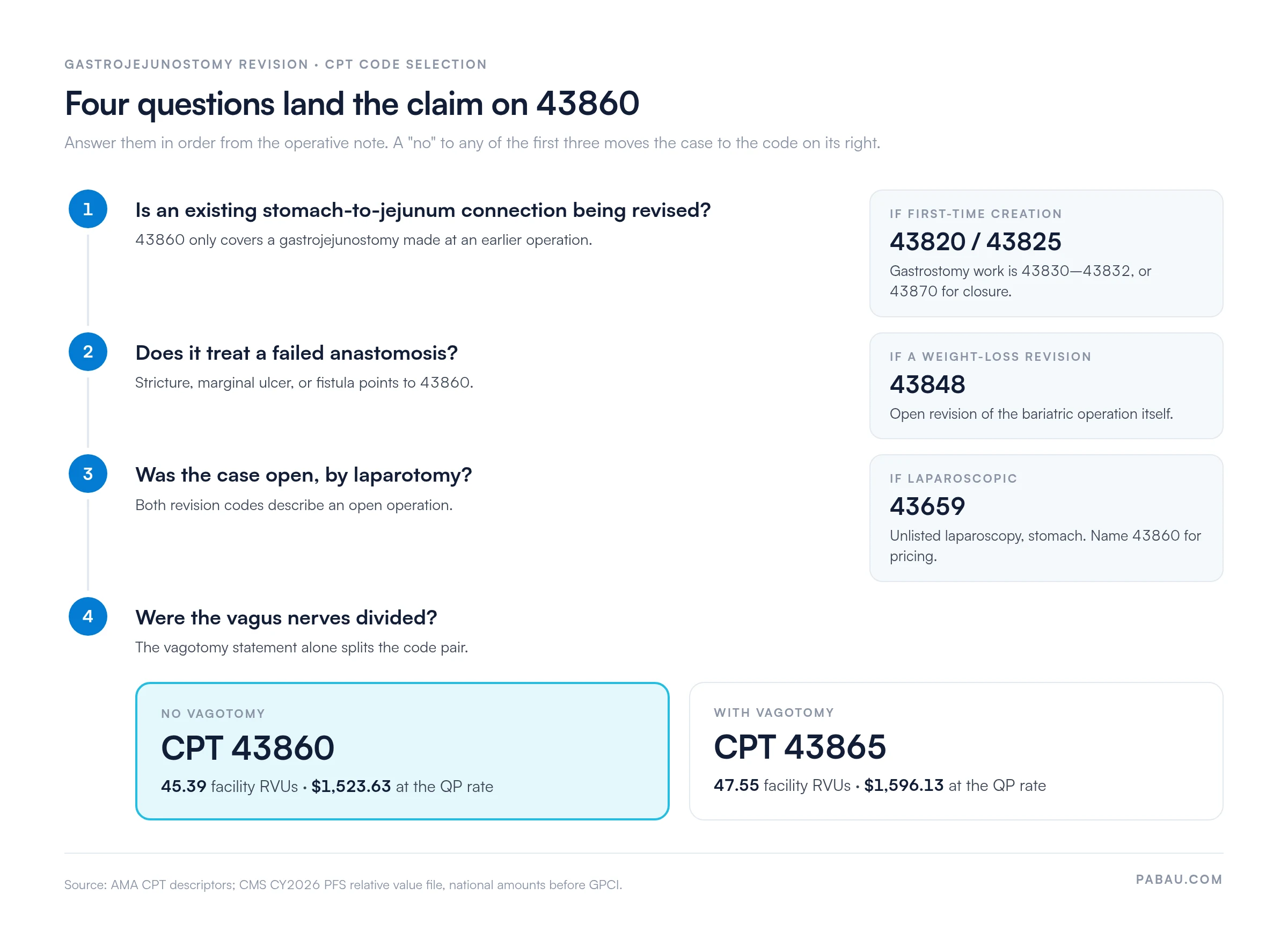
Decision path for coding a gastrojejunostomy revision
Three of the four checks route a case away from 43860, so read the operative note in this order. Descriptors follow the AMA CPT code set, and payments come from the CMS CY2026 PFS relative value file.

Documentation requirements for CPT 43860

Payers reviewing 43860 pull the operative report and the preoperative history and physical, and both must tell the same story. For that reason, a clean claim submission needs each element below in the record before the claim goes out.

  • Preoperative diagnosis: the named failure, such as anastomotic stricture, marginal ulcer, fistula, or obstruction.
  • Workup: endoscopy, contrast study, or CT findings that confirm the problem.
  • Failed conservative care: acid suppression for an ulcer, or endoscopic dilation for a stricture, where tried.
  • Operative report: takedown of the old anastomosis, any resection, and construction of the new one.
  • Vagotomy statement: a clear note that no vagotomy was performed, or code 43865 if one was.
  • Surgeon signature: the operating surgeon signs the report.

If an element is missing, query the surgeon before you submit. Otherwise, an incomplete operative note usually triggers a records request or a denial.

Documentation elementSource documentWhat auditors look for
Clinical indicationPreoperative history and physical, office visit notesA named anastomotic failure that needs surgical correction
Diagnostic evidenceEndoscopy or imaging reportsFindings that match the stated indication
Operative techniqueOperative reportTakedown and reconstruction, not dilation or a simple suture repair
Vagotomy statusOperative reportAgreement with the code billed, 43860 or 43865
Postoperative diagnosisOperative report, discharge summaryAgreement with the ICD-10-CM codes on the claim

Bariatric and gastric revision documentation

Revisions after bariatric surgery draw closer review because payers check whether the operation treats a complication or repeats a weight-loss procedure. Their bariatric policies also often ask for more than the operative note.

  • Original operation: the type and date of the bariatric procedure, with its operative report if available.
  • Complication evidence: endoscopy showing a stricture, marginal ulcer, or fistula, and the symptoms it causes.
  • Conservative treatment: dates and outcomes of medical or endoscopic treatment before surgery.
  • Nutritional status: weight trend, intake, and any deficiencies linked to the complication.
  • Ulcer risk factors: smoking and NSAID use, with the cessation advice given.
  • Program records: for a revision done for weight regain, the payer’s bariatric criteria, such as BMI and a multidisciplinary evaluation.

Many plans limit or exclude revisions done for weight regain alone, so check the policy before you schedule one of those cases.

Pro Tip

Before you submit 43860, search the operative report for the word vagotomy. If the vagus nerves were divided, the code is 43865. If the case was laparoscopic, the code is unlisted 43659. Either miss changes the payment and invites an audit.

ICD-10 codes commonly paired with CPT 43860

The diagnosis on a 43860 claim has to name the failure that justified the revision. In fact, a status code alone does not show medical necessity. Check each code against the current ICD-10-CM tabular list before you submit.

ICD-10-CM codeDescriptionUse with 43860 when
K28.9Gastrojejunal ulcer, unspecified as acute or chronic, without hemorrhage or perforationA marginal ulcer at the anastomosis has failed medical treatment
K28.4Chronic or unspecified gastrojejunal ulcer with hemorrhageA bleeding marginal ulcer needs surgical revision
K28.5Chronic or unspecified gastrojejunal ulcer with perforationA perforated marginal ulcer is treated by revising the anastomosis
K91.89Other postprocedural complications and disorders of digestive systemAn anastomotic stricture or similar complication follows non-bariatric gastric surgery
K91.1Postgastric surgery syndromesDumping or bile reflux follows earlier gastric surgery
K95.89Other complications of other bariatric procedureA complication follows gastric bypass, with a second code for the specific problem
K31.6Fistula of stomach and duodenumA gastrogastric fistula follows gastric bypass

Coding practice: after bariatric surgery, sequence K95.89 first and add a code for the specific complication, such as K28.9 or K31.6. After other gastric surgery, a K28 marginal ulcer code or K91.89 usually carries the claim.

Medicare reimbursement for CPT 43860 in 2026

Medicare pays CPT 43860 under the Physician Fee Schedule, at the facility rate only. CMS lists no non-facility practice expense for it, because the operation is not performed in an office. The figures below come from the CY2026 PFS relative value file.

RVU component4386043865
Work RVU27.1928.32
Practice expense RVU (facility)11.2911.66
Malpractice RVU6.917.57
Total facility RVU45.3947.55
National payment, QP rate ($33.5675)$1,523.63$1,596.13
National payment, non-QP rate ($33.4009)$1,516.07$1,588.21
Non-facility rateNot applicableNot applicable

Each payment figure is total RVUs times the conversion factor, before geographic adjustment. CY2026 has two conversion factors: $33.5675 for qualifying APM participants and $33.4009 for everyone else. Your locality’s GPCIs then move the final amount up or down.

Also, the same file sets the surgical indicators. The 90-day global splits 9% preoperative, 81% intraoperative, and 10% postoperative. Multiple-procedure rules apply, an assistant at surgery is payable, and co-surgeons can be paid with supporting records.

In contrast, commercial payers set their own fee schedules, often as a percentage of Medicare rates.

Modifiers applicable to CPT 43860

Modifier selection for CPT Code 43860 follows standard surgical rules. Still, a wrong or missing modifier is a common denial trigger on major revisions.

ModifierNameUse whenDocumentation required
22Increased procedural servicesThe work is substantially greater than usual, such as dense adhesions from several prior operationsAn operative note that quantifies the extra time and difficulty
51Multiple proceduresAnother separately reportable procedure is done in the same sessionA distinct indication and description for each procedure
59 or XSDistinct procedural service, or separate structureAn NCCI edit must be bypassed for a procedure on a separate siteRecords showing the services are distinct; check current NCCI edits
62Two surgeonsTwo surgeons each perform a distinct part of the revisionA separate operative note from each surgeon
78Unplanned return to the operating room, related procedureThe patient returns to the OR for a complication within the 90-day globalA note linking the return to the original revision
79Unrelated procedure during the postoperative periodA new, unrelated procedure is done within the 90-day globalDocumentation that the procedure is unrelated
80Assistant surgeonA second surgeon assists, which Medicare pays for on 43860An operative note naming the assistant and their role

Prior authorization by payer type

Prior authorization for CPT 43860 depends on the payer and on the reason for the revision. Check each patient’s plan before you schedule the case.

  • Original Medicare: 43860 is not among the hospital outpatient services that need Medicare prior authorization. Medical necessity still has to be documented.
  • Medicare Advantage: many plans require authorization for inpatient surgery and bariatric procedures. Check the plan’s own list.
  • Commercial insurers: most require authorization for bariatric revisions, and many ask for endoscopy findings and failed conservative care.
  • Medicaid: requirements vary by state and managed care plan. Contact the plan directly.

Therefore, send the specific complication code, the endoscopy or imaging report, and the history of the original operation with the request. Sound medical billing compliance processes build that packet before every surgical case.

Pro Tip

Run eligibility and authorization checks when the case is booked, not on the day of surgery. Ask whether the plan treats the case as a complication repair or a bariatric revision, since the criteria differ. Record the authorization number, the agent’s name, and the date in the patient’s record.

Common denial reasons and how to avoid them

Denials on CPT Code 43860 cluster around a few common coding and documentation failures. A strong denial management workflow catches them before submission.

  • Vagotomy mismatch: 43860 is billed when the note documents a vagotomy, or 43865 when it does not. Fix: match the code to the operative note and resubmit.
  • Laparoscopic case billed as open: 43860 describes an open operation. Fix: report 43659 with the operative note and a comparison to 43860.
  • Smaller procedure billed as a revision: endoscopic dilation or suture repair of a perforation does not support 43860. Fix: code the procedure performed.
  • Bariatric policy mismatch: the payer reads the case as a weight-loss revision without program approval. Fix: lead with the complication diagnosis and its evidence, or obtain bariatric authorization.
  • Incorrect ICD-10 pairing: a status code without the complication fails the medical necessity check. Fix: code the specific complication first.
  • Global period conflicts: a related service within 90 days of an earlier surgery bundles into it without modifier 78 or 79. Fix: check the original date and apply the right modifier.
  • Unbundling errors: the descriptor already includes partial gastrectomy and intestine resection, and NCCI bundles routine adhesiolysis. Fix: use 59 or XS only when the record supports a separate service.

Each denial comes back with a CARC, and often a RARC, that names the reason. Finally, the billers’ denial code guide maps each code to the correction it needs.

Working inside the 90-day global period

CMS assigns CPT Code 43860 a 90-day global surgical period, so routine preoperative care from the day before surgery and postoperative care for 90 days after it are bundled into the payment. For this reason, billing staff should track the global end date for every 43860 case.

Three scenarios need specific modifier handling within the global period.

  1. Related return to the OR (78): report the new procedure with modifier 78 when it treats a complication of the revision. The global period of the original 43860 does not restart.
  2. Unrelated procedure (79): use modifier 79 for an unrelated operation during the global period. The operative report should state that the procedure is unrelated to the revision.
  3. Office visits: routine follow-up visits are bundled. A visit for an unrelated problem can be billed with modifier 24, under the Medicare Claims Processing Manual (Pub. 100-04).

Tracking global periods by hand across a busy surgical practice is a known weak point in revenue cycle management. Indeed, separately billing bundled follow-up care is the error auditors find most often on major surgery codes.

How Pabau keeps surgical revision claims clean

A revision case produces paperwork over several months: the authorization, the operative note, the claim, and 90 days of follow-up. Pabau, the practice management and billing platform we build, keeps those records on one patient file.

In the US, Pabau’s claims management software submits CMS-1500 claims through Claim.MD. Eligibility checks and ERA remittances run in the same workflow, so a denied 43860 line comes back to the patient record for follow-up.

However, your coders still assign the codes from the operative note. Pabau sends the claim, tracks the response, and keeps the documents an appeal needs in one place.
Pabau checkout screen showing a completed invoice and recorded payment
Pabau’s checkout records the invoice and payment on the patient record, so the balance left after a 43860 claim is paid sits beside it.

Streamline surgical billing from note to paid claim

Pabau keeps the authorization, operative documentation and claim for each surgical case on one patient record. US claims go out through Claim.MD, with eligibility checks and remittances in the same workflow.

Pabau claims management dashboard

Conclusion

CPT 43860 is a major revision code, and the operative note decides almost every part of the claim. Read the note for three facts before you code: open or laparoscopic, vagotomy or not, and the specific anastomotic failure.

If you get those right, the global period, the modifiers, and the diagnosis pairing follow. If you get them wrong, the claim pays at the wrong rate or not at all. Book a demo to see how Pabau keeps the authorization, the note, and the claim for each surgical case together.

Continue your research

Continue your research

Coding a laparoscopic revision instead? CPT 43659 explains the unlisted laparoscopic stomach code used when a revision is done laparoscopically.

Need a framework for reducing surgical claim denials? Denial management in healthcare covers the end-to-end process for tracking, appealing, and preventing claim rejections across surgical codes.

Want to understand how claims flow from submission to payment? Claim.MD clearinghouse integration explains how electronic claims reach payers and how remittances come back. It covers the full 837/835 cycle.

Looking for the right medical billing platform for your surgical practice? Best medical billing software for US practices compares platforms across claim accuracy, clearinghouse integration, and denial management tools.

Frequently asked questions

What does CPT Code 43860 describe?

CPT Code 43860 describes revision of a gastrojejunal anastomosis (gastrojejunostomy) with reconstruction, with or without partial gastrectomy or intestine resection, without vagotomy. It is an open operation to rebuild a failed stomach-to-jejunum connection.

What is the difference between CPT 43860 and CPT 43865?

The only difference is vagotomy. 43860 is the revision without vagotomy, and 43865 is the same revision with vagotomy. In CY2026, 43865 carries 47.55 facility RVUs against 45.39 for 43860.

Is CPT 43860 a gastrostomy revision code?

No. 43860 revises a gastrojejunostomy, the connection between the stomach and the jejunum. CPT has no gastrostomy revision code. Open gastrostomy is 43830 to 43832, and closure of a gastrostomy is 43870.

What modifiers are used with CPT Code 43860?

The common ones are 22 for unusually difficult cases, 51 for multiple procedures, and 59 or XS for distinct services. Modifier 62 covers co-surgeons, 78 and 79 apply during the global period, and 80 reports an assistant surgeon.

How is a laparoscopic gastrojejunostomy revision coded?

CPT has no specific laparoscopic code for this revision, so report unlisted code 43659. Send the operative note with the claim and name 43860 as the comparable open procedure for pricing.
Avatar photo
Despina Petrushevska
Content Writer

Despina Petrushevska is a content writer covering aesthetics, dermatology, and clinic operations, known for making detailed clinical concepts clear and engaging. Outside of work, she enjoys photography, weekend getaways, and finding inspiration in everyday experiences.
×