

CCSD code G5100: Bypass of duodenum billing guide
CCSD code G5100 bills a bypass that leaves the duodenum in place CCSD code G5100...

Last Updated: Oct 16, 2026
33210 is the CPT code for insertion or replacement of temporary transvenous single chamber cardiac electrode or pacemaker catheter (separate procedure). It covers one temporary pacing lead connected to an external generator, typically placed emergently for high-degree AV block or symptomatic bradycardia.
Coders most often confuse it with 33211 (temporary dual-chamber pacing), 33216 (single transvenous permanent lead) and 33208 (permanent dual-chamber pacemaker system). The separate procedure label matters too, because 33210 usually bundles when it is placed during a larger procedure such as cardiac catheterization.
Let Pabau's smart automation suggest the right codes, reduce claim denials, and keep your practice compliant—effortlessly.
Automate repetitive tasks and focus on what matters most—your patients.
Reduce coding errors and ensure compliance with the latest regulations.
Clean claims, fewer denials, and faster reimbursements.
Powerful insights and reporting to help your practice thrive.
HIPAA compliant SOC 2 certified GDPR-compliant Trusted by 4,000+ clinics worldwide

CPT code 33210 covers one temporary transvenous pacing electrode on an external generator, not a permanent generator or dual-chamber pacing.
33210 may bundle with 33233, so check the current NCCI PTP table for the pair and its modifier indicator before billing both.
AV block (I44.0, I44.1, I44.2), sick sinus syndrome (I49.5) and cardiac arrest (I46.x) commonly support medical necessity for 33210.
CPT labels 33210 a separate procedure, so it usually bundles when placed as part of a planned cardiac catheterization.
Pabau’s Claim.MD integration submits 33210 claims electronically, checks eligibility in real time and tracks claim status.
CPT code 33210, as defined by the American Medical Association, describes the insertion or replacement of temporary transvenous single-chamber cardiac electrode or pacemaker catheter. That descriptor limits the code to three components. The access is transvenous, the chamber count is single, and the device is an electrode or catheter only, never a permanent generator.
The full descriptor also carries the CPT “separate procedure” label. That means 33210 is reported on its own only when it is not an integral part of a larger procedure in the same session.
The procedure starts with percutaneous venous access, typically through the subclavian, internal jugular or femoral vein. The physician advances a pacing lead into the right ventricle under fluoroscopic or ECG guidance. Threshold testing confirms capture, and the lead is then connected to an external pulse generator. The external generator is not separately billable under 33210; its use is bundled into the global package.
33210 is mostly used in emergent inpatient care. Typical scenarios include:
It does not apply to epicardial pacing leads placed during open cardiac surgery, which are bundled into the surgical code.
Scope errors are a common reason 33210 claims are upcoded, downcoded or bundled incorrectly. The table below separates what the code covers from what needs a separate code or is excluded entirely.
Temporary pacing coding errors usually come from picking the wrong member of the 332xx pacemaker family. Three questions separate them: temporary or permanent, single or dual chamber, and electrode only or full system. The chart and table below walk through the codes most often confused with 33210.
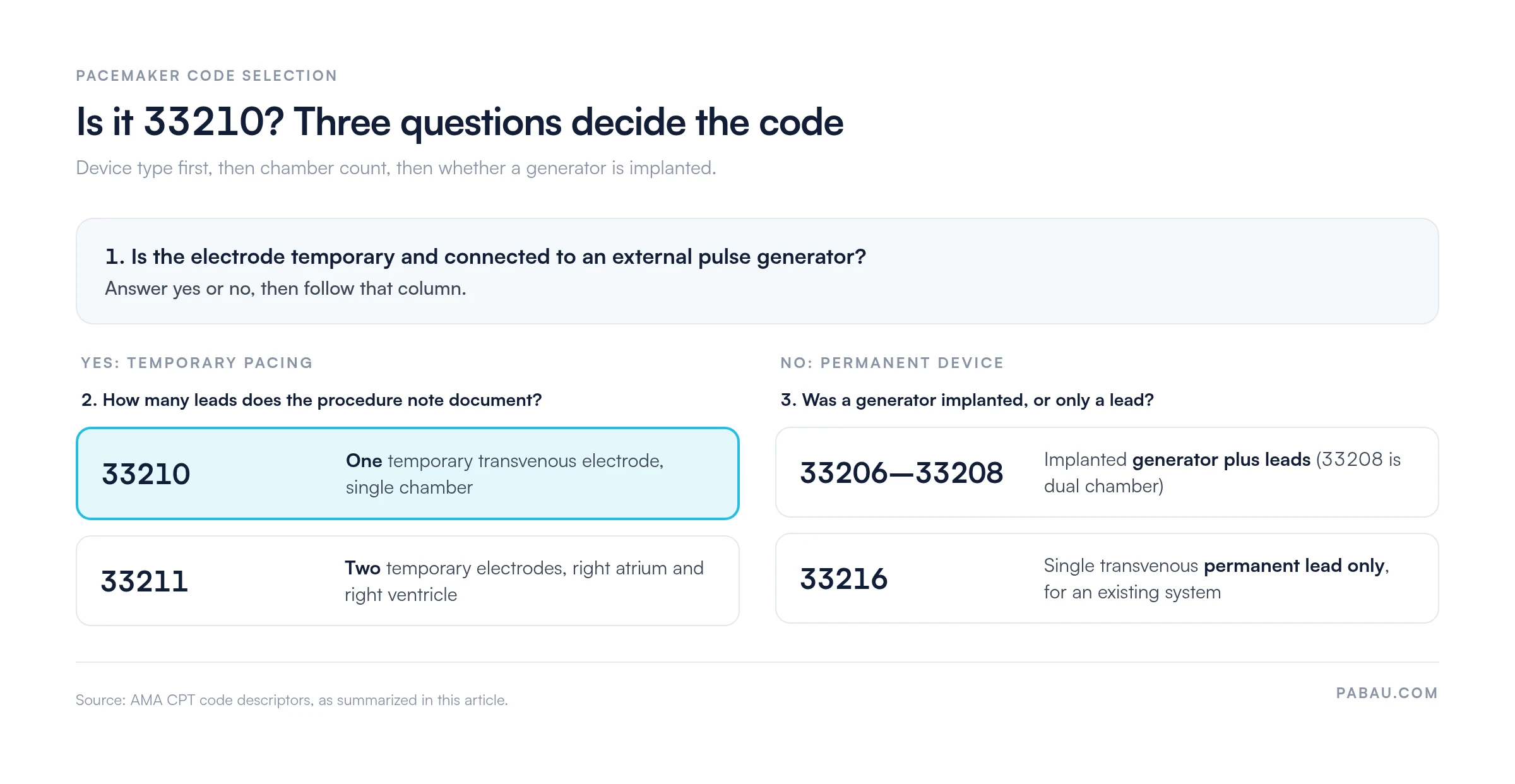
The 33210 vs 33216 distinction trips up coders because both involve a single lead. 33216 is a permanent lead placed into an existing permanent system. A full permanent dual-chamber system with an implanted generator is billed under 33208 instead. If the electrode is temporary and connected to an external generator, the code is 33210.
The National Correct Coding Initiative (NCCI) edits govern which code pairs bundle automatically and which allow a modifier override. Two code pairings need the closest attention on 33210 claims.
33210 may bundle with 33233 (removal of the permanent pacemaker pulse generator). Check the current NCCI procedure-to-procedure (PTP) table for the pair and its modifier indicator before billing both. An indicator of 0 means no modifier can unbundle the pair. An indicator of 1 allows modifier -59 or XU when the record supports a distinct service.
Billing CPT code 33210 alongside cardiac catheterization codes (93451-93461) is a documented denial trigger. When temporary pacing is inserted prophylactically as part of a planned catheterization, NCCI edits generally bundle 33210 into the catheterization code.
Separate billing may be supported when all three of these conditions hold:
Payers review these claims closely, so the documentation must be explicit.
Review the current NCCI tables on the CMS NCCI page before submitting. Edits are updated quarterly, and the modifier indicator for each 33210 code pair can change.
Always document the independent clinical indication for temporary pacing in a separate procedure note, distinct from the cardiac catheterization report. Payers audit 33210 and cath code combinations aggressively. A single combined note that describes temporary pacing as a ‘precaution during the procedure’ is the fastest route to a bundling denial.
Every 33210 claim needs a linked ICD-10-CM diagnosis code that establishes medical necessity. Covered diagnoses come from the applicable MAC LCD or payer policy, which you can verify in the CMS Medicare Coverage Database. The codes below commonly support 33210. Check each against the current fiscal-year ICD-10-CM code set, because codes are revised annually.
Verify the full covered-diagnosis list in the CMS Medicare Coverage Database or the applicable MAC LCD before submitting. A diagnosis outside the covered list is a frequent cause of 33210 denials.
Medicare payment rates for CPT code 33210 are set annually under the Medicare Physician Fee Schedule (MPFS). The values below are the CY2026 national RVUs. Payment still varies by geographic locality, so verify current figures through the CMS fee schedule lookup before quoting a rate.
With a 000-day global period, 33210 has no postoperative follow-up window. An E&M service on the same date is bundled unless it is significant and separately identifiable. In that case, append modifier -25 to the E&M code. Use the CMS Physician Fee Schedule lookup to pull current-year, locality-adjusted payment before quoting a reimbursement figure.
Insufficient documentation sits alongside bundling errors as a leading cause of 33210 denials. The procedure note must contain each of the following elements to survive a payer audit or a clean claim review.
Understanding denial management workflows for 33210 requires knowing which denials are preventable at claim creation and which need an appeal. The table below maps the most frequent denial reasons to their corrective actions.
Review denial patterns across your cardiology claims quarterly. Tracking medical billing denial codes at the CARC level shows where 33210 denials cluster. The usual groups are NCCI edits (CARC 97), medical necessity (CARC 50) and coding errors (CARC 4). That pattern tells you which fix to make first. Each electronic remittance advice carries the CARC, so the ERA is where that tracking starts.
Medicare generally covers CPT code 33210 for emergent inpatient temporary pacing when the clinical indication is documented and the applicable MAC LCD covers the diagnosis. Prior authorization is not typically required for emergent inpatient procedures; however, commercial payers vary significantly and some require pre-authorization for elective temporary pacing. Always verify with the specific payer before the procedure in non-emergent cases.
Key medical billing compliance points for Medicare 33210 claims:
Request the payer’s coverage policy document for pacemaker procedures (CPT 332xx range) at the start of each contract year. Policies update alongside LCD revisions, so a current copy shows which diagnoses a payer has dropped before claims start to deny. File the policy document in your billing team’s shared drive with the payer name and effective date.
Without an integrated clearinghouse, a billing team checks eligibility by phone, keys each claim into a payer portal and chases remittances by hand. For an emergent procedure like 33210, a bundling or coverage denial then surfaces weeks after the patient was paced.
Pabau, the practice management platform we build, includes streamlined claims management software that sends claims to US payers through Claim.MD. Eligibility is checked in real time before a claim goes out, and status updates come back from the payer.
Electronic remittance advice returns into Pabau, and denied claims are flagged for rework. Your team can correct a missing modifier or diagnosis link and resubmit while the procedure note is still fresh.
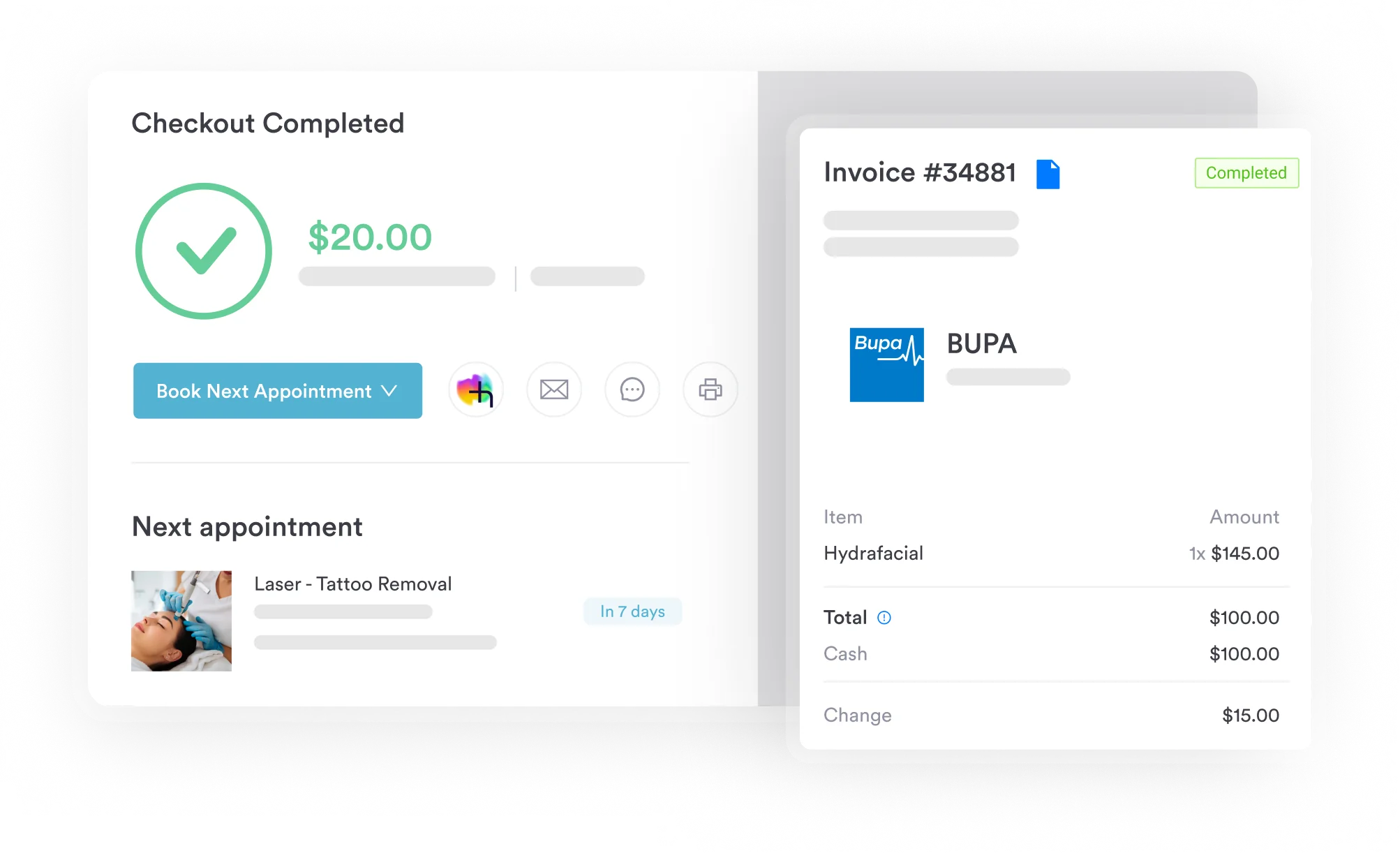

Pabau submits claims through Claim.MD, checks eligibility in real time and flags denied claims for rework, so cardiology teams resubmit faster.

A 33210 claim pays when three things line up. The code must match a temporary single-chamber lead, and the diagnosis must be one the applicable LCD covers. The procedure note must also show that the pacing decision stood on its own.
Check the NCCI modifier indicator before you bill 33210 with a catheterization code or 33233, not after the denial. That lookup takes minutes, while an appeal takes weeks.
If your team still tracks these claims by hand, book a demo to see how Pabau handles cardiology claims from submission to remittance.

Need to understand how clearinghouse submission works? Medical claims clearinghouse guide explains how electronic claim routing reduces errors between your practice and the payer.
Tracking denial patterns across your cardiology claims? Revenue cycle management fundamentals covers how to build a denial-tracking workflow from ERA data.
Submitting 837 files for hospital-based procedures? Superbill and electronic claim submission explains the relationship between the superbill, 837P, and CMS-1500 for physician claims.
CPT code 33210 covers the insertion or replacement of a temporary transvenous single-chamber cardiac pacing electrode or catheter. It includes vascular access, electrode advancement, ECG or fluoroscopic guidance, threshold testing and connection to an external pulse generator. The code does not include the external generator itself, permanent lead placement, or dual-chamber pacing.
CPT 33210 covers single-chamber temporary pacing, with one electrode in the right ventricle or right atrium. CPT 33211 covers dual-chamber temporary pacing, with leads in both the right atrium and right ventricle. If the procedure note documents two leads, 33211 is the correct code, not 33210.
CPT 33210 has a 000-day global period, meaning there is no postoperative period. A same-day evaluation and management service may be billed separately with modifier -25 on the E&M code. It must be a separately identifiable service beyond the procedure itself.
Common supporting diagnoses include AV block (I44.0, I44.1, I44.2, I44.30, I44.39), sick sinus syndrome (I49.5), cardiac arrest (I46.9) and symptomatic bradycardia (R00.1). Verify each one against the applicable MAC LCD or payer policy in the CMS Medicare Coverage Database, because covered diagnoses change.



