

HCPCS Code E0272: Foam rubber mattress billing guide
HCPCS Code E0272: official descriptor and code overview HCPCS Code E0272 is the ...

Last Updated: Nov 6, 2026
Billable Code
29550 is the CPT code for strapping of one or more toes, including buddy taping. It covers tape or cohesive bandage applied to the toes only, distal to the metatarsophalangeal joint. Strapping that crosses the ankle or covers the midfoot is reported with 29540 instead.
The code carries a 0-day Medicare global period, so each re-strapping visit is billed separately when the note supports it. Medicare also expects a toe modifier, -TA through -T9, that names the digit treated.
Let Pabau's smart automation suggest the right codes, reduce claim denials, and keep your practice compliant—effortlessly.
Automate repetitive tasks and focus on what matters most—your patients.
Reduce coding errors and ensure compliance with the latest regulations.
Clean claims, fewer denials, and faster reimbursements.
Powerful insights and reporting to help your practice thrive.
HIPAA compliant SOC 2 certified GDPR-compliant Trusted by 4,000+ clinics worldwide

CPT code 29550 covers strapping of one or more toes, buddy taping included. Strapping that reaches the ankle or foot is reported with 29540.
Medicare expects a toe modifier, -TA through -T9, that names the specific toe treated.
A same-day E/M visit needs modifier -25 on the E/M code. Without it, payers deny the strapping as bundled.
Medicare assigns 29550 a 0-day global period, so each documented re-strapping visit is billed separately.
Pabau’s claims management software flags missing toe modifiers and ICD-10 mismatches before claims leave the practice.
CPT code 29550 is the procedure code for strapping one or more toes, including buddy taping. The AMA’s official descriptor, “strapping; toes,” limits it to the digits distal to the metatarsophalangeal joint. Strapping that reaches the midfoot, ankle, or leg moves to a different code, usually 29540.
The 0-day global period means no post-procedure care is bundled into the payment. Strapping applied again on a return visit is separately billable, provided each visit documents medical necessity.
The clinical scenarios that justify CPT code 29550 all share one feature: The pathology is toe-level. Closed toe fracture aftercare, sprain stabilization, joint reduction support, and post-operative toe immobilization all fall within scope. Buddy taping also falls under 29550, even though the AMA descriptor does not name it. AAPC forum consensus and Pediatric Coding Alert commentary support this classification.
One billing scenario trips up even experienced coders: A patient presents with both a toe sprain and an ankle sprain on the same visit. If strapping is applied to both areas, 29550 covers the toe and 29540 covers the ankle. Both may be billed with modifier -59 to signal distinct anatomical sites, provided the documentation clearly describes each application separately.
Documentation is what separates a paid claim from a denied one for CPT code 29550. The procedure note must demonstrate medical necessity, describe the technique, and confirm the outcome, all within the same encounter record. A note that says only “buddy taped 2nd toe” is insufficient for most payers.
The clinical steps a coder should expect to see documented in the note follow a consistent pattern. Clean claim submission for 29550 depends on each of these elements being present.
Payers conducting post-payment audits look specifically for the neurovascular check and the medical necessity rationale. Notes that document technique but skip the clinical justification are the most common audit finding for strapping codes. Superbill documentation that pre-populates these fields reduces omission risk substantially.
Every CPT code 29550 claim needs a diagnosis code that establishes medical necessity. The most defensible pairings come from the toe sprain (S93) and fracture (S92) categories. Encounter stage sits at the 7th character and laterality at the 6th. Using an unspecified or non-covered diagnosis is one of the top denial triggers for this code.
The 7th character matters. Initial encounter (A) covers active treatment. Subsequent encounter (D) applies to return visits while the condition is still being actively managed. Using an initial-encounter code on a follow-up visit is a documentation mismatch that payers flag on audit. Laterality sits in the 6th character, so match it to the side named in the note. S93.503A and S93.504A are the left great toe and left lesser toe(s) versions of the right-side sprain codes above.
The most common upcoding and downcoding errors with CPT code 29550 happen when coders do not consult the anatomical boundaries in the descriptor. The decision rule is straightforward: If the strapping does not involve the ankle joint or the leg, 29550 is the correct choice. The moment it does, the code changes.
Strapping that crosses the ankle belongs to 29540, and a rigid splint below the knee belongs to 29515. The flow below puts the three deciding questions in order, so the toes-only case is the one left standing.
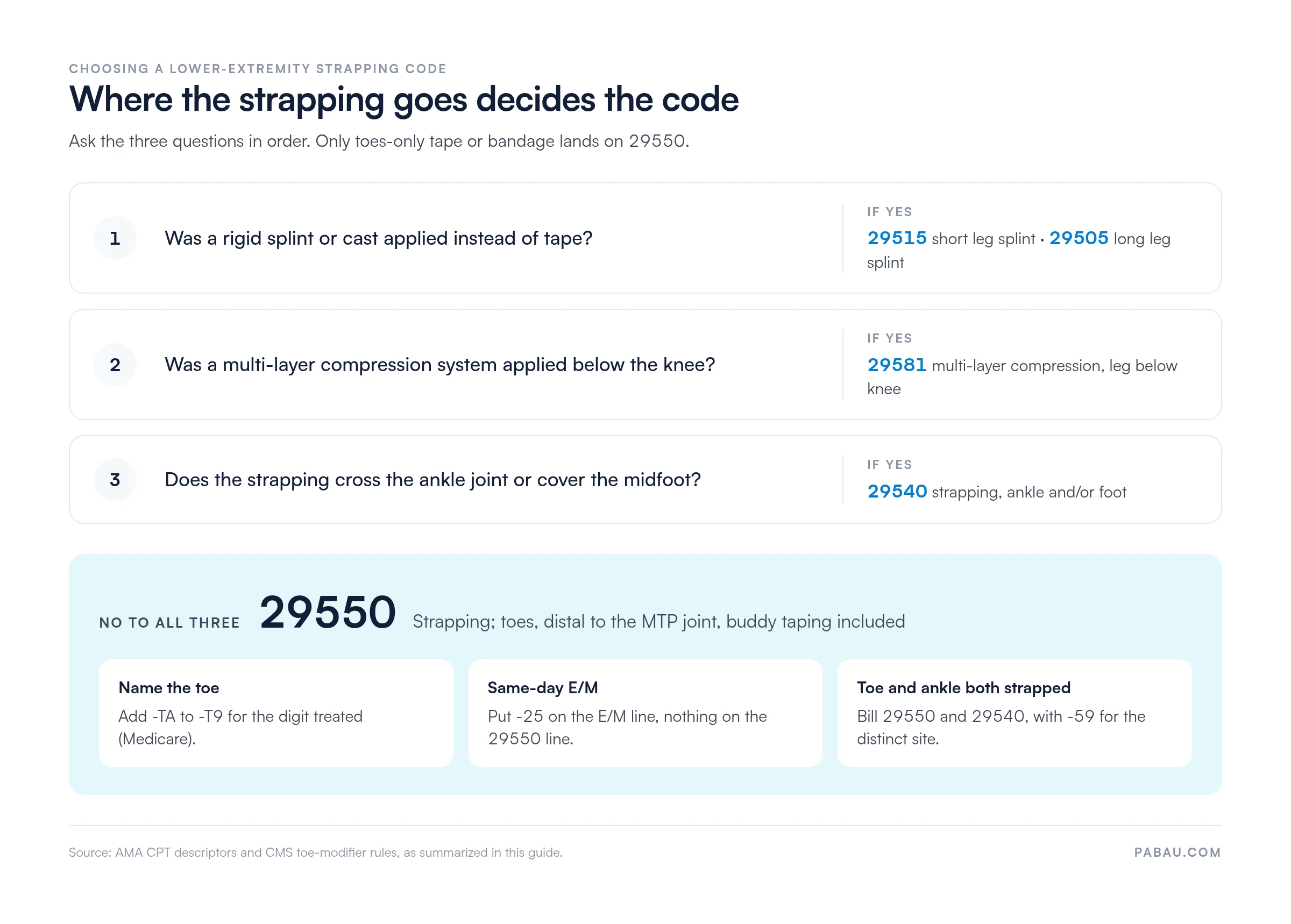
Use the AAPC CPT code range lookup to cross-reference the full descriptor before submitting. The CrossCoder bidirectional crosswalk tool is also useful for confirming LCD policies associated with each strapping code when payer-specific coverage guidance is unclear.
Modifier selection is where CPT code 29550 claims either pass or stall. Medicare requires toe-level modifiers for all podiatry toe procedures. Commercial payers have varying requirements, but applying the modifiers consistently across all payers reduces rejection risk without creating compliance exposure.
These modifiers identify the specific toe treated. Medicare’s Claims Processing Manual requires them for podiatric toe procedures. The mapping is consistent across all MAC jurisdictions.
Medicare covers CPT code 29550 when medical necessity is established by the treating provider’s documentation. Coverage is not automatic: The claim must carry a supported diagnosis code and a note that justifies the strapping. The CMS Physician Fee Schedule sets national non-facility and facility reimbursement rates, which are adjusted by geographic practice cost index (GPCI) in each MAC jurisdiction. Rates change every year, so verify against the current-year MPFS before quoting a reimbursement amount to a provider.
Checking eligibility before the encounter cuts coverage-related denials at the source. The Medicare coverage rules for CPT code 29550 are:
CPT code 29550 is not inherently bundled with evaluation and management codes under NCCI edits. The two services can be billed together on the same date. If the claim is structured wrongly, payers auto-deny the strapping as part of the office visit payment.
The required configuration is: Modifier -25 on the E/M code, nothing on the 29550 line. The -25 signals that the E/M was a separately identifiable service, not simply the history and exam that preceded the strapping. The documentation must support this distinction: The note needs to show a clinical decision-making component that goes beyond selecting the strapping technique.
A routine strapping change with no new complaint, no findings that need judgment, and no plan change does not support a separate visit code. A new injury, a healing assessment, or a complication that needs clinical decision-making does support one. The note decides which case applies, whatever label the provider gives the encounter.
Before billing an E/M alongside CPT 29550, ask: does the note contain clinical decision-making separate from the strapping application? Document the assessment findings, differential considerations, or treatment plan changes that justify billing the visit separately. A note that describes only the strapping technique will not support -25 on audit.
Denial patterns for CPT code 29550 are consistent across payers. The same coding and documentation errors turn up in remittance advice again and again. Understanding which denial reason codes map to which workflow failure makes prevention systematic rather than reactive. Denial management workflows that track these at the claim level catch repeat errors before they compound.
Our guide to medical billing denial codes explains what each CARC and RARC code means across claim types.
Each denial pattern above starts with a manual step in a workflow that repeats all week. A podiatry practice billing 29550 dozens of times a week cannot rely on each coder to catch every missing toe modifier or mismatched diagnosis.
Pabau, the practice management and billing platform we build, runs each claim through error-checking claims software before it goes out. It integrates with Claim.MD across thousands of US payers, so eligibility is verified before the appointment. Claims are then validated against CPT and ICD-10 pairing rules before submission.
Modifier conflicts surface while the claim is being built. A 29550 line without a toe modifier, or a same-day E/M without -25, is flagged before the claim leaves the practice. Your coders spend their time on the claims that need judgment, and fewer CO-4 and CO-97 denials come back to rework.
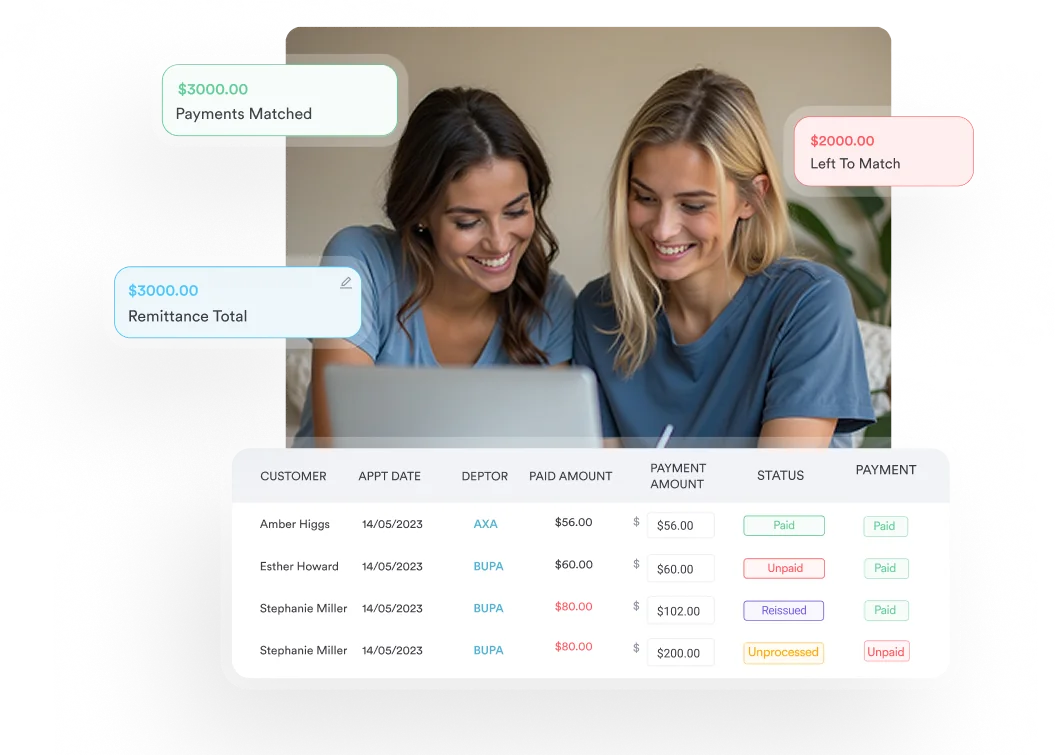

Pabau’s billing tools auto-flag missing toe modifiers, ICD-10 mismatches, and same-day E/M bundling issues before claims leave your practice. See how it works in a live demo.

CPT code 29550 pays reliably when the note and the claim agree on one boundary: Toes only, distal to the MTP joint. Settle that first, and the right code, toe modifier, and diagnosis all follow from the same documentation.
The trade-off is a little more effort at the point of care. A note that names the toe, the side, and the reason for strapping takes a minute longer to write. It is also the note that stands up when a payer audits the claim.
If your team still checks toe modifiers and same-day -25 by hand, move those checks into the billing workflow. Book a demo to see how Pabau validates strapping claims before they reach the payer.

Strapping an ankle sprain as well? CPT code 29540 covers ankle and foot strapping, the code that replaces 29550 once tape crosses the ankle.
Applying an Unna boot instead of tape? CPT code 29580 explains how paste boot application is billed and where it sits among the strapping codes.
Want to see where strapping claims sit in the revenue cycle? Revenue cycle management fundamentals covers how claims flow from coding through payment posting in a clinical practice.
Preparing for a payer audit? Medical billing compliance outlines the documentation and coding standards payers audit most frequently.
Tracing a denial back to its source? Understanding electronic remittance advice explains how to read ERA files and trace denial reason codes back to the claim.
CPT code 29550 is the billing code for strapping one or more toes. It covers buddy taping, closed toe fracture support, sprain stabilization, and post-operative toe immobilization. It applies only distal to the metatarsophalangeal joint, and ankle or foot strapping goes to 29540 instead.
Yes, buddy taping of a single toe or multiple toes falls under CPT 29550, even though the AMA descriptor does not name it explicitly. AAPC coding guidance and Pediatric Coding Alert commentary support this classification based on the descriptor’s scope of “strapping; toes.”
Medicare requires a toe-level modifier (-TA through -T9) identifying the specific toe treated. When a same-day E/M code is also billed, modifier -25 must appear on the E/M, not on the 29550 line. Commercial payers may require -RT or -LT instead of, or alongside, the toe modifiers. Check the specific payer’s billing manual.
Yes, Medicare reimburses CPT code 29550 when medical necessity is documented and the claim includes a supported ICD-10 diagnosis code. The global period is 0 days, so return strapping visits are separately billable. Reimbursement rates are locality-adjusted, so check the current-year CMS Physician Fee Schedule for the applicable MAC jurisdiction.
CPT 29550 covers toe strapping only. Code 29540 covers ankle and/or foot strapping, and 29581 covers a multi-layer compression system below the knee. The key decision rule is anatomical: If the strapping extends to the ankle joint, 29550 is incorrect. If a multi-layer compression system is applied for venous or lymphatic conditions, 29581 is the correct code regardless of whether toes are involved.
Physicians (MD/DO), podiatrists (DPM), and orthopedic surgeons may bill CPT 29550 without restriction. Physical therapists may bill it depending on state scope-of-practice law and payer contract terms. Confirm billing rights with the MAC or commercial payer before submitting PT claims for 29550.




