CPT Code 64642: Chemodenervation of one extremity billing guide
CPT Code 64642: Official descriptor and procedure overview CPT code 64642 is def...

Last Updated: Oct 13, 2026
29540 is the CPT code for strapping; ankle and/or foot. It covers adhesive tape applied to the ankle, the foot, or both, billed as one unit per encounter, with a 0-day global period under Medicare.
Orthopedic, sports medicine, urgent care, and emergency department coders report it most often. Denials usually trace to missing medical necessity documentation, the wrong place-of-service code, or an NCCI bundle edit with a same-day procedure such as 20550.
Let Pabau's smart automation suggest the right codes, reduce claim denials, and keep your practice compliant—effortlessly.
Automate repetitive tasks and focus on what matters most—your patients.
Reduce coding errors and ensure compliance with the latest regulations.
Clean claims, fewer denials, and faster reimbursements.
Powerful insights and reporting to help your practice thrive.
HIPAA compliant SOC 2 certified GDPR-compliant Trusted by 4,000+ clinics worldwide

CPT code 29540 covers strapping of the ankle and/or foot — a distinct procedure from casting, splinting, and multilayer compression systems
The code carries a 0-day global period under the Medicare Physician Fee Schedule, meaning an E&M on the same date requires modifier 25
HCPCS Level II A-codes for elastic bandage and tape may be separately billable, depending on each payer’s supply-bundling rules
Pabau’s claims management software submits CPT 29540 claims electronically through Claim.MD, tracks claim status, and returns ERA remittances into Pabau
CPT code 29540 is defined by the American Medical Association (AMA) as “Strapping; ankle and/or foot.” It sits in the casts and strapping subsection (codes 29000-29799) of the musculoskeletal system section of the CPT codebook. It covers adhesive strapping applied to the ankle, foot, or both in a single encounter.
Strapping is not the same as casting or splinting. A cast immobilizes using rigid material. A splint semi-immobilizes with a padded rigid board. Strapping uses elastic or non-elastic tape applied in overlapping layers to provide support, limit range of motion, or reduce soft-tissue swelling without rigid immobilization. The distinction matters at audit time.
Key facts about the code:
The code applies whichever foot or ankle is strapped. One unit is the correct billing for a single encounter, even when the ankle and foot are strapped together.
CPT code 29540 is appropriate whenever a clinician applies adhesive strapping to stabilize or support the ankle and/or foot as a primary therapeutic intervention. The code is tied to a technique rather than a diagnosis. The clinical indication must therefore be documented in the note and linked to an ICD-10-CM diagnosis code.
Common clinical indications include:
Turf toe, a first MTP sprain (S93.521A right or S93.522A left, initial encounter), is reported with 29550 when only the toe is strapped. Strapping applied as part of fracture or dislocation care is included in that treatment and is not reported separately with 29540. The decision path below shows which strapping code fits what was actually applied.
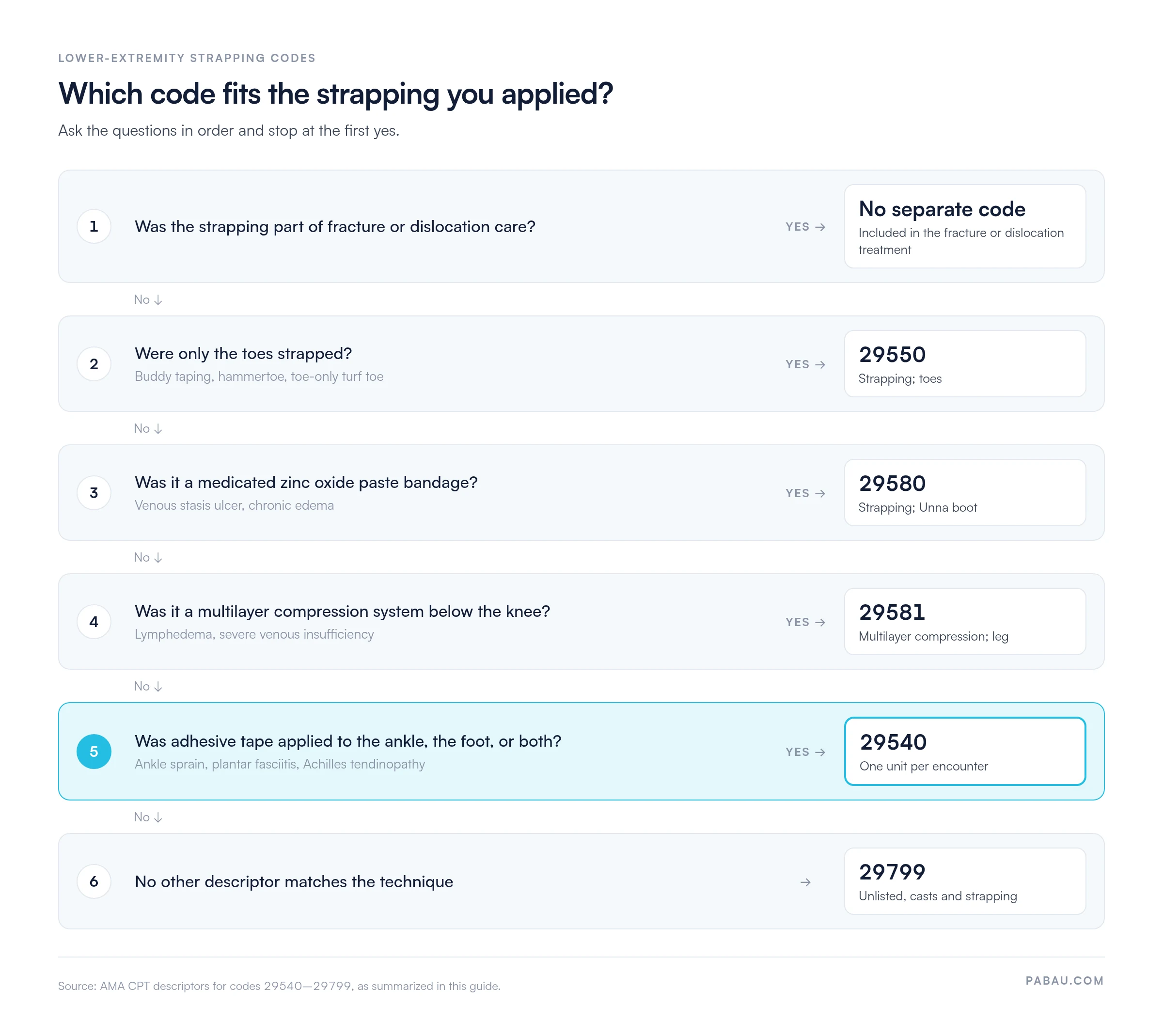
The code is appropriate in the office, urgent care, sports medicine practice, and emergency department. Athletic trainers and physical therapists who apply strapping under physician supervision may also generate a billable encounter, subject to payer incident-to rules. Pair 29540 with its ICD-10-CM code when the encounter is created, so a missing or vague diagnosis surfaces before submission.
Missing or insufficient documentation is the leading cause of CPT 29540 denials on audit. The note must support both the medical necessity of strapping and the technical performance of the procedure itself.
Required documentation elements:
A superbill that captures all six elements at the point of care sends the claim out with its documentation already complete. Generate it at checkout rather than at the end of the billing week.
Document the strapping technique in the same note section as the procedure, not as an addendum. Payers that audit 29540 claims look for contemporaneous documentation. An addendum written after a denial notice carries less weight in an appeal.
CPT code 29540 carries a 0-day global period under the Medicare Physician Fee Schedule. That means no post-procedure care is bundled into the fee. An evaluation and management service billed on the same date needs modifier 25 on the E&M code, not on 29540 itself.
Place of service codes: Use POS 11 for an office and POS 20 for urgent care. Use POS 22 for an outpatient hospital setting and POS 23 for the emergency department.
The POS code affects both the facility component of the fee schedule payment and the medical necessity review criteria some MACs apply. A POS mismatch is one of the cleaner denial patterns to fix. A common example is POS 11 on a claim where the rendering location is a hospital outpatient department.
Modifier 25 documentation: The same-day E&M must represent a separately identifiable service beyond the decision to perform strapping. A brief assessment that only concludes “apply strapping” does not satisfy modifier 25. Document the history, exam, and medical decision-making that stand independently.
In Pabau, the practice management platform we build, claims go out electronically through Claim.MD. Check the E&M line for modifier 25 before submission whenever 29540 shares the date.
Medicare covers CPT 29540 when medical necessity is established. Under incident-to rules, the supervising physician must be in the office suite, though not necessarily in the room. This applies when a PA, NP, or other non-physician practitioner performs the strapping. If the practitioner bills independently under their own NPI, Medicare applies their applicable payment rate rather than the physician rate.
Physical therapists and athletic trainers face an additional layer. Medicare does not allow athletic trainers to bill independently; their services must be incident-to a physician. Physical therapists may bill 29540 when it falls within their scope of practice under state law. It is not a physical therapy-specific code, though, and some commercial payers apply specialty restrictions.
Check which provider types each payer accepts for 29540 before you set one billing policy for the whole clinical team. Our overview of how medical billing works walks through the claim cycle those rules plug into.
The CMS Physician Fee Schedule lookup tool publishes the current year’s work RVUs, practice expense RVUs, and geographic adjustment factors for 29540. Use it to calculate the expected allowed amount for your MAC jurisdiction. RVUs change each January 1, so verify the current year’s values before using any figure for financial planning.
For a detailed RVU breakdown including geographic modifiers, the FastRVU 2026 RVU lookup tool makes the calculation straightforward.
Commercial payers: Most follow Medicare’s general framework but diverge on supply bundling (see the HCPCS section below) and bilateral billing. Some commercial plans pay bilateral strapping as two units of 29540; others apply a 150% rule. Verify each payer’s fee schedule addendum or call provider relations before assuming Medicare’s bilateral rule applies.
Store payer-specific rules at the plan level in your claims management software, not only at the insurance company level. Otherwise a UnitedHealthcare commercial plan gets billed the same way as UnitedHealthcare Medicare Advantage, which has different rules.
CPT 29540 covers the application of the strapping. It does not automatically include the cost of supplies. Whether supplies are separately billable depends on the payer. Medicare generally bundles routine supplies into the procedure payment, while many commercial payers allow separate HCPCS Level II billing for the materials.
Before billing HCPCS A-codes separately, check the payer’s policy on supply bundling for strapping codes. If the payer bundles supplies into 29540, submitting A-codes will generate a CO-97 denial. Verify with the payer’s provider manual or ERA remittance data from a previous claim before assuming separate billing is permitted.
CPT code 29540 is one of several lower-extremity strapping codes. Selecting the wrong code is a direct cause of both underpayment and audit exposure. The most common mix-up is between 29540 and 29581, the multilayer compression code. The note decides which one applies, because the two describe different procedures.
The most consequential distinction is between 29540 and 29581. CPT 29581 describes a multilayer compression system for the leg below the knee. It typically involves a wound contact layer, padding layer, compression layer, and cohesive outer wrap. It is a different, more resource-intensive procedure. Payers cover it mainly for lymphedema and chronic venous disease rather than acute ankle sprains.
Billing 29581 when the clinical picture matches 29540 constitutes upcoding. Billing 29540 when the procedure was genuinely multilayer compression undersells the service. The AAPC Codify CPT lookup provides the full descriptor text and instructional notes for each code in this range.
The National Correct Coding Initiative (NCCI) bundles 29540 into a number of other procedures as a column 2 code. Billing both codes on the same date without an applicable modifier generates an automatic bundle denial on the column 2 code.
One verifiable example is CPT 20550, an injection of a single tendon sheath or ligament. In the procedure-to-procedure (PTP) edit table, 20550 is the column 1 code and 29540 is the column 2 code, with modifier indicator 1. That indicator allows modifier 59 or XS to bypass the edit, but only when the strapping was a distinct service. Check the current quarter’s PTP edit table for 29540 before you report it with any other same-day procedure.
Run a monthly NCCI edit report filtered to 29540 claims. Repeated CO-97 denials alongside 20550 or another same-day column 1 code call for a note audit. Confirm separate documentation exists before resubmitting with modifier 59. Resubmitting without the documentation correction will generate the same denial.
CPT code 29540 denials cluster around a handful of predictable patterns. The denial codes on the ERA or remittance advice show which one you are hitting. That points directly to the corrective action needed.
Strong denial management workflows track CARC reason codes by procedure code. A spike in 29540 denials then triggers an investigation within the billing cycle, not at the end of the quarter.
When the strapping note lives in one system and the claim is built in another, the modifier, laterality, and supply codes get re-keyed by hand. Each re-keyed field is another chance for the CO-4 and CO-5 denials in the table above.
Pabau sends 29540 claims electronically through Claim.MD and tracks each claim’s status. ERA remittances come back into Pabau, so your billing team reviews payer responses in the same system that holds the note.
When a remittance carries a CARC code, match it to the corrective action in the denial table. Then resubmit a clean claim with the fix documented against the same visit.

Pabau sends claims through Claim.MD, tracks their status, and returns ERA remittances into the system. See how it works for orthopedic and sports medicine billing.

Treat every 29540 claim as a three-point check before it goes out. The diagnosis needs laterality, a same-day E&M needs modifier 25, and any A-code needs a payer that pays supplies separately.
The trade-off is a minute at checkout against an appeal later. A note written at the visit carries more weight with a payer than an addendum written after the denial arrives.
Book a demo to see how Pabau keeps the strapping note, the claim, and the remittance for each 29540 visit in one place.

Need a framework for managing claim denials at scale? Denial management in healthcare covers the end-to-end workflow for tracking, appealing, and preventing recurring denials across procedure codes.
Want to understand how clearinghouse claim submission works? Medical claims clearinghouse explains the role of the clearinghouse in the claim lifecycle and what to look for in a clearinghouse integration.
Looking for a billing compliance checklist? Medical billing compliance outlines the documentation and submission standards that prevent audit exposure across CPT code categories.
CPT code 29540 is the AMA’s procedure code for strapping of the ankle and/or foot. It covers adhesive tape applied in any pattern to support or limit motion of the ankle, the foot, or both in a single encounter. It does not include casting, splinting, or multilayer compression systems.
CPT code 29540 carries a 0-day global period under the Medicare Physician Fee Schedule. No post-procedure follow-up visits are bundled into the payment, and an E&M billed on the same date requires modifier 25 appended to the E&M code.
CPT 29540 covers standard adhesive strapping of the ankle and/or foot. CPT 29581 describes a multilayer compression system applied below the knee, with distinct compression and padding layers for lymphedema or chronic venous disease. They are clinically distinct procedures and are not interchangeable.
Yes, Medicare covers CPT code 29540 when medical necessity is documented. Reimbursement is calculated using the Medicare Physician Fee Schedule RVU values adjusted for the geographic practice cost index of the rendering location. Use the CMS Physician Fee Schedule lookup tool for the current year’s allowed amount in your MAC jurisdiction.
Commonly paired codes include A6448 and A6449 (elastic compression bandage by width and yard) and A6441 (non-elastic padding bandage, per yard). A6413 (first-aid adhesive bandage, each) is sometimes listed too, but it is not a strapping supply. Whether these are separately billable depends on the payer; Medicare generally bundles supplies into the procedure fee, while many commercial payers allow separate supply reporting.
The most common denial reasons are missing medical necessity documentation (CO-50) and an NCCI bundle edit with a same-day procedure such as 20550 (CO-97). A missing modifier 25 on a same-day E&M (CO-4) and a wrong place-of-service code (CO-5) are the other two. Each has a specific corrective action; see the denial table in this reference for the fix for each pattern.
Yes, CPT code 29540 may be billed in the emergency department using place-of-service code 23. The strapping must be documented as a procedure distinct from the E&M encounter. NCCI edits apply regardless of setting, and modifier 25 is required on the same-day E&M if billed together.