HCPCS Code Q4185: Cellesta flowable amnion billing guide
HCPCS Code Q4185: definition and official descriptor HCPCS Code Q4185 is the Lev...

Last Updated: Nov 20, 2026
28510 is the CPT code for closed treatment of a phalanx fracture in a lesser toe, without manipulation. It is reported once per toe and covers toes 2 through 5, with the great toe excluded.
The fracture is treated without an incision, and the fragments are not reduced. Buddy taping, a rigid-sole shoe and routine follow-up within the 90-day global period are part of the service. If the provider manipulates the fracture, 28515 applies instead, and open treatment is 28525.
Let Pabau's smart automation suggest the right codes, reduce claim denials, and keep your practice compliant—effortlessly.
Automate repetitive tasks and focus on what matters most—your patients.
Reduce coding errors and ensure compliance with the latest regulations.
Clean claims, fewer denials, and faster reimbursements.
Powerful insights and reporting to help your practice thrive.
HIPAA compliant SOC 2 certified GDPR-compliant Trusted by 4,000+ clinics worldwide

CPT code 28510 covers closed treatment of a phalanx fracture in toes 2 to 5 when the provider does not reduce the fracture.
The great toe is excluded, closed manipulation moves the claim to 28515, and open treatment is 28525.
Report 28510 once per fractured toe, with T1 to T4 for the left foot or T6 to T9 for the right.
Medicare lists 28510 with a 90-day global period, so routine fracture follow-up in that window is not billed separately.
Pabau’s claims management software sends the claim through Claim.MD and posts the remittance against the patient record.
CPT code 28510 reports closed treatment of a fractured phalanx in toes 2 through 5 when the provider does not manipulate the fracture. AAPC’s code entry for 28510 describes the same service: a toe other than the great toe, treated closed, with no adjustment of the fractured bone.
The descriptor in the AMA CPT code set reads: “Closed treatment of fracture, phalanx or phalanges, other than great toe; without manipulation, each.” Five of its terms decide whether a claim fits.
28510 belongs to 28510-28525, the lesser-toe phalanx fracture family. That family sits inside 28400-28675, the fracture and dislocation procedures on the foot and toes. 28510 is the most conservative code in it. When the provider manipulates the fracture, the code moves to 28515, and open treatment moves it to 28525.
The descriptor names the great toe as excluded. A great-toe phalanx fracture is coded from its own family instead, starting with 28490 for closed treatment without manipulation. Billing 28510 for the hallux is a miscoding that can draw an audit.
Proximal, middle, and distal phalanx fractures are all included. Fractures of the metatarsals, the long bones behind the toes, are not, and closed treatment of one without manipulation is 28470. A patient with both a metatarsal fracture and a lesser-toe phalanx fracture needs two separate codes.
The phrase “without manipulation” sets the boundary between 28510 and the codes above it. Manipulation means the provider physically moves, reduces, or repositions the fracture fragments, with or without anesthesia. If that happens, 28510 is the wrong code.
The clinical steps that fall within 28510 include:
None of these involve hands-on reduction. The note must show that the fracture position was acceptable without intervention, and that conservative care was a deliberate clinical choice.
Document the fracture alignment in the note. Write “fracture alignment acceptable; no manipulation required” rather than leaving the manipulation question implied. Payers look for this language on 28510 claims. If the note says only “applied buddy tape,” the fracture care code is harder to defend against a strapping code.
The S92 category of ICD-10-CM covers fractures of the foot and toe, except the ankle. For CPT code 28510, the diagnosis comes from S92.50-S92.59, fracture of lesser toe(s). The S92.4 codes describe the great toe and never pair with 28510.
Each code also takes a 7th character for the encounter. A marks the initial encounter for a closed fracture, D a subsequent encounter with routine healing, and S a sequela.
Laterality has to agree across the claim. A right-foot diagnosis such as S92.511A is denied when the 28510 line carries a left-foot modifier. TA through T4 are left; T5 through T9 are right. A displaced middle-phalanx fracture of the left fourth toe, for example, takes S92.522A with modifier T3.
Use the A character only for the initial treatment of the acute injury. Follow-up visits during the global period are documented with the D character.
CPT code 28525 covers open treatment of a lesser-toe phalanx fracture, including internal fixation when performed. It is the surgical counterpart to 28510. The decision point is whether the fracture needed an incision to reach acceptable alignment. Significant displacement or angulation that closed care cannot hold points to 28525.
A common error is billing 28510 after the provider reduced the fracture by closed manipulation under local anesthetic. Closed manipulation, even without an incision, moves the claim to CPT 28515, closed treatment with manipulation. Billing 28510 in that case undercodes the work performed.
Put together, the four codes a lesser-toe injury can take turn on two questions, set out below.
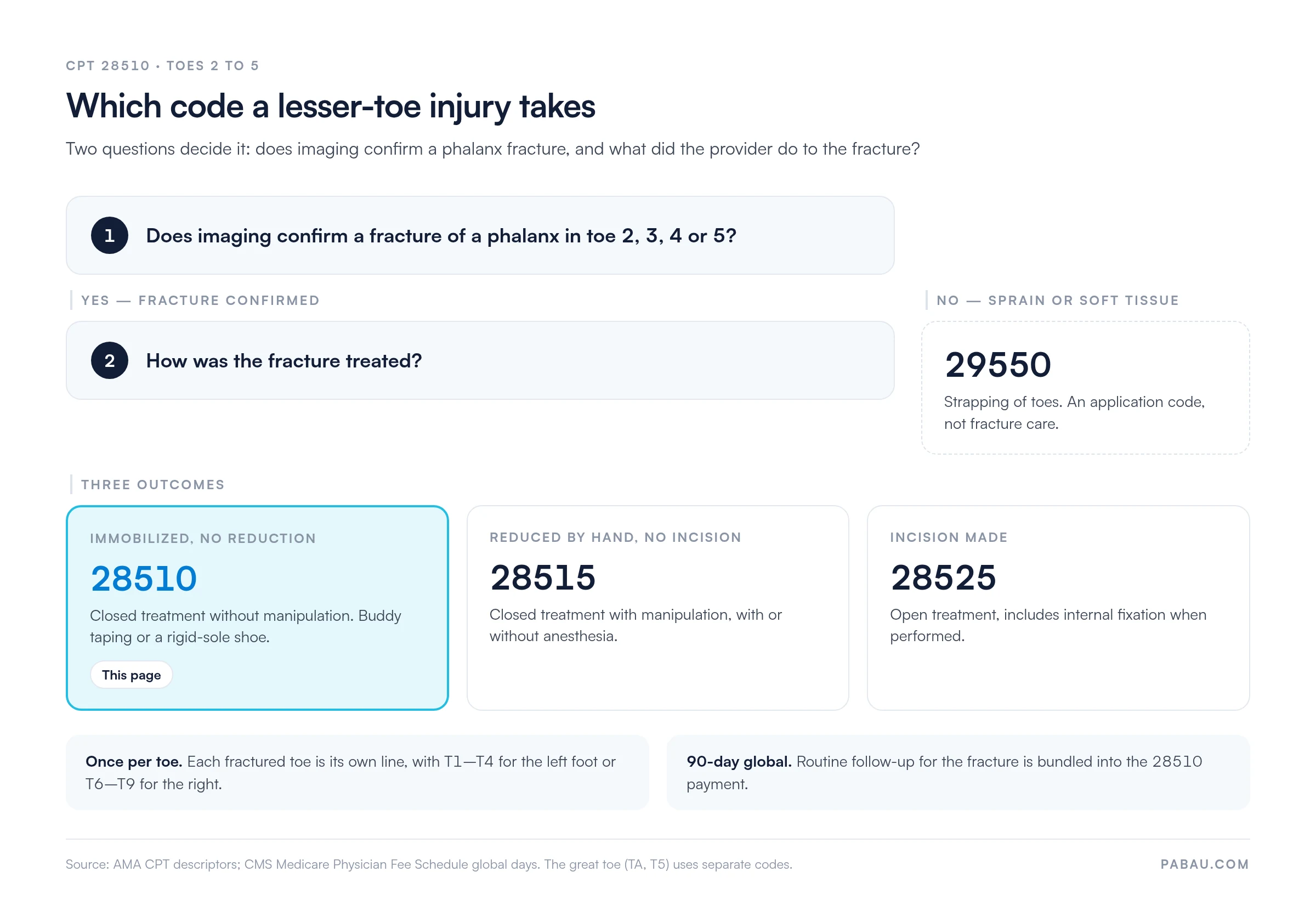
CPT 29550, strapping of toes, is an application code rather than a fracture care code. It applies when imaging does not confirm a fracture, or when strapping treats a sprain or soft tissue injury. When imaging confirms a phalanx fracture and the provider treats it conservatively, 28510 is the correct code.
NCCI edits bundle 29550 into 28510 when both are billed together, because strapping is part of the fracture care. Billing both without modifier 59 or XS (separate structure) gets 29550 denied. The modifier overrides the edit only when the strapping treated a separate anatomic site, which is rare in a lesser-toe fracture visit.
Digit modifiers identify which toe was treated. Medicare contractors expect one on every 28510 line, and a missing modifier is a frequent reason these claims come back.
When several toes are fractured in one encounter, bill 28510 once per toe, each line with its own digit modifier. Some payers also want modifier 59 or XS on the later lines. Modifier 50 does not apply to toe procedures. Toes on both feet go on separate lines with left-foot and right-foot digit modifiers.
Some commercial payers handle multiple-toe reporting differently from Medicare, so confirm their rules before submission.
CPT code 28510 carries a 90-day global surgery period under the CMS Medicare Physician Fee Schedule. Routine follow-up care for the fracture is bundled into the original payment, from the day before the procedure to 90 days after it.
Check the global days in the CMS Physician Fee Schedule search tool each year, since the annual update can change them.
Medicare pays for CPT code 28510 from its Physician Fee Schedule RVUs. For current national and locality rates, use the FastRVU 2026 lookup tool or the CMS search tool above. Payment rates change each year with the Medicare conversion factor, so prior-year figures go stale.
Documentation is where 28510 claims succeed or fail on audit. A clean claim submission for this code needs five note elements that map to the payer’s medical necessity criteria.
The treating provider’s signature, or an attestation in EHR-generated notes, must be present. Unsigned notes trigger denials on audit and are not billable under most payer contracts.
The denials below are the ones that come up on 28510, and each has a clear fix. Tracking them in your denial management workflow for three to six months shows which one costs your practice the most.
For the CARC codes that come back on these rejections, see our guide to medical billing denial codes. It covers the codes that appear most often on musculoskeletal procedure denials.
Run a quarterly audit of your 28510 claims. Pull every denial in the period, sort them by CARC code, and tally the top three reasons. Check digit modifiers and laterality first, because both are fixed upstream in the note template and the charge entry.
In the emergency department, the professional and facility sides of a lesser-toe fracture are billed separately. That split in medical billing decides who reports 28510 and on which form.
The 28510 denials above start before the claim is built. A toe modifier is left off, a right-foot diagnosis lands on a left-foot line, or a follow-up is billed inside the 90-day window. Each one sends a biller back to the note to rework a claim that should have gone out clean.
Pabau, the practice management platform we build, keeps the fracture note, the charge and the claim on one patient record. Its claims management software sends US claims through the Claim.MD clearinghouse as CMS-1500/837P claims, with eligibility checks before the visit.
Remittances come back as ERAs against the same record. A denied 28510 line then sits next to the note that has to support it. Secondary claims go out from the same screen.

Pabau’s claims management software sends claims through Claim.MD, checks eligibility, and posts remittances against the patient record. See how it handles fracture care billing.

The code choice is rarely the hard part of a 28510 claim. It follows from two facts in the note: no incision and no reduction. The money is lost in what surrounds it: the digit modifier, an S92.5 diagnosis with matching laterality, and follow-up kept inside the 90-day global.
Build those three checks into the note template and the charge screen, and 28510 claims stop coming back for rework. Book a demo to see how Pabau keeps the fracture note, the claim and its remittance on one patient record.

Submitting claims electronically for the first time? Claim.MD clearinghouse guide explains how clearinghouse submission works and what to expect from real-time claim validation.
Want to understand the full revenue cycle behind billing decisions? What is revenue cycle management gives a complete overview of the claim lifecycle from encounter to payment posting.
CPT code 28510 is the procedure code for closed treatment of a phalanx fracture in toes 2 through 5, without manipulation. It is reported once per toe. It applies when the fracture position is acceptable without reduction and the injury is immobilized, for example with buddy taping and a rigid-sole shoe.
CPT 28510 covers toes 2 through 5 only. The great toe (hallux) is excluded and is coded from the 28490 family instead. Proximal, middle, and distal phalanx fractures of the covered toes are all included.
CPT 28510 is closed treatment without manipulation. CPT 28525 is open treatment of a lesser-toe phalanx fracture, including internal fixation when performed. The distinction is whether the fracture needed an incision to reach acceptable alignment. 28510 is managed in an office or ED, while 28525 is an operating room procedure.
CPT 29550 is strapping of the toes, an application code rather than a fracture care code. Use 28510 when imaging confirms a phalanx fracture and the provider gives fracture care. Use 29550 when strapping treats a sprain, contusion, or soft tissue injury with no confirmed fracture. NCCI edits bundle 29550 into 28510 when both are billed together. Modifier 59 or XS separates them only when the services are distinct.
Bill a separate line for each fractured toe, each with its digit modifier. T1 to T4 cover toes 2 to 5 on the left foot, and T6 to T9 cover toes 2 to 5 on the right. Modifier 50 does not apply to toe procedures. Toes on both feet go on separate lines with left-foot and right-foot digit modifiers.
CPT 28510 has a 90-day global period under the Medicare Physician Fee Schedule. Routine follow-up visits for the fracture during those 90 days are included in the payment and are not billed separately. An unrelated visit in that window takes modifier 24 on the E/M code.
Medicare pays CPT 28510 from the current-year Physician Fee Schedule RVUs, multiplied by the annual conversion factor and adjusted by the locality’s GPCI. Rates change each calendar year. Use the CMS fee schedule search tool for current-year figures rather than relying on prior-year amounts.