

CCSD code G5100: Bypass of duodenum billing guide
CCSD code G5100 bills a bypass that leaves the duodenum in place CCSD code G5100...

Last Updated: Oct 16, 2026
29580 is the CPT code for strapping; Unna boot. It covers a single-layer zinc oxide or gelatin paste bandage applied from the toes to mid-leg.
Practices billing this code face denials from missing coverage documentation, wrong diagnosis code pairing, and unbundling errors with adjacent compression codes.
Let Pabau's smart automation suggest the right codes, reduce claim denials, and keep your practice compliant—effortlessly.
Automate repetitive tasks and focus on what matters most—your patients.
Reduce coding errors and ensure compliance with the latest regulations.
Clean claims, fewer denials, and faster reimbursements.
Powerful insights and reporting to help your practice thrive.
HIPAA compliant SOC 2 certified GDPR-compliant Trusted by 4,000+ clinics worldwide

CPT code 29580 describes a single-layer Unna boot application to the lower extremity, not a multi-layer compression system.
Medicare coverage follows the wound and ulcer care LCD L38904 and its billing and coding article A58567.
Claims need a lateralized, specific ICD-10 diagnosis at the I83.x or I87.x level, never an unspecified code.
Billing 29580 and 29581 on the same leg and date without distinct documentation triggers an NCCI bundling denial.
Practice management software like Pabau tracks denial reasons by procedure code, so 29580 trends surface early.
CPT code 29580 is the AMA’s code for Unna boot strapping of the lower extremity. The American Medical Association’s CPT code set publishes the official descriptor as Strapping; Unna boot. Toes to mid-leg is the anatomic extent the code covers, not the descriptor text itself.
The code sits in the Musculoskeletal System surgery section, inside the strapping subsection, within the 29000-29799 range. Medicare and most commercial payers pay it once medical necessity is documented. It describes the strapping procedure only. Supplies are billed separately under HCPCS supply codes where payer policy allows.
A billable 29580 encounter has the clinician applying a zinc oxide or calamine-impregnated bandage from the toes to mid-calf. An outer cotton or elastic wrap usually holds the paste bandage in place. The compression forms a semi-rigid shell that reduces edema and supports venous return.
Patients with chronic venous insufficiency or open venous ulcers are the usual candidates. The procedure is complete once the bandage has been applied continuously across the defined anatomic range. A single-layer application to one extremity is one billable unit. Treat both legs on the same date and bilateral billing applies, with the modifiers covered below.
Elastic compression stockings, ACE wraps applied without paste, and multi-layer compression systems do not qualify under 29580. They fall under different codes, or count as non-billable supply items depending on payer policy.
Several adjacent procedures are frequently miscoded as 29580. Knowing the exclusions prevents unbundling errors and claim rejections before they reach the payer.
The table below matches each scenario to the code it supports, and to what the claim still needs.
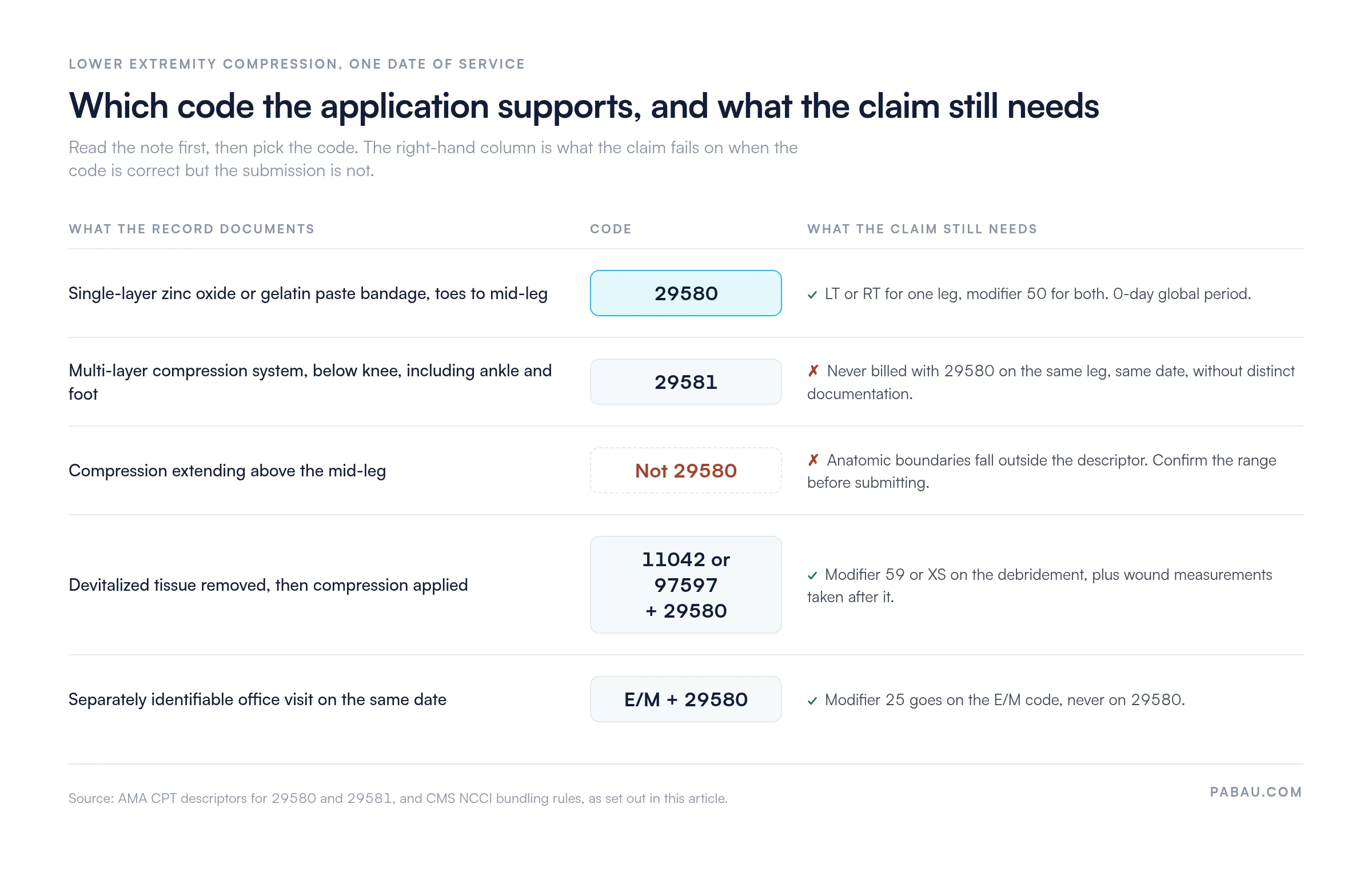
CPT 29581 describes application of a multi-layer compression system below the knee. It is typically a four-layer bandage used when a venous leg ulcer needs sustained compression over 40 mmHg. Payers audit for unbundling when both codes appear on the same claim for the same extremity and date.
Coders frequently misapply debridement codes when a clinician debrides a wound and applies an Unna boot at the same visit. Debridement and strapping describe separate procedural acts. Both can be billed on the same date only when the record documents each one distinctly. That means timing, wound measurements before and after debridement, and the clinical rationale for the compression.
Sequencing is what decides this pair. The debridement has to be finished before the boot goes on, and the record has to show wound measurements taken in that window. Without that order in the note, a payer reads the visit as one wound care encounter. The debridement then bundles into 29580 and is denied.
Missing documentation is the leading cause of 29580 denials. Every element below belongs in the medical record before the claim is submitted. Practices working toward medical billing compliance on wound care codes should audit notes at the point of care, not retrospectively.
All six elements need to be present before the claim leaves the practice. Correcting them after submission adds days to the payment cycle and raises audit risk.
Audit your 29580 notes against the six-element checklist at the point of documentation, not after the claim is queued. A templated wound care note that pre-populates laterality, material and wound measurement fields cuts the time per encounter. It also catches missing elements before they turn into denials.
CPT code 29580 carries no modifier inherently, but several are required depending on the billing scenario. Using the wrong modifier, or omitting a required one, causes claim rejection or post-payment audit recovery.
For same-day E/M billing, see the section below on office visit bundling rules. Modifier 25 applies to the E/M code, not to 29580 itself.
Medicare reimbursement for CPT code 29580 is set annually through the CMS Medicare Physician Fee Schedule. Rates vary by geographic locality and by place of service. The code carries a 0-day global period, so each application is billed as a separate encounter with no bundled follow-up.
Non-facility rates in an office or outpatient setting run higher than facility rates, because the practice overhead component sits in the non-facility rate. Pull the current figure from the CMS fee schedule look-up tool for your own locality. Locality multipliers move the national base rate materially.
Coverage sits with the applicable Medicare Administrative Contractor (MAC). The governing policy is LCD L38904, Wound and Ulcer Care, supported by billing and coding article A58567. A58567 is an article rather than an LCD, so cite the two separately when you appeal. The policy requires medical necessity to be documented from the patient’s underlying condition.
Frequency limits for Unna boot reapplication are not defined nationally by Medicare. They are set in MAC-specific policy. Check your own region’s policy before advising patients on a reapplication schedule, and document continued medical necessity at each visit.
An E/M service can be billed on the same date as CPT code 29580 when it is separately identifiable. That means work beyond the decision to apply the Unna boot. This is one of the most commonly mishandled scenarios in wound care billing.
Commercial payer policies vary here. Some follow Medicare NCCI edits, others apply their own bundling logic. Check the payer’s provider manual before assuming Medicare rules apply.
Strapping claims fail for a short list of reasons, and those reasons repeat. Documentation requirements are specific, and coverage criteria differ by MAC jurisdiction. Knowing which reason codes come back most often is where a fix starts.
Reviewing remittance advice for 29580 claims after each payment cycle shows which denial reasons recur. Catching the pattern early keeps it from adding up to material revenue loss.
Run a monthly pull of all 29580 claims adjudicated in the prior 30 days, filtered by CARC denial code. Frequency-limit denials (CO-119) clustering with medical necessity denials (CO-50, CO-57) on one provider or location usually points at the documentation template. Treat it as a template problem before you treat it as a coding error.
Pairing the right ICD-10 code with CPT code 29580 is what satisfies the wound and ulcer care policy. The codes below are the most common pairings. Always code to the highest specificity the clinical documentation supports.
Coding guidelines from the CMS ICD-10 coding updates page are published annually. Verify codes against the current fiscal year tabular list, since laterality and severity subcodes can change between editions.
Most wound care practices run 29580 through two systems. The clinical note lives in the chart, the claim lives in the billing tool, and the two get reconciled only when a denial arrives.
Practice management software like Pabau keeps both on one record. A templated wound care note captures laterality, material, and wound measurements at the point of care. The coded claim is built from that note, so the documentation supporting 29580 travels with it.
Claim submission and tracking run from the same place, so a 29580 denial is visible against the note behind it. Denial reasons are tracked by procedure code. That is how a frequency-limit pattern surfaces after the second claim rather than the twentieth.
Every Pabau subscription includes every feature, so a single-site wound care practice gets the same documentation and claims tools as a multi-location group.

Pabau keeps your wound care notes, coded claims, and submission history in one platform. Track 29580 outcomes, spot denial patterns by procedure code, and keep every note audit-ready.

29580 is a narrow code with a short descriptor, and the work sits in what surrounds it. Coverage policy, ICD-10 specificity, modifier placement, and NCCI edits each carry their own denial.
Practices that stop losing money on this code fix the note template rather than the individual claim. Six documentation elements, a lateralized diagnosis and the right modifier separate a paid claim from a 60-day appeal.
Pabau’s claims management software keeps 29580 performance visible across the revenue cycle. Book a demo to see how wound care documentation and claims hold together on one record.

Need to understand how clearinghouse edits affect your wound care claims? Claim.MD clearinghouse overview explains how electronic claim routing and real-time edits work for US payers.
Looking for a structured billing compliance framework? What is revenue cycle management covers the end-to-end workflow from patient encounter to payment posting.
Want to reduce claim denials across all procedure codes? Insurance eligibility verification explains how pre-visit checks prevent the most common coverage-based denials.
CPT code 29580 covers application of an Unna boot to the lower extremity, from the toes to the mid-leg. The bandage is a single-layer zinc oxide or gelatin paste compression dressing. It applies to venous stasis ulcers, edema, and chronic venous insufficiency. Multi-layer compression systems are billed under CPT 29581 instead.
Medicare reimbursement for CPT 29580 varies by geographic locality and place of service. Non-facility rates in an office setting are higher than facility rates. Use the CMS Physician Fee Schedule look-up tool with your own locality and year, since CMS updates rates annually.
The Unna boot CPT code is 29580. Its official AMA descriptor is Strapping; Unna boot. Any single-layer zinc oxide or gelatin paste compression bandage applied from the toes to mid-leg falls within that descriptor.
The most common denial reasons for 29580 are missing medical necessity documentation and unspecified ICD-10 diagnosis codes. Unbundling errors when 29581 is also billed, missing wound measurements, and place-of-service errors account for most of the rest. Reviewing remittance denial reason codes after each adjudication cycle shows which one drives your own losses.



