HCPCS Code Q4185: Cellesta flowable amnion billing guide
HCPCS Code Q4185: definition and official descriptor HCPCS Code Q4185 is the Lev...

Last Updated: Nov 20, 2026
29200 is the CPT code for strapping; thorax. It covers adhesive tape applied to the chest wall to immobilize it or restrict painful movement after injuries such as rib contusions and intercostal strains.
It is the only thorax strapping code, billed as one unit per application. The 29220 still listed in some old guides described the low back and was deleted in 2010. Kinesiology taping that supports movement during therapy belongs to 97112 or 97110 instead.
Let Pabau's smart automation suggest the right codes, reduce claim denials, and keep your practice compliant—effortlessly.
Automate repetitive tasks and focus on what matters most—your patients.
Reduce coding errors and ensure compliance with the latest regulations.
Clean claims, fewer denials, and faster reimbursements.
Powerful insights and reporting to help your practice thrive.
HIPAA compliant SOC 2 certified GDPR-compliant Trusted by 4,000+ clinics worldwide

CPT Code 29200 reports strapping of the thorax. The descriptor names the body region, not a tape brand or material.
Documentation must name the diagnosis, the region strapped, and why immobilizing the chest wall was medically necessary.
29200 has no sibling thorax code. CPT 29220 described low-back strapping, and the AMA deleted it on January 1, 2010.
Pabau’s claims management tools help physical therapy and sports medicine practices submit and track 29200 claims cleanly.
CPT Code 29200 describes strapping of the thorax by a qualified provider. Strapping means overlapping strips of adhesive tape applied to hold a structure in place and restrict its movement. The American Medical Association (AMA), which maintains the CPT code set, places 29200 first in the 29200-29280 strapping range.
That range covers the body and upper extremity, any age. The code is not time-based, so one application counts as one billable unit, however long it takes.
CPT Code 29200 applies when a provider tapes the chest wall to immobilize it or restrict painful movement. The code is defined by body region and purpose, not by the brand or stretch of the tape. Strapping a different region, or taping to aid movement during therapy, calls for a different code.
29200 is the only CPT code for strapping the thorax. There is no elastic or non-elastic version of it, so code choice turns on the region strapped and the purpose of the taping. The chart below settles it with two questions, and the table after it gives each descriptor.
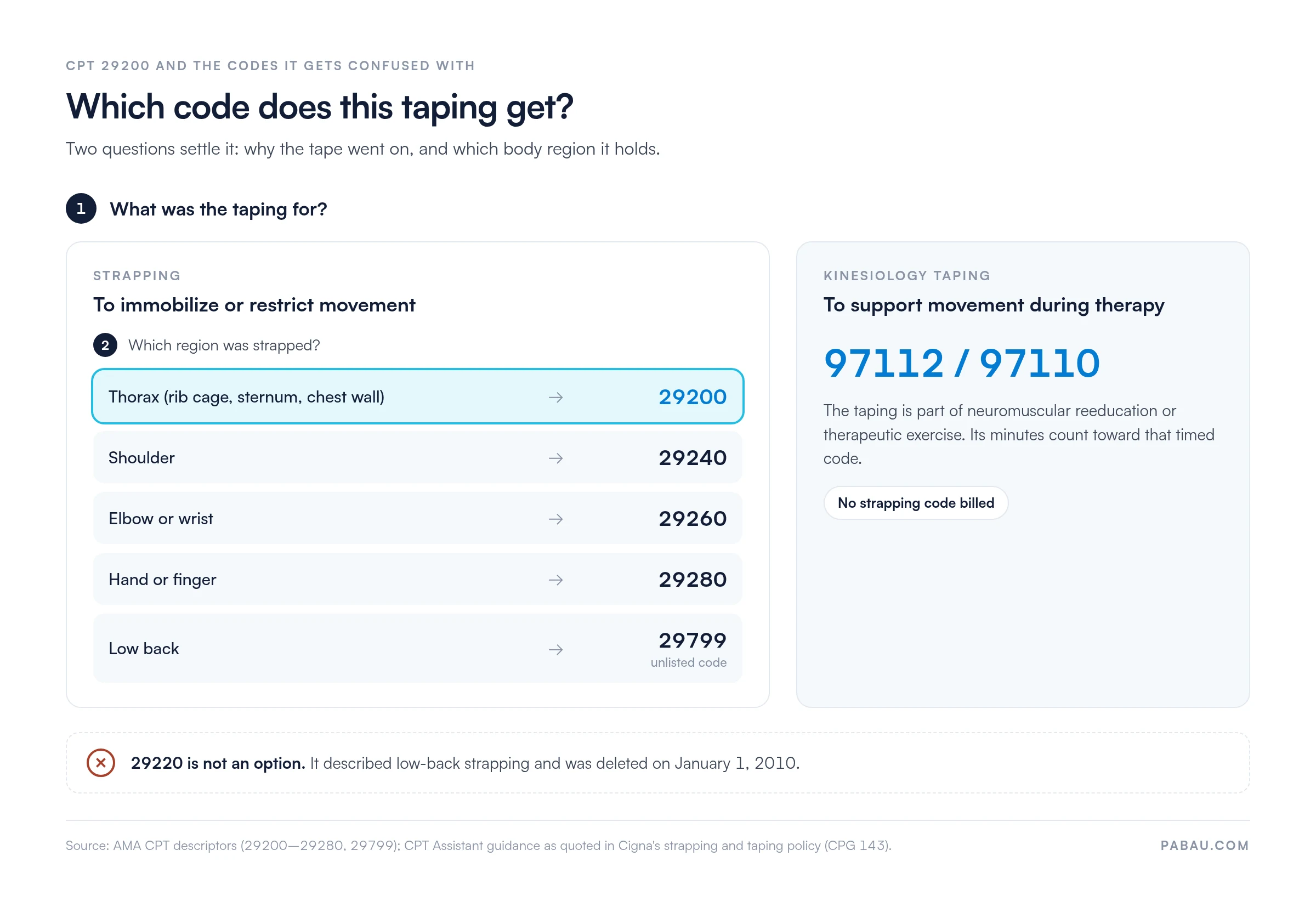
Older billing guides and fee lists still pair 29200 with 29220. The AMA deleted 29220 from CPT 2010, and it described the low back, not the thorax.
A claim carrying 29220 today is rejected as an invalid code. Low-back strapping now goes to 29799, and Medicare treats it as an obsolete, non-reimbursable service. Strip 29220 from any charge master or superbill template that still lists it.
CMS documentation standards for strapping codes require the medical record to establish both what was done and why. For CPT Code 29200, that means more than a procedure note stating “thorax strapping applied.”
A standard documentation template for thorax strapping cuts CO-16 denials for insufficient documentation. Superbill documentation and structured visit notes capture the details at the point of care, not on appeal. Every note supporting a 29200 claim should include these elements:
For building a clean claim, the documentation should be complete before the claim is submitted. Appeals on 29200 often succeed when the original note was complete but never attached to the claim. A documentation checklist in your EHR workflow keeps the note and the claim together from the start.
Payers validate 29200 claims against diagnosis codes. A thorax strapping code paired with an unrelated ICD-10 code will trigger a medical necessity denial. So will a condition that rarely calls for strapping. The table below lists the ICD-10-CM codes most commonly accepted as supporting 29200.
Always verify payer-specific Local Coverage Determinations (LCDs) before relying on a diagnosis pairing. CMS LCDs for strapping vary by Medicare Administrative Contractor (MAC) region, and a code accepted by one MAC may require prior authorization under another.
Medicare covers CPT Code 29200 as a strapping service under the Medicare Physician Fee Schedule (MPFS), subject to medical necessity documentation. Commercial payers are stricter. Cigna’s strapping and taping policy rates chest or thorax strapping as not medically necessary for any indication.
Check each plan’s coverage and authorization policy before providing the service. Running insurance eligibility verification at scheduling captures benefit-level detail. That detail flags the plans that require prior authorization for strapping codes.
Medicare reimbursement for CPT Code 29200 is based on Relative Value Units (RVUs) set annually by CMS. Non-facility rates (e.g., office settings) are higher than facility rates (e.g., hospital outpatient departments).
The table below reflects approximate 2026 ranges. Use the CMS Physician Fee Schedule lookup tool for the exact rate in your locality.
Use the FastRVU 2026 RVU lookup to calculate expected reimbursement at your practice’s geographic adjustment factor. In Pabau’s billing software, each 29200 claim passes an eligibility check before it goes out, which lowers the risk of a coverage-based denial.
Run a CMS Physician Fee Schedule lookup for CPT Code 29200 at the start of each calendar year. Medicare reimbursement rates update on January 1. Locality adjustments mean the national average in public calculators can differ from what your MAC pays. Build the updated rate into your fee schedule before the first claim of the year goes out.
Denials on CPT Code 29200 cluster around four claim adjustment reason codes (CARCs), and each one has a specific fix. Our guide to denial codes for billers decodes every CARC on a remittance. A working denial management process then stops the same reason code from coming back.
In Pabau’s claims management workflow, each ERA remittance posts back against its claim with the payer’s adjustment reason codes. A biller can then see whether a CO-97 keeps recurring on one payer contract or was a one-off coding error.
Usually not. Strapping codes describe taping that immobilizes or restricts movement after an injury. Kinesiology tape is applied to support and facilitate movement, so it does a different job.
AMA CPT Assistant guidance, as quoted in Cigna’s strapping and taping policy, addresses this case directly. Kinesio taping that enables less painful use and greater function is typically billed within 97112 or 97110, the neuromuscular reeducation and therapeutic exercise codes. The taping time counts toward that timed code, and a strapping code is not billed for it.
Physical therapists bill CPT Code 29200 alongside sports medicine and orthopedic practices. PT-specific billing rules add a layer beyond the base code requirements. Getting them right avoids the CO-4 and CO-97 denials common on outpatient PT claims.
Audit your 29200 claims quarterly against your CO-97 denial rate. If bundling denials cluster on one payer, pull that payer’s current CCI edit table. Compare it against your most common same-day code combinations. A single billing rule update often resolves a pattern that looks like a documentation problem.
Practices billing CPT Code 29200 meet the same denial patterns again and again. The note misses the strapping purpose, the ICD-10 code does not fit, or a CCI edit bundles the service. Pabau’s claims tools are built to stop each of those problems before a claim reaches the payer.
US claims go out through Claim.MD, the clearinghouse Pabau connects to, as CMS-1500 and 837P submissions. An eligibility check runs before each claim is sent. ERA remittances post back against the claim, so a CO-97 on a 29200 claim shows up in Pabau instead of on a paper remittance.
Where a plan asks for prior authorization, the auth code, dates and sessions sit on the patient’s case. Pabau warns the front desk when one is missing, before the strapping visit is billed.
Practices also build structured strapping notes in Pabau’s digital forms. The note records the strapping purpose, body region, and medical necessity at the point of care. Those are the three details missing from the notes behind the CO-16 denials in the table above.

Pabau checks eligibility, sends 29200 claims through Claim.MD, and posts ERA remittances back to the claim. Physical therapy and sports medicine practices see each denial reason the day it arrives.

CPT Code 29200 has a narrow scope: strapping that immobilizes the thorax. It has no thorax sibling, and the 29220 still printed in old guides has been invalid since 2010. Kinesiology taping during therapy belongs to 97112 or 97110, not to 29200.
Coverage is a bigger risk than coding. Medicare pays when necessity is documented, but some commercial payers decline thorax strapping outright. Check the plan policy before you strap, so the billing decision is settled before the tape goes on. Book a demo to see how Pabau keeps the strapping note and the claim in one workflow.

Need to understand how clearinghouses process your CPT claims? Medical claims clearinghouse guide covers how clearinghouses validate and route claims to payers.
Want to understand how the 837 file works for CPT claims? 837 EDI file guide breaks down the electronic claim format used for submitting 29200 and other procedure codes.
CPT Code 29200 is the procedure code for strapping of the thorax. A provider tapes the chest wall to restrict movement after injuries such as rib contusions and intercostal strains. It sits in the AMA’s 29200-29280 strapping range and bills as one unit per application, not by time.
Yes, Medicare covers CPT Code 29200 under the Medicare Physician Fee Schedule when medical necessity is documented. Non-facility (office) rates are higher than facility rates. Rates update every January 1, so check the CMS MPFS lookup tool for your locality.
No. The AMA deleted CPT 29220 effective January 1, 2010, and it described strapping of the low back, not the thorax. 29200 is the only thorax strapping code, with no elastic or non-elastic variant. Low-back strapping now goes to unlisted code 29799, and Medicare does not pay for it.
Usually not. AMA CPT Assistant guidance treats kinesio taping that supports movement as part of neuromuscular reeducation (97112) or therapeutic exercise (97110). The taping time counts toward that code. Bill 29200 only when the taping immobilizes or restricts chest wall movement, and document that purpose.
CO-16 (missing documentation) and CO-11 (diagnosis inconsistent with procedure) are the most frequent. CO-16 typically means the note lacks the strapping purpose or medical necessity language. CO-11 means the ICD-10 code does not support a thorax strapping claim. CO-97 appears when 29200 is bundled with a same-day therapeutic exercise code without modifier 59 or XS.
The most common pairings are S20.219A (thorax wall contusion), S29.011A (front wall strain), and S29.012A (back wall strain). All three are initial encounter codes. M54.6 (thoracic spine pain) is accepted by some payers for paraspinal strapping applications. Always verify against your MAC’s LCD before submitting.