ICD-10 Code S42.444P: Medial epicondyle fracture, right humerus
ICD-10 Code S42.444P: full descriptor and code validity ICD-10 Code S42.444P car...

Last Updated: Oct 13, 2026
Billable Code Specific Code
S93.522D is the billable ICD-10-CM code for sprain of metatarsophalangeal joint of left great toe, subsequent encounter.
Coders apply it to a follow-up visit once the active phase of treatment is complete. It does not describe a new or ongoing acute injury. The 7th character is the part that decides the claim. Submitting S93.522A for a physical therapy follow-up is the error payers reject most often.
Let Pabau's smart automation suggest the right codes, reduce claim denials, and keep your practice compliant—effortlessly.
Automate repetitive tasks and focus on what matters most—your patients.
Reduce coding errors and ensure compliance with the latest regulations.
Clean claims, fewer denials, and faster reimbursements.
Powerful insights and reporting to help your practice thrive.
HIPAA compliant SOC 2 certified GDPR-compliant Trusted by 4,000+ clinics worldwide

S93.522D is a valid, billable ICD-10-CM code for a left great toe MTP joint sprain at a follow-up encounter.
The 7th character D means active treatment is complete, so every PT visit after the first qualifies as subsequent.
Most denials trace back to S93.522A on a follow-up visit, or to notes that omit laterality and joint specificity.
Practice management software like Pabau runs claim validation and eligibility checks before submission, which cuts avoidable rejections.
ICD-10 Code S93.522D is the ICD-10-CM diagnosis code for a sprain of the metatarsophalangeal joint of the left great toe, subsequent encounter.
It sits within the S93 parent block (dislocation and sprain of joints and ligaments of ankle, foot, and toes) inside the S90-S99 injury chapter. The code is billable and active for FY 2025, which runs October 1, 2024 through September 30, 2025. It is also active for FY 2026, through September 30, 2026. Neither update cycle deleted it or changed its descriptor.
The 7th character D means the patient is receiving care for a condition whose active treatment phase has already occurred. Per the CMS ICD-10-CM coding guidelines, “subsequent encounter” does not mean a second visit to the same physician. It means any visit where the injury is healing under routine or rehabilitative care rather than acute intervention. For a left great toe MTP sprain, that distinction kicks in earlier than many coders expect.
A patient’s first emergency department visit for an acute sprain warrants S93.522A. A follow-up visit five days later with a primary care physician already qualifies as S93.522D. Active treatment, meaning immobilization, acute pain management and diagnostic imaging, was completed at the initial encounter. Every physical therapy visit that follows is unambiguously subsequent.
S93.522A applies to the initial encounter, S93.522D to subsequent encounters, and S93.522S to sequela visits. The most common coding error is submitting S93.522A for any visit after the first, particularly in physical therapy settings. Payers including Medicare cross-reference claim history. If S93.522A was billed previously for the same diagnosis, a second S93.522A claim triggers an automatic edit or an outright rejection. The care timeline below shows where each character takes over.
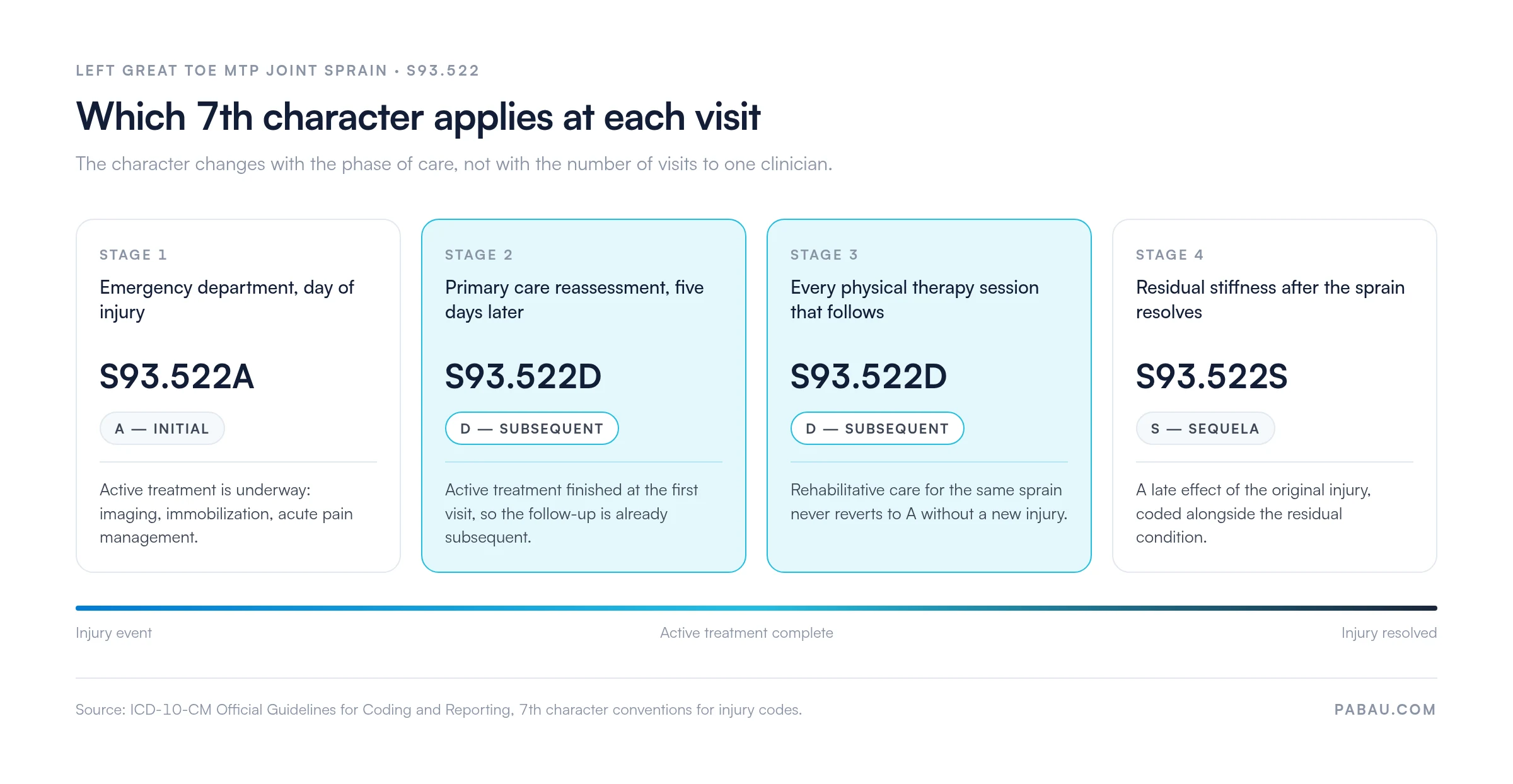
S93.522S is not interchangeable with S93.522D. Sequela describes a residual condition that persists after the acute injury has resolved entirely. Chronic stiffness or scar tissue at the MTP joint following a resolved sprain would warrant S93.522S, coded alongside the sequela condition. A patient still completing their PT course for the same sprain uses S93.522D. Sequela codes are far less common in outpatient billing for foot sprains, so S93.522D is the safer choice for active rehabilitation visits.
Run a 7th-character audit on all foot and ankle injury claims before month-end close. Filter claims where an initial-encounter code (A) is billed on the same patient more than once without a new injury event documented. For toe sprains, any claim after the first visit should carry D instead of the initial-encounter character. Catching this before submission prevents payer-level edits and avoids reopening closed encounters.
The metatarsophalangeal joint of the left great toe connects the first metatarsal head to the proximal phalanx of the hallux. It is the primary load-bearing joint during the push-off phase of gait. That makes it vulnerable to hyperextension injuries, lateral stress during cutting movements, and compressive trauma. According to the CDC/NCHS ICD-10-CM tool, S93.522 captures sprains of this specific joint on the left side, including ligament and capsular sprains.
Laterality is clinically and billing-relevant. S93.521 covers the right great toe; S93.522 covers the left. Coding S93.521D when the documented injury is the left great toe is a laterality error, whether or not the payer catches it at adjudication. Always confirm left versus right in the encounter note before selecting the code.
S93.522D covers sprains of the capsular ligaments and supporting ligaments of the first metatarsophalangeal joint of the left great toe at a subsequent encounter. It does not cover fractures, dislocations, or tendon injuries at the same site. Those require separate code selection from within the S90-S99 block, or from the M chapter for chronic tendinopathy.
Open wounds of the toes fall outside this code family too. A laceration without a foreign body on the right great toe, with damage to the nail, takes S91.211D. That code shares only the 7th character D with S93.522D, since it names a different injury and the opposite side.
S93.522D sits within a tight cluster of codes that share the same descriptor words but differ by laterality, specificity, or encounter type. Selecting the wrong neighbor is the single most correctable source of claim inaccuracy for this injury site. Verify each detail in the encounter note before choosing from this group.
Submitting ICD-10 Code S93.522D without a matched CPT procedure code does not generate a reimbursable claim. For follow-up office visits, evaluation and management codes 99212-99213 are the most common pair depending on complexity. Physical therapy encounters covering rehabilitative exercise and modality application use the therapeutic exercise and neuromuscular re-education codes. Run the pairing through claim validation before submission, so a mismatched CPT and ICD-10 combination is caught before the payer sees it.
S93.522D claims require specific documentation elements before submission. Missing any single element is sufficient grounds for payer denial, and reconstructing the record afterwards is slow and often unsuccessful. Physical therapy practices run into the prior-initial-encounter requirement more often than any other setting, because their caseload is almost entirely follow-up visits.
Structured documentation templates are what make the list above repeatable. Every element has to be in the record before the claim is generated, not added as an amendment once a denial arrives. Retrospective additions to medical records draw scrutiny from compliance reviewers.
Payer requirements for S93.522D vary meaningfully across insurance categories. Knowing which rule belongs to which payer prevents avoidable friction at adjudication. The table below summarizes the major payer categories and their characteristic requirements.
Denials for S93.522D cluster around a small number of repeating errors, most of them documentation-side rather than code-side. Good denial management in healthcare starts in the chart, not in the appeals queue. Correct the note before the claim goes out and the denial never happens. The table below maps the most common denial reasons to their direct remediation.
Physical therapy is the clinical setting where S93.522D is used most frequently. The initial evaluation is typically billed with S93.522A. Every PT session after it, for the same left great toe MTP sprain, is a subsequent encounter by definition. A PT follow-up for the same unresolved sprain never reverts to S93.522A, unless the patient presents with a new injury event at the same site.
PT practices billing S93.522D should build a claim-history check into the billing workflow. Software that auto-populates the 7th character from the visit sequence takes that verification off billing staff. The primary PT codes used alongside S93.522D are 97110 (therapeutic exercise), 97530 (therapeutic activities), and 97014 (electrical stimulation). Documentation must support the medical necessity of each modality applied at each session.
S93.522D is valid for both FY 2025 and FY 2026. The ICD-10-CM code database confirms no changes, deletions, or descriptor updates affecting S93.522D. That holds for both update cycles published by the CDC National Center for Health Statistics. The S93 block, covering dislocation and sprain of joints and ligaments of ankle, foot, and toes, has remained structurally stable across recent annual releases.
The ICD-10-CM code set is republished each October 1, so a code that was valid last fiscal year is not automatically valid this one. Re-checking the S93 block once a year is enough for a practice that bills toe and foot sprains regularly.
Check the CDC ICD-10-CM code files at the start of each fiscal year (October 1) to confirm no changes affect the S93 block. The NCHS publishes tabular additions, deletions, and revisions annually. Bookmark the CDC ICD-10-CM web tool at icd10cmtool.cdc.gov to verify any injury code before building it into your charge master.
The 7th character is usually decided by whoever codes the encounter, from memory, with the patient’s visit history open in another tab. That works until the PT schedule fills up. Then S93.522A goes out on a fourth rehabilitation visit and the payer rejects it. Someone spends twenty minutes reopening a closed encounter to fix one letter.
Pabau is practice management software that keeps the patient’s full visit history, the clinical note and the claim in one record. Because the prior encounter is already on file, the coder can see at a glance that this visit is a follow-up rather than the first. Our billing tools then run claim validation and eligibility checks before submission, through our Claim.MD integration.

The result is software for cleaner claims, so a toe-sprain episode leaves the practice with its documentation and its coding already in agreement. Billing staff spend their time on the exceptions instead of re-checking routine follow-up visits one by one.

Pabau’s claims management software runs claim validation and eligibility checks before submission, then sends claims to thousands of US payers through its Claim.MD integration. See how it handles foot and ankle injury billing in a live demo.

The wrong 7th character costs practices clean claims and clean cash flow. S93.522D is billable, current, and specific to its clinical context: a left great toe MTP sprain at a follow-up or rehabilitative visit. Getting it right means documenting laterality, confirming the prior initial encounter, and applying D rather than A to every PT session after the first.
The trade-off worth remembering is that none of this is caught at the claim stage. The note decides the code, so the fix belongs in the encounter template rather than in the appeals queue. Build the laterality and joint-specificity prompts into the PT note once, and the coding follows on its own. Book a demo to see how Pabau keeps subsequent encounter coding and documentation in step for foot and ankle injuries.

Need a framework for managing claim denials systematically? Denial codes in medical billing breaks down the most common CARC and RARC codes and how to action each one.
Want to understand how clearinghouse submission works end-to-end? Medical claims clearinghouse guide explains the 837P electronic claim path from practice to payer.
Looking for guidance on electronic remittance and ERA reconciliation? Electronic remittance advice explained covers how ERAs map payment back to submitted claims.
ICD-10 Code S93.522D is the billable ICD-10-CM diagnosis code for a sprain of the metatarsophalangeal joint of the left great toe at a subsequent encounter. The 7th character D indicates care given after the active treatment phase is complete. It covers every follow-up and rehabilitative visit for this injury.
Yes. S93.522D is a valid, billable ICD-10-CM code active for FY 2025 and FY 2026 with no changes in either update cycle. It can be submitted directly on a claim without requiring an additional more-specific code.
S93.522A covers the initial encounter, where active treatment for the left great toe MTP sprain is underway. S93.522D covers subsequent encounters, where active treatment is complete and the patient is in follow-up or rehabilitation. Using S93.522A on any visit after the first is the most common billing error for this injury.
Use S93.522D while the original sprain episode is ongoing and the patient is receiving follow-up or rehabilitative care. Use S93.522S only when the original sprain has fully resolved. It applies when the patient presents with a residual late effect, such as persistent joint stiffness, caused by the prior injury.
The most common pairings are 99212-99213 for established patient office visits and 97110 for therapeutic exercise. Also common are 97530 (therapeutic activities), 97014 (electrical stimulation), and 73630 (foot X-ray for follow-up imaging). Confirm medical necessity documentation supports each CPT code before submission.
The most frequent denials come from using S93.522A on a follow-up visit, or from a clinical note that omits laterality. Billing the unspecified code S93.529D when left laterality is recorded is another common cause. Absent PT progress notes and a missing physician plan of care on Medicare PT claims also trigger denials.
Medicare accepts S93.522D for outpatient PT claims when medical necessity is documented. A signed physician plan of care must also be on file, with a progress note for each session. Coverage is not guaranteed for an unlimited number of visits; Medicare applies functional improvement criteria to ongoing PT authorization.