CCSD Code D1010: Radical mastoidectomy including meatoplasty
CCSD Code D1010: Definition and clinical scope CCSD Code D1010 is the UK private...

Last Updated: Nov 25, 2026
M1310 is the CCSD code for percutaneous fine needle biopsy of lesion of kidney. It covers a thin-gauge needle passed through the skin under image guidance to draw cells from a kidney lesion for cytology.
The code sits in CCSD section 12.1.0 Kidney/Renal Pelvic. A tru-cut core biopsy of the same lesion is M1380, and a biopsy of a transplanted kidney is M0813. Image guidance is billed separately.
Let Pabau's smart automation suggest the right codes, reduce claim denials, and keep your practice compliant—effortlessly.
Automate repetitive tasks and focus on what matters most—your patients.
Reduce coding errors and ensure compliance with the latest regulations.
Clean claims, fewer denials, and faster reimbursements.
Powerful insights and reporting to help your practice thrive.
HIPAA compliant SOC 2 certified GDPR-compliant Trusted by 4,000+ clinics worldwide

CCSD Code M1310 covers percutaneous fine needle biopsy of a lesion of the kidney, which yields cytology specimens only — not tissue cores for histology.
Image guidance (ultrasound or CT) is billed separately from M1310 and should be listed on the insurer’s pre-authorization request.
UK private insurers such as Bupa, AXA Health and Healix expect an authorization number before the biopsy. Each insurer sets its own fee for M1310.
Pabau’s claims management keeps the authorization number, ICD-10 code and claim status on the patient’s record, with UK claims sent through Healthcode and BUPA.
CCSD Code M1310 describes a percutaneous fine needle biopsy of a lesion of the kidney. The code comes from the official CCSD Schedule, the procedure code set UK private insurers use on claims. “Percutaneous” means the needle passes through the skin rather than through a surgical incision.
“Fine needle” refers to a thin-gauge needle (typically 20–25 gauge) that aspirates cellular material for cytology. The specialist performs it under real-time image guidance, so the needle tip reaches the lesion rather than normal kidney tissue.
CCSD stands for Clinical Coding and Schedule Development. The CCSD Group maintains the schedule, and Bupa, AXA Health and Healix all use it. Each insurer sets its own fee for the code, and the consultant billing it must be GMC-registered and recognized by that insurer.
M1310 sits in chapter 12 (urinary system and male reproductive), section 12.1.0 Kidney/Renal Pelvic. Pabau’s CCSD codes billing reference covers other codes from the same schedule.
Percutaneous fine needle biopsy of a kidney lesion is a minimally invasive day-case procedure. The patient usually lies prone or on their side, which gives the specialist access to the posterior part of the kidney.
The key clinical distinction for billers is cytology versus histology. Fine needle aspiration under M1310 draws out individual cells for cytological analysis. A core needle biopsy removes a cylinder of tissue for histopathology instead. So M1310 is correct only when the technique is fine needle aspiration (FNA), not when a Tru-cut or similar core needle is used.
UK private insurers assess medical necessity when they authorize the procedure. Knowing the accepted indications lowers the risk of a query before the biopsy goes ahead.
Accepted indications include:
Relative contraindications include uncorrected coagulopathy, uncontrolled hypertension, a solitary functioning kidney and the lack of a safe needle path on imaging. Document the clinical reason for proceeding despite a relative contraindication, because an insurer may ask for it at audit.
Image guidance is a separate billable service and is not part of the M1310 fee. Add it to the authorization request alongside M1310, because guidance billed without authorization is a common reason for a rejected claim line.
Check the current CCSD schedule and the insurer’s own rules before billing, because imaging codes and insurer terms change. The key billing rules around image guidance are:
If the radiologist and the biopsy operator are different consultants, each bills their own part of the episode. The Bupa CCSD billing guide explains how UK insurers handle CCSD codes and fee limits.
Choosing the wrong kidney biopsy code is a frequent reason for a queried claim. Three facts in the procedure note settle which code applies: which kidney, which approach and which needle.
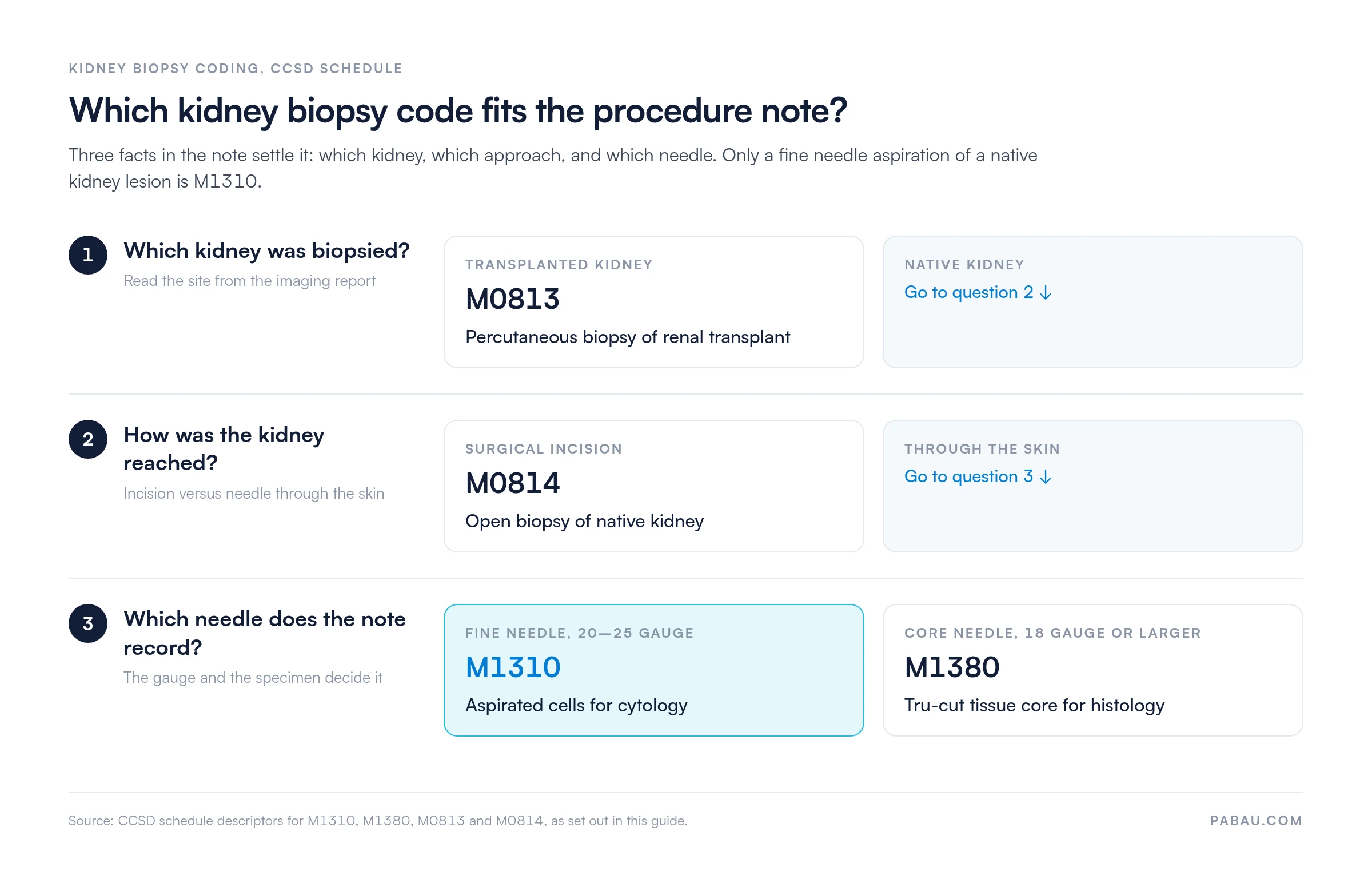
The table below compares M1310 with the adjacent kidney biopsy codes in the CCSD schedule. Always confirm the current descriptors in the CCSD schedule before billing.
Critical rule: If the procedure note records a core needle (e.g. an 18-gauge Tru-cut or biopsy gun), do not bill M1310. A tru-cut biopsy of a kidney lesion is M1380, and a biopsy of a transplanted kidney is M0813. Billing M1310 when a core biopsy was performed is a coding error that an insurer audit will pick up.
Before you select M1310, check the procedure note for the needle gauge and technique. A gauge of 18 or larger usually means a core needle, which is a different CCSD code. Fine needle aspiration uses a 20–25 gauge needle, produces cytology only, and is the only technique M1310 covers.
UK private insurers expect an ICD-10 diagnosis code alongside the CCSD procedure code. The code should reflect the clinical picture at the time of the biopsy, not the final pathology result. Before the biopsy the diagnosis is often uncertain, so an imaging-finding code is usually the right choice.
The WHO ICD-10 browser gives the official definition of each code below.
Avoid an unspecified code as the primary diagnosis when a more specific finding code exists. Insurers query claims where the diagnosis does not explain why a biopsy was needed.
R93.4 is usually the most defensible code before diagnosis, because it states the reason for the procedure: an imaging abnormality that needs characterization. For the wider set of kidney mass codes, see Pabau’s renal mass ICD-10 guide.
UK private insurers expect a planned procedure such as M1310 to be authorized before it takes place. The patient usually contacts their insurer, such as Bupa, AXA Health or Healix, with the CCSD code and the diagnosis. The insurer then issues an authorization or claim number.
A biopsy performed without authorization risks an unpaid claim, and insurers handle late requests in different ways. Confirm the insurer’s rules before the procedure date, because requirements differ by insurer and by policy.
Information insurers commonly ask for before authorizing M1310:
Keep the imaging reports and referral letter ready, because the insurer may ask for them. Online insurer guides are not always current, so confirm the checklist with the insurer directly.
Incomplete documentation is a leading cause of queried M1310 claims. The record must support every part of the CCSD descriptor. That means percutaneous (not open), fine needle (not core), biopsy (not drainage) and a lesion of the kidney confirmed by imaging.
A digital procedure note in your practice management software captures these details at the time of the procedure, not from memory afterward.
The patterns below are the most frequent reasons a UK insurer queries or rejects a kidney fine needle biopsy claim. Each one has a preventable root cause.
Run a monthly audit of your M1310 claims. Look for claims where a guidance code was billed but the authorization request did not include it. This single check catches most guidance rejections before the insurer does. Build the guidance code into your authorization checklist from day one.
M1310 is usually performed under local anesthetic, with or without sedation, as a day case. The anesthesia arrangement decides which other charges can be billed alongside it.
Check co-billing rules in the Healix fee schedule and the AXA Health procedure code portal. For Bupa, the Bupa fee schedule guide explains how Bupa sets its fee limits.
An M1310 claim depends on several pieces arriving together: the authorization number, the guidance code, the ICD-10 code and the cytology request. When those sit in email threads, insurer portals and spreadsheets, one missing piece holds up the fee.
Pabau’s claims management software keeps the authorization number, diagnosis code and claim status on the patient’s record. UK claims go out through Healthcode and BUPA, so your team can see which claims are paid and which need a resubmission.
For urology, nephrology or interventional radiology practices, the M1310 billing workflow usually follows these steps:
Your billing team spots a missing authorization number or guidance line before the claim goes out, so fewer M1310 claims come back for correction.

Pabau supports insurance billing and claims management, with UK claims sent through Healthcode and BUPA. See how specialist practices track authorization numbers and claim status for codes like M1310.

CCSD Code M1310 only holds up when the procedure note proves a fine needle aspiration of a kidney lesion. If the note records a core needle, the claim belongs under M1380, and a UK insurer will query it.
Secure authorization from the patient’s insurer before the biopsy, with the guidance code on the same request. Afterward, pair M1310 with R93.4 or the confirmed diagnosis, and record the needle gauge and passes.
Pabau sends UK insurance claims through Healthcode and BUPA and keeps every claim’s status in view. Book a demo to see how it fits your billing workflow for kidney biopsy codes.

Billing other CCSD codes for UK private insurers? Bupa CCSD billing guide covers how the CCSD schedule applies under Bupa’s fee structure and submission rules.
Coding a tru-cut biopsy of a kidney lesion? Pabau’s CCSD Code M1380 guide covers the core needle code that sits next to M1310.
Checking what Bupa pays for a CCSD code? Pabau’s Bupa procedure codes and fee schedule guide explains how Bupa sets its fee limits for CCSD procedure codes.
Looking to reduce claim rejections across all procedure codes? Claims management software outlines how Pabau handles claim submission, authorization tracking and resubmission.
Coding the diagnosis behind a kidney biopsy? Pabau’s ICD-10 renal mass codes guide covers the codes and documentation for a kidney mass found on imaging.
CCSD Code M1310 covers a percutaneous fine needle biopsy of a lesion of the kidney, which yields cytology specimens. It does not cover a tru-cut core biopsy of a kidney lesion, which is M1380, or an open biopsy, which is M0814.
Yes. Ultrasound or CT guidance is billed separately, not as part of the M1310 fee. List the guidance code on the insurer’s authorization request and on the claim. Guidance added only after the event is often rejected.
A fine needle biopsy (M1310) uses a 20–25 gauge needle to aspirate cells for cytology. A core needle biopsy uses an 18-gauge or larger cutting needle to remove a tissue core for histology. The two have different CCSD codes, and the needle gauge in the procedure note decides which one applies.
The most common mix-up is with M1380, the percutaneous tru-cut needle biopsy of a kidney lesion. Both are percutaneous, but M1380 takes a tissue core. M0813 covers a biopsy of a transplanted kidney, and M0814 covers an open biopsy of a native kidney.
Insurers commonly ask for the CCSD code, any guidance code, the ICD-10 diagnosis, the radiology report and the planned procedure date. The patient usually requests authorization, and the insurer issues an authorization number. Requirements differ by insurer and policy, so confirm them directly.
The most common reasons are a missing authorization number and an ICD-10 code that does not justify a biopsy. Others are image guidance billed without authorization and a procedure note that does not confirm the fine needle technique. A structured pre-submission checklist prevents each one.
Local anesthetic is part of the M1310 procedure and is not billed separately. If a consultant anesthetist provides sedation or general anesthesia, they bill the insurer separately, quoting the same CCSD code. Hospital facility charges are billed by the hospital, not under M1310.
R93.4, abnormal findings on diagnostic imaging of urinary organs, usually fits best before a diagnosis. It states the reason for the biopsy: an imaging abnormality that needs characterization. Once cancer is confirmed, use the specific code, such as C64 or C79.0.