CCSD Code M6530: Endoscopic resection of prostate (TUR)
CCSD Code M6530: Definition and clinical scope CCSD Code M6530 is the UK private...

Last Updated: Nov 6, 2026
28470 is the CPT code for closed treatment of metatarsal fracture; without manipulation, each. It covers a fracture of any of the five metatarsals that is immobilized in its presenting position, with no reduction or realignment.
The code is reported once per metatarsal treated and carries a 90-day global period. If the note documents manipulation, the correct code is 28475 instead.
Let Pabau's smart automation suggest the right codes, reduce claim denials, and keep your practice compliant—effortlessly.
Automate repetitive tasks and focus on what matters most—your patients.
Reduce coding errors and ensure compliance with the latest regulations.
Clean claims, fewer denials, and faster reimbursements.
Powerful insights and reporting to help your practice thrive.
HIPAA compliant SOC 2 certified GDPR-compliant Trusted by 4,000+ clinics worldwide

CPT code 28470 covers closed treatment of a metatarsal fracture without manipulation, reported once per metatarsal treated.
Documentation decides the code: any note language describing reduction or realignment moves the claim to CPT 28475.
CPT 28470 carries a 90-day global surgical period, and casting at the same session is bundled into the payment.
The 2026 national total is 7.10 RVUs in an office setting and 6.25 RVUs in a facility.
Pabau’s claims management software scrubs each claim for missing or invalid details before submission, so fewer 28470 claims come back denied.
CPT code 28470 reports closed treatment of a metatarsal fracture that needs no manipulation, once for each bone treated. The official descriptor reads: Closed treatment of metatarsal fracture; without manipulation, each. The American Medical Association (AMA) places it in the foot and toes fracture and dislocation range, 28400-28675. Its neighbors are 28475, with manipulation, and 28476, percutaneous skeletal fixation with manipulation.
Three terms in the descriptor carry precise clinical and billing meaning:
The word “each” is easy to overlook. If a patient fractures the second and third metatarsals and both are treated without manipulation in the same session, report CPT 28470 with two units. Check current National Correct Coding Initiative (NCCI) edits before billing multiple units, as payer-specific rules apply.
CPT 28470 applies to any of the five metatarsal bones, first through fifth. The descriptor simply reads “metatarsal fracture” and doesn’t differentiate by bone. The fifth metatarsal is the bone most often coded under 28470. Avulsion fractures at its base often present without significant displacement and are managed conservatively.
One code per bone is the governing billing principle, because each treated metatarsal fracture is a separately reportable service. The table below shows how multiple fractures at the same visit are handled:
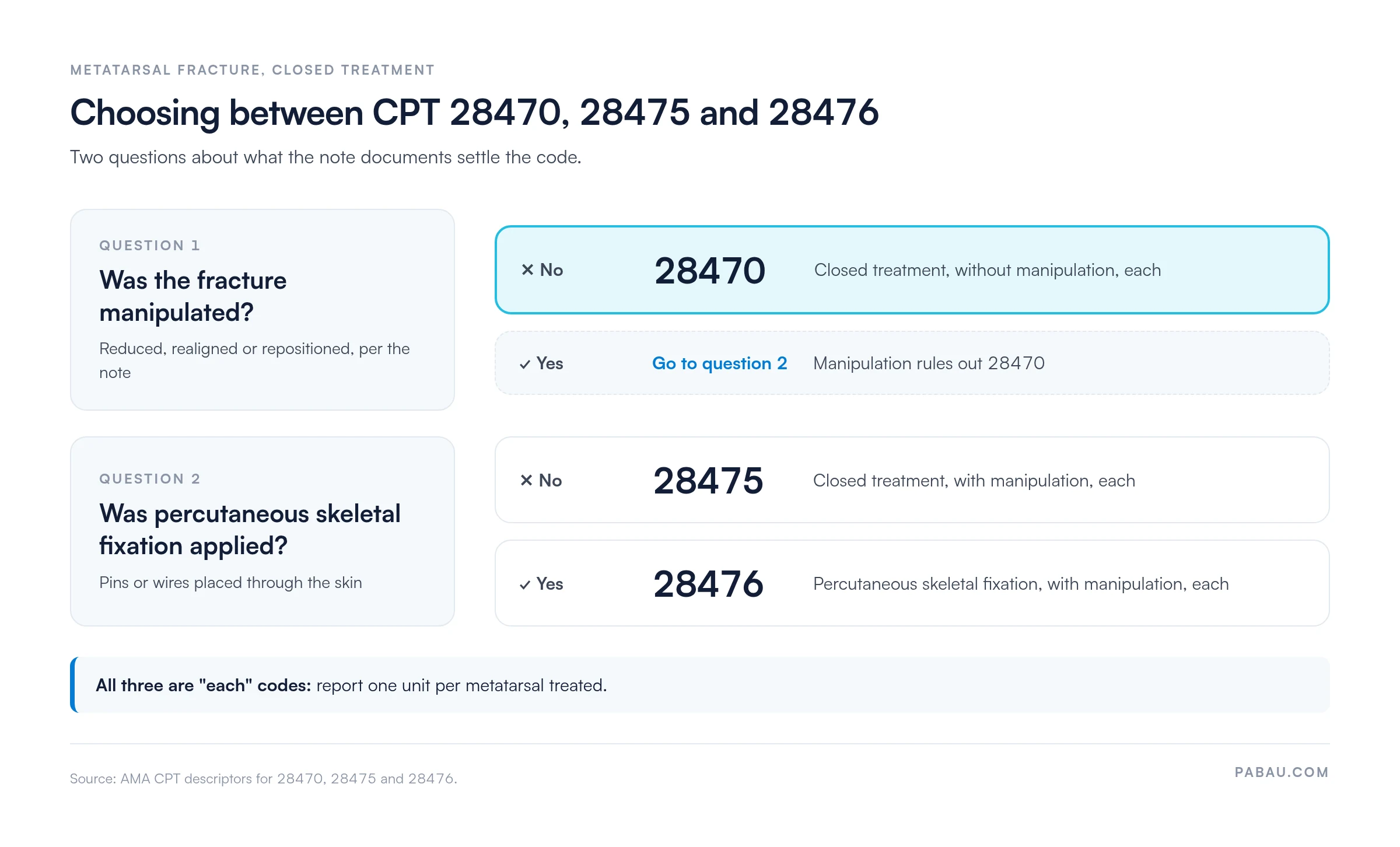
The split between CPT 28470, 28475, and 28476 turns on what the note documents. Whether the fracture was manually reduced decides 28470 versus 28475. Fixation only matters for 28476, the percutaneous skeletal fixation code, which always includes manipulation.
Coding errors here usually involve 28470 claims whose note contains phrases such as “fracture realigned,” “position corrected under fluoroscopy,” or “traction applied to restore alignment.” Any of those phrases documents manipulation, so 28475 is the correct code. When the note simply states “fracture immobilized in a short leg cast” or “boot applied, fracture non-displaced,” CPT 28470 stands. Run every note through the same two questions, in this order:
One injury pattern falls outside all three codes. If a metatarsal fracture comes with a tarsometatarsal dislocation that is reduced through an open incision, the procedure code is 28615 instead.
A CPT 28470 note must establish three clinical facts: the fracture is confirmed, no manipulation was performed, and which immobilization method was used.
Cast application doesn’t change code selection. Under CMS global surgery policy, casting and splinting performed at the same session as CPT 28470 are included in the global package. Separately billing a 29000-series casting code on the same date typically creates an NCCI conflict. Verify the current edit table annually, as bundling rules update each year.
Document the exact metatarsal number and laterality in every CPT 28470 note. Vague language like ‘foot fracture treated conservatively’ leaves the claim vulnerable at audit. Payers want to see which bone, which foot, and what was done, all in a single encounter note.
The primary ICD-10-CM code family for metatarsal fractures is S92.3-. Codes in this family specify laterality and displacement. A nonspecific or mismatched diagnosis code is a common reason CPT 28470 claims are denied.
Always apply the seventh character correctly: A for the initial encounter (active treatment), D for a subsequent encounter (routine healing), and S for sequela. Submitting an “A” code on a follow-up visit, or a “D” code at the initial treatment, is a common ICD-10 error on CPT 28470 claims. The CDC/NCHS ICD-10-CM web tool provides the current-year tabular list and a searchable index.
Modifier selection for CPT 28470 depends on laterality, whether multiple bones are treated, and the place of service.
CPT 28470 carries a 90-day global surgical period, assigned by CMS under global period indicator “090.” All routine postoperative care related to the fracture is bundled into the single CPT 28470 payment for 90 days after the procedure date.
What the global period includes, and what can still be billed separately, often causes confusion:
Tracking 90-day global periods by hand in a busy podiatry or orthopedic practice invites denials. Keep a list of every 28470 date of service with its day-90 end date, and check it before any E/M claim goes out. Making that check a fixed step in your medical billing workflow catches these errors before the payer does.
Medicare reimbursement for CPT 28470 is calculated with the Relative Value Unit (RVU) system under the Medicare Physician Fee Schedule (MPFS). The rate varies by year and by place of service. Facility rates are lower than non-facility rates because the facility bills its own costs separately.
These are the 2026 national RVUs from the CMS fee schedule file. Your payment multiplies them by your locality’s geographic practice cost index (GPCI) and the annual CMS conversion factor. Use the CMS Physician Fee Schedule lookup tool for current national and locality-adjusted rates. For a quick wRVU lookup, FastRVU’s free 2026 RVU lookup lists work, PE, and malpractice RVUs by code.
Commercial payer rates for CPT 28470 are set by contract and often expressed as a percentage of MPFS (for example, 115% of Medicare). Workers’ compensation rates follow each state’s own fee schedule and can’t be generalized. Practices billing 28470 to many workers’ compensation payers should check the applicable schedule with each state’s workers’ compensation board.
Most CPT 28470 denials follow a handful of repeatable patterns, so podiatry and orthopedic billing teams can check for each one before submission.
Effective denial management in healthcare starts with pre-submission claim scrubbing. Running CPT 28470 claims through validation checks before they reach the payer cuts avoidable denials. The clean claim standard, a claim with no errors at first submission, should be the target for every 28470 case.
When a 28470 claim is denied anyway, the remark code on the remittance tells you why. Our guide to medical billing denial codes explains CO-4, CO-97, and how to appeal them.
Run a quarterly audit of all CPT 28470 claims against your clearinghouse’s remittance data. Pull every denial with a CO-4 (modifier) or CO-97 (bundled service) remark code first. Both trace back to the modifier and bundling errors covered above, so fix the documentation or billing template behind them, not just the individual claim.
Usually not. Most commercial payers don’t require prior authorization for CPT 28470, because closed treatment without manipulation is widely considered medically necessary when imaging confirms the fracture. Medicaid managed-care plans and workers’ compensation carriers often set their own authorization rules, so don’t assume.
Before treating, verify benefits for the specific plan. Key questions to ask the payer’s provider services line:
Workers’ compensation billing for CPT 28470 requires a claim number from the employer’s carrier before services are rendered. State fee schedules apply rather than commercial rates. Some states also require documentation of work-relatedness, meaning a description of the injury mechanism that connects the metatarsal fracture to the workplace incident.
Podiatry and orthopedic practices billing CPT 28470 at volume juggle four risks on every claim. Manipulation language, the 90-day global period, bilateral modifiers, and ICD-10 laterality all land on the same claim. One error on any of them earns a denial or an audit flag.
Pabau, the practice management platform we build, keeps the treating provider’s notes and the claim on one patient record. Its podiatry claims management software scrubs every claim for missing or invalid details before it leaves Pabau. A claim that fails comes back flagged “Needs action,” with a link to the field that needs fixing.
Claims go out through Pabau’s Claim.MD integration as electronic CMS-1500 claims, reaching thousands of US payers. Real-time eligibility checks run from the patient record before the visit. Remittance advice flows back into the claims dashboard and is matched to the claim it settles. Our 837 file guide explains the electronic claim standard that clearinghouses work with.

Pabau scrubs every claim for missing or invalid details before submission. Your podiatry or orthopedic billing team fixes 28470 errors before a payer sees them, not after a denial.

CPT 28470 rewards the practice whose notes say plainly what was not done. Write “no reduction performed” alongside the bone and the foot, and the code holds up at audit. Leave it vague, and the payer ends up choosing between 28470 and 28475 for you.
The trade-off is a few extra words at the point of care. They cost the provider seconds and save the billing team a denial, an appeal, and weeks of rework inside the 90-day global period.
Start with your next five 28470 notes and check each one against the two coding questions above. Book a demo to see how Pabau keeps fracture notes and scrubbed claims on the same patient record.

Want to understand how clearinghouse submissions work? Medical claims clearinghouse guide explains how claims move from practice to payer and where errors are caught.
Billing multiple codes on the same date? Denial codes in medical billing covers CARC codes, CO-4, CO-97, and how to appeal common bundling denials.
Filling in a paper claim for a fracture visit? CMS-1500 form template shows where the CPT code, modifiers, units, and ICD-10 pointer go on the claim.
Treating a workers’ compensation or Medicaid patient? Prior authorization process walks through how to request approval before treatment and what payers ask for.
Coding fractures alongside other procedures? Medical coding cheat sheet puts common CPT, ICD-10, and modifier rules on one reference page.
CPT code 28470 covers closed treatment of a metatarsal fracture without manipulation, meaning no reduction or realignment of the fragments. The fracture is immobilized in its presenting position with a cast, boot, or splint. The code applies to any of the five metatarsals and is reported once per bone treated.
CPT 28470 is used when no manipulation is performed, and CPT 28475 when the provider manually reduces or realigns the fracture fragments. Any note language indicating reduction, realignment, or traction means 28475 applies. If percutaneous skeletal fixation is also placed, the code is 28476.
CPT 28470 carries a 90-day global surgical period. Routine postoperative care for the fracture, including follow-up visits, cast changes, and splint adjustments, is bundled into the original payment. Unrelated conditions or complications may be billed separately with the appropriate modifier.
The most common are -LT and -RT for laterality and -24 for an unrelated E/M visit during the 90-day global period. For both feet, Medicare typically expects a single 28470-50 line, while some commercial payers want separate -LT and -RT lines. A second metatarsal on the same foot is billed as a second unit. Add -59 only when 28470 is billed with 28475, or when the payer or an NCCI edit requires it.
Yes. Under CMS global surgery policy, casting performed at the same session as CPT 28470 is bundled and cannot be billed separately. Billing a 29000-series cast code on the same date typically triggers an NCCI edit denial. Q4001-Q4051-series casting supply codes may be separately reportable in some circumstances, so verify current NCCI edits annually.
Medicare pays CPT 28470 based on its RVUs, your geographic practice cost index (GPCI), and the annual CMS conversion factor. The 2026 national total is 7.10 RVUs in an office and 6.25 in a facility. Use the CMS Physician Fee Schedule lookup tool for your locality’s dollar rate.
Yes, but state fee schedules apply rather than Medicare rates. A claim number from the employer’s carrier is required before billing. Some states also require documentation of the injury mechanism connecting the fracture to the workplace incident. Verify the applicable fee schedule directly with the carrier.