HCPCS code V2599: Other type contact lens billing guide
What is HCPCS code V2599? HCPCS code V2599 is the Level II supply code for a con...

Last Updated: Oct 20, 2026
28615 is the CPT code for open treatment of tarsometatarsal joint dislocation, includes internal fixation when performed. Surgeons report it when they open the Lisfranc joint, reduce it under direct view, and hold it with screws, plates, or k-wires.
Fixation is bundled, so it never goes on its own line. The code carries a 90-day global period, and payment depends on three details: the open approach, a laterality modifier, and the right diagnosis pairing. The sections below cover each one, from the operative note to remittance.
Let Pabau's smart automation suggest the right codes, reduce claim denials, and keep your practice compliant—effortlessly.
Automate repetitive tasks and focus on what matters most—your patients.
Reduce coding errors and ensure compliance with the latest regulations.
Clean claims, fewer denials, and faster reimbursements.
Powerful insights and reporting to help your practice thrive.
HIPAA compliant SOC 2 certified GDPR-compliant Trusted by 4,000+ clinics worldwide

CPT code 28615 reports open treatment of a tarsometatarsal (Lisfranc) dislocation, and screws, plates, or k-wires placed in the same session are bundled in.
Closed treatment belongs to 28600 or 28605 and percutaneous pinning to 28606, so the approach in the operative note decides the code.
Pair 28615 with S93.324A, S93.325A, or S93.326A, and add an S92 code when a fracture comes with the dislocation.
A diabetic Charcot midfoot is coded to E08-E13 with .610, such as E11.610, while non-diabetic cases use M14.671 or M14.672.
The 90-day global period bundles routine follow-up, and a decision-for-surgery E/M visit on the day of or before surgery takes modifier -57.
CPT code 28615 is the code for open treatment of a tarsometatarsal joint dislocation, and it includes internal fixation when the surgeon places it. It sits in the musculoskeletal surgery section of the AMA CPT code set, among the foot and toe fracture and dislocation codes 28400 to 28675.
The official descriptor reads: Open treatment of tarsometatarsal joint dislocation, includes internal fixation when performed. Three conditions have to hold for the code to fit.
Start with the approach, because that’s where most selection errors begin. CPT code 28615 covers complete or partial tarsometatarsal dislocation, with or without a fracture, as long as the joint was opened.
The neighboring codes describe the same joint treated another way, or a different joint entirely. Picking the wrong one leads to downcoding or upcoding flags during claim review.
Open versus closed is the mistake payers catch most often. Billing 28600 or 28605 when the note describes an open approach undervalues the work. Billing 28615 when the note describes percutaneous pinning is an upcoding risk.
Fusion is a separate fork. If the surgeon prepares the joint surfaces and fuses them, the service becomes an arthrodesis. It is reported with 28730 for multiple joints or 28740 for a single joint. The decision path below walks through each fork in order.
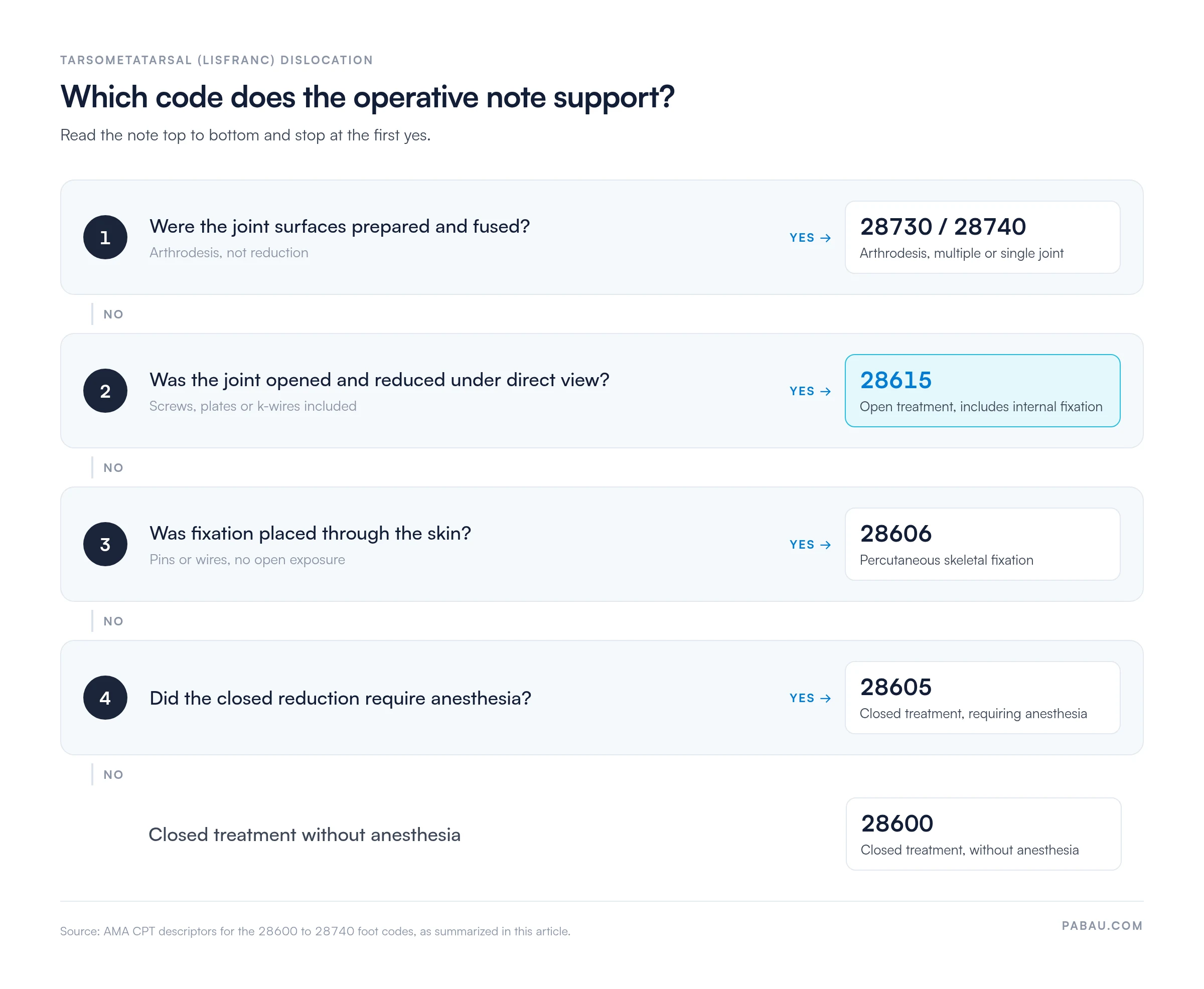
A clean 28615 claim starts in the operating room. Before the note reaches coding, check that it documents each of these elements.
Orthopedic and podiatric practices that template the operative note around these fields spend less time answering coder queries. They also send more claims out clean on the first pass.
The S93.32- subcategory covers subluxation and dislocation of the tarsometatarsal joint. Its dislocation codes are the standard primary pairing for 28615, and each one needs a laterality digit and an encounter character to be billable.
Separate Charcot arthropathy from a traumatic Lisfranc injury before you code. A diabetic patient with a collapsed midfoot may have a Charcot dislocation rather than a traumatic S93.32- injury. Code the diabetic Charcot foot to E08-E13 with .610, such as E11.610 for type 2 diabetes.
Reserve M14.671 or M14.672 for neuropathic arthropathy that isn’t caused by diabetes. Payers apply different medical necessity criteria to neuropathic and traumatic dislocations, so mixing them up leads to coverage denials.
No, the procedure code stays the same. When a tarsal or metatarsal fracture comes with the dislocation, 28615 is still correct as long as the surgeon openly reduces the dislocation.
What changes is the diagnosis coding. Report the S93.32- dislocation code and add the S92 fracture code alongside it. Don’t swap in a fracture-only code, because that removes the indication for 28615 and invites a medical necessity denial.
Charcot cases follow their own path. Use the E08-E13 .610 or M14.67- codes described above instead of the traumatic S93.32- codes. Mixing the two families on one claim is a reliable audit trigger. Before submission, confirm the claim carries every element of a clean claim.
Because 28615 is a major surgical procedure, the modifiers that matter cover complexity, laterality, multiple procedures, and staged work. Each one needs its own supporting documentation.
Commercial payers often review modifier -22 for medical necessity. Attach a short narrative letter that explains the anatomical complexity, the extra time, and why the standard descriptor understates the work. Claims sent with -22 and no supporting documentation are routinely downcoded on first pass.
Payment for 28615 reflects its status as a major open orthopedic procedure. Under the 2026 Medicare Physician Fee Schedule it carries about 10.43 work RVUs, and rates still vary by setting and locality (GPCI).
Check current figures in the CMS Physician Fee Schedule lookup tool before quoting a payment amount.
Once payment lands, reconcile the electronic remittance advice (ERA) against the contracted rate for each payer. Underpayments on high-value surgical codes slip through easily when posting is manual.
Most commercial payers cover open Lisfranc reduction when imaging confirms the dislocation and conservative care has been considered. Here is the path a typical claim takes, and the check that belongs at each step.
Some payers require authorization for elective stabilization, while acute traumatic dislocations usually go through as urgent requests. Have these ready either way.
The same handful of problems causes most 28615 denials. Each one traces back to a step in the walkthrough above.
When a denial does come back, the CARC code on the remittance shows where to start. Our guide to medical billing denial codes explains the common ones and how to respond.
High-volume orthopedic practices benefit from structured denial management workflows that track denial reasons by code and payer. That way the team fixes root causes instead of fighting one-off appeals.
CPT code 28615 carries a 90-day global surgical period under Medicare. Routine post-operative visits in that window are bundled into the surgical fee and can’t be billed separately.
Hardware removal after a Lisfranc ORIF is typically staged 4-6 months after surgery, once the joint is stable. Bill the removal with modifier -58 if it was planned and documented at the original surgery. If removal was unplanned because of symptomatic hardware, use modifier -78. Check whether the payer needs a separate prior authorization for it.
Lisfranc cases put a dense checklist on the billing team: operative note completeness, ICD-10 pairing, modifiers, prior authorization, and 90 days of global tracking. Centralizing those steps in one system cuts the rework for billing staff.
Pabau, the practice management platform we build, handles this cycle in its claims management software. Eligibility is checked before the date of service. Through the Claim.MD integration, claims route electronically to thousands of US payers, and electronic remittance advice (ERA) comes back for payment reconciliation.
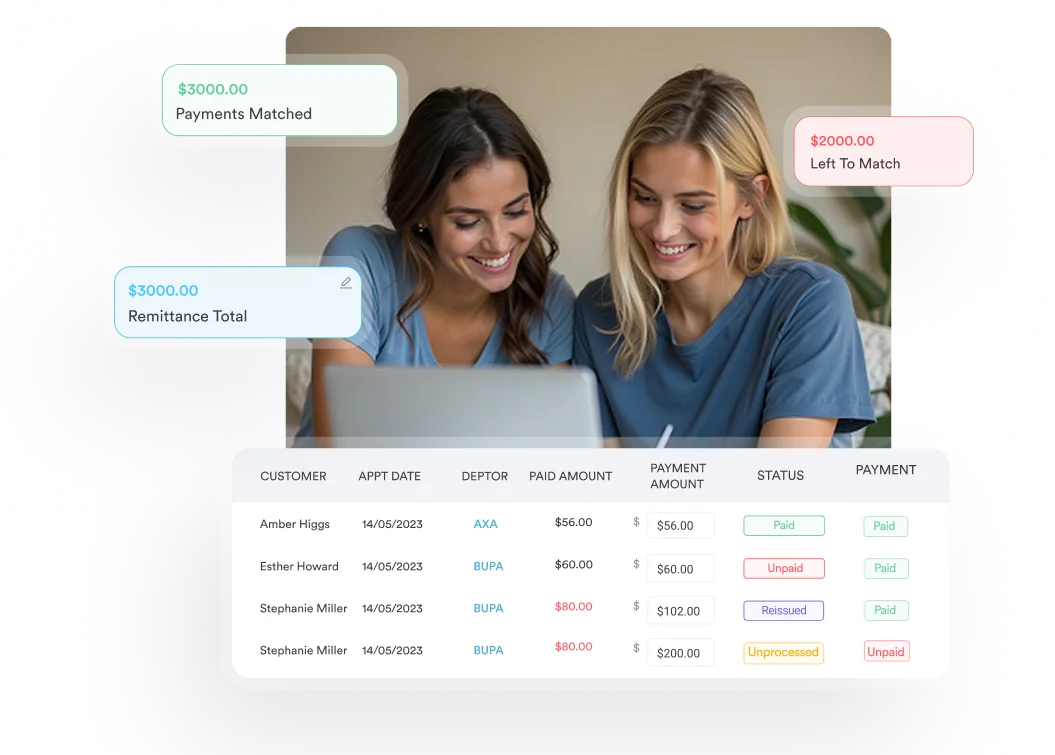
Denial tracking by CPT code and payer shows whether 28615 denials cluster around documentation, one payer’s modifier policy, or missed authorizations. Reviewing the fundamentals of medical billing and the compliance requirements for surgical billing helps you build workflows that hold up in payer audits.

Pabau connects clinical documentation, claims submission, and payment reconciliation in one platform. See how orthopedic and podiatric practices reduce claim denials and speed up reimbursement cycles.

Coding 28615 well comes down to one habit: let the operative note decide. If the note proves an open approach, names the hardware, and states the side, the code and modifiers follow without argument.
The trade-off is effort up front. Templating the note and confirming authorization before surgery take time, but they cost far less than chasing a suspended claim later.
To see how Pabau keeps Lisfranc claims, remittances, and denial trends in one place, book a demo with our team.

Need to decode a denial on a 28615 claim? Medical billing denial codes explains the most common CARC reason codes and how to respond to each one.
Posting surgical payments by hand? Electronic remittance advice (ERA) explains how to read 835 remittance files and reconcile payments against expected rates.
Want to see how RVUs turn into collected revenue? Revenue cycle management covers the end-to-end process from code selection to collected reimbursement.
Choosing a billing system for a surgical practice? Medical practice billing software compares the options for practices that submit their own claims.
No. When the surgeon prepares the joint surfaces and fuses them, the procedure is an arthrodesis. Report 28730 for multiple tarsometatarsal joints or 28740 for a single joint, and keep 28615 for open reduction without fusion.
Hardware removal is reported separately, usually with 20680 for removal of a deep implant. Inside the 90-day global period, add modifier -58 if the removal was planned at the original surgery. Use -78 for an unplanned return to the operating room.
Usually not. Fluoroscopy that guides and confirms the reduction is part of the procedure, so the surgeon doesn’t report it on its own line. Check NCCI edits if imaging served a separate purpose.
Medicare reimbursement for CPT 28615 is based on approximately 10.43 work RVUs, plus about 11.48 practice expense and 1.84 malpractice RVUs. The locality GPCI and the annual conversion factor set the final amount, so confirm it in the CMS lookup tool.
Yes. The descriptor includes internal fixation when performed, so screws, plates, and k-wires placed in the same session are never billed separately.