CPT Code 88346
CPT code 88346 is the billing code for immunofluorescence on a tissue specimen, ...

Last Updated: Nov 26, 2026
29425 is the CPT code for application of a short leg cast, below knee to toes, built as a walking or ambulatory type. It pays for the casting service itself, and Medicare gives it a zero-day global period.
The fact that matters most is who bills the fracture care. When the same provider bills it, the first cast is part of that package, and a separate 29425 line draws a bundling denial. The code stands alone for sprains, for casts applied while another provider manages the fracture, and for replacement casts. Below, you'll find the documentation, modifiers, 2026 RVUs and denial fixes that keep a walking cast claim paid.
Let Pabau's smart automation suggest the right codes, reduce claim denials, and keep your practice compliant—effortlessly.
Automate repetitive tasks and focus on what matters most—your patients.
Reduce coding errors and ensure compliance with the latest regulations.
Clean claims, fewer denials, and faster reimbursements.
Powerful insights and reporting to help your practice thrive.
HIPAA compliant SOC 2 certified GDPR-compliant Trusted by 4,000+ clinics worldwide

CPT code 29425 reports a short leg cast from below the knee to the toes, built as a walking or ambulatory type.
When the same provider bills fracture care, the first cast is included in that package, so 29425 isn’t billed separately.
29425 stands on its own for sprains, for casts applied while another provider manages the fracture, and for replacement casts.
Medicare’s 2026 fee schedule gives 29425 a 000-day global period, a work RVU of 0.78 and 2.42 total non-facility RVUs.
Payers commonly require RT or LT on lower-extremity casting claims, so check your payer’s policy and set it as a default.
CPT code 29425 reports the application of a short leg walking cast, running from below the knee to the toes. CMS’s January 2026 fee schedule file lists it with a 000-day global period and a work RVU of 0.78. The code pays for applying the cast, not for treating the injury underneath it.
The American Medical Association maintains the CPT code set. Its descriptor reads: Application of short leg cast (below knee to toes); walking or ambulatory type. The code sits in the lower extremity casting range, 29305-29450, inside the casts and strapping subsection (29000-29799).
The 29425 payment covers the cast application from start to finish. Other services from the same visit need their own lines, where they’re billable at all.
Included in CPT code 29425:
Billed separately, when payer rules allow:
Supplies and imaging each have their own codes. Cast supplies are reported with HCPCS Level II codes from the Q4001-Q4051 casting-supply range, and Q4037-Q4040 cover short leg casts. Many payers fold supplies into the casting payment, so check before you add them.
Imaging goes on its own line too, for example 73610 for a complete ankle series.
The 000-day (zero-day) global package means no follow-up days are bundled into 29425. Later visits to check the cast are billed as separate E/M services, unless a fracture-care global already covers them.
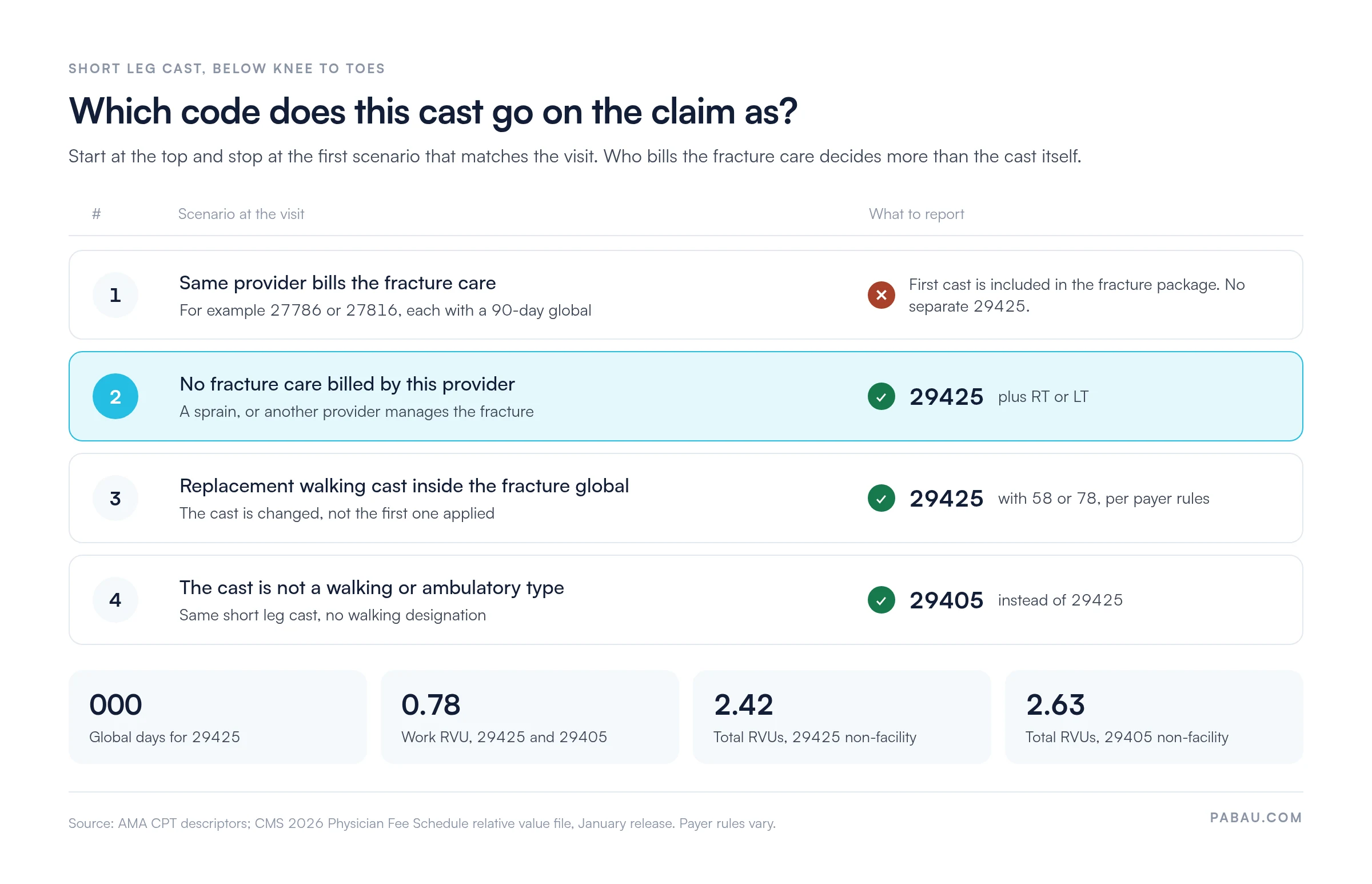
Most casting errors start with one question: who bills the fracture care? When the same provider bills the fracture treatment, the first cast is part of that service. Codes such as 27786 and 27816 carry a 90-day global, and the initial cast sits inside it.
Modifier 59 doesn’t change that. 29425 is billed separately in three situations instead:
The table below runs through the scenarios in order, so you can stop at the first one that fits the visit.
29425 fits when the treating provider decides the patient can bear weight in the cast. That call is clinical. Coders report what the note records and never make the decision themselves.
Common indications include stable ankle fractures, stable metatarsal fractures and ankle sprains that need rigid support. After foot or ankle surgery, a walking cast fits when the surgeon’s protocol allows weight bearing.
CPT 29405 describes the same short leg cast (below knee to toes), with no walking/ambulatory designation. The only descriptor difference is that 29425 adds walking or ambulatory type. So the note has to show the cast was built and ordered for walking.
One detail surprises many coders. Under the 2026 Medicare fee schedule, 29405 carries more non-facility RVUs than 29425, at 2.63 against 2.42. Billing the walking cast isn’t an upcode, then. A mismatch still creates audit exposure either way, because the code must match the cast the patient left with.
Miscoding inside the 29xxx family usually happens between casts and splints. A cast wraps the whole limb, while a splint supports only part of it, so the two aren’t interchangeable. The AAPC CPT code range lookup lists the full casts and strapping section.
Two neighbors cause frequent mix-ups. A 29445 total contact cast has its own code and isn’t a walking cast variant. Ankle tape strapping goes to 29540, not to any cast code.
Getting a clean claim out for 29425 depends on six details in the medical record.
Run a weekly check of 29425 claims returned with adjustment reason code CO-4 or CO-16. CO-4 points to a modifier problem, and CO-16 to missing information. Catching them early lets you correct and resubmit before the payer’s timely filing limit runs out.
Laterality comes first. Payers commonly require RT/LT on lower-extremity casting claims, so check your payer’s policy and make it a template default. The other modifiers depend on what else happened at the visit.
A casting claim passes through several hands, and each one can stall it. Here’s the usual path.
Most problems trace back to steps 2 and 3. When those are right, the rest is routine.
Medicare pays 29425 under the Medicare Physician Fee Schedule (MPFS). The CMS Physician Fee Schedule lookup tool shows rates by locality, because a geographic adjustment (GPCI) applies to each RVU component.
The 2026 file gives 29425 a work RVU of 0.78 and 2.42 total RVUs in the office. In a facility the total drops to 1.53, because the facility carries the overhead. At the general 2026 conversion factor of $33.4009, that’s about $80.83 non-facility and $51.10 facility before geographic adjustment.
Qualifying APM participants use a slightly higher factor of $33.5675. To cross-check figures for your locality, the FastRVU 2026 RVU lookup is a quick secondary source.
Private payer rates vary by contract. Compare each contract’s casting rates with the Medicare figures when you renegotiate. After payment, reviewing your electronic remittance advice helps you spot repeat underpayments across the 29xxx codes.
NCCI bundles a routine E/M into a same-day casting procedure. The evaluation that leads to the cast counts as part of 29425. The test for a separate E/M is whether the visit went beyond that decision.
Modifier 25 applies when the visit addresses a separate, significant problem. Picture an ankle fracture patient whose uncontrolled hypertension is also managed that day. The hypertension work is separately identifiable, so it goes on an E/M line with modifier 25.
The E/M stays bundled when the visit only covers the casting decision. Examining the injury, reviewing the X-ray and choosing a walking cast all belong to the casting service.
Write the separate E/M note so it stands on its own, rather than as a longer version of the fracture assessment. Auditors watch modifier 25 on procedure days closely.
Most 29425 denials repeat across orthopedic and podiatry practices, so you can fix them at the workflow level. Building denial management into the pre-submission check recovers revenue faster than reacting to EOBs.
Check your MAC’s local coverage articles and each payer’s casting policy before billing. Some set diagnosis, provider type and documentation rules on top of the general CMS guidance.
Many practices still build a casting claim by hand. Someone reads the note, keys the codes and modifiers, and later checks the remittance in a separate portal.
Pabau, a practice management platform with built-in medical billing software, keeps that work on one record. The CPT code on the service lands on the claim line, and ICD-10 codes come from the patient’s recorded problem list. Required claim fields must be complete before the claim can be sent.
Pabau supports US electronic claims through Claim.MD with eligibility checks and ERA remittances. Your billing team then sees eligibility, claim status and payments in one place.
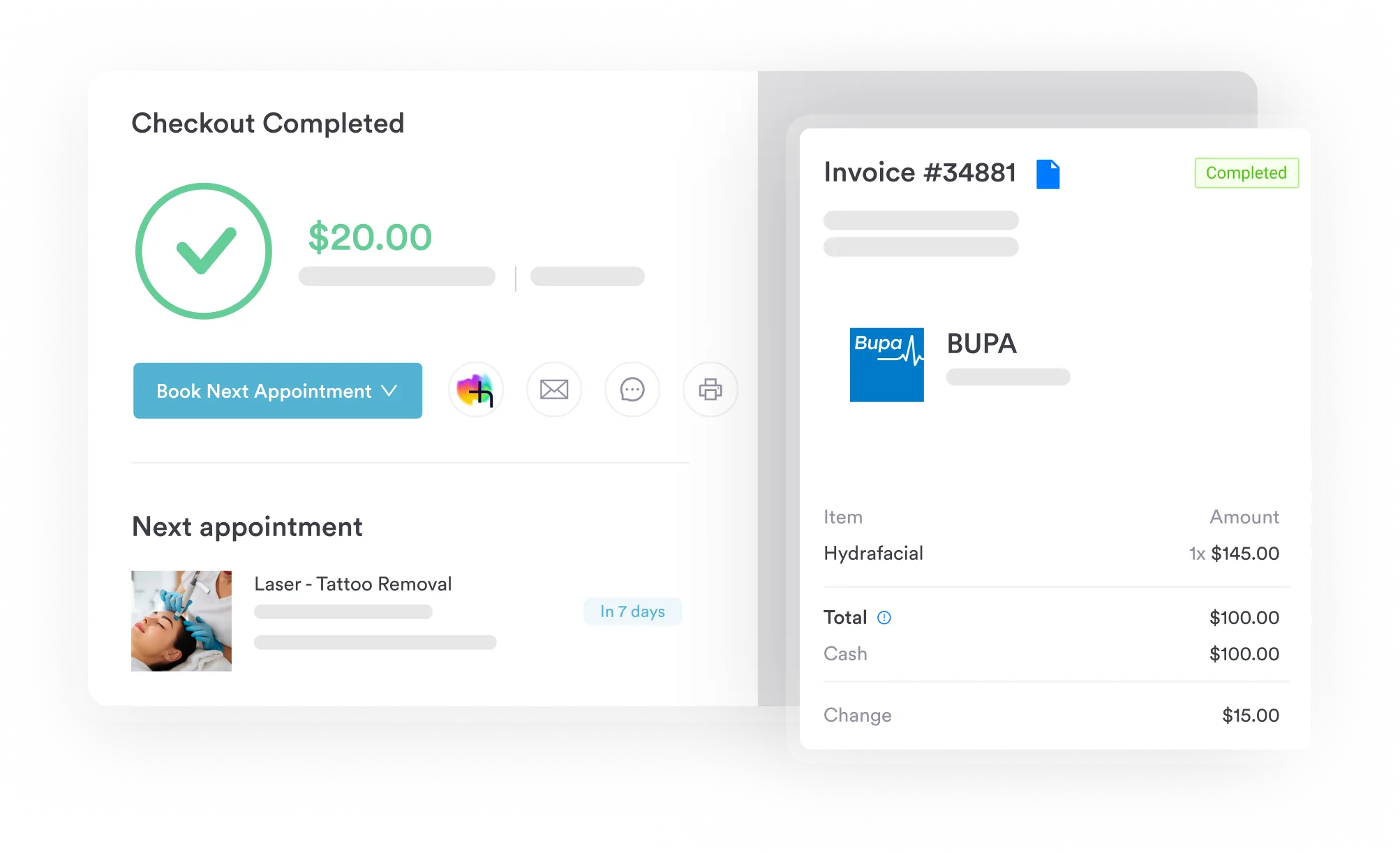

Pabau pre-fills claims from the patient record, checks required fields before sending and posts ERA remittances through Claim.MD. Your team tracks every casting claim in one place.

The walking cast is rarely what sinks a 29425 claim. The bigger risk is the fracture-care question that comes before it. Settle who bills the fracture, and the code choice mostly makes itself.
From there, keep the habits simple. Ask providers to write walking cast with a weight-bearing order, and set RT or LT as a template default. Treat each replacement cast as its own case with the right modifier.
Pabau’s claims management sends electronic claims through Claim.MD and posts remittances, so your team tracks claims in one place. Book a demo to see how it follows a casting claim from submission to remittance.

Need to understand how claims get from your EHR to the payer? How Claim.MD clearinghouse works explains the electronic submission process for orthopedic and casting claims.
Seeing repeat denials across your casting codes? Denial codes in medical billing breaks down CARC and RARC codes so your team can action remittances faster.
Coding an upper-limb cast next? CPT code 29075 covers short arm cast billing, RVUs and modifiers.
Casting the hand and lower forearm? CPT code 29085 explains gauntlet cast billing.
No. A prefabricated walking boot isn’t a cast, so 29425 doesn’t apply. It’s supplied as durable medical equipment and billed with a HCPCS L code, such as L4361 for a pneumatic walking boot.
Only when a different provider applied the cast. Removing a cast you applied is part of the original application. CPT’s cast removal codes, 29700-29710, are for casts applied elsewhere.
Yes, the professional payment is lower. Medicare’s 2026 file gives 29425 2.42 total RVUs in an office and 1.53 in a facility, where the facility covers the overhead.
Yes, when the cast is replaced. Each new walking cast is a new application. Inside a fracture-care global, add modifier 58 or 78 as your payer requires, and document why the cast was changed.
Only when the E/M is significant and separately identifiable from the casting decision. Put modifier 25 on the E/M line, and make sure the note documents the separate problem.