HCPCS code S0162: Medroxyprogesterone acetate injectable contraceptive
HCPCS code S0162 is the Level II code for medroxyprogesterone acetate 150mg inje...

Last Updated: Nov 13, 2026
28450 is the CPT code for treatment of a tarsal bone fracture (except talus and calcaneus) without manipulation, reported once for each fractured bone. It covers the cuboid, the navicular and the three cuneiforms when the fracture is immobilized without reduction.
Code selection turns on three facts in the note: which tarsal bone broke, whether the clinician manipulated it, and how many bones were treated. A reduction moves the claim to 28455, and a talus fracture belongs in the 28430 series. The code carries a 90-day global period.
Let Pabau's smart automation suggest the right codes, reduce claim denials, and keep your practice compliant—effortlessly.
Automate repetitive tasks and focus on what matters most—your patients.
Reduce coding errors and ensure compliance with the latest regulations.
Clean claims, fewer denials, and faster reimbursements.
Powerful insights and reporting to help your practice thrive.
HIPAA compliant SOC 2 certified GDPR-compliant Trusted by 4,000+ clinics worldwide

CPT Code 28450 applies only to the cuboid, navicular and three cuneiforms. Talus fractures use the 28430 series, and calcaneus fractures use the 28400 series.
Without manipulation is the deciding qualifier. If the clinician reduced the fracture, bill 28455 instead, because the two codes are mutually exclusive.
A 90-day global surgical package applies. Follow-up visits, cast changes and splint removal in that window are bundled, so billing them separately draws a denial.
Pair 28450 with a laterality-specific S92.2 code, such as S92.211A for a displaced fracture of the right cuboid, initial encounter.
Pabau, our practice management platform, submits 28450 claims through Claim.MD, runs eligibility checks and brings ERA remittances back with their denial codes.
CPT Code 28450 reports treatment of a cuboid, navicular or cuneiform fracture when the clinician does not manipulate the bone. It is billed once for each fractured bone. The AMA maintains the CPT code set through its CPT Editorial Panel. The code sits in the Musculoskeletal System section, under Foot and Toes, among the fracture and dislocation codes 28400-28675.
The official descriptor reads: 28450: “Treatment of tarsal bone fracture (except talus and calcaneus); without manipulation, each”.
Three elements of that descriptor carry billing weight. First, “tarsal bone fracture (except talus and calcaneus)” defines the anatomical scope. Second, “without manipulation” sets the procedure type and separates this code from 28455. Third, “each” means each bone, so a fracture of a different tarsal bone takes an additional unit of 28450, subject to NCCI edits.
The foot contains seven tarsal bones. CPT Code 28450 applies to five of them:
The descriptor excludes the talus and calcaneus by name. Talus fractures use the 28430 series. Calcaneus fractures use the 28400 series, which runs up to open repair under 28415. Billing 28450 for either bone is a code-selection error that draws a denial, or a recoupment demand after a post-payment audit.
The 90-day global package for CPT Code 28450 bundles most of the fracture care that follows the first visit. These services are included:
These services are not included and can be billed separately:
Manipulation changes the code. If the treating clinician reduces the fracture during the encounter, CPT Code 28450 no longer applies, and the correct code becomes 28455. Billing 28450 after a reduction understates the work and can be flagged as under-coding in an audit. Billing 28450 when no manipulation took place is a supported claim.
Treatment starts with a confirmed fracture diagnosis, usually from plain radiographs of the foot in AP, lateral and oblique views. The clinician assesses alignment, displacement and stability. Where alignment is acceptable for conservative care, the decision to treat without manipulation is made and recorded in the encounter note.
Immobilization comes next. Depending on the bone, the fracture pattern and the patient’s activity level, that means a cast, a posterior splint or a controlled ankle motion boot. The patient leaves with weight-bearing instructions and a follow-up plan, and that follow-up care is bundled into the 28450 payment for 90 days.
Payer auditors reviewing 28450 claims look for specific elements, and missing any one of them is enough for a denial or recoupment. Check the note for each of these before submission:
Incomplete documentation causes more 28450 denials than any other single problem. A claim with “foot fracture” in the diagnosis field and no imaging reference is unlikely to survive an audit. A clean claim submission depends on the clinical note and the claim form telling the same story.
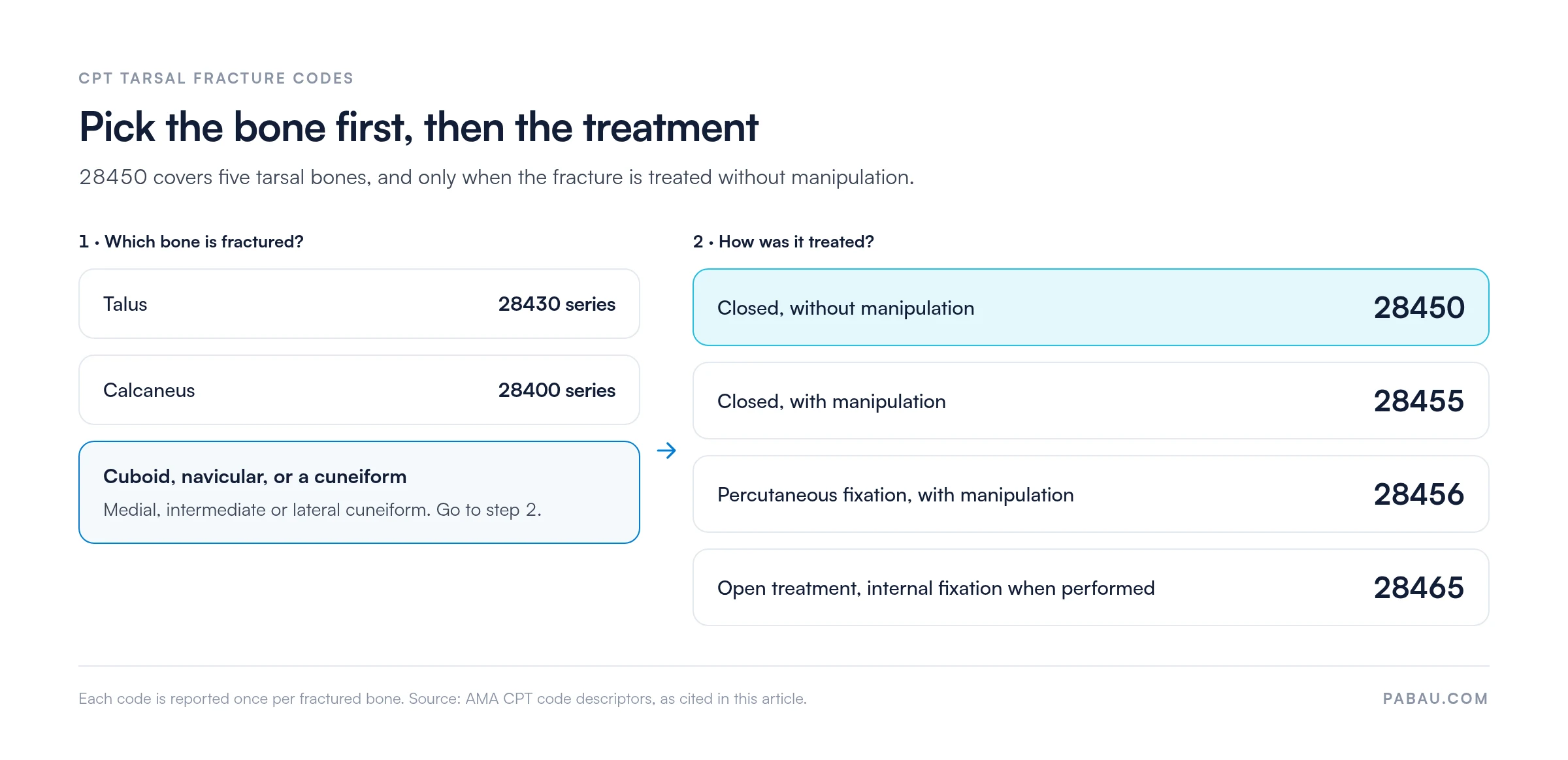
CPT Code 28450 sits within a cluster of foot and tarsal fracture codes. A wrong selection usually comes down to two variables: which bone was fractured, and whether manipulation was performed. The table below maps the adjacent codes billers confuse most often.
The two most common confusion pairs are 28450 vs. 28455 (the manipulation question) and 28450 vs. 28430 (the bone question). Both come down to documentation, because the encounter note must state which bone broke and whether reduction was performed. The diagram below puts the two questions in order, bone first and treatment second.
For procedures beyond the foot, the CPT code reference library lists each code with its own billing guide.
Pairing CPT Code 28450 with a non-specific ICD-10-CM code is a common denial reason. Payers require the correct laterality and encounter type, and an unspecified code where a specific one exists triggers medical necessity review.
The relevant codes fall in category S92 (fracture of foot and toe, except ankle). In tarsal codes the 6th character carries laterality, so none uses an “x” placeholder:
The table lists displaced forms. A nondisplaced fracture takes 4 (right) or 5 (left) as the 6th character, such as S92.214A for the right cuboid.
The encounter character matters. The first treatment uses “A”, subsequent encounters during active healing use “D”, and sequela use “S”. A follow-up visit billed with “A” inside the global period triggers review.
CPT Code 28450 carries a 90-day global surgical period under CMS policy, starting on the date of the fracture treatment encounter. Routine follow-up visits, cast changes and splint removal within that window are bundled into the global package. Billing them separately generates a denial under the global surgery policy.
The CMS Physician Fee Schedule governs Medicare payment rates, which vary by geographic payment locality. For CY2026, 28450 carries a work RVU of 1.98, with total RVUs of 6.93 in a non-facility setting and 5.82 in a facility setting. That puts the national non-facility payment at about $231 before GPCI adjustment, inside a typical $200-$280 range. MPFS values change every year, so check your MAC locality for the adjusted rate.
Revenue cycle teams can record the 28450 global period end date on the superbill and in their billing calendar. Any encounter scheduled within the window then gets a bundling review before a separate claim is generated.
Track global period end dates for every 28450 encounter as a calendar event in your billing system. Set a review flag 5 business days before the window closes. That gives the team time to decide whether a scheduled follow-up falls inside the bundled package or can be billed separately.
Modifier selection for CPT Code 28450 affects both payment accuracy and claim acceptance. A wrong or missing modifier triggers either a denial or an incorrect payment amount.
Bilateral billing note: modifier 50 tells a payer that the same procedure was performed on both feet on the same date. Medicare and most commercial payers accept it for 28450 when bilateral fractures occurred together. Some payers require two line items (28450-LT and 28450-RT) instead. Never apply modifier 50 by default, and check the payer’s billing manual before submitting.
Medicare does not require prior authorization for CPT Code 28450. The claim is processed under Local Coverage Determination (LCD) policies issued by each Medicare Administrative Contractor (MAC). These policies set the medical necessity criteria the documentation must satisfy. Because LCDs vary by MAC jurisdiction, identify your MAC and review its current LCD for fracture care.
Commercial payers are less predictable. Some require prior authorization for non-emergency fracture care beyond the initial encounter, particularly when the injury did not come through an emergency department. Verify authorization requirements with each patient’s payer before a planned follow-up visit that might be billed outside the global period.
Whatever the payer, the office note for CPT Code 28450 should contain these elements:
Notes that read as generic fracture templates, without bone-specific findings, are a primary target in post-payment audits.
Most CPT Code 28450 denials trace back to one of six root causes, and each has a specific fix. Effective denial management workflows begin by grouping remittance codes, so patterns surface quickly instead of claim by claim.
Run a quarterly audit on your 28450 claims. Pull every denied claim and group it by remittance code. Then decide whether the top reason is documentation (missing imaging, unspecified ICD-10) or billing (unbundling, missing modifier). Documentation failures need a clinical workflow fix, while billing failures need a scrubber rule update.
The six denial causes above start where the clinical note meets the claim. Podiatry and orthopedic practices billing 28450 at volume often move that information by hand, from the note to a spreadsheet to the claim form.
Pabau, the practice management platform we build, sends US claims as CMS-1500 or 837P files through Claim.MD. The front desk runs the patient’s eligibility check before the visit, so coverage is confirmed before the fracture is treated. Our claim submission software also handles secondary claims from the same record.
Electronic remittance advice (835 ERAs) brings denial reason codes back from the payers Claim.MD supports. That gives the medical billing team the CARC data it needs to work 28450 denials without re-keying them. Reviewing those patterns alongside the AAPC’s CPT coding resources shows which errors keep coming back.

Pabau sends 28450 claims through Claim.MD, runs eligibility checks and brings ERA remittances back with their denial codes. Your billing team works each denial from the codes the payer returns.

Code 28450 only when the note shows three facts together: a cuboid, navicular or cuneiform fracture, no manipulation, and one unit per bone. If one of them is missing, fix the note or change the code before the claim goes out. No modifier rescues a claim that names the wrong bone or skips a documented reduction.
The 90-day global package is where correctly coded 28450 claims still lose money. Set the end date on day one, and send nothing routine to the payer before it passes.
Book a demo to see how Pabau takes a fracture care claim from eligibility check to ERA through Claim.MD.

Need to understand how clearinghouse submission works for fracture claims? Claim.MD clearinghouse overview explains the end-to-end electronic claim submission and ERA process.
Seeing recurring denials you can’t explain? Denial codes in medical billing maps the most common CARC codes to actionable remediation steps.
Want to understand the 837 file format for electronic claims? 837 file overview explains the EDI transaction set that carries your CPT and ICD-10 data to payers.
Coding a heel fracture that needed surgery? CPT code 28415 covers open treatment of a calcaneal fracture.
CPT Code 28450 covers treatment of a tarsal bone fracture without manipulation, excluding the talus and calcaneus. It is reported once for each fractured bone. The five eligible bones are the cuboid, navicular, medial cuneiform, intermediate cuneiform and lateral cuneiform. The code includes a 90-day global package covering initial treatment and routine follow-up.
CPT 28455 is used when the clinician manipulates the fracture, performing a closed reduction to reposition the bone fragments. It covers the same eligible tarsal bones. CPT Code 28450 is used when no manipulation was performed. The two codes are mutually exclusive, so the documentation must state clearly whether manipulation occurred.
No. CPT Code 28450 specifically describes treatment without manipulation. Performing manipulation changes the correct code to 28455. If the clinical note shows manipulation was performed but 28450 is billed, the claim carries a documentation-to-code mismatch that an audit can identify.
CPT Code 28450 carries a 90-day global surgical period. All routine follow-up visits, cast changes and immobilization removal within that 90-day window are bundled into the original payment. Billing these services separately during the global period results in denial under the global surgery policy.