CCSD Code C1540: Surgical correction of trichiasis and upper lid entropion
CCSD Code C1540: Definition and official descriptor CCSD Code C1540 is the Clini...

Last Updated: Nov 16, 2026
Billable Code
28645 is the CPT code for open treatment of metatarsophalangeal joint dislocation, with or without internal or external fixation. It applies when the surgeon opens the joint and reduces the dislocated toe under direct vision, at any of the five MTP joints.
The AMA places 28645 in the Musculoskeletal System section of CPT, within the 28400-28675 range for fracture and dislocation procedures on the foot and toes. Medicare assigns it a 90-day global surgery period, so routine follow-up visits in that window are paid within the surgical fee.
Let Pabau's smart automation suggest the right codes, reduce claim denials, and keep your practice compliant—effortlessly.
Automate repetitive tasks and focus on what matters most—your patients.
Reduce coding errors and ensure compliance with the latest regulations.
Clean claims, fewer denials, and faster reimbursements.
Powerful insights and reporting to help your practice thrive.
HIPAA compliant SOC 2 certified GDPR-compliant Trusted by 4,000+ clinics worldwide

CPT code 28645 describes open reduction of a dislocated metatarsophalangeal joint, distinct from closed codes 28630 and 28635 and percutaneous code 28636.
A 90-day global surgery period applies, so routine post-op visits in that window are bundled and cannot be billed separately.
Laterality modifiers (-LT or -RT) are required by most payers, and a missing one is among the top denial triggers for this code.
The matching diagnosis comes from the S93.12x series, coded to the toe and the side the operative note names.
Pabau, the practice management platform we build, sends US claims through Claim.MD and warns staff when a case is missing its prior authorization code.
CPT code 28645 covers open treatment of a dislocated metatarsophalangeal (MTP) joint, with or without internal or external fixation. The AAPC code reference files it under fracture and dislocation procedures on the foot and toes, codes 28400 to 28675. The surgeon makes an incision, exposes the joint, and reduces the dislocation under direct vision. A closed or percutaneous reduction does not qualify for this code.
Procedures included within the global payment for CPT code 28645 are listed below. Each item on this list should be reflected in the operative note, because payers audit for bundled services billed separately.
The MTP joints covered by CPT 28645 include the first through fifth toes. The code is not joint-specific within the MTP series. The operative note must still name which toe or toes were treated and document laterality (left or right foot).
Use this table to confirm you have the right code before building the claim. It sets the descriptor and code range alongside the billing attributes coders check most often.
Knowing what CPT code 28645 does not cover prevents unbundling errors and claim audits. The following services either have their own CPT codes or are explicitly excluded from this code’s reimbursement scope.
A contracted or subluxated MTP joint that is released rather than reduced takes a different code. Capsulotomy of the MTP joint is reported with CPT 28270, which is coded per joint.
The surgical approach decides which code applies. An open incision, a percutaneous pin, and a closed manipulation each have their own code, and anesthesia splits the closed MTP codes in two. The decision path below follows that order, and it also shows where the 90-day global period begins.
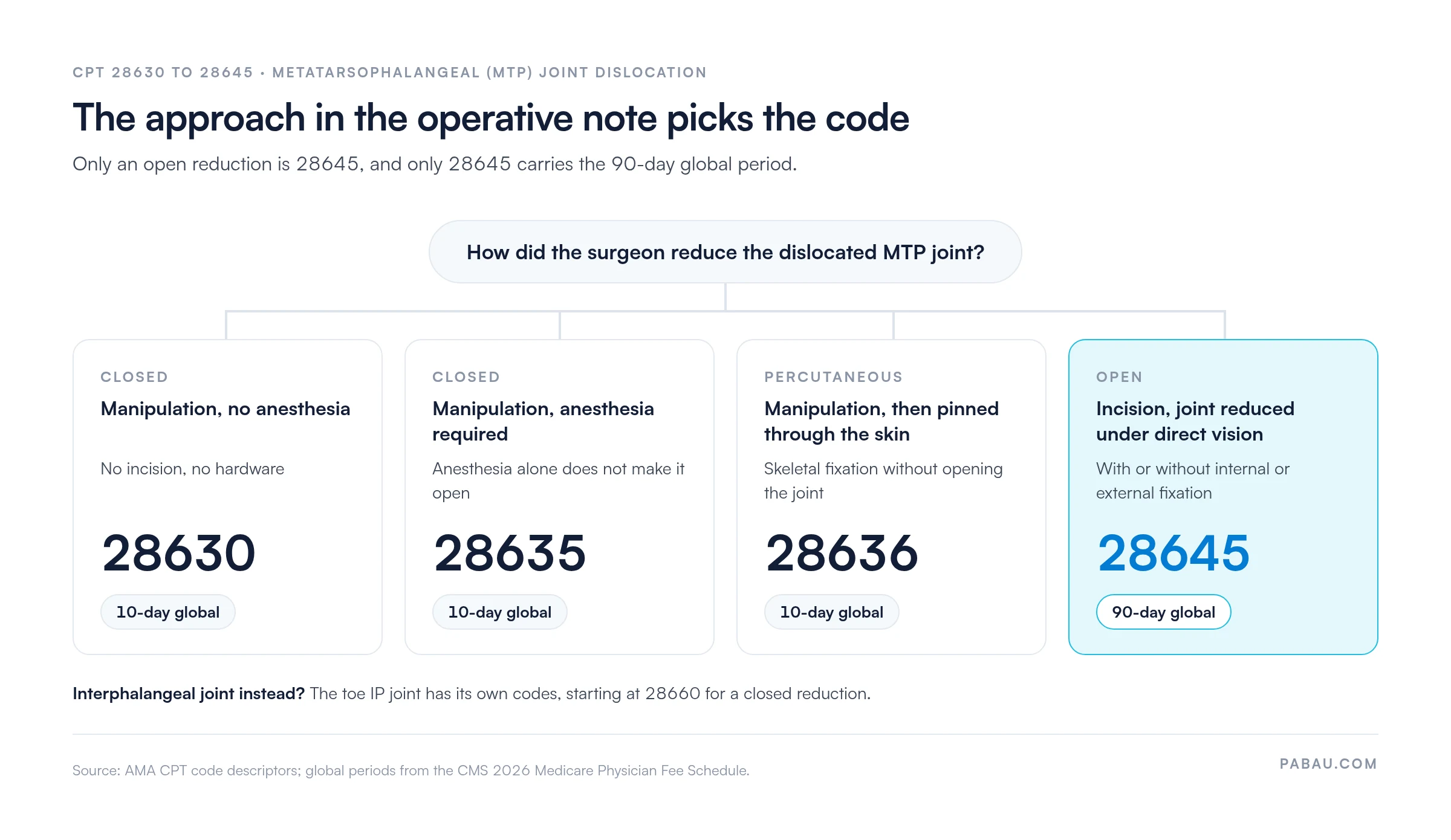
The most common upcoding audit flag on this code set is a closed-reduction operative note paired with CPT 28645. Payers and RAC auditors look specifically for the word “incision” or “open exposure” in the operative report. If those terms are absent, expect a denial or recoupment request.
The ICD-10-CM S93.12x subcategory covers dislocation of the MTP joint, with separate codes for the great toe and the lesser toes on each foot. Pairing the wrong diagnosis code, or an unspecified side when the note names one, is a leading medical-necessity denial trigger for CPT code 28645. When the note points to a diagnosis outside this table, search our ICD-10-CM code library for its exact descriptor.
Use the AAPC’s CPT-to-ICD-10 crosswalk to verify that your chosen diagnosis code has an established medical-necessity link to CPT 28645 before submission. Payers run automated crosswalk edits, and a mismatched pair triggers an automatic denial rather than a human review.
Always code to the highest specificity the operative note supports. If the surgeon documented ‘left first MTP joint,’ use S93.122A, not an unspecified code. Using an unspecified code when a specific one is available can trigger a documentation deficiency audit even when the claim pays on first submission.
Modifiers signal to payers that a code is being reported under conditions that differ from its standard description. For CPT 28645, laterality and bilateral reporting account for most modifier questions coders face.
Confirm the modifier policy with your MAC before submitting, particularly for bilateral claims. Jurisdiction-level local coverage determinations (LCDs) can override standard CMS guidance on how -50 is reported. A commercial CPT code database such as AAPC Codify can help verify current modifier indicators by payer.
Payers and Medicare auditors compare the operative note against a checklist before approving CPT code 28645. A clean claim submission for this code requires the operative report to contain each of the following elements explicitly, not by inference.
For surgical superbill documentation, include the CPT code, the ICD-10-CM code(s), the date of service, and the operating surgeon’s NPI. Add the place of service too: 21 for an inpatient hospital, 22 for an on-campus outpatient hospital, or 24 for an ambulatory surgical center. Incomplete superbills trigger manual review delays even when the operative note itself is complete.
Prior authorization for CPT 28645 depends on payer class and plan type. No universal rule applies, so verify the requirement before scheduling surgery. Understanding medical billing fundamentals for surgical procedures helps staff identify which payers require pre-approval and what clinical information they need to submit.
When authorization is required, document the authorization number on the claim. Claims submitted without an auth number for plans that require one are denied on first submission. They are rarely overturned on appeal without documented proof of an auth request.
CMS updates the Medicare Physician Fee Schedule (MPFS) each November for the following calendar year. The figures below are the 2026 national RVU values, before geographic adjustment. Always verify the current year’s rates using the CMS Physician Fee Schedule lookup before quoting rates to patients or setting contractual benchmarks. Rates vary by geographic locality, and the conversion factor changes annually.
*Payment approximations are based on published RVU values and the 2026 conversion factor. Actual payments vary by geographic practice cost index (GPCI) and locality. Use the FastRVU lookup tool for locality-adjusted payment calculations.
CPT 28645 carries a 90-day global surgery period (CMS indicator 090). Routine follow-up services related to the procedure are bundled into the surgical fee for 90 days after the operation. A standard office visit billed for a routine wound check or suture removal in this window will be denied unless a recognized exception applies.
Most denials on CPT code 28645 are preventable. The table below pairs each common denial reason with its corrective action, drawn from the patterns that surface in denial management workflows for musculoskeletal procedures. Maintaining medical billing compliance for surgical codes requires a pre-submission checklist that covers every row below.
Run a pre-submission audit on every CPT 28645 claim. First, confirm the operative note says ‘open exposure’ or equivalent. Second, verify the laterality modifier matches the note. Third, check the PA auth number is on file. Fourth, cross-reference the S93.12x code with the specific toe and side documented. Catching all four before submission heads off most of the denial reasons in the table above.
In many orthopedic and podiatry practices, prior authorizations live in a spreadsheet and 28645 claims are keyed by hand from the operative note. The auth number can drop out somewhere between scheduling and billing, and the claim then leaves without it.
In Pabau, the authorization code, its dates, and the approved sessions are recorded on the patient’s case. Staff see a warning when a case has no auth code, before the claim is built. US claims then go out as CMS-1500/837P files through end-to-end claims management connected to the Claim.MD clearinghouse.

Pabau tracks prior authorization codes on each case and sends CPT 28645 claims through Claim.MD with eligibility checks and ERA remittances. See how it fits an orthopedic or sports medicine practice.

CPT code 28645 rewards the coder who reads the operative note before the pre-op sheet. If the note says incision and names the toe and the side, the code, the S93.12x diagnosis, and the laterality modifier all follow from it. If it doesn’t, an addendum from the surgeon costs far less than an appeal.
The second habit is administrative. Confirm the payer’s prior authorization rule when the surgery is booked, and keep the auth number on the case so it reaches the claim. Book a demo to see how Pabau keeps the authorization and the 28645 claim on one record for your foot surgery patients.

Looking for a smarter way to manage medical claims? Claims management software from Pabau covers Claim.MD submission, eligibility checks, and ERA remittances in one workflow.
Need to understand how clearinghouse submission works? Medical claims clearinghouse explains how payers, clearinghouses, and practices exchange claim data electronically.
Getting denials with CARC codes you don’t recognize? Denial codes in medical billing breaks down the most common CARC and RARC codes and what they mean for resubmission.
CPT code 28645 covers open reduction of a dislocated metatarsophalangeal (MTP) joint, with or without internal or external fixation. It includes joint exposure, reduction under direct vision, any K-wire or pin fixation, and wound closure. It applies when the surgeon makes an incision and sees the joint directly, unlike closed codes 28630 and 28635.
CPT 28630 describes closed reduction of an MTP joint dislocation without anesthesia. CPT 28645 describes open reduction through an incision, with the joint reduced under direct vision. If the surgeon incises the skin, it is 28645. If manipulation alone reduces the joint, it is 28630, or 28635 when anesthesia is required.
The S93.12x series (dislocation of metatarsophalangeal joint) is the primary ICD-10-CM pairing for CPT 28645. Use S93.121A for the right great toe and S93.122A for the left great toe on the initial claim. For the lesser toes, use S93.124A (right) or S93.125A (left). Always code to the most specific toe and side the operative note documents.
CPT 28645 carries a 90-day global surgery period (CMS indicator 090). Routine post-operative visits, suture removal, and standard cast changes within those 90 days are bundled into the surgical fee. A return to the operating room for a complication is billed with modifier -78. Care for an unrelated condition takes modifier -24 for E/M services or -79 for surgical services.
Most payers and MACs require the laterality modifiers -LT (left) and -RT (right). Modifier -50 applies when both feet are treated at the same session, and Medicare pays bilateral claims at 150% of the unilateral rate. Modifier -59 marks a distinct procedure at a separate anatomical site in the same session. Modifier -78 covers a return to the operating room for a related complication during the global period.
Prior authorization requirements for CPT 28645 vary by payer. Traditional Medicare does not require PA, but medical necessity documentation must be on file for potential audits. Medicare Advantage plans may impose their own PA requirements. Most commercial insurers require PA for elective open foot surgery. Confirm with the specific plan before scheduling and document the authorization number on the submitted claim.
The leading denial reasons are missing prior authorization and the wrong code. A typical case is 28630 or 28635 billed when the operative note describes an open approach. Other frequent causes are a missing -LT or -RT modifier, a mismatched diagnosis, and a note that never confirms open exposure. NCCI bundling edits are a secondary cause, when a same-session procedure is billed without modifier -59.