CPT code 51797: Intra-abdominal voiding pressure add-on
What CPT code 51797 covers CPT code 51797 is the add-on code for intra-abdominal...

Last Updated: Oct 19, 2026

CPT Code 15832 reports excision of excessive skin and subcutaneous tissue, including lipectomy, of the thigh.
Medicare covers 15832 only when the record documents medical necessity, so cosmetic thigh lipectomies are non-covered whatever the technique.
Missing documentation of functional impairment or weight-related skin conditions is the leading cause of 15832 denials.
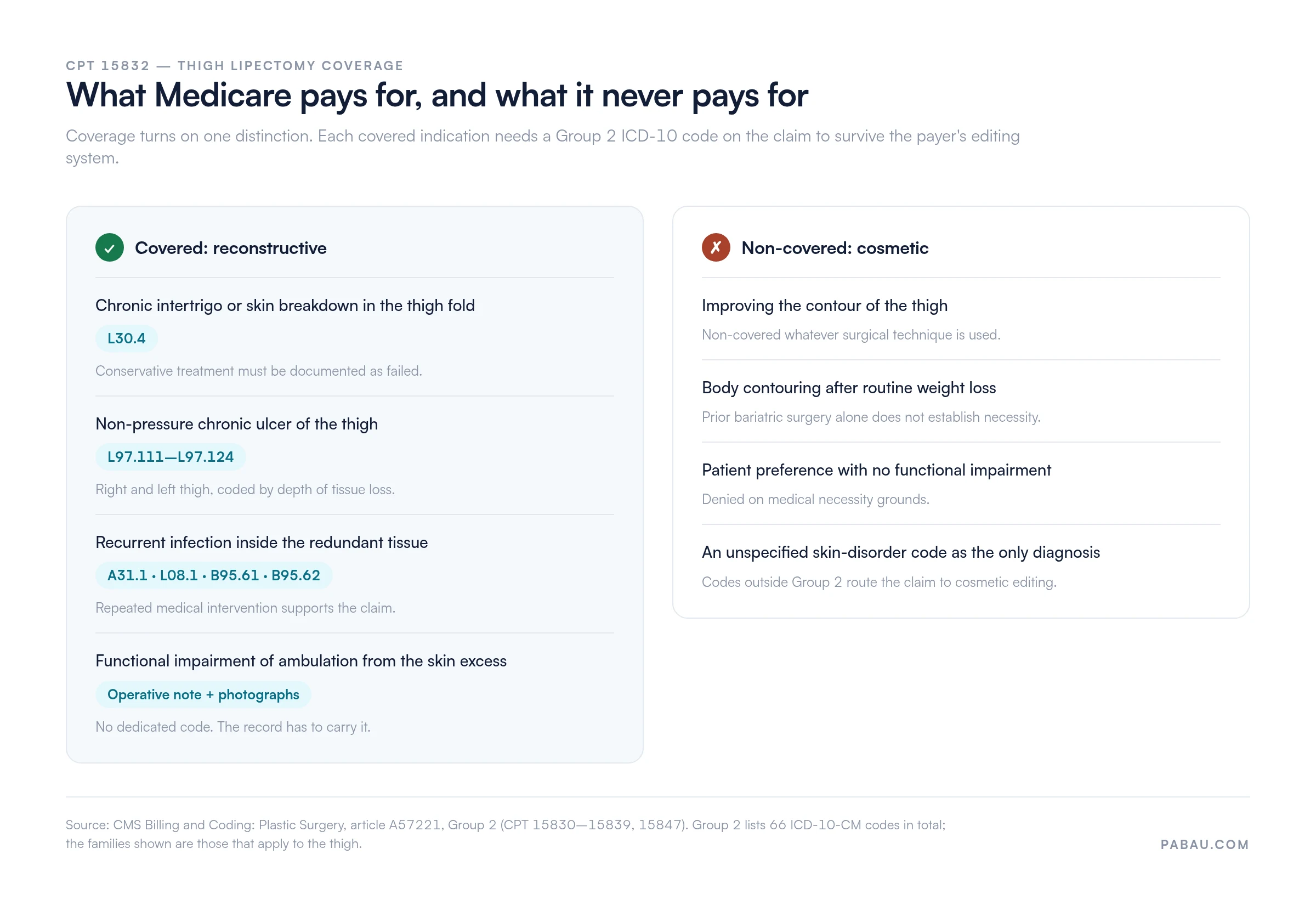
Only ICD-10 codes from Group 2 of CMS article A57221 support the claim, and L30.4 is the one most often used.
Practice management software like Pabau links operative notes, photographs and consent forms to the claim, so nothing is missing at submission.
CPT Code 15832 reports excision of excessive skin and subcutaneous tissue, including lipectomy, of the thigh. Medicare pays it only as a reconstructive procedure. The diagnosis code on the claim and the language in the operative note decide whether it survives review.
This reference covers the AMA descriptor, medical necessity criteria, and documentation requirements. It also covers 2025/2026 Medicare reimbursement and RVU values, modifiers, the ICD-10 crosswalk, and the rest of the 15830-15839 series. It is written for medical coders, billers, and plastic and reconstructive surgery practices.
The AMA CPT code set places 15832 in the integumentary system section. It sits in the 15830-15839 family, which covers excision of excessive skin and subcutaneous tissue by body site. The official descriptor reads:
Excision, excessive skin and subcutaneous tissue (includes lipectomy); thigh
The procedure targets the thigh specifically. Adjacent body sites (abdomen, arm, forearm, hand, other area) are reported with separate codes in the same series. 15832 is a standalone parent code, not an add-on. Report it once per thigh unless a bilateral modifier applies.
Medicare and most commercial payers classify thigh lipectomy as cosmetic by default. Coverage depends on whether the record documents the procedure as reconstructive.
CMS article A57221 covers the 15830-15839 range only where medical necessity is established and documented. Cosmetic procedures stay non-covered even after bariatric surgery or a large weight change. Prior weight loss surgery on its own does not make the procedure reconstructive.
Covered indications for CPT 15832 generally include:
Non-covered indications include procedures performed solely for cosmetic improvement, body contouring after routine weight loss, or patient preference without functional impairment. Review the applicable Local Coverage Determination before submission, since payer policies vary and some require prior authorization for any 15830-series code. Good medical billing compliance practice starts with verifying coverage before you schedule the procedure. Secondary payers often allow a shorter window than the primary, so the filing deadline differs by claim.
The split below is the whole coverage question in one view. Each covered indication carries the Group 2 diagnosis code that has to appear on the claim.
Payers require a paper trail that establishes medical necessity without the reviewer having to infer it. Clean claim submission for 15832 depends on gathering these elements before the procedure, not after a denial arrives.
Some payers require prior authorization before the procedure. Always obtain it in writing and retain the reference number in the patient record. Authorization does not guarantee payment, but it removes medical necessity as a denial reason. Practices running post-bariatric programs on weight loss clinic software already hold the weight history these claims need.
Medicare pays for 15832 under the Medicare Physician Fee Schedule (MPFS) when medical necessity is documented and the procedure is reconstructive. RVU values and payment rates are updated annually. The figures below reflect national averages for 2025/2026. Payment varies by geographic practice cost index (GPCI). Use the CMS fee schedule tool to retrieve the locality-adjusted rate for your ZIP code.
Practices using claims management software integrated with a clearinghouse can verify eligibility and track ERA payments against expected MPFS rates. Pabau’s Claim.MD clearinghouse integration supports eligibility checks and electronic remittance advice for reconstructive surgery claims. That shortens the lag between submission and payment reconciliation.
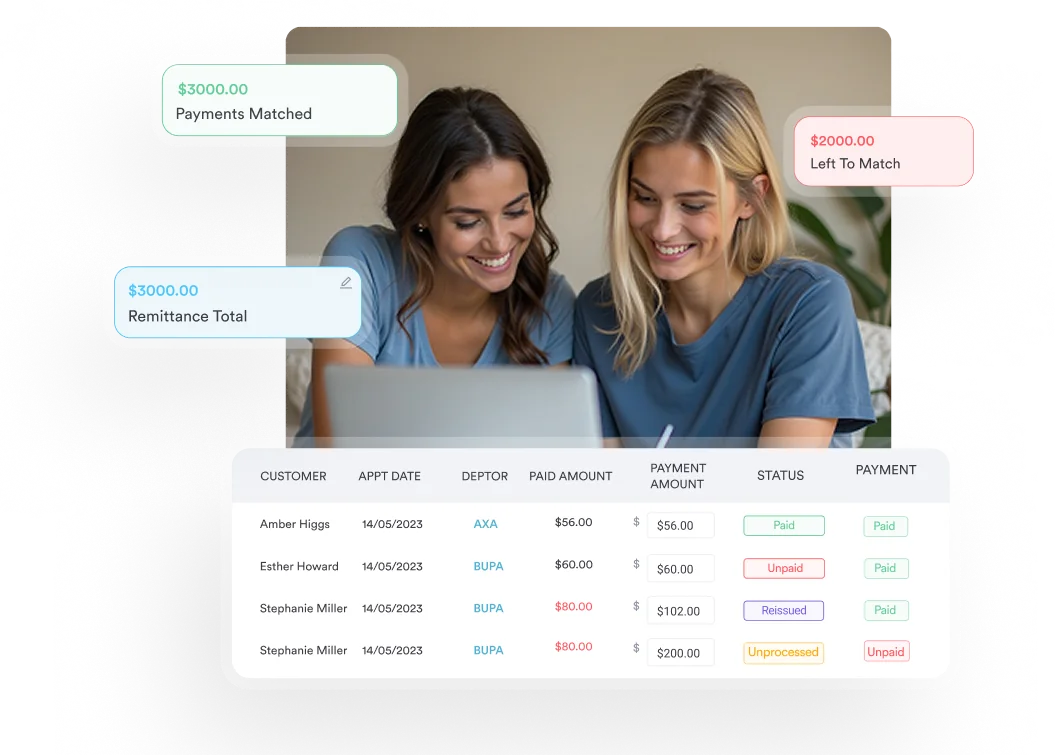
Review electronic remittance advice after each claim to reconcile the payment received against expected MPFS rates. Discrepancies often signal modifier errors or bundling issues that need correcting before the next billing cycle.
Pull your 15832 RVU values directly from the CMS MPFS Look-Up Tool using your specific ZIP code and facility type. National averages can sit well above or below your locality-adjusted rate. Always verify current-year figures, as RVU weights and conversion factors change with each January MPFS update.
Modifier selection for 15832 is a frequent denial trigger. Three mistakes account for most of them:
Modifier 59 carries audit risk. Use it only when the service is distinct, and document the basis in the operative report. Check the National Correct Coding Initiative (NCCI) edits for 15832 first. That confirms the code pair is subject to a bundling edit that 59 can override.
The diagnosis code you pair with 15832 communicates the medical rationale to the payer’s claims system. Group 2 of CMS article A57221 lists the 66 codes that support the 15830-15839 range. A code outside that list triggers an automatic denial, even when the clinical record supports the procedure.
ICD-10-CM codes are updated every October 1, and A57221 is revised on its own schedule. Verify that the codes above remain valid for the fiscal year you are billing. Read the current Group 2 list in the CMS article rather than a cached copy. MAC and LCD revisions can change the set.
The 15830-15839 family covers excision of excessive skin and subcutaneous tissue by body site. Selecting the wrong code in this series is a common unbundling error. Body site determines the code. When several sites are excised in the same session, report a separate code for each one. Practices billing multiple sites need every code on the fee schedule in their plastic surgery software.
CPT 15847 is an add-on code for excision of excess abdominal skin, reported with 15830. The AMA parenthetical note for 15847 cross-references 15830 as the primary code it accompanies. Whether 15847 can be appended to 15832 instead needs checking against current AMA parenthetical guidance. Payer editing rules matter too. Do not assume the add-on applies across the whole series.
When 15830 and 15832 are both performed in the same session, report both codes with modifier 51 on the secondary code. Then evaluate whether 15847 applies to the abdominal component only.
Most 15832 denials fall into four patterns. Recognizing them before submission saves the rework of an appeal. Pabau’s guide to denial management strategies covers the workflow, and the reference list of denial codes maps each rejection to its reason.
Run a quarterly audit of your 15832 denial codes. Group denials by reason code and map each to its root cause: missing documentation, a modifier error, the wrong ICD-10 pairing, or an NCCI edit. Practices that track denial patterns by CPT code identify systemic billing issues faster than those that review denials case by case.
Most 15832 denials start where clinical care hands off to billing. Pabau’s plastic surgery EMR is built around the workflows that generate the evidence payers ask for. That covers treatment notes, before-and-after photographs, consent forms, and prior authorization records.
When a reconstructive thigh lipectomy is planned, the documentation trail starts at the consultation. Medical necessity letters, conservative treatment records, and weight history all land in the patient record. By the time the claim is ready, the supporting evidence is already attached. US groups running charting this way, such as Esteem Life Medical Group, keep records and compliance evidence in one place.
Pabau integrates with the Claim.MD clearinghouse for US practices, supporting CMS-1500 and 837P claim submission, eligibility verification, and ERA reconciliation. Claim.MD submits and tracks what the record already holds, so the coding decisions stay with your coders.

Pabau connects clinical documentation directly to your billing workflow. Attach operative notes, photographs, and medical necessity letters to each claim at the point of care. Nothing is missing when the claim reaches the clearinghouse.

CPT Code 15832 rewards practices that settle the coverage question before the patient reaches the operating room. The cosmetic versus reconstructive call is what the claim pays or denies on. Everything from the ICD-10 pairing to the operative note language has to frame the procedure as reconstructive.
Build the coverage evidence into the consultation and the claim becomes a formality. Leave it to the operative note alone and you will be writing an appeal instead. Book a demo to see how Pabau attaches documentation to 15832 claims before they reach the clearinghouse.

Documenting a binocular movement disorder instead? ICD-10 code H51.0 guide covers the billable subcode for palsy of conjugate gaze and its place in the H51 category.
Chasing the payer’s approval before you operate? Prior authorization software explains how practices track approvals and reference numbers without a spreadsheet.
Building the paperwork for a 15830-series authorization? Medical prior authorization form gives you a form to send alongside the medical necessity letter.
Not sure which binocular movement code fits? Unspecified binocular movement disorder code covers the code’s definition, billable status, hierarchy, and documentation requirements.
CPT Code 15832 covers excision of excessive skin and subcutaneous tissue, including lipectomy, of the thigh. It is reported for reconstructive procedures only. The skin excess must cause functional impairment or a documented condition such as chronic intertrigo or recurrent skin infections. Purely cosmetic thigh lipectomies are not covered under Medicare or most commercial payer policies.
Modifier 50 applies when both thighs are excised in the same session. Add modifier 51 when 15832 is one of several procedures performed on the same date. Modifier 59 overrides an NCCI bundling edit when the documentation supports a distinct service. LT and RT indicate laterality on a unilateral excision. Modifier 22 may apply to a substantially more complex procedure, but it needs a detailed operative note.
Medicare reimburses 15832 through the Medicare Physician Fee Schedule (MPFS). The rate is the total RVU multiplied by the annual conversion factor, adjusted by geographic practice cost indices. National averages run around $750-$900 at non-facility rates for 2025/2026, and locality-adjusted rates vary. Use the CMS fee schedule tool with your ZIP code and facility type for the precise figure. Medicare will not pay if the procedure is classified as cosmetic.
You need a physician letter of medical necessity and clinical photographs showing the extent of the skin excess. Add records of failed conservative treatment, such as topical medications and skin barrier products. Weight history is required when the indication is post-massive-weight-loss skin excess. The operative report must describe the reconstructive rationale. Retain prior authorization documentation where the payer requires pre-authorization for 15830-series codes.