



CCSD code G5100: Bypass of duodenum billing guide
CCSD code G5100 bills a bypass that leaves the duodenum in place CCSD code G5100...

Last Updated: Oct 16, 2026

CPT Code 15837 describes excision of excessive skin and subcutaneous tissue, including lipectomy, of the forearm or hand.
It belongs to the 15830-15839 body contouring family and is not a skin tag code; skin tag removal is billed with 11200 and add-on 11201.
Medicare treats the procedure as cosmetic and non-covered by default under the exclusion at 42 CFR 411.15(h), so reconstructive documentation carries the claim.
The code carries a 90-day global period, so routine follow-up care is already bundled into the surgical payment.
Pabau surfaces the documented procedure and site details alongside the claim, so coders can verify the CPT-ICD-10 pairing before submission.
Official descriptor: Excision, excessive skin and subcutaneous tissue (includes lipectomy); forearm or hand.
CPT Code 15837 sits in the integumentary system surgery section of the American Medical Association code set, under Other Repair (Closure) Procedures. It reports surgical removal of redundant skin and underlying subcutaneous tissue from the forearm or the hand.
This is reconstructive body contouring rather than lesion removal. The typical patient has lost a large amount of weight, or carries chronic limb swelling that has left the forearm draped in loose tissue. Lipectomy is written into the descriptor, so fat removal at the same site never earns a separate charge.
One point decides most claims. Medicare and commercial payers treat excess skin excision as cosmetic until the chart proves otherwise. This guide covers the descriptor, RVU values, the 90-day global period, modifier selection, and ICD-10 pairings. It also covers the documentation that turns a cosmetic denial into a paid reconstructive claim.
The surgeon marks and excises an ellipse of redundant skin along the forearm, most often on its ulnar or volar aspect. The excision carries the underlying subcutaneous fat with it. Closure is layered, and the resulting scar runs along the length of the forearm toward the wrist.
Forearm and hand excisions are far less common than abdominal or arm excisions. When they do happen, they usually sit inside one of a few clinical stories.
The distinction that matters for coding is anatomical, not technical. CPT 15837 covers the forearm and the hand. The upper arm is a separate site with its own code. The descriptor does not care whether the surgeon used a scalpel, a cautery device, or a combination.
A persistent error assigns CPT 15837 to skin tag excision. It does not describe that procedure at all. Skin tag removal has its own pair of codes, and they sit in a different part of the CPT manual.
The two families answer different questions. The 11200 series is driven by lesion count and treats method as irrelevant. The 15830-15839 series is driven by body site and ignores lesion count entirely, because it removes a sheet of tissue rather than discrete lesions.
Billing 15837 for a skin tag encounter overstates the service by a wide margin. The code carries roughly nine work RVUs and a 90-day global period, while 11200 carries well under one. Payers audit that difference, and a recovery demand is the usual outcome.
Relative value units drive how Medicare and most commercial payers calculate payment. The figures below are the CY 2026 national values published in the Medicare Physician Fee Schedule relative value file. Practice expense is the only component that changes between settings.
Multiply the total by the conversion factor to reach the national unadjusted payment. CMS finalized two CY 2026 conversion factors: $33.4009 for most clinicians and $33.5675 for qualifying participants in advanced alternative payment models.
At $33.4009, the facility total of 19.71 RVUs yields $658.33 and the non-facility total of 28.06 RVUs yields $937.23. The whole $278.90 difference sits in practice expense, which almost doubles once the office absorbs supply and staff costs.
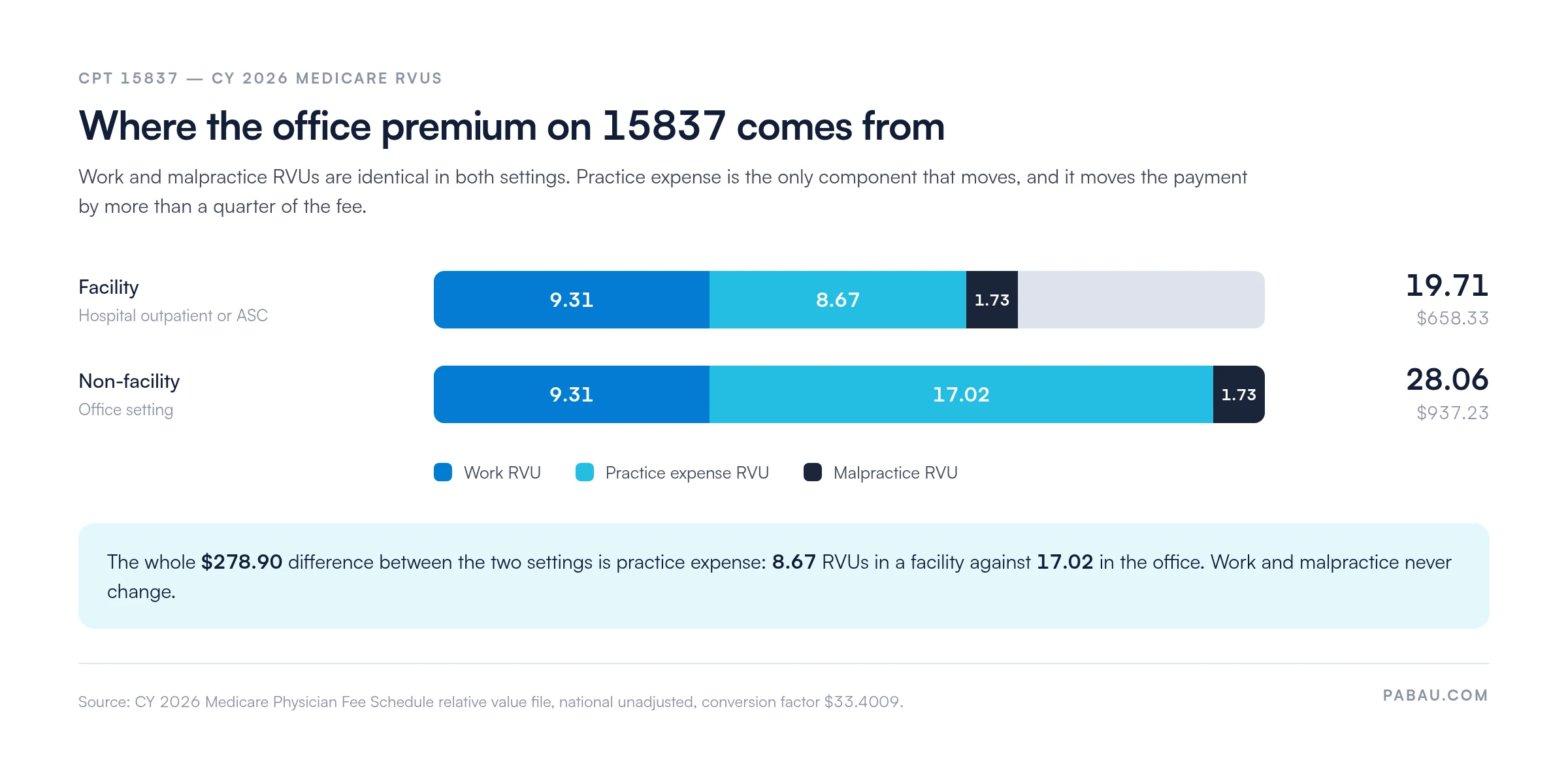
Your own locality figure will differ. Each RVU component is weighted by a geographic practice cost index before the conversion factor is applied.
Verify both the RVUs and the conversion factor for your locality in the CMS fee schedule lookup before you quote a figure. CMS revises the relative value file every January, and mid-year corrections do happen.
Medicare excludes cosmetic surgery from coverage under 42 CFR 411.15(h). That exclusion does not apply to surgery needed for prompt repair of accidental injury, or for improvement of the functioning of a malformed body member.
Excess skin excision therefore pays only when the record establishes a functional problem rather than an appearance concern. The code itself is never the deciding factor.
There is no national coverage determination for excess skin excision of the forearm or hand. Coverage is decided by your Medicare Administrative Contractor, and several contractors publish local coverage determinations or billing articles for cosmetic and reconstructive surgery. Read the one covering your jurisdiction before you schedule the case.
Submit through a clearinghouse that returns eligibility and remittance data quickly, because coverage surprises on this code are expensive. Practices using Pabau’s Claim.MD integration transmit the claim and retrieve the remittance advice without leaving the patient record.
Before scheduling, run insurance eligibility verification and ask the payer specifically about excess skin excision of the forearm, not about body contouring in general. Plans frequently cover abdominal panniculectomy while excluding every other site in the 15830-15839 family. Record the reference number and the representative’s name in the patient file, so the appeal has a starting point if the claim is denied.
CPT 15837 carries a 090 global period. Routine post-operative care for the next 90 days is already paid for inside the surgical fee. A separate office visit for suture removal, wound review, or scar reassurance is not billable.
Care that falls outside the routine course can still be reported, provided the right modifier explains why.
The pre-operative evaluation is a separate matter. Payers expect a documented history of the functional problem, conservative treatment, and photographs. Those visits happen before the global period opens, so they are reported and paid on their own merits.
Modifier selection is where otherwise clean claims for this code stumble. The forearm is a paired site, and the procedure is often one part of a larger contouring session.
Check the current National Correct Coding Initiative edits before you pair 15837 with another integumentary code. The edit tables are revised quarterly, and this code carries several bundling relationships. A modifier cannot bypass every edit, so verify the modifier indicator rather than assuming -59 will clear it.
Modifier -22 needs evidence, not adjectives. Record the operative time, the weight or dimensions of the tissue removed, and the specific finding that made the case harder. A note that says the anatomy was difficult will not survive review.
The diagnosis code tells the payer why the excision was necessary. Because most excess skin surgery is elective, this pairing gets close attention. Choose the code that matches what the chart documents, then add secondary codes for the underlying cause and the functional consequence.
The Excludes1 note under I89.0 is worth knowing. It prevents reporting general lymphedema together with postmastectomy lymphedema syndrome, so pick one and support it with the history. Submitting both on the same claim triggers an edit rejection rather than a coverage review.
L98.7 also carries Excludes2 notes for excess eyelid skin and for skin changes from chronic nonionizing radiation exposure. Those are Excludes2, so both codes may appear on one claim when the patient genuinely has both conditions.
Build the pairing from the operative note and the progress notes, never from the procedure alone. Coders who reverse that order end up defending a diagnosis the record does not contain. Accurate diagnosis capture is where medical billing compliance begins for this code.
A reconstructive determination rests on documented function, not on how much skin is present. The chart has to show a medical problem caused by the redundant tissue, and show that reasonable non-surgical care did not fix it.
The elements payers look for are consistent across contractors and commercial plans.
The line against cosmetic surgery is easy to cross in writing. Brachioplasty, abdominoplasty, and forearm contouring performed to improve contour or appearance are cosmetic, and no documentation makes them payable. The same operation becomes reconstructive only when it treats a functional deficit the chart already describes.
Wording in the note decides how a reviewer reads the case. A phrase such as patient unhappy with forearm appearance frames the case as cosmetic, even when a genuine functional indication exists elsewhere in the record. Write what is being treated, and let the aesthetic result be a by-product.
A handful of errors account for most denials on this code. All of them are preventable with a pre-billing review.
Track the denial codes coming back on this code by payer. Patterns emerge quickly, and they tell you whether the problem is your documentation or a specific plan’s policy. That distinction decides whether you fix the note template or the payer conversation.
Every code in this family shares the same descriptor stem and differs only by body site. Selection depends entirely on where the tissue was removed. Several codes may be reported for one session when the surgeon works on separate sites, subject to modifier and edit rules.
The pairing of 15836 and 15837 deserves attention. An extended brachioplasty that crosses the elbow onto the forearm involves two coded sites. Both may be reportable when the note describes each excision separately. A single continuous ellipse described as one arm excision supports only 15836.
Two more codes are worth keeping straight. CPT 15847 is an add-on for abdominal excess skin excision performed with another abdominal procedure, and it applies to the abdomen only. Nothing in the family works as an add-on to 15837.
Coding references give you the descriptor and the RVUs, then stop. The denials on this code happen in the distance between the operative note and the submitted claim. That is where the site, the modifier, and the diagnosis have to agree.
Practice management software like Pabau closes that distance by keeping both in one record. In a plastic surgery practice, the surgeon writes the operative note in the same system that holds the scheduling, the photographs, and the claim. Nobody retypes the site or the laterality into a second application, which is where transcription errors on 15837 usually start.
Pabau’s claims management software surfaces the documented procedure, site, and laterality alongside the claim form. A coder reads the note and the claim together, then confirms the CPT-ICD-10 pairing before the 837 claim file goes out. Pabau presents the evidence. The coder still assigns every code.
The pre-operative record matters as much as the note. Digital forms capture the weight loss history, the conservative treatments tried, and the functional complaints at intake. Clinical photographs and consent attach to the same patient file, so a medical necessity review has everything in one place.
Prior authorization details live in the record too. Staff record the reference number and the plan’s conditions against the appointment, so billing can see them at submission instead of hunting through a spreadsheet.

Pabau puts the operative note, the photographs, and the claim in one patient record. Your coders can verify the site, modifier, and diagnosis on codes like 15837 before submission. See how it works for plastic surgery and aesthetics practices.

CPT Code 15837 is simple to identify and hard to get paid. It reports excision of excessive skin and subcutaneous tissue of the forearm or hand, nothing else. Read the site in the operative note, not the specialty or the patient’s reason for coming in.
Three things decide the claim. The record has to establish a functional problem rather than an appearance concern. The ICD-10 pairing has to match what the chart documents. The modifier has to reflect laterality and any other site treated in the session. The 90-day global period then governs everything you bill for the next three months.
Pabau keeps those pieces in one record. A coder can check the site and the pairing against the note before the claim leaves the practice. To see how that works for surgical and aesthetic billing, book a demo with the team.

Billing the upper arm rather than the forearm? CPT code 15836 covers brachioplasty and explains how site specificity drives code choice in this family.
Coding an unclear pupillary exam finding? Pupillary function anomaly code covers billable status, code hierarchy, and documentation standards coders need before submitting a claim.
Checking coverage before you schedule surgery? Insurance eligibility verification shows how to confirm benefits and authorization requirements up front.
Covering the wound with a skin substitute instead? CPT code 15271 covers skin substitute application to the trunk, arms, or legs.
Closing the defect with a full-thickness graft? CPT code 15221 is the add-on that reports each additional graft area.
No. CPT 15837 is a body contouring code for excess forearm or hand skin, and it has no relationship to skin tags. Skin tag removal is reported with 11200 for up to 15 lesions, plus add-on 11201 for each additional 10 lesions. Billing 15837 for a skin tag encounter overstates the service by roughly nine work RVUs. It also adds a 90-day global period that does not belong on the claim.
Medicare covers it only for a reconstructive indication. The cosmetic surgery exclusion at 42 CFR 411.15(h) rules out procedures aimed at appearance. It allows surgery that improves the functioning of a malformed body member. Coverage therefore depends on documented functional problems such as recurrent skin fold infection, skin breakdown, or restricted motion. Most contractors also expect pre-operative photographs and evidence that conservative treatment failed.
The CY 2026 Medicare Physician Fee Schedule lists a work RVU of 9.31 for CPT 15837. Total RVUs are 19.71 in a facility and 28.06 in the office, the difference coming entirely from practice expense. The CY 2026 conversion factor is 33.4009 dollars. That produces national unadjusted payments of 658.33 dollars in a facility and 937.23 dollars in the office. Your locality figure will differ, so verify it in the CMS lookup tool.
L98.7, excessive and redundant skin and subcutaneous tissue, is usually the primary diagnosis. Supporting codes depend on the cause and the consequence documented in the chart. Common choices are I97.2 for postmastectomy lymphedema and I89.0 for lymphedema from another cause. Others are Z98.84 for bariatric surgery status, E66.01 for morbid obesity, and L30.4 for intertrigo. An Excludes1 note prevents reporting I89.0 together with I97.2, so choose one.



