CPT code 51797: Intra-abdominal voiding pressure add-on
What CPT code 51797 covers CPT code 51797 is the add-on code for intra-abdominal...

Last Updated: Oct 19, 2026
68810 is the CPT code for probing of nasolacrimal duct, with or without irrigation. It applies when the probing does not require general anesthesia.
It sits in the lacrimal system procedures (68400-68899) of the AMA CPT code set and is commonly used for congenital nasolacrimal duct obstruction. The code yields to 68811 when general anesthesia is required and to 68815 when a tube or stent is left in place. Balloon catheter dilation is reported with 68816. Denials often trace to missing proof of failed conservative treatment, a missing side modifier, or the wrong sibling code.
Let Pabau's smart automation suggest the right codes, reduce claim denials, and keep your practice compliant—effortlessly.
Automate repetitive tasks and focus on what matters most—your patients.
Reduce coding errors and ensure compliance with the latest regulations.
Clean claims, fewer denials, and faster reimbursements.
Powerful insights and reporting to help your practice thrive.
HIPAA compliant SOC 2 certified GDPR-compliant Trusted by 4,000+ clinics worldwide

CPT code 68810 covers nasolacrimal duct probing, with or without irrigation, when the procedure does not require general anesthesia.
Anesthesia type decides the code: 68810 for local or topical anesthesia, 68811 when general anesthesia is required.
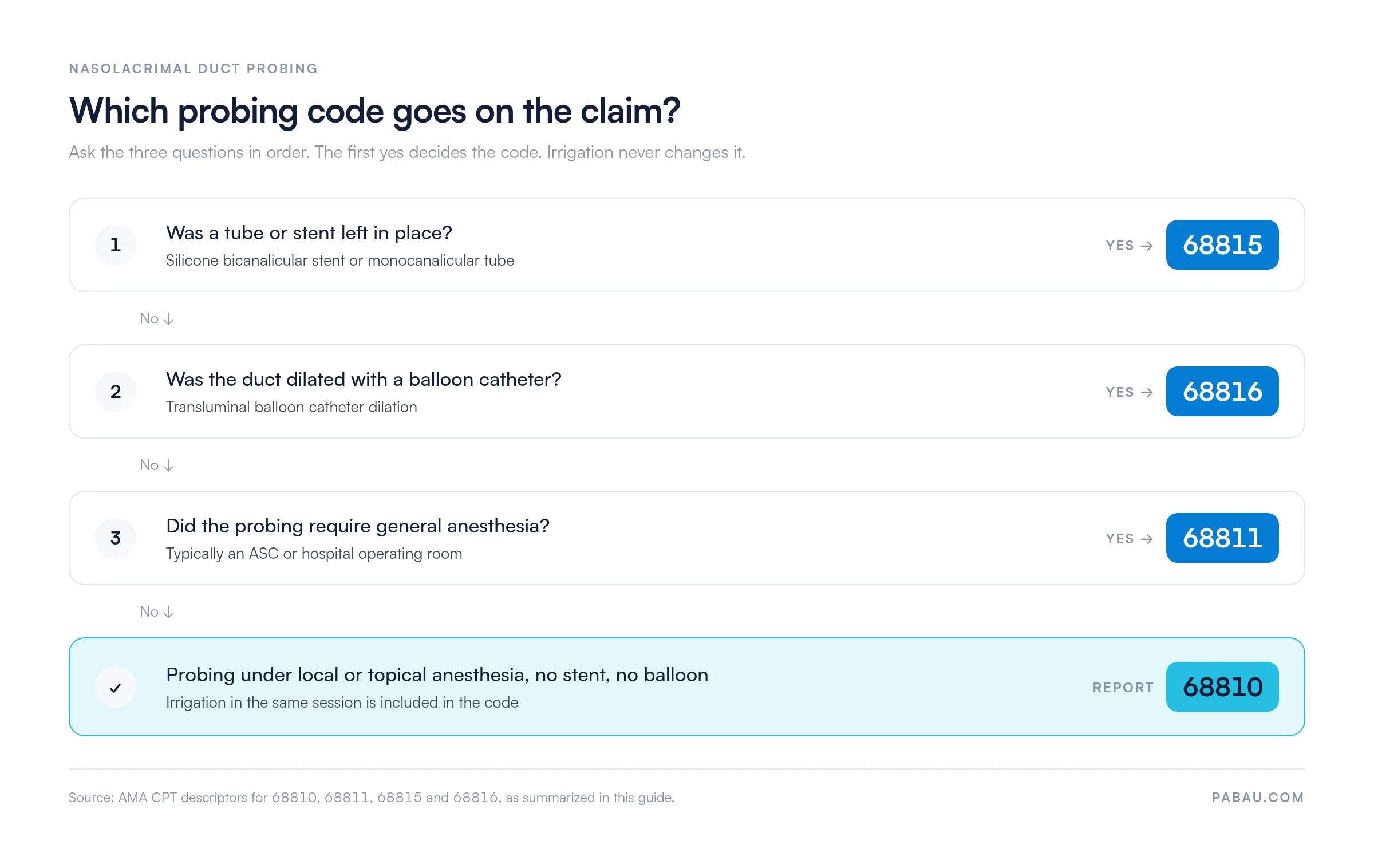
A stent or tube left in place moves the claim to 68815, and balloon catheter dilation moves it to 68816.
Medicare (e.g., CGS) bills a bilateral probing on one line with modifier -50, while -RT and -LT report the side of a unilateral service.
Pabau, the practice management platform we build, submits and tracks claims electronically through its Claim.MD integration.
CPT code 68810 describes probing of the nasolacrimal duct, with or without irrigation, when the procedure does not require general anesthesia. A blunt metal probe passes through the punctum, along the canaliculus and lacrimal sac, and into the nasolacrimal duct to open a membranous obstruction.
The procedure is performed under local or topical anesthesia, typically in an office or ambulatory setting. Stent placement, balloon catheter dilation or general anesthesia each move the claim to a different code.
According to the American Medical Association’s CPT code set, 68810 sits in the lacrimal system procedures (68400-68899) of the eye and ocular adnexa surgery section. It is most often performed on infants with congenital nasolacrimal duct obstruction (NLDO).
Probing typically follows several months of failed conservative management, but the timing criteria belong to each payer, so verify them before scheduling. A grasp of medical billing fundamentals for surgical codes helps ophthalmology practices avoid the documentation errors that lead to 68810 denials.
The quick-reference table below captures the core billing parameters for this code.
Irrigation is part of the 68810 descriptor (“with or without irrigation”), so irrigation in the same session is not separately reportable. Punctal dilation done to pass the probe is bundled as well.
Bundled into 68810 (do not bill separately):
Not included in 68810 (report a different code, or bill separately):
CPT 68811 is the code for nasolacrimal duct probing requiring general anesthesia. Anesthesia type, not patient age, determines which code to bill. A toddler probed in the office under topical drops is 68810. That same child probed in an OR under general anesthesia is 68811. Age matters only as a medical necessity criterion for prior authorization, not for code selection.
The operative note must state the anesthesia type used. A note that names neither local nor topical anesthesia leaves the choice between 68810 and 68811 unsupported, which invites a records request on audit.
CPT 68815 covers probing of the nasolacrimal duct with insertion of a tube or stent. When a silicone bicanalicular stent or monocanalicular tube is left in place at the end of the procedure, 68815 replaces 68810 entirely. The two codes cannot be billed together for the same duct on the same date.
Stent placement is typically indicated after a failed first probing or a more proximal obstruction. It is also used when the surgeon anticipates a higher recurrence risk. The decision is made intraoperatively, so the note must document both the probing and the rationale for tube insertion. Billing 68810 when a stent was placed is a downcoding error. Billing both is an unbundling error.
The lacrimal code family covers a narrow range of related procedures. Confusing them leads to either upcoding audits or lost revenue from undercoding. For the four nasolacrimal probing codes, three questions settle the choice, asked in the order shown below.
Payers validate medical necessity by cross-checking the diagnosis code against the procedure. A non-covered diagnosis triggers a denial regardless of how complete the operative note is. The table below lists the ICD-10-CM codes most often paired with 68810.
For Medicare in Jurisdiction 15 (Kentucky and Ohio), CGS’s local coverage determination (LCD) L34171 sets the coverage criteria for nasolacrimal duct probing. Other Medicare Administrative Contractors (MACs) may publish different policies or none, so check your MAC’s LCD before submission.
Where an LCD applies, confirm the diagnosis on the claim appears on its covered-diagnosis list. Avoid the unspecified H04.9 code when the record names the duct and the side, because payers expect the most specific diagnosis available.
Reimbursement for 68810 varies by place of service, geographic adjustment factor and MAC. Non-facility rates (office, POS 11) are typically higher than facility rates (ASC POS 24 or hospital outpatient POS 19/22). That is because the practice absorbs the overhead costs in a non-facility encounter.
Use the CMS Medicare Physician Fee Schedule look-up tool to retrieve current-year non-facility and facility payment amounts for your MAC jurisdiction. Published rates change with each January fee schedule (MPFS) update, so hardcoded figures in billing guides go stale quickly.
Commercial rates vary by contract, often benchmarked to the MPFS. Practices billing 68810 through Pabau can submit claims electronically via its Claim.MD clearinghouse integration. Claim.MD runs eligibility checks and submits claims to thousands of US payers.
The FastRVU 2026 look-up tool shows the work, practice expense and malpractice relative value units (RVUs) for 68810 at no cost. Its figures come from the published CMS data file.
Modifier selection for 68810 depends on laterality, whether the procedure is bilateral, and any global period considerations. Incorrect modifier use is a common reason 68810 claims are rejected. Pabau’s electronic claims management submits each claim with its modifiers and tracks its status, so a rejection surfaces quickly.
Medicare (e.g., CGS) bills a bilateral service on one line with -50, and -RT or -LT apply to a unilateral service. Some payers want two lines with -RT and -LT instead, so verify payer policy before billing.
An operative note for 68810 must contain more than “nasolacrimal duct probing performed.” Payers need evidence that the procedure was medically necessary and that the record supports the code billed. In Jurisdiction 15, CGS’s LCD L34171 sets that standard for Medicare.
For Medicare in Jurisdiction 15 (Kentucky and Ohio), CGS’s LCD L34171 sets the coverage framework for nasolacrimal duct probing. Other MACs may publish different policies or none, so check your MAC’s LCD. Commercial payers set their own criteria, which often start with documented failure of conservative management.
Prior authorization requirements vary by payer and can depend on the setting. Check them at scheduling, not on the day of the procedure, as part of a structured prior authorization process. Follow clean claim submission practices so authorization numbers are attached at submission, not added on appeal.
Run an eligibility check the day before the procedure, not just at scheduling. Prior authorization for pediatric ophthalmology procedures is frequently time-limited. An authorization obtained six weeks earlier may have expired, or the patient’s coverage may have changed. A same-day eligibility confirmation prevents day-of-service claim rejections that are nearly impossible to reverse retroactively.
Most 68810 denials fall into a predictable set of categories. Effective denial management workflows track these patterns and catch them before the claim leaves the practice. The specific medical billing denial codes on each rejection tell you whether to correct and resubmit or file a formal appeal.
Claims for 68810 tend to fail on details set before submission: the side, the diagnosis and the authorization number. Without a connected system, staff re-key each claim into a payer portal and chase its status by phone.
Pabau’s claims management, with Claim.MD, submits claims electronically from the patient’s billing record and tracks each one after it leaves. Eligibility checks run through the same integration, so coverage can be confirmed the day before the procedure.
The result is fewer re-keyed claims and a clear view of which 68810 claims are paid, pending or denied.

Pabau’s claims management, with Claim.MD, submits and tracks claims electronically, so your team can see where every CPT 68810 claim stands.

Once the operative note states the anesthesia type and whether a stent or balloon was used, the code choice for 68810 is straightforward. The harder work sits upstream, in confirming the payer’s timing criteria and authorization before the patient is booked.
Settle the side, the diagnosis and the authorization at scheduling, and the denial reasons above have little left to catch. Book a demo to see how Pabau submits and tracks lacrimal probing claims electronically, from eligibility check to payment.

Billing an eye exam on the same day as the probing? CPT code 92014 covers comprehensive ophthalmological services for established patients, the visit most often paired with modifier -25.
Want to understand how electronic remittance advice reduces posting errors? Electronic remittance advice in medical billing explains how ERAs reduce manual payment posting and flag CARC denial reasons automatically.
Looking to strengthen your revenue cycle from eligibility through payment? What is revenue cycle management covers the end-to-end workflow from scheduling through collections.
CPT code 68810 is the procedure code for probing of the nasolacrimal duct, with or without irrigation, when general anesthesia is not required. It is used mainly for congenital or acquired nasolacrimal duct obstruction, under local or topical anesthesia in an office or ambulatory setting.
CPT 68811 is for nasolacrimal duct probing that requires general anesthesia, while 68810 covers the same procedure under local or topical anesthesia. Anesthesia type, not patient age, determines which code to bill. A child probed in the office under topical drops is 68810, and the same child probed in an OR under general anesthesia is 68811.
Three groups of diagnosis codes are most often paired with 68810. They are Q10.5 (congenital stenosis of the lacrimal duct), H04.531-H04.533 (neonatal obstruction by laterality) and H04.551-H04.553 (acquired nasolacrimal duct stenosis by laterality). Q10.5 and H04.53- carry an Excludes1 note, so report one or the other. In Jurisdiction 15, a diagnosis missing from the covered list in CGS’s LCD L34171 is a common denial trigger.
The global period for CPT 68810 is 10 days. An unplanned return to the OR for a related complication takes modifier -78 (reduced payment), and an unrelated procedure takes -79. Routine postoperative care within the 10-day global is not separately billable.