ICD-10 code S31.44XA: Vaginal and vulvar puncture wound with foreign body
ICD-10 code S31.44XA: Definition and billable status ICD-10 code S31.44XA is the...

Last Updated: Oct 12, 2026
Billable Code Specific Code
V95.10XD is the billable ICD-10-CM code for unspecified ultralight, microlight or powered-glider accident injuring occupant, subsequent encounter. It tells the payer how the injury happened, while a separate injury code says what was injured. Use it after active treatment ends, when the patient returns for routine healing care. Typical visits include a cast change or a follow-up X-ray.
The code is valid from FY2025 through FY2027 and sits in category V95 of Chapter 20. It always follows an injury code and never goes first on a claim. Common errors include listing it first, picking the 7th character by visit count, and sending it without the injury code it explains.
Let Pabau's smart automation suggest the right codes, reduce claim denials, and keep your practice compliant—effortlessly.
Automate repetitive tasks and focus on what matters most—your patients.
Reduce coding errors and ensure compliance with the latest regulations.
Clean claims, fewer denials, and faster reimbursements.
Powerful insights and reporting to help your practice thrive.
HIPAA compliant SOC 2 certified GDPR-compliant Trusted by 4,000+ clinics worldwide

V95.10XD codes an unspecified ultralight, microlight or powered-glider accident injuring an occupant, at a subsequent encounter.
Use the 7th character D once active treatment is complete and the patient gets routine care while the injury heals.
List the injury code first, because V95.10XD can never be the first-listed or principal diagnosis.
Report Y92, Y93 and Y99 codes once, on the initial encounter claim, and leave them off V95.10XD follow-ups.
Pabau’s claims management software pre-fills claims from the patient record and validates required fields before Claim.MD submission.
ICD-10 code V95.10XD is a billable external cause code for an unspecified ultralight, microlight or powered-glider accident injuring an occupant, at a subsequent encounter. It is valid from FY2025 through FY2027. The code explains how the injury happened. A separate injury code, listed first, says what the injury is.
“Unspecified” refers to the type of accident. The record confirms an ultralight-class aircraft but doesn’t say whether it crashed, made a forced landing or collided. When the record does say, a more specific V95.1 code applies.
The tabular hierarchy runs from V95 (powered aircraft) to V95.1 (ultralight, microlight and powered-glider accidents). It then narrows to V95.10, the non-billable unspecified-accident code, and finally to V95.10XD. The X in position six is a placeholder that lets the code reach its 7th character.
The injury codes that pair with it, from rib fractures to concussions, sit in our diagnostic codes library.
The 7th character D marks a subsequent encounter. Under ICD-10-CM Official Guidelines section I.C.19.a, D applies once the patient has completed active treatment. From then on, the patient receives routine care while the injury heals or recovers.
Typical D visits include a cast change, a follow-up X-ray to check healing, removal of a fixation device and a medication adjustment. The visit count doesn’t decide the character. A patient seen three times during active treatment stays on A for all three visits.
The external cause code always follows the injury code. If the injury code ends in D, the external cause code is V95.10XD. For a sequela visit, the residual condition goes first, then the injury code with S, then V95.10XS.
Read the encounter note before you assign a 7th character. A note saying ‘fracture healing well, return in four weeks’ after treatment has ended points to the D character. A note describing surgery, a new evaluation or ongoing active management points to the A character. If the visit treats a lasting effect such as chronic pain, use the S character.
V95.10XD covers anyone riding in or flying an ultralight, microlight or powered glider. That includes the pilot and any passenger. These are light, engine-powered aircraft that sit outside the helicopter and fixed-wing categories.
Other aircraft and other people take different codes:
A hang glider without an engine moves to V96, as with V96.11XS for a hang-glider crash sequela. Within V95.1, pick the specific accident type whenever the chart names it. V95.10XD is for records that leave the accident type open.
The aircraft type sets the V95 subcategory, and the accident type sets the fifth character. A private-plane crash at the first visit, for example, is V95.21XA. The table maps the main codes and their three encounter versions.
V95.10XD explains how an injury happened, not what the injury is. Under ICD-10-CM Official Guidelines section I.C.20, external cause codes are always additional codes. They can never be the first-listed or principal diagnosis.
On a subsequent encounter claim, list the codes in this order:
Place of occurrence (Y92), activity (Y93) and external cause status (Y99) codes don’t go on this claim. Guidelines section I.C.20 says to report each one once, at the initial encounter. Status codes such as Y99.8 follow the same once-only rule.
The chart below shows how the claim changes across the three phases of care.
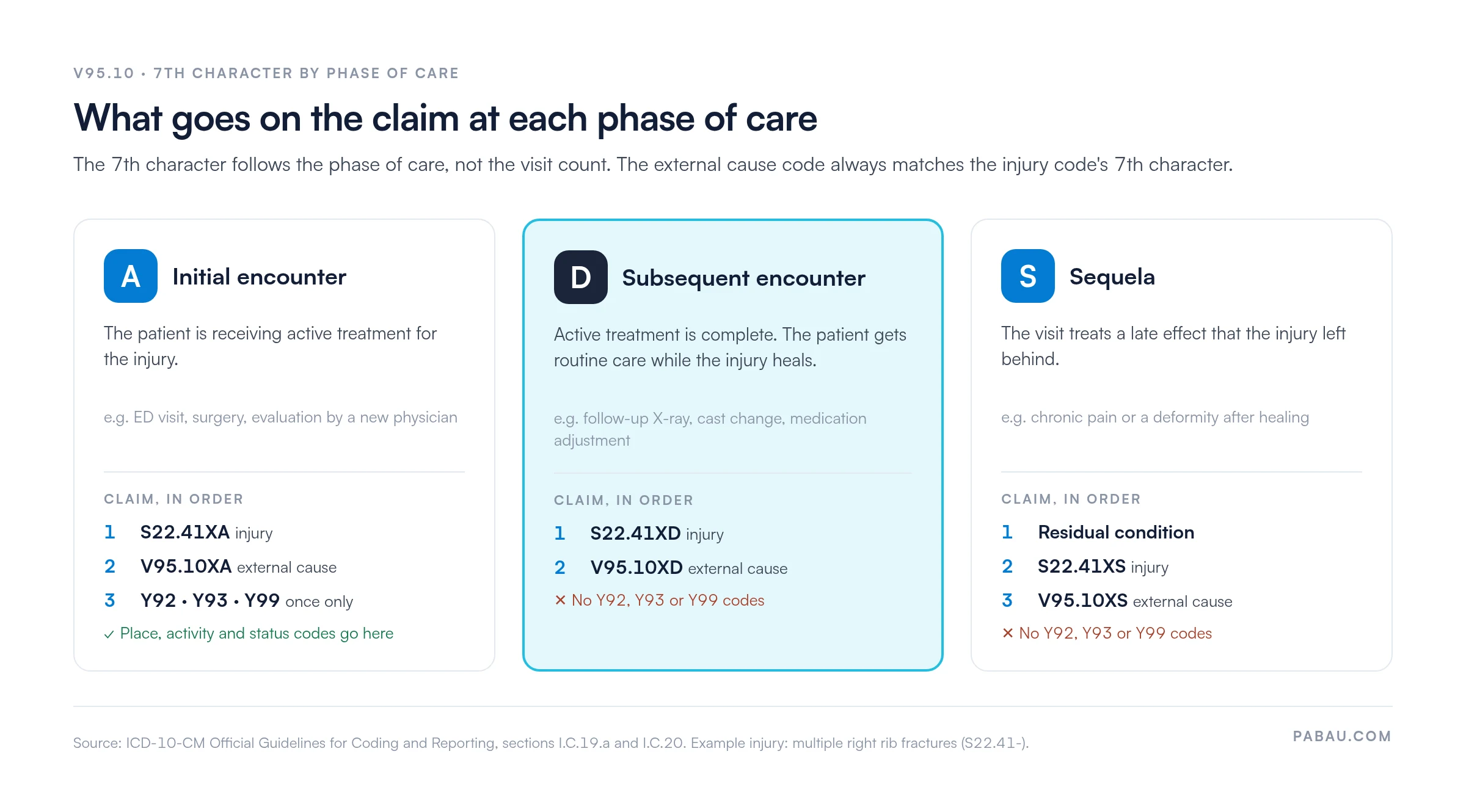
A pilot breaks several right ribs in an ultralight accident, and the record doesn’t name the accident type. The ED visit is active treatment, so that claim uses S22.41XA and V95.10XA. It also carries the Y92, Y93 and Y99 codes.
Six weeks later, the pilot returns for a follow-up X-ray of the healing ribs. That visit is routine healing care. The claim lists S22.41XD first and V95.10XD second, with no Y codes.
Run these checks against the chart before the claim leaves:
When the aircraft type or the care phase is unclear, query the provider before you submit. Changing a code without provider input means coding something the record doesn’t support. Sound medical billing compliance keeps those queries on file, so an auditor can see why a code changed.
Traditional Medicare doesn’t require external cause codes for claim processing, though some Medicare Advantage plans and supplemental payers ask for them. Reporting V95.10XD on a Medicare claim does no harm. Leaving it off rarely triggers a denial by itself.
Two payer groups give external cause codes more weight:
Aviation injuries add a coordination of benefits (COB) step. An aircraft liability policy or a pilot’s personal accident cover may pay before health insurance does. Payers often send a COB request when an aviation external cause code appears.
A COB request asks for details of the patient’s other coverage. Answer it promptly so the claim doesn’t age past timely filing. Running insurance eligibility verification before the visit brings that other coverage to light early.
Each error below has a clear fix, and three of the five go back as a corrected claim.
The denial management workflow is the same as for other coding errors. Find the CARC and RARC codes on the ERA and match them to a row above. Fix the source record, then resubmit inside the payer’s timely filing window.
Set a billing worklist filter for any ERA denial on a claim that contains a V95 code. Aviation claims with COB holds involve two insurers, so they can sit unresolved for weeks. A fixed follow-up date, such as 14 days, keeps them inside timely filing limits.
Follow-up trauma claims go wrong easily when a biller re-keys codes from the chart. The injury code, the external cause code and the patient’s details all have to line up by hand.
Pabau’s claims management software pre-fills each claim from the patient record. Built-in ICD-10-CM and CPT lookup libraries help coders find V95.10XD and the injury code it explains. Pabau then validates the required claim fields and submits the claim through Claim.MD.
Eligibility checks run before the visit, and ERA posting brings payer responses back into the same record. A COB request or a denial lands where your billing team already works, so follow-up starts sooner.

Pabau pre-fills claims from the patient record, validates required fields and submits through Claim.MD. Eligibility checks and ERA posting keep follow-up visits like V95.10XD in one workflow.

V95.10XD has one job on a claim. It tells the payer that a follow-up visit traces back to an ultralight accident. Take the 7th character from the phase of care, not the visit count, and keep the injury code in first position.
The trade-off is documentation. If the chart never says active treatment ended, a D code invites a query or a denial. Ask the provider before you bill, rather than after the ERA comes back.
If your team bills follow-up trauma care, book a demo to see how Pabau pre-fills these claims and tracks them through to payment.

Need to understand how clean claims prevent downstream denials? Clean claim requirements in medical billing walks through what payers look for before processing a submission.
Working through an ERA denial and not sure how to read the reason codes? Electronic remittance advice explained covers CARC and RARC interpretation for billing staff.
Coding the injury that goes first on the claim? ICD-10 code S22.49XD covers multiple rib fractures at a subsequent encounter.
Still unsure which 7th character fits a visit? ICD-10 code S72.012B works through 7th character choices on a fracture code.
Want the full picture on medical billing workflow? What is medical billing covers the end-to-end revenue cycle from patient encounter to payment posting.
A crash has its own codes in subcategory V95.11, such as V95.11XD for a follow-up visit. Use V95.10XD only when the record names an ultralight accident but not its type. If the chart says crash, forced landing or collision, code that instead.
No. A hang glider without an engine is a nonpowered aircraft, so it belongs in category V96. V95.1 covers powered gliders, microlights and ultralights. Check whether the aircraft had an engine before you pick the category.
Yes. The code describes an occupant, which covers the pilot and any passenger on board. A person struck on the ground isn’t an occupant and takes a code from V97.3 instead.
No. External cause codes in Chapter 20 don’t map to CMS-HCC categories, so V95.10XD adds nothing to a risk score. Payers still use it to spot liability claims and other coverage.
Yes, when the therapy is routine care during the healing or recovery phase. Pair it with the injury code ending in D, as on any other subsequent visit. The therapist’s note should show that active treatment has ended.