ICD-10 code S61.201A: Open wound of left index finger without nail damage
ICD-10 code S61.201A covers a left index finger wound of unstated type ICD-10 co...

Last Updated: Oct 16, 2026
Billable Code Specific Code
S72.012B is the billable ICD-10-CM code for unspecified intracapsular fracture of left femur, initial encounter for open fracture type I or II.
Send the six-character parent instead and the claim rejects before a human reads it. Pick the wrong grade and the diagnosis stops matching the operative note.
This page works through the descriptor and the full 7th character set. It also covers the CPT codes that belong beside it, and how the stay lands in an MS-DRG.
Let Pabau's smart automation suggest the right codes, reduce claim denials, and keep your practice compliant—effortlessly.
Automate repetitive tasks and focus on what matters most—your patients.
Reduce coding errors and ensure compliance with the latest regulations.
Clean claims, fewer denials, and faster reimbursements.
Powerful insights and reporting to help your practice thrive.
HIPAA compliant SOC 2 certified GDPR-compliant Trusted by 4,000+ clinics worldwide

ICD-10 code S72.012B reports an unspecified intracapsular fracture of the left femur, initial encounter for open fracture type I or II.
The code is billable only with its 7th character. The six-character parent S72.012 gets rejected on a claim.
Character B means a Gustilo-Anderson type I or II wound. Types IIIA, IIIB and IIIC take S72.012C instead.
Femoral neck repair pairs with CPT 27235 or 27236, never with the trochanteric codes 27244 and 27245.
Practice management software like Pabau pre-fills the CMS-1500 from the record and checks required claim fields before submission.
The official descriptor reads: unspecified intracapsular fracture of left femur, initial encounter for open fracture type I or II. Every phrase in it narrows the code, so it helps to take them one at a time.
Drop the B and you are left with S72.012, which no payer accepts. ICD-10-CM requires a 7th character on every S72 fracture code, so six characters is a structurally incomplete claim line. The CDC/NCHS ICD-10-CM web tool confirms S72.012B as active for fiscal year 2026 and valid for HIPAA-covered submission.
The proximal femur sits inside the hip joint capsule, and the blood supply to the femoral head runs along the neck. A break inside that boundary can interrupt the supply.
That is why intracapsular fractures carry a higher risk of avascular necrosis than trochanteric ones. It is also why the surgeon’s wording matters so much to the coder.
S72.01 exists for the case where nobody wrote down which part of the neck broke. As soon as the note gets specific, a more precise code applies.
Transcervical and midcervical fractures take S72.03x. A fracture at the base of the neck takes S72.04x. Fractures of the femoral head take S72.05x or S72.06x.
Two neighbors get mixed up with S72.01 often enough to flag. S72.00 is an unspecified fracture of the neck of the femur, not the head. S72.02 is an epiphysis separation. Neither one is a substitute for S72.01x.
“Unspecified” is not a comment on the quality of the record. It only means the subtype was never differentiated. Query the physician when the note supports more detail, and never infer a subtype from imaging alone.
One character carries two facts: which phase of care the encounter belongs to, and how bad the wound was. S72 fracture codes take 16 of them.
Every healing phase splits three ways, once for a closed fracture and twice for the two open grades.
Notice that I, L and O are missing from the list. ICD-10-CM skips those letters so nobody reads them as the digits 1 and 0.
B and C differ only in how severe the wound was, and that judgment belongs to the surgeon. Gustilo-Anderson grades an open fracture on wound size, contamination and soft tissue damage.
When the note says open fracture and stops there, do not default to type I or II. Query first. The grade moves the stay between payment tiers, and it changes the clinical picture a reviewer sees.
Reading the hierarchy from the top is the quickest way to catch a truncated code. Here is the full path down to S72.012B.
Each level adds specificity, and only the last one is submittable. The CMS ICD-10 codes page publishes the tabular list and the update files for each fiscal year. The AAPC ICD-10-CM code lookup shows the same tree with the 7th character extensions attached.
Five facts have to be in the chart. Miss any one of them and the code is unsupported, whatever the imaging shows.
Some payers will accept S72.012B with a coding note when the grade cannot be obtained before the claim goes out. Treat that as a fallback rather than a plan. Sound medical billing compliance means flagging incomplete open fracture documentation while the chart is still open.
This is the confusion that generates the most rework, so it is worth stating plainly. Initial encounter covers any encounter during the active treatment phase. A patient moved from a community hospital to a trauma center on day two is still in that phase, so B still applies.
Once treatment shifts to monitoring or rehabilitation, the subsequent characters take over. Character S is different again. It applies only when a late effect of the fracture is the reason for the visit, long after healing finished.
Femoral neck repair is reported with CPT 27235 or 27236. S72.012B sits in the S72.0 block, which covers the head and neck of the femur, so the anatomy settles the procedure code.
The 7th character B also confirms an open wound, and most of these cases carry a debridement of the fracture site alongside the repair.
Report 11010 or 11011 instead of 11012 when the documented debridement stops at subcutaneous tissue, or at muscle and fascia. Depth drives the choice, and the operative note has to state it.
Three codes turn up on femoral neck claims where they have no business being. Each one describes a different procedure, or a different part of the femur.
The descriptors for 27244 and 27245 also get reversed a lot. 27244 is the plate or screw implant, and 27245 is the intramedullary nail. Plenty of secondhand coding notes have it the other way around.
CPT selection follows the surgical approach the surgeon documented, never the diagnosis code. No crosswalk from ICD-10 can tell you whether the acetabulum was replaced, so the operative note stays the only source for that call.
S72.012B as a principal diagnosis can land in either of two MS-DRG families, and the surgery decides which. Internal fixation of the neck groups to the hip and femur procedure DRGs. A hip replacement done for the fracture groups to the fracture-specific replacement DRGs instead.
The grouper reads more than the diagnosis, though. Procedure codes, discharge disposition and reported comorbidities all feed into the same calculation.
CMS carved 521 and 522 out of MS-DRG 469 and 470, so a replacement done for a fracture no longer groups with elective joint replacement. Weights and base rates change every year. Check the current CMS IPPS final rule before you quote any payment figure.
For Medicare, S72.012B is valid under the current ICD-10-CM code set adopted through HIPAA. Every active ICD-10-CM code is HIPAA-valid by definition, as long as the record supports the diagnosis.
The claim passes through five sets of hands between the operating room and the remittance. Each handoff has one habitual failure, and knowing which one is yours saves an appeal later.
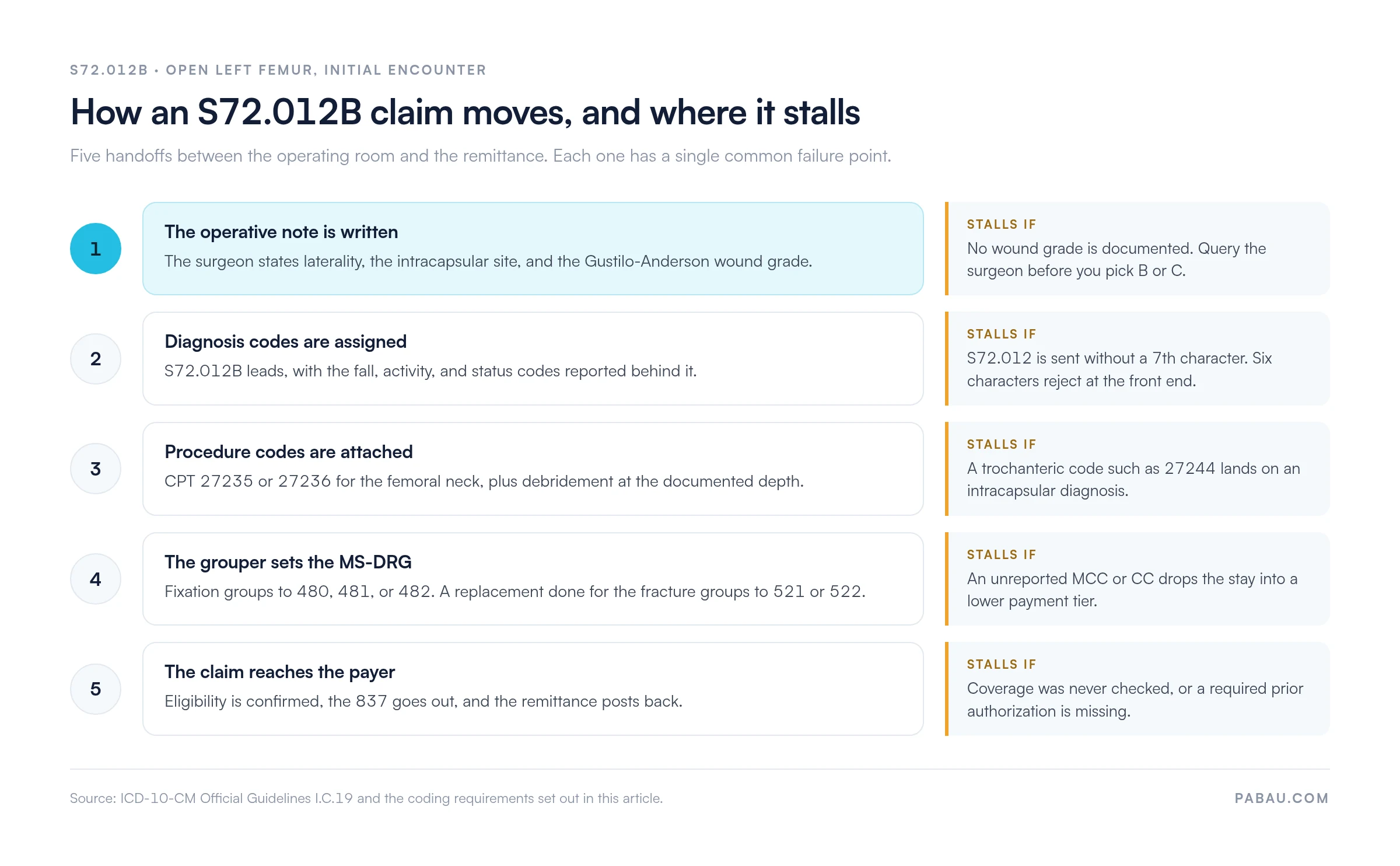
Stage five is where the money gets stuck. A rejected line comes back with a reason code, and the fix depends on whether the diagnosis, the procedure or the patient’s coverage caused it. Our reference on denial codes maps the codes you are most likely to see on an orthopedic claim.
Inpatient reporting generally expects an external cause code beside the injury. Outpatient rules vary by payer, so check the local coverage determination and your facility’s policy before you leave them off.
Notice that the external cause codes need their placeholder X and 7th character too. The same completeness rule that governs S72.012B governs W18.31XA.
For an older patient with a documented fall, the usual pairing is a W00-W19 code beside S72.012B. When osteoporosis is in the picture, decide first whether the break was traumatic or pathological.
An age-related osteoporotic fracture of the left femur is M80.052 with its own 7th character, and it sequences differently from a traumatic fracture.
Laterality, encounter type and wound grade are the three places a neighboring code sneaks onto the claim. The table sets each one against S72.012B so the difference is obvious.
Always verify laterality from imaging reports and operative notes, not only from nursing documentation. Imaging reports may say ‘left hip’ while a nursing note says ‘right hip’ due to documentation from the patient’s perspective versus the clinical perspective. The operative note or physician attestation is the authoritative source for laterality coding.
Coding an open hip fracture correctly is a documentation problem before it is a billing problem. Practice management software like Pabau keeps both in one record, so the claim gets built from the note instead of retyped from it.
Pabau’s claims management software pre-fills the CMS-1500 straight from the chart. The CPT code attached to the service lands on the charge line, and the ICD-10 slots are seeded from the recorded problem list. Built-in ICD-10-CM and CPT lookup libraries let a coder confirm S72.012B without leaving the claim.
The send button stays locked until the claim-required fields are complete, membership and authorization numbers included.
On the US pipeline, Pabau runs eligibility checks through the Claim.MD clearinghouse, posts electronic remittances and tracks claim status. So a missing authorization surfaces before surgery rather than after the denial.

Pabau connects to the Claim.MD clearinghouse for ICD-10 claim submission, real-time eligibility checks and claim status tracking. Your billing team can spend its time on accurate coding instead of chasing rejections.

S72.012B is a narrow code doing a lot of work. Seven characters fix the side, the site, the phase of care and the wound grade. The last one is also the one that gets it wrong most often.
The habit worth building is small. Read the operative note for the Gustilo grade before you code, then confirm the procedure describes the femoral neck rather than the trochanter. Those two checks head off most of the rework on these claims.
Book a demo to see how Pabau builds the claim from the chart, so coding accuracy holds all the way to the remittance.

Need a process for the rejections that do come back? Denial management in healthcare sets out how to work an orthopedic denial from reason code to resubmission.
Wondering what an 837 file contains? 837 file submission guide walks through the electronic claim format that takes S72.012B to the payer.
New to the mechanics of the billing cycle? What is medical billing covers each step from patient registration through to payment posting.
Reconciling payments on a hip fracture stay? Electronic remittance advice explains how to read an 835 and match it back to the claim you sent.
Not yet enrolled with the payers you are billing? How to get credentialed with insurance companies covers the enrollment steps that come before any claim.
No. ICD-10-CM does not use aftercare Z codes for injuries. Report the same fracture code with a subsequent-encounter 7th character instead. So S72.012B becomes S72.012E for routine healing of an open type I or II fracture. Aftercare Z codes stay for conditions such as joint replacement status.
On an inpatient claim, yes. Every reported diagnosis carries a present-on-admission indicator. A fracture the patient arrived with is reported as Y for yes. Outpatient claims do not use the indicator. An incorrect value can affect quality reporting even when the payment does not change.
The facility claim does not. Hospitals report procedures in ICD-10-PCS, and those codes feed the MS-DRG grouper. The surgeon’s professional claim still uses CPT, which is where 27235 and 27236 appear. One diagnosis, two claims, two different procedure code sets.
Report each side with its own code. S72.01 has no bilateral option, so an open type I or II fracture on the left is S72.012B and the right is S72.011B. Sequence the more severe injury first when both are treated in the same encounter.