ICD-10 Code Y78.0: Radiological device malfunction
ICD-10 Code Y78.0: Definition and official descriptor ICD-10 Code Y78.0 is the b...

Last Updated: Nov 3, 2026
Billable Code Specific Code
V96.03XA is the billable ICD-10-CM code for balloon collision injuring occupant, initial encounter. It records how an injury happened when a hot air or gas balloon strikes another aircraft, an object, or terrain.
As an external cause code, it sits behind the code for the injury itself and covers the pilot and passengers alike. Assignment turns on the record naming a collision. A balloon accident with no stated mechanism takes V96.00XA instead.
Let Pabau's smart automation suggest the right codes, reduce claim denials, and keep your practice compliant—effortlessly.
Automate repetitive tasks and focus on what matters most—your patients.
Reduce coding errors and ensure compliance with the latest regulations.
Clean claims, fewer denials, and faster reimbursements.
Powerful insights and reporting to help your practice thrive.
HIPAA compliant SOC 2 certified GDPR-compliant Trusted by 4,000+ clinics worldwide

ICD-10 Code V96.03XA is a billable external cause code, never a standalone primary diagnosis, so always pair it with the injury code it supports.
The 7th character A applies only during active treatment. Switch to XD for routine follow-up and to XS for sequela visits.
V96.03XA needs a documented collision mechanism, because ‘balloon accident’ or ‘aircraft injury’ alone supports only the unspecified V96.00XA.
Pabau’s claims management software scrubs each claim for missing or invalid details before it goes to the payer.
ICD-10 Code V96.03XA is the ICD-10-CM code that identifies a balloon collision injuring an occupant, initial encounter. Each part of that descriptor has a set meaning:
This is an external cause code. It records how and where the injury happened. The fracture, laceration, burn, or contusion goes on a separate primary injury code. V96.03XA follows it as a secondary code that gives the claim its medical necessity context.
The table below summarizes the key reference fields for this code. Verify the effective date against the CDC/NCHS ICD-10-CM web tool for the current fiscal year release.
Understanding the parent-to-child hierarchy helps coders navigate to the right specificity level and avoid defaulting to unspecified codes when documentation supports a more precise one. According to the CMS ICD-10 code guidance, coders should always assign the highest degree of specificity documented in the record.
The “X” placeholder in position 6 holds the code’s place so the encounter qualifier can sit in position 7. It carries no clinical meaning. The final character (A, D, or S) is that 7th-character encounter qualifier.
The 7th character distinguishes between three clinically distinct encounter phases. Selecting the wrong one is a common cause of claim rejection on V96.03X codes.
Key rule: A single patient episode can use all three codes chronologically. The ER visit gets XA, the orthopedic follow-up gets XD, and any visit for a residual late-effect condition gets XS. The 7th character follows the encounter, not the patient.
Check the physician note’s stated purpose before assigning the 7th character. ‘Return visit for wound check’ signals XD, not XA. Applying XA to a routine follow-up is an encounter-type error that auditors catch quickly. Payers often reject it as a misrepresentation of the visit.
The code applies when a balloon aircraft collides with something and an occupant sustains injury as a result. Three collision mechanisms fall under this code:
“Occupant” includes both the pilot and fare-paying or non-paying passengers aboard the basket or gondola at the time of the collision. The specific injury, whether a fracture, laceration, burn, contusion, or traumatic brain injury, is coded separately from Chapter 19 or Chapter 13. V96.03XA never describes the injury itself. It describes how the injury happened.
The V96 category carries several important exclusions that prevent miscoding when the mechanism or aircraft type differs from a nonpowered balloon.
No Excludes1 note on V96.03XA prohibits using it alongside specific injury codes. The external cause code can accompany any injury code from the relevant clinical chapters, as long as the mechanism matches.
The V96.0 subcategory contains seven distinct balloon accident codes, each defined by mechanism of injury. A wrong sibling code usually traces back to a vague note. The record has to state the collision explicitly to justify V96.03XA over the unspecified default.
The decision point between V96.00XA (unspecified) and V96.03XA (collision) rests on what the physician documented. “Patient fell from balloon basket” does not support a collision code. “Balloon struck power line during landing approach” does.
A fire on board is a different mechanism with its own codes, and follow-up visits for those burns move to V96.04XD. The chart below matches each documented mechanism to its code.
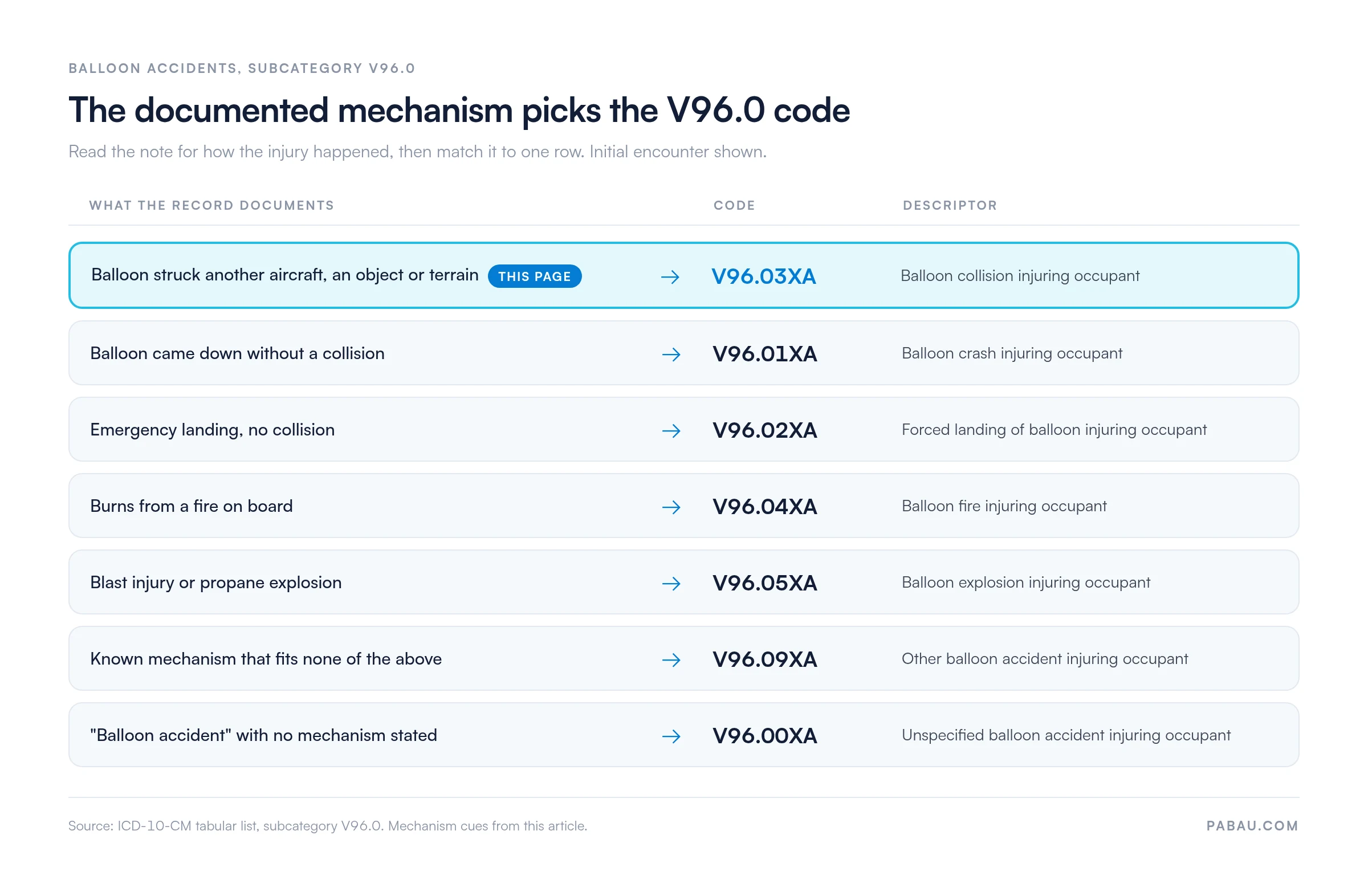
V96.03XA is an external cause code. It answers “how did the injury happen?” while the injury code answers “what is the injury?” That distinction drives the sequencing rules for every claim it appears on. Knowing the medical billing fundamentals behind external cause codes prevents the sequencing errors that trigger common denials.
Sequencing rule: The primary injury code always goes first. V96.03XA is always secondary. Placing the external cause code in the primary diagnosis position is a claim error that payers reject outright.
Three additional external cause code categories should accompany V96.03XA when the information is available in the record:
Using V96.03XA instead of the unspecified V96.00XA requires specific language in the medical record. A vague entry like “aviation accident” or “balloon injury” does not support the more specific collision code. Maintaining medical billing compliance for external cause codes means the documentation must contain each of the following elements.
Emergency department notes and operative reports are the most common source documents. If the ER record says only “patient injured in balloon accident,” the coder cannot upgrade to V96.03XA. V96.00XA stays the correct default until a physician query clarifies the mechanism.
When documentation is ambiguous about the accident mechanism, query the treating physician before assigning V96.03XA. Upgrading from an unspecified code without supporting documentation is a compliance risk, so never infer the mechanism from context alone.
External cause codes from the V96 category generate predictable denial patterns. Knowing them ahead of submission is more efficient than managing them through the denial management workflow after the fact.
For a reference on denial reason codes and how to respond to them, see the medical billing denial codes guide. Reviewing clean claim requirements for external cause codes before submission prevents most of these rejections.
V96.03XA is an external cause code and does not itself trigger pre-authorization requirements. Authorization requirements attach to the procedures for the primary injury, such as the surgery, imaging study, or inpatient admission that V96.03XA puts in context. The external cause code’s role is to support medical necessity for those procedures, not to require separate authorization.
Two payer contexts require additional attention for balloon-related injuries:
For Medicare and commercial payer claims, the AAPC ICD-10-CM code lookup provides payer edit information and medical necessity crosswalk data for V96 category codes. The ICD List reference includes code edit flags and DRG grouper output for inpatient claims involving external cause codes.
The denials above are administrative errors, such as a missing injury code, a reversed sequence, or the wrong 7th character. Catching them by hand means a biller rereads each claim line before it goes out.
In Pabau, the practice management platform we build, claims management software scrubs each claim for missing or invalid details before it leaves the system. Pabau also connects to the Claim.MD clearinghouse for claim submission.
If a payer still rejects a claim, Pabau shows the reason so you can correct the code and resubmit. Your billing team spends less time reworking injury claims and more time on the next encounter.

Pabau’s claim validation checks each claim for missing or invalid details before submission, and Claim.MD carries it to the payer. Fewer rejections mean faster reimbursement.

Code V96.03XA only when the note names a collision, and always file it behind the injury it explains. If the record says no more than “balloon accident,” query the physician first. V96.00XA remains the correct code until the mechanism is documented.
The payoff is a claim that survives both the payer’s edits and a later audit. Change the 7th character as the patient moves from active treatment to follow-up, and one balloon collision codes cleanly across every visit.
Book a demo to see how Pabau’s claim validation catches missing details before an injury claim reaches the payer.

Need to understand how denial codes map to external cause rejections? Denial codes in medical billing covers the most common CARC and RARC codes affecting V-category external cause claims.
Want a clear overview of how clearinghouse validation works? Medical claims clearinghouse explains how payer edits catch sequencing and pairing errors before adjudication.
Handling 837P submissions with external cause codes? 837 file formatting walks through how external cause codes are structured in electronic claim transactions.
ICD-10 Code V96.03XA is the ICD-10-CM diagnosis code for a balloon collision injuring an occupant during an initial encounter. It identifies the external cause of injury, a balloon striking another object, aircraft, or terrain. It applies while the patient is in active treatment. It must accompany a primary injury code because it does not describe the injury itself.
Yes, V96.03XA is a billable ICD-10-CM code valid for claim submission, but it cannot stand alone as a primary diagnosis. It must be paired with a primary injury code (fracture, laceration, burn, or other trauma code) in the secondary position. Submitting it without a paired injury code results in claim rejection.
The three codes cover the same balloon collision event at different treatment phases. V96.03XA applies during active treatment (emergency care, surgery, initial fracture management). V96.03XD applies during subsequent encounters for routine healing and follow-up. V96.03XS applies when treating sequela, meaning a late-effect condition that resulted directly from the original balloon collision injury.
The most common denials follow a missing primary injury code or the wrong 7th character. Placing the external cause code in the primary diagnosis field also triggers rejection. Using V96.00XA (unspecified) when the record documents a collision and vice versa is also a frequent audit finding.
Always report the primary injury code first. When the record supports them, also report a place of occurrence code (Y92), an activity code (Y93), and an external cause status code (Y99). These companion codes add context for medical necessity and are recommended under ICD-10-CM Official Guidelines Section I.C.20.
No. External cause codes in the V00-Y99 chapter are never sequenced as primary diagnoses. V96.03XA describes how an injury occurred, not what the injury is. A primary injury code from the appropriate clinical chapter must always appear first on the claim.